Quick Verdict: Jeep's First Global BEV Delivers Screens and Speed
The 2026 Jeep Wagoneer S is the brand's first battery-electric vehicle built on Stellantis' STLA Large platform, and it arrives with a clear mission: blend luxury-SUV presence with sports-car acceleration and a screen-laden cabin that redefines what a Jeep interior can be. With 617 horsepower in Launch Edition trim, a 100 kWh battery, and an EPA-estimated 300 miles of range, it targets buyers cross-shopping the BMW iX, Tesla Model X, and Rivian R1S. But does the Jeep Wagoneer S EV interior live up to its premium positioning, and how does the rest of the package hold up under real-world scrutiny?
We've spent time with the specs, the cabin, and the charging data. Here's the full breakdown.
| Spec | Launch Edition (AWD) |
|---|---|
| EPA Est. Range | 300 miles |
| Battery (Usable) | ~100 kWh, NMC lithium-ion |
| Drivetrain | Dual-motor AWD |
| Horsepower | 617 hp |
| 0–60 mph | 3.4 seconds |
| Max DC Fast Charge | ~200 kW (peak) |
| 10–80% DCFC Time | ~23 minutes |
| Level 2 Home Charging | 11 kW onboard (~33 mi/hr) |
| Efficiency | ~87 MPGe / ~39 kWh/100 mi |
| Cargo (behind 2nd row) | 30.4 cu ft |
| Cargo (total, seats folded) | 61.0 cu ft |
| Base MSRP | $71,995 |
| Battery Warranty | 8 years / 100,000 miles |
Inside the Wagoneer S EV Interior: Screens, Materials, and Space
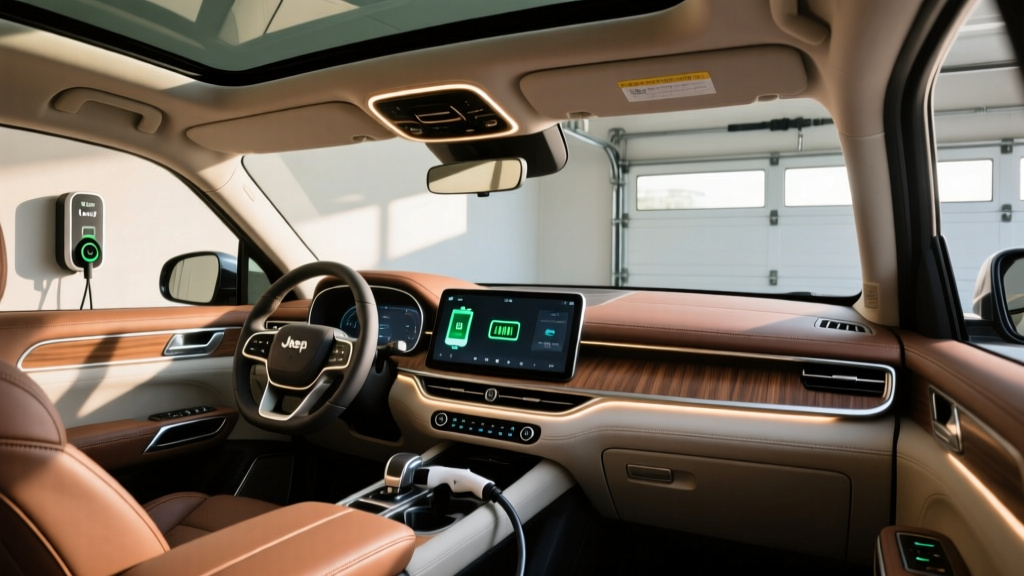
The headline of the Wagoneer S experience is its cabin. Jeep has loaded this SUV with what it calls a "45 inches of screen real estate" spread across the dashboard — a configuration that includes a 12.3-inch driver cluster, a 12.3-inch front passenger display, and a central 12.3-inch touchscreen, plus a dedicated 10.25-inch lower screen for climate and vehicle controls. The front passenger gets their own dedicated display for navigation, media, or even an external HDMI input — a feature aimed squarely at the luxury-tech crowd.
Materials in the Launch Edition are genuinely upscale: synthetic leather (Jeep calls it "Premium Plus" upholstery) covers the seats, which are 16-way power-adjustable up front with heating, ventilation, and massage. Real aluminum trim accents the dash and door panels, and ambient lighting with customizable zones adds to the premium feel. A 19-speaker McIntosh MX950 audio system is standard on the Launch Edition — one of the best factory audio setups in any SUV at this price point.
Passenger and Cargo Dimensions
The Wagoneer S is a two-row, five-passenger SUV. Front legroom measures 40.9 inches, with rear legroom at 38.5 inches — competitive with the BMW iX and slightly tighter than the three-row Rivian R1S. Headroom is generous at 40.2 inches front and 38.8 inches rear, aided by the standard panoramic fixed glass roof (it does not open, but the electrochromic dimming panel is a nice touch).
Cargo space behind the second row is 30.4 cubic feet — adequate for a week's worth of luggage for a family of four. Fold the 60/40 split rear seats and total volume expands to 61.0 cubic feet. There is no front trunk (frunk); the space under the hood is occupied by drive-unit electronics and HVAC components. A power liftgate with hands-free operation is standard.
Infotainment and Connectivity
The Uconnect 5 system runs the central stack, supporting wireless Apple CarPlay and Android Auto, native navigation with real-time traffic, and over-the-air (OTA) updates for both infotainment and vehicle firmware. A built-in 4G LTE Wi-Fi hotspot (subscription required after trial) supports up to eight devices. The lower touchscreen handles climate, seat controls, and drive-mode selection — a layout that reduces menu-diving compared to single-screen setups, though some buyers may find four screens overwhelming at first glance.
Range, Battery, and Real-World Efficiency
The Wagoneer S uses a ~100 kWh (usable) lithium-ion battery pack with NMC (nickel-manganese-cobalt) chemistry. NMC offers higher energy density than LFP (lithium iron phosphate), which is why Jeep can package 300 miles of range without excessive weight. The trade-off: NMC cells are more sensitive to sustained high-state-of-charge storage, so daily charging to 80% is recommended for longevity — a practice most EV owners adopt anyway.
EPA estimate: 300 miles
Real-world expectation: Plan for approximately 250–275 miles in mixed highway driving at 70–75 mph. In cold weather (below 32°F), expect a 15–25% reduction, bringing usable range to roughly 225–255 miles. The Wagoneer S's heat pump (standard) mitigates some cold-weather loss compared to resistive-heater EVs, but the 5,000+ lb curb weight and 39 kWh/100 mi combined consumption mean highway efficiency drops noticeably at speed.
The 87 MPGe combined rating (fueleconomy.gov) is respectable for a 617-hp AWD SUV but trails the more efficiency-focused BMW iX xDrive50 (89 MPGe). If you commute primarily in the city where regenerative braking recovers more energy, you'll see results closer to or slightly above the EPA sticker.
Charging Speeds: DC Fast Charging and Home Level 2
The Wagoneer S comes equipped with a NACS (North American Charging Standard) port, giving it native access to Tesla's Supercharger network — the most reliable and extensive DC fast-charging network in the U.S. It also supports CCS1 via adapter for Electrify America, EVgo, and other networks.
| Charging Level | Power / Rate | Miles Added per Hour | Notes |
|---|---|---|---|
| Level 1 (120V household) | ~1.4 kW | ~3–4 mi/hr | Emergency/trickle only; full charge takes ~70+ hours |
| Level 2 (240V home) | 11 kW | ~33 mi/hr | Full 0–100% in ~9.5 hours; ideal for overnight |
| DC Fast Charge (peak) | ~200 kW | ~150+ mi in 10 min | 10–80% in ~23 min; tapers sharply above 80% |
The 200 kW peak DC fast-charge rate is competitive but not class-leading — the Hyundai Ioniq 5 and Kia EV9 both peak above 235 kW. In practice, the Wagoneer S sustains close to peak rate between 10% and roughly 55% state of charge, then begins a gradual taper. The 10–80% time of approximately 23 minutes is acceptable for road-trip stops, though you'll want to precondition the battery (via the navigation-routed preconditioning feature) before arriving at a charger to hit these numbers.
For home charging, the 11 kW onboard charger means a standard 48-amp Level 2 wall connector on a 60-amp circuit will replenish the full battery overnight in about 9.5 hours. Most owners will wake up to a full charge every morning — the most convenient aspect of EV ownership.
Performance: 617 HP and a 3.4-Second Sprint
The Launch Edition's dual-motor all-wheel-drive powertrain produces 617 horsepower and an estimated 617 lb-ft of torque. The 0–60 mph time of 3.4 seconds places the Wagoneer S in serious sports-sedan territory — quicker than a base Porsche Cayenne and neck-and-neck with the Tesla Model X Dual Motor. Jeep offers selectable drive modes (Auto, Sport, Snow, Sand) that adjust throttle mapping, suspension damping, and torque distribution.
Ride quality benefits from the standard adaptive air suspension, which can lower the vehicle for highway efficiency or raise it by roughly 1.5 inches for rough roads. Steering is direct but light, appropriate for a luxury cruiser rather than a canyon carver. Regenerative braking offers multiple levels selectable via steering-wheel paddles, including a near-one-pedal driving mode at the highest setting — though it does not come to a complete hold without touching the brake pedal.
Pricing, Trims, and Federal Tax Credit Eligibility
The 2026 Wagoneer S launches exclusively in the Launch Edition trim at $71,995 (including destination). Jeep has indicated that lower-priced trims will follow, potentially bringing the base MSRP closer to $65,000 in subsequent model years. As tested with available packages (premium paint, tow package), expect as-tested prices in the $74,000–$76,000 range.
| Scenario | Amount |
|---|---|
| Launch Edition MSRP | $71,995 |
| Federal §30D Credit (if eligible) | Up to $7,500 |
| Effective Price (max credit) | ~$64,495 |
Does the Wagoneer S Qualify for the Federal EV Tax Credit?
The Wagoneer S clears the MSRP cap for SUVs ($80,000 under IRS §30D rules). However, full $7,500 eligibility depends on three additional criteria that change periodically:
- Buyer income caps: Modified AGI must not exceed $150,000 (single), $225,000 (head of household), or $300,000 (joint).
- Battery component sourcing: A percentage of battery components must be manufactured or assembled in North America (thresholds increase annually).
- Critical minerals: A percentage of critical minerals must be sourced from the U.S. or free-trade-agreement partners.
The credit can now be transferred to the dealer at point of sale, reducing your purchase price directly rather than waiting for a tax refund. Because battery-sourcing rules tighten each year, verify current eligibility on the IRS clean vehicle credit page or with your dealer before purchase. State and local incentives may also apply — check afdc.energy.gov for your jurisdiction.
Driver Assistance and Safety Technology
The Wagoneer S includes Jeep's Active Driving Assist system, which combines adaptive cruise control with lane-centering on highways. This is a SAE Level 2 driver-assistance system — it requires continuous driver supervision and is not autonomous or "self-driving." Hands must remain on the wheel, and the system monitors attention via a driver-facing camera.
Active Driving Assist does not navigate intersections, stop lights, or construction zones autonomously. It will disengage and alert the driver if hands are not detected on the steering wheel. It is not a substitute for an attentive driver. No production consumer vehicle sold in the U.S. is currently SAE Level 3 or above for general use.
Standard safety features include automatic emergency braking with pedestrian detection, blind-spot monitoring, rear cross-traffic alert, 360-degree surround-view camera, and front/rear parking sensors with automatic braking. The Wagoneer S has not yet been crash-tested by NHTSA or IIHS at the time of publication — ratings will be updated when available.
Pros, Cons, and Who Should Buy the Wagoneer S
Pros
- 300-mile EPA range is competitive for a luxury AWD SUV
- Stunning screen-heavy interior with McIntosh audio
- 3.4-second 0–60 mph with dual-motor AWD
- NACS port gives native Tesla Supercharger access
- Air suspension and adaptive damping for ride comfort
- 8-year / 100,000-mile battery warranty
Cons
- Starting price above $71,000 — premium territory
- No frunk; cargo space trails some competitors (61 cu ft max)
- Only two rows / five seats — no three-row option
- 200 kW peak charge rate trails 800V rivals (235+ kW)
- Four-screen layout may overwhelm some drivers
- No NHTSA/IIHS crash-test data yet
Who the Wagoneer S Suits Best
Buy it if: You want a fast, tech-forward luxury electric SUV with Jeep branding, you value a screen-rich premium interior, you commute in a two-adult household without needing a third row, and you want native Supercharger access for road trips.
Look elsewhere if: You need three rows (consider the Rivian R1S or Kia EV9), you prioritize maximum cargo volume, you want the fastest possible DC charging, or you need a sub-$55,000 entry price.
Frequently Asked Questions
What is the real-world range of the Jeep Wagoneer S EV?
The EPA rates it at 300 miles. In real-world highway driving at 70–75 mph, expect 250–275 miles. Cold weather (below freezing) can reduce that to 225–255 miles. The standard heat pump helps but cannot eliminate cold-weather range loss entirely.
How fast does the Wagoneer S charge at home and on the road?
On a Level 2 home charger (240V, 48A), it charges at 11 kW, adding roughly 33 miles per hour — a full charge takes about 9.5 hours overnight. On DC fast chargers, it peaks at approximately 200 kW, reaching 10–80% in around 23 minutes when the battery is preconditioned.
How much does the Wagoneer S cost after tax credits?
The Launch Edition starts at $71,995. If you qualify for the full $7,500 federal §30D credit (subject to income, MSRP, and battery-sourcing rules), the effective price drops to approximately $64,495. The credit can be applied at point of sale through a participating dealer. State incentives may reduce the cost further.
Is the Wagoneer S worth buying vs. the BMW iX or Tesla Model X?
The Wagoneer S competes on interior luxury and Jeep brand appeal. The BMW iX xDrive50 offers similar range with slightly better efficiency and a more established luxury pedigree. The Tesla Model X provides falcon-wing doors, optional third row, and access to Tesla's software ecosystem but at a higher starting price. The Rivian R1S offers three rows and genuine off-road capability. Your choice depends on whether the Wagoneer S interior and brand resonate more than those alternatives.
Does the Wagoneer S have a front trunk (frunk)?
No. The area under the hood houses drive-unit electronics, the onboard charger, and HVAC components. All cargo must go in the rear cargo area (30.4 cu ft behind the second row, 61.0 cu ft total).
What is the battery warranty?
Jeep covers the high-voltage battery and electric powertrain for 8 years or 100,000 miles, whichever comes first. This is the federal minimum standard for EV batteries and matches most competitors. The warranty covers defects and excessive capacity degradation (typically below 70% of original capacity, though confirm exact threshold with your dealer).