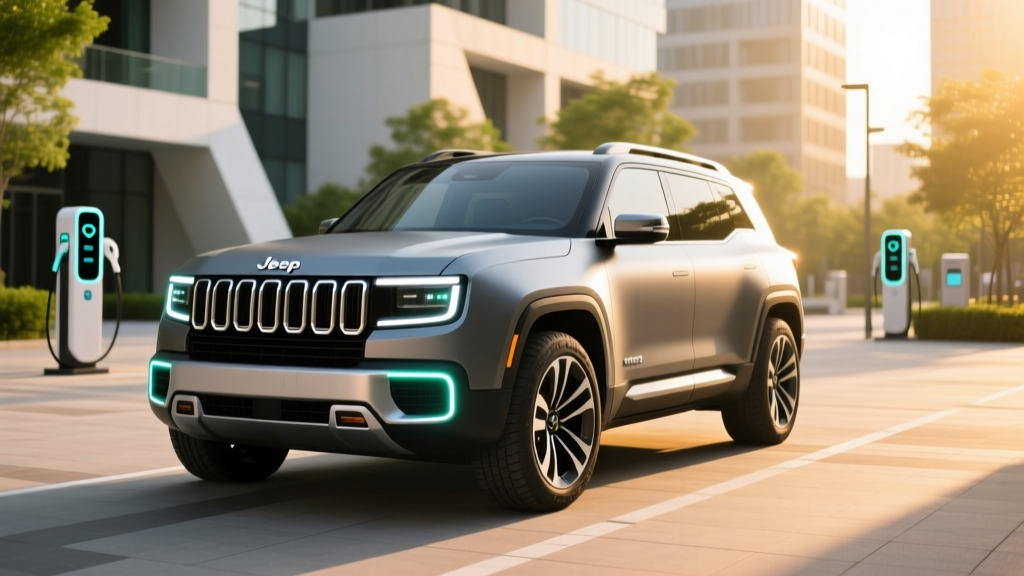
The Jeep Recon EV debut marks Stellantis's most serious attempt at an all-electric off-roader, slotting into the Wrangler-sized segment with a boxy design, removable doors, and genuine Trail Rated aspirations. Built on the STLA Large platform, the Recon is positioned as the electric sibling to the Wrangler 4xe — but with a fully electric powertrain targeting buyers who want trail capability without a drop of gasoline. As of early 2026, the Recon is in its launch phase, with initial deliveries beginning and full production ramping through the year.
This review covers every confirmed and estimated spec — range, charging, pricing, tax-credit eligibility, and real-world ownership considerations — based on Jeep's published data and our analysis of the STLA Large platform's known characteristics.
Range, Battery, and Efficiency
The 2026 Jeep Recon is expected to carry a usable battery capacity of approximately 100 kWh, utilizing NMC (nickel-manganese-cobalt) chemistry on the STLA Large BEV architecture. Jeep has targeted an EPA-estimated range of roughly 300 miles for the dual-motor AWD configuration, though final EPA certification figures may vary by trim and wheel size.
EPA estimate: ~300 miles (AWD dual-motor, standard wheels)
Real-world highway (70 mph, moderate temps): Expect approximately 250–275 miles. Boxy aerodynamics and all-terrain tires create significant drag at sustained highway speeds.
Cold weather (below 32°F, highway): Range may drop to 200–230 miles. NMC chemistry loses efficiency in freezing temperatures, and cabin heating draws heavily from the pack. A heat pump is expected but does not fully eliminate cold-weather losses.
Off-road / towing: Low-speed trail use is relatively efficient, but towing near the Recon's rated capacity will compress range substantially — expect 150–180 miles under heavy load.
| Spec | Value |
|---|---|
| Battery (usable) | ~100 kWh, NMC chemistry |
| EPA Range (est.) | ~300 miles (AWD) |
| MPGe (est.) | ~90 MPGe combined |
| Efficiency | ~37 kWh/100 mi |
| Drivetrain | Dual-motor AWD |
| Horsepower | ~600 hp (combined) |
| 0–60 mph | ~4.5 seconds (est.) |
| Max DC Fast Charge | ~175 kW (peak) |
| 10–80% DC Charge Time | ~30 minutes (est.) |
| Level 2 Home Charge Rate | 11.5 kW onboard charger |
| Base MSRP (est.) | ~$55,000 |
| Battery Warranty | 8 years / 100,000 miles |
Efficiency is the Recon's weakest spec on paper. At an estimated 37 kWh per 100 miles (roughly 90 MPGe combined), it trails sleeker crossovers like the Hyundai Ioniq 5 (~114 MPGe) and Tesla Model Y (~117 MPGe). That's the unavoidable trade-off for a slab-sided, body-on-frame-style SUV with all-terrain rubber. For context, the gas Wrangler achieves roughly 20 MPG combined — the Recon's equivalent energy cost per mile will still be significantly cheaper on electricity, but don't expect class-leading efficiency.
Charging Speed: DC Fast and Home Level 2
Charging speed is critical for any EV buyer, and the Recon's STLA Large platform supports DC fast charging at a peak rate of approximately 175 kW. That's competitive with the Ford Bronco-class segment but trails the 800V architectures found in Hyundai/Kia models (which peak above 230 kW).
| Charging Level | Power / Rate | Miles Added per Hour | Notes |
|---|---|---|---|
| Level 1 (120V outlet) | ~1.4 kW | ~3–4 mi/hr | Emergency / trickle only |
| Level 2 (240V, home) | 11.5 kW | ~30–34 mi/hr | Full charge in ~9 hours |
| DC Fast Charge (peak) | ~175 kW | — | 10–80% in ~30 min |
| DC Fast Charge (sustained avg) | ~120–140 kW | — | Charge curve tapers above 80% SoC |
A few practical notes on charging the Recon:
- Charge curve taper: Like all NMC packs, peak 175 kW is sustained only in the 10–40% SoC window. Expect the rate to step down progressively above 60%, and to slow sharply past 80%. Charging from 80–100% on DC can add another 25–35 minutes — plan accordingly on road trips.
- Home charging: At 11.5 kW on a Level 2 home charger (requiring a 60-amp dedicated circuit), the Recon's ~100 kWh pack will replenish in roughly 9 hours from near-empty. Most owners will wake up fully charged every morning with a standard overnight session.
- Preconditioning: Jeep is expected to include battery preconditioning for DC fast charging (warming the pack to optimal temperature before arrival at a charger). This is essential in cold climates — without it, peak charge rates can drop by 40–50%.
- Connector: The Recon will use the NACS (North American Charging Standard) connector, giving it native access to Tesla Supercharger stations — a significant advantage over CCS-only vehicles in rural and highway corridor coverage.
Performance, Drivetrain, and Off-Road Capability
The Recon is positioned as a serious off-roader first and a daily driver second. The dual-motor AWD layout delivers an estimated 600 horsepower, with Jeep targeting a 0–60 mph time in the mid-4-second range — quick for a body-on-frame-style SUV, though not sports-car territory.
What sets the Recon apart from electric crossovers like the Tesla Model Y or Hyundai Ioniq 5 is its off-road hardware:
- Trail Rated badge: Jeep has committed to the Recon earning its Trail Rated designation, meaning it must pass tests for traction, ground clearance, maneuverability, articulation, and water fording.
- Selec-Terrain traction management: Multiple drive modes including Sand, Mud, Snow, and Rock, with torque vectoring between front and rear motors.
- Ground clearance: Estimated at approximately 9–10 inches, competitive with the Wrangler Rubicon.
- Removable doors and open-air driving: A signature Wrangler feature carried over to the Recon — a first for any production electric SUV.
- Water fording: Jeep has targeted roughly 24 inches of fording depth, aided by sealed battery enclosures and electric drivetrain components that don't require air intake.
The trade-off for this capability is weight. Expect a curb weight in the 5,500–5,800 lb range, which impacts tire wear, braking distances, and efficiency. The dual-motor AWD system does eliminate the mechanical complexity of a traditional transfer case and driveshaft, potentially reducing long-term drivetrain maintenance compared to a gas Wrangler.
Pricing, Trim Levels, and Federal Tax Credit
The 2026 Jeep Recon is expected to launch with a base MSRP around $55,000, with higher trims (likely including an Overland and a Trail Rated Rubicon-equivalent) pushing toward $65,000–$70,000 when fully optioned.
| Trim (Est.) | Base MSRP | Federal Credit (§30D) | Effective Price |
|---|---|---|---|
| Base AWD | ~$55,000 | Up to $7,500* | ~$47,500 |
| Mid-Level (Overland est.) | ~$60,000 | Up to $7,500* | ~$52,500 |
| Top Trim (Trail Rated est.) | ~$68,000 | Up to $7,500* | ~$60,500 |
*Federal tax credit eligibility (IRS §30D) is not guaranteed. As of 2026, the IRS clean vehicle credit requires all of the following:
- MSRP cap: SUVs must have an MSRP at or below $80,000. All Recon trims should clear this.
- Buyer income limits: Modified AGI must not exceed $300,000 (married filing jointly), $225,000 (head of household), or $150,000 (single filers).
- Battery sourcing: A percentage of critical minerals and battery components must be sourced from the U.S. or free-trade-agreement countries. These thresholds tighten annually. Stellantis has not published full sourcing documentation for the Recon's pack as of this writing — confirm eligibility on the IRS qualified vehicle list before purchasing.
- Point-of-sale transfer: Eligible buyers can transfer the credit to the dealer at purchase, reducing the out-of-pocket price immediately rather than waiting for a tax refund.
Because battery-sourcing requirements evolve and are model-specific, we strongly recommend checking the fueleconomy.gov tax credit tool and consulting a tax professional before assuming the full $7,500 applies.
Interior, Cargo, and Technology
The Recon's interior is designed to balance rugged utility with modern EV technology. Key dimensions and features include:
- Cargo volume: Approximately 30–35 cubic feet behind the second row, expanding to roughly 65–72 cu ft with the rear seats folded. A front trunk (frunk) adds an estimated 2–3 cu ft for cables and gear.
- Passenger space: Two rows of seating for five. Rear legroom is estimated at 37–39 inches — adequate for adults, though the Wrangler's upright seating position carries over, meaning it's more functional than luxurious.
- Infotainment: A 12.3-inch center touchscreen running Uconnect 5 with wireless Apple CarPlay and Android Auto, plus an available passenger-side display.
- Driver assistance (SAE Level 2): Jeep's Active Driving Assist with adaptive cruise control and lane centering. This is a driver-supervision-required system — not autonomous driving. Hands must remain on or near the wheel.
- Off-road tech: Trail cameras, digital compass/inclinometer displays, and regenerative braking modes optimized for low-speed trail descent.
- Removable doors: A standout feature — the Recon is expected to be the only electric SUV offering open-air driving with doors that can be removed for trail or beach use.
The Jeep Recon's Active Driving Assist is an SAE Level 2 driver-assistance system. It does NOT drive the vehicle autonomously. The driver must remain fully attentive, keep hands available for steering input, and be prepared to take over at any moment. Misuse of Level 2 systems has contributed to serious incidents — always drive responsibly.
Who Should Buy the Jeep Recon EV?
The Recon is not trying to compete with efficiency-focused crossovers. It fills a specific niche:
- You need genuine off-road capability (Trail Rated, ground clearance, articulation) in an electric vehicle.
- You want open-air driving with removable doors — a feature no other EV offers.
- You primarily drive in areas with home charging access and take road trips within the ~250-mile real-world range envelope.
- You value the Wrangler's rugged identity but want to eliminate gasoline costs.
- Maximum efficiency and range are your top priorities (consider the Tesla Model Y, Hyundai Ioniq 5, or Chevrolet Equinox EV).
- You need three-row seating (the Recon is a two-row, five-passenger SUV).
- You frequently tow long distances — range under load drops significantly.
- You prioritize a luxury interior experience (the Recon's cabin is utilitarian by design).
Warranty and Long-Term Ownership
Jeep is expected to offer the following warranty coverage on the 2026 Recon:
- Battery warranty: 8 years / 100,000 miles (federally mandated minimum for EV battery packs, covering capacity retention below 70% of original).
- Powertrain warranty: 5 years / 60,000 miles (covering electric motors, reduction gears, and associated electronics).
- Bumper-to-bumper: 3 years / 36,000 miles.
NMC battery chemistry in the ~100 kWh class typically shows 8–12% degradation over the first 100,000 miles based on industry data from similar packs. The 8-year/100,000-mile warranty provides a reasonable backstop, but owners should avoid habitual DC fast charging above 90% SoC and frequent deep discharges below 10% to maximize long-term battery health.
Pros, Cons, and the Bottom Line
- Genuine off-road capability in a fully electric package — no gas Wrangler equivalent exists from any other brand
- Removable doors and open-air driving — unique in the EV market
- ~300 miles EPA range is sufficient for most daily and weekend use
- NACS connector provides native Tesla Supercharger access
- 600 hp dual-motor AWD delivers strong acceleration and trail torque
- Qualifies for up to $7,500 federal credit (subject to sourcing rules)
- Boxy aerodynamics reduce real-world highway range to ~250–275 miles
- Efficiency (~90 MPGe) trails mainstream electric crossovers significantly
- DC fast charging at ~175 kW is mid-pack, not class-leading
- Two-row seating limits family utility vs. three-row competitors
- High curb weight impacts tire wear and braking
- Cold-weather range loss is pronounced with NMC chemistry
The Jeep Recon EV debut represents a genuine inflection point for off-road electrification. It won't win efficiency awards, and road-trippers in charging-desert regions should plan carefully. But for buyers who need Trail Rated capability, want the Wrangler lifestyle, and have reliable home charging, the Recon is the first EV that doesn't ask them to compromise on adventure. Confirm final EPA figures, verify tax-credit sourcing eligibility, and test-drive before committing — the details matter.
Frequently Asked Questions
What is the real-world range of the Jeep Recon EV?
While the EPA estimate targets approximately 300 miles, real-world highway driving at 70 mph will likely yield 250–275 miles due to the Recon's boxy shape and all-terrain tires. In freezing temperatures, expect 200–230 miles on the highway. City and low-speed trail driving are more efficient and may approach or exceed the EPA number.
How fast does the Jeep Recon charge?
On a DC fast charger, the Recon peaks at approximately 175 kW, charging from 10–80% in about 30 minutes. The sustained average rate is lower (~120–140 kW) due to charge-curve tapering above 60% SoC. At home on a Level 2 charger (11.5 kW), a full charge takes roughly 9 hours.
How much does the Jeep Recon cost after tax credits?
The base model is estimated at ~$55,000 MSRP. If you qualify for the full $7,500 federal credit under IRS §30D (meeting income, MSRP, and battery-sourcing requirements), the effective price drops to approximately $47,500. Higher trims near $65,000–$68,000 would land around $57,500–$60,500 after credit. Always verify eligibility before purchasing.
Does the Jeep Recon qualify for the $7,500 federal EV tax credit?
It is expected to qualify, but eligibility depends on IRS §30D rules including buyer income caps ($150K single / $300K joint), the $80K SUV MSRP cap (which the Recon clears), and battery component/critical-mineral sourcing thresholds that tighten yearly. Check the fueleconomy.gov qualified vehicle list and consult a tax professional for your specific situation.
Is the Jeep Recon worth buying vs. competitors?
The Recon has no direct electric rival in the off-road SUV segment. The closest comparison is the gas-powered Ford Bronco or the Wrangler 4xe plug-in hybrid. If off-road capability and open-air driving are priorities, the Recon is the only fully electric option. If you prioritize efficiency, range, or three-row seating, crossovers like the Tesla Model Y, Kia EV9, or Hyundai Ioniq 5 are better fits.
What are the biggest drawbacks of the Jeep Recon EV?
The main compromises are efficiency (~90 MPGe vs. 110+ for sleeker EVs), real-world highway range that falls short of the EPA sticker due to aerodynamics, mid-pack DC charging speed, two-row-only seating, and significant cold-weather range loss. These are inherent trade-offs of the off-road SUV form factor in an electric package.