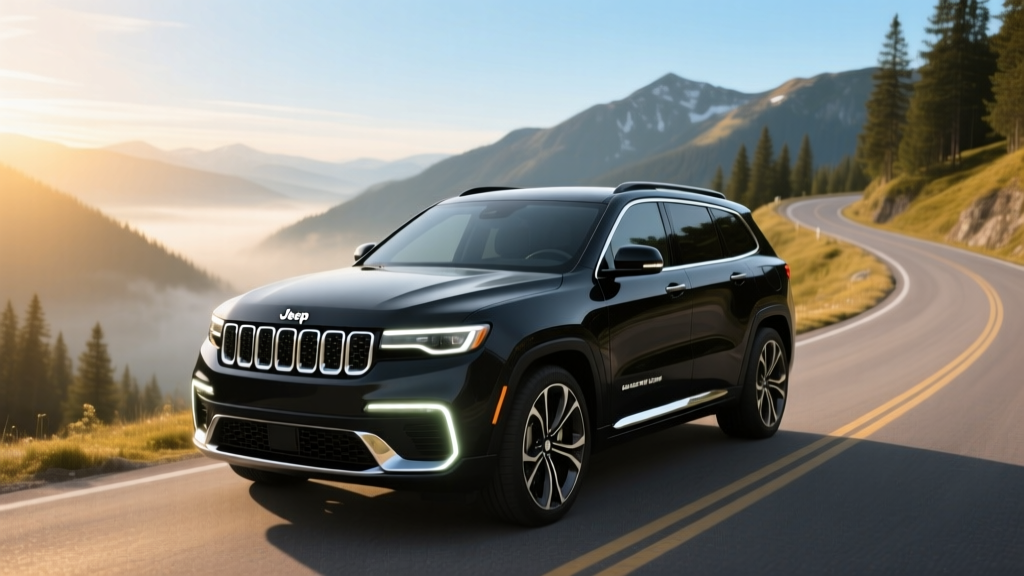
Quick Answer: The 2026 Jeep Grand Cherokee EV is the all-electric version of Jeep's best-selling midsize SUV, built on Stellantis' STLA Large platform. It targets an EPA range of approximately 300–320 miles depending on trim, with DC fast charging capability expected to peak around 200+ kW. Pricing starts in the mid-$50,000s before destination. As an announced vehicle entering production, final EPA-certified figures remain subject to confirmation. Buyers should weigh it against the Grand Cherokee 4xe plug-in hybrid if home charging access is limited or if frequent long-distance towing is a priority.
What the Grand Cherokee EV Actually Offers
Jeep's entry into the three-row-capable electric SUV segment arrives with serious intent. The Grand Cherokee EV rides on the STLA Large architecture—a flexible platform supporting both battery-electric and range-extended configurations. Stellantis has confirmed the EV variant will feature dual-motor all-wheel drive on higher trims and a single-motor rear-drive option on the base model, echoing the strategy used in other STLA Large products.
For buyers cross-shopping the segment, the Grand Cherokee EV slots against the Hyundai Ioniq 5, Kia EV9, Tesla Model X, and Rivian R1S in terms of size and aspiration, though Jeep is positioning it with more traditional SUV proportions and off-road credibility than most EV competitors.
| Specification | Estimated / Announced |
|---|---|
| EPA Range (target) | ~300–320 miles (AWD); ~330+ miles (RWD est.) |
| Battery Capacity (usable) | ~95–105 kWh (NMC chemistry expected) |
| Peak DC Fast Charge Rate | ~200–250 kW |
| 10–80% DC Fast Charge Time | ~22–28 minutes (estimated) |
| Level 2 Home Charge Rate | 11.5 kW (48A) |
| Horsepower (AWD dual-motor) | ~450–500 hp (est.) |
| 0–60 mph | ~4.5–5.5 seconds (est.) |
| Starting MSRP | ~$55,000–$58,000 (est.) |
| Battery Warranty | 8 years / 100,000 miles (min. 70% capacity retention per federal mandate) |
Note: The Grand Cherokee EV is an announced/upcoming model. All specifications above are based on Stellantis disclosures and STLA Large platform data. Final EPA-certified figures will be published closer to the on-sale date. Always verify with fueleconomy.gov once the vehicle is certified.
Real-World Range Reality: A targeted EPA range of 310 miles (AWD) is a strong headline number, but real-world conditions shift the calculus. Expect approximately 250–275 miles at sustained highway speeds (70–75 mph) in moderate temperatures. In cold weather (below 30°F), range can drop 20–30%, putting realistic winter highway range in the 210–240 mile window. If you regularly tow—even a light trailer—expect a 35–50% range reduction depending on weight and aerodynamics. Plan road trips around 200-mile legs with the Grand Cherokee EV to maintain a comfortable buffer.
Charging: Home Setup, Public Networks, and Realistic Times
Charging infrastructure compatibility will determine whether the Grand Cherokee EV fits your lifestyle. Stellantis has committed to adopting the NACS (North American Charging Standard) connector across its EV lineup, meaning the Grand Cherokee EV should arrive with native Tesla Supercharger compatibility—a significant advantage for road-trip charging access.
| Level | Power (kW) | Miles of Range Added Per Hour | Typical Use Case |
|---|---|---|---|
| Level 1 (120V household) | 1.4 kW | ~4–5 miles | Overnight top-up, emergency use |
| Level 2 (240V home) | 11.5 kW | ~35–40 miles | Daily home charging, full overnight refill |
| DC Fast Charge | ~200–250 kW (peak) | ~600+ mi/hr (at peak) | Road trips, 10–80% in ~22–28 min |
Home charging is the backbone. A Level 2 home charger (240V, 48-amp circuit on a 60-amp breaker) adds roughly 35–40 miles of range per hour. For a ~100 kWh battery, a full charge from near-empty takes approximately 9–10 hours. This is ideal for overnight charging: plug in when you get home, wake up to a full battery.
Installation cost reality: If your electrical panel has capacity and the run from panel to garage/driveway is short (under 30 feet), expect $800–$1,500 for a professional Level 2 installation (electrician labor, permit, and a quality 48A charger). Longer conduit runs, panel upgrades (200A service), or trenching for detached garages can push costs to $2,500–$5,000+. Always get a quote from a licensed electrician before committing to the vehicle.
DC fast charging curve reality: The peak charge rate of ~200–250 kW is not sustained for the entire session. Like all EVs, the Grand Cherokee EV will charge fastest between roughly 10–50% state of charge, then taper significantly above 80% to protect battery health. A 10–80% session will take approximately 22–28 minutes at a compatible high-power charger, but charging from 80–100% can add another 20–30 minutes. For road trips, the optimal strategy is to charge to 80% and go.
Grand Cherokee EV vs. Gas and 4xe Plug-In Hybrid
The most common cross-shop for Grand Cherokee EV buyers isn't a Tesla—it's the gas-powered Grand Cherokee and the 4xe plug-in hybrid variant. Here's how they compare on the metrics that matter.
| Metric | Grand Cherokee EV (AWD est.) | Grand Cherokee 4xe (PHEV) | Grand Cherokee Gas (V6 AWD) |
|---|---|---|---|
| Starting MSRP (est.) | ~$55,000–$58,000 | ~$59,000–$62,000 | ~$42,000–$46,000 |
| EPA Range / Fuel Economy | ~310 mi (est.) | 25 mi electric + ~450 mi gas | ~19/26/22 MPG (city/hwy/combined) |
| Energy Cost per Mile | ~$0.04–$0.06 (home charging) | ~$0.04 electric / ~$0.14 gas | ~$0.13–$0.16 (at $3.30/gal) |
| Annual "Fuel" Cost (15k mi) | ~$600–$900 | ~$1,200–$1,800 (mixed) | ~$2,000–$2,400 |
| Maintenance Cost (Annual) | Low (no oil, fewer fluids) | Moderate (gas engine maintenance) | Moderate–High |
| Federal Tax Credit (§30D) | Up to $7,500 (if eligible) | Up to $7,500 (if eligible) | None |
| Towing Capacity | Est. 3,500–5,000 lbs | ~6,000 lbs | ~6,200–7,200 lbs |
The cost math over five years: Assuming 15,000 miles per year, the Grand Cherokee EV saves approximately $6,000–$9,000 in fuel costs over five years compared to the gas V6 model when charging primarily at home. Factor in lower maintenance (no oil changes, reduced brake wear from regenerative braking, fewer fluid replacements) and the savings widen further. However, the higher purchase price of the EV means the break-even point depends heavily on your local electricity rates, driving mileage, and whether you qualify for the federal tax credit.
When the 4xe makes more sense: If you lack reliable home charging, frequently tow heavy loads, or regularly drive in remote areas with sparse charging infrastructure, the Grand Cherokee 4xe plug-in hybrid offers 25 miles of electric-only range for daily commuting while retaining the gas engine's range and towing capability for weekends and road trips.
Federal Tax Credit and Real Purchase Cost
The federal EV tax credit under IRS §30D can reduce the effective purchase price by up to $7,500—but eligibility is far from guaranteed. The rules are complex and subject to change.
- MSRP Cap: SUVs must have an MSRP at or below $80,000 to qualify.
- Buyer Income Limits: Modified AGI must not exceed $300,000 (joint filers), $225,000 (head of household), or $150,000 (single filers).
- Battery Sourcing Requirements: Critical minerals and battery components must meet escalating percentages sourced from the U.S. or free-trade-agreement partners. These requirements tighten annually, and many EVs that qualified in prior years may not qualify in 2026.
- Point-of-Sale Transfer: Eligible buyers can transfer the credit to the dealer at purchase, reducing the sale price immediately rather than waiting to claim it on a tax return.
- Assembly Requirement: Final assembly must occur in North America.
For the Grand Cherokee EV, assembly in the U.S. (likely at a Stellantis North American plant) should satisfy the assembly requirement. However, battery sourcing compliance is the wildcard—Stellantis' battery supply chain partnerships will determine whether the full $7,500, a partial credit, or no credit is available. Always verify current eligibility on IRS.gov before purchasing.
Estimated 5-Year Total Cost of Ownership (15,000 mi/year)
| Cost Category | Grand Cherokee EV | Grand Cherokee Gas V6 |
|---|---|---|
| Purchase Price (base, est.) | $57,000 | $44,000 |
| Federal Tax Credit | –$7,500 (if eligible) | $0 |
| Effective Purchase | $49,500 | $44,000 |
| Fuel/Energy (5 years) | $3,500–$4,500 | $10,000–$12,000 |
| Maintenance (5 years) | $1,500–$2,000 | $3,000–$4,000 |
| Insurance (5 years, est.) | $9,000–$11,000 | $7,500–$9,500 |
| Estimated 5-Year Total | $63,500–$67,000 | $64,500–$69,500 |
Insurance estimates are approximate and vary by driver profile, state, and insurer. EV insurance premiums tend to run 10–20% higher than comparable gas vehicles due to higher repair costs. Get personalized quotes before purchasing.
First-Time EV Buyer: What You Must Know Before Committing
Buying your first EV introduces considerations that don't exist with gas vehicles. Here's what the brochures don't emphasize.
Home charging access is non-negotiable for most owners. Approximately 80–90% of EV charging happens at home. If you live in an apartment, condo, or street-parking situation without access to a dedicated 240V outlet, public charging becomes your primary refueling method—and that's significantly more expensive ($0.30–$0.50/kWh at DC fast chargers vs. $0.12–$0.18/kWh at home) and less convenient. Confirm your charging situation before ordering.
Cold weather is real range loss, not a myth. Lithium-ion batteries lose efficiency in cold temperatures, and cabin heating draws significant energy. In sustained sub-freezing conditions, expect 20–30% range reduction. A vehicle rated at 310 miles may deliver 215–250 miles in a Minnesota January. The Grand Cherokee EV is expected to include a heat pump (standard on most modern EVs), which mitigates but does not eliminate cold-weather losses. Preconditioning the battery while plugged in helps preserve range.
EV insurance costs more. Insurers charge higher premiums for EVs due to costlier collision repairs (specialized parts, high-voltage safety protocols, and limited body-shop expertise). Budget an additional $200–$500/year compared to the gas Grand Cherokee. Shop quotes from multiple carriers—some insurers now offer EV-specific discounts.
Tires wear faster. EVs are heavier than gas equivalents (the battery pack adds 1,000+ lbs) and deliver instant torque. Expect tire replacement at 25,000–40,000 miles rather than the 50,000+ miles typical for gas SUVs. Budget $1,200–$2,000 for a set of EV-optimized touring tires.
Depreciation is still a wildcard. EV depreciation has been volatile. Early adopters of some models saw steep drops, while popular models held value well. The Grand Cherokee nameplate carries strong resale equity in the gas market; whether that transfers to the EV variant depends on long-term battery confidence and market adoption. Lease if depreciation risk concerns you.
Common Misconceptions — Fact vs. Fiction
| Myth | Fact |
|---|---|
| "The battery will need replacing in 5 years and cost $20,000." | Modern NMC batteries are warrantied for 8 years/100,000 miles with a minimum 70% capacity retention guarantee. Real-world degradation data from similar platforms shows ~10–15% capacity loss over 150,000 miles. Full replacement is rare and costs are declining. |
| "I can tow my boat just as far on a charge." | Towing dramatically increases energy consumption. Expect 35–50% range reduction with a loaded trailer. A 310-mile range becomes 155–200 miles when towing. The gas Grand Cherokee remains the better tow vehicle for long hauls. |
| "Federal tax credit means $7,500 off for everyone." | The §30D credit has income caps, MSRP caps, and battery-sourcing requirements. Many buyers will not qualify for the full amount. Verify on IRS.gov before counting on it. |
| "DC fast charging is always fast." | Peak kW rates apply only in a narrow state-of-charge window. Charging slows dramatically above 80%. A "250 kW" charger may average 100–130 kW across a 10–80% session depending on battery temperature and taper curve. |
| "EVs have no maintenance costs." | EVs eliminate oil changes, spark plugs, and transmission fluid. But tires wear faster, cabin air filters need replacement, coolant loops require service, and wiper/brake fluid still need attention. Budget $300–$500/year for EV maintenance. |
Decision Framework: Is the Grand Cherokee EV Right for You?
Choose the Grand Cherokee EV if:
- You have reliable home Level 2 charging access (garage or driveway with 240V).
- Your daily driving is under 200 miles round-trip and you take road trips fewer than 6 times per year.
- You qualify for the §30D federal tax credit (or your state offers additional EV incentives).
- You value quiet, instant-torque acceleration and want to reduce ongoing fuel costs.
- You don't regularly tow more than 3,500 lbs over long distances.
- You want NACS Supercharger access for the most reliable road-trip charging network.
Choose the Grand Cherokee 4xe (PHEV) instead if:
- You lack home charging access or live in an apartment without EV infrastructure.
- You tow frequently or take long road trips through areas with limited DC fast chargers.
- You want electric-only commuting (25 mi) but need unlimited gas-engine range for weekends.
- You live in a very cold climate where winter range loss on a full EV would cause anxiety.
Choose the gas Grand Cherokee if:
- Upfront purchase price is your primary constraint and you drive fewer than 10,000 miles per year (fuel savings won't offset the EV premium).
- You regularly tow 5,000+ lbs and need maximum towing capacity and range.
- You plan to keep the vehicle 10+ years and want the simplicity of established repair infrastructure in rural areas.
Frequently Asked Questions
When will the Jeep Grand Cherokee EV be available to buy?
Stellantis has announced the Grand Cherokee EV as part of its STLA Large platform rollout. Production timing points to late 2025 or 2026 model-year availability. Reservations and configurator access are expected to open closer to the production date. Check Jeep's official site and local dealers for updates.
Will the Grand Cherokee EV qualify for the $7,500 federal tax credit?
Eligibility depends on three factors: the buyer's income (within §30D caps), the vehicle's MSRP (under $80,000 for SUVs), and battery component/critical mineral sourcing compliance. North American assembly is expected, but battery sourcing rules tighten annually. Verify eligibility at IRS.gov at the time of purchase—do not assume eligibility based on announcements.
How long does it take to charge the Grand Cherokee EV at home?
With a Level 2 home charger (11.5 kW / 48 amps), a full charge from near-empty takes approximately 9–10 hours for a ~100 kWh battery. Most owners charge overnight and never experience "empty-to-full" scenarios in daily use—topping up from 30–80% takes about 4–5 hours. On a standard 120V household outlet (Level 1), a full charge would take 60–70+ hours—suitable only for emergency or very low-mileage use.
Is the Grand Cherokee EV good for off-roading?
Jeep is expected to offer Trailhawk or similar off-road-oriented trims with increased ground clearance, skid plates, and terrain-select drive modes. EVs have advantages off-road (instant torque at zero RPM, precise traction control, low center of gravity from the battery pack). However, off-roading consumes energy rapidly, and remote trails may lack charging infrastructure. For serious backcountry use, plan your energy budget carefully.
What happens if the battery degrades significantly?
Federal law requires EV battery warranties of at least 8 years/100,000 miles (10 years/150,000 miles in CARB states like California). The warranty covers capacity retention below a threshold (typically 70% of original capacity). Real-world data from similar NMC batteries shows gradual degradation of roughly 1–2% per year under normal use. Catastrophic battery failure is rare and covered under warranty.
How does the Grand Cherokee EV compare to the Kia EV9 or Tesla Model X?
The Kia EV9 offers three-row seating at a lower starting price (~$55,000) with comparable range but less off-road capability. The Tesla Model X offers faster charging and more range but at a significantly higher price ($80,000+) and with polarizing styling. The Grand Cherokee EV's differentiator will be its blend of traditional SUV proportions, Jeep brand credibility, and NACS charging access. Final comparisons depend on confirmed specs and pricing at launch.
Specifications in this article reflect announced and estimated data as of early 2026. Final EPA-certified range, pricing, and tax credit eligibility will be confirmed at the vehicle's on-sale date. Always verify with fueleconomy.gov, IRS.gov, and Jeep's official channels before making a purchase decision.