The Quick Answer
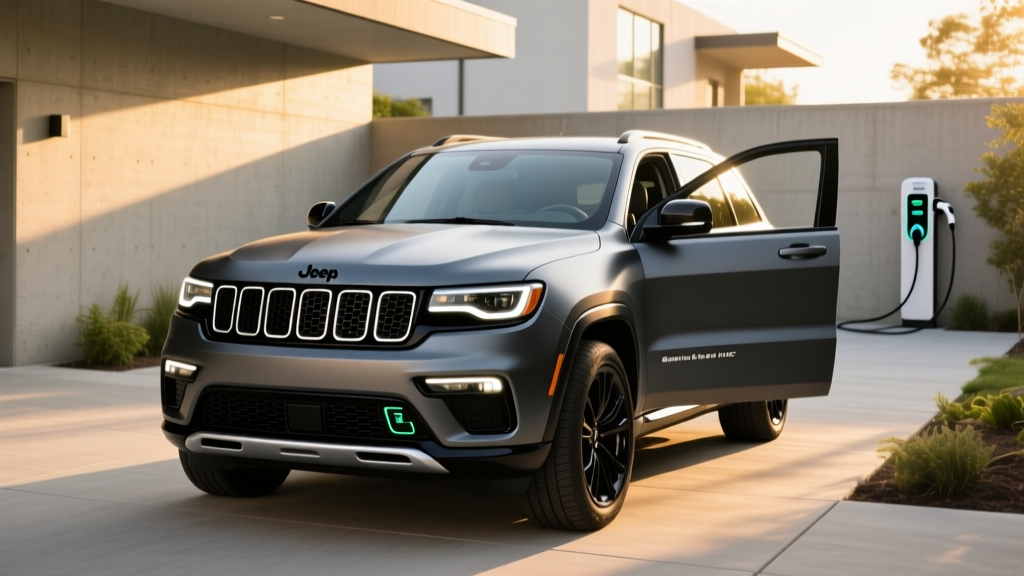
As of early 2026, Jeep has not yet released a fully electric Grand Cherokee. The current Grand Cherokee lineup includes the 4xe plug-in hybrid (PHEV) with an EPA-estimated 25 miles of electric-only range and a combined 56 MPGe. A battery-electric Grand Cherokee is widely expected as part of Stellantis's EV roadmap, potentially riding the STLA Large platform, but no official specs, pricing, or on-sale date have been confirmed. If you need a three-row electric SUV today from Stellantis, the closest option is the Jeep Wagoneer S (starting around $65,900, EPA-estimated 300+ mile range). If you want a Grand Cherokee with electric capability now, the 4xe PHEV remains your option.
Current Grand Cherokee Electrified Option: The 4xe PHEV
Before speculating about a battery-electric Grand Cherokee, it's worth understanding what Jeep currently offers. The Grand Cherokee 4xe pairs a 2.0-liter turbocharged inline-four with two electric motors and a 17.3 kWh (usable) lithium-ion battery pack. Here's what the numbers look like:
| Spec | 2025/2026 Grand Cherokee 4xe |
|---|---|
| Powertrain | 2.0L turbo I4 + 2 electric motors |
| Combined Output | 375 hp / 470 lb-ft torque |
| Battery (usable) | 17.3 kWh, NMC chemistry |
| EPA Electric-Only Range | 25 miles |
| EPA Combined MPGe | 56 MPGe |
| Gas-Only Combined MPG | 23 MPG |
| 0–60 mph | |
| Level 2 Charge Rate | 7.4 kW (~2.5 hrs to full) |
| DC Fast Charging | Not supported |
| Starting MSRP | ~$60,490 (base 4xe) |
| Federal Tax Credit (§30D) | Up to $3,750 (PHEV, subject to sourcing rules) |
| Battery Warranty | 8 years / 100,000 miles |
The 4xe qualifies as a PHEV, not a BEV. That means the federal tax credit under IRS §30D is capped at $3,750 (not the full $7,500 available to qualifying BEVs), and eligibility depends on battery component sourcing, buyer income limits, and MSRP caps. Always verify current-year eligibility with a tax professional before relying on credit estimates.
What a Fully Electric Grand Cherokee Could Look Like
Stellantis has confirmed the STLA Large platform will underpin several upcoming electric SUVs across its brands. Industry analysts expect a battery-electric Grand Cherokee to eventually use this architecture. While nothing is official, here's a realistic projection based on the platform's known capabilities and competitive positioning against the Ford Explorer EV, Hyundai Ioniq 7, and Kia EV9:
- Battery capacity: 85–110 kWh usable (likely NMC for higher trims, possible LFP base option)
- EPA range estimate: 280–350 miles depending on drivetrain and battery size
- DC fast charging: STLA Large supports up to 800V architecture, potentially 200–270 kW peak charge rate, enabling a 10–80% charge in roughly 20–25 minutes
- Level 2 home charging: Expected 11.5–19.2 kW onboard charger (3.5–7+ hours for a full charge on a 48-amp Level 2 circuit)
- Horsepower: 350–500+ hp depending on single- vs. dual-motor configuration
- Estimated starting price: $55,000–$65,000 (before incentives)
Important: These figures are projections based on platform announcements and competitive analysis. They are not manufacturer-confirmed specs. We will update this guide when Jeep publishes official data.
EV vs. Gas vs. PHEV: Cost Comparison for Grand Cherokee Buyers
Whether you choose the existing 4xe PHEV, wait for a BEV, or stick with the conventional gas Grand Cherokee, the real-world cost picture matters. Below is a 5-year total cost of ownership estimate assuming 15,000 miles/year, $3.50/gal regular gas, and $0.16/kWh home electricity (national average).
| Cost Factor | Gas Grand Cherokee (V6, 21 MPG) | Grand Cherokee 4xe PHEV | Projected EV Grand Cherokee (300 mi range) |
|---|---|---|---|
| Base MSRP (est.) | $42,000 | $60,490 | $60,000 (est.) |
| Federal Tax Credit | $0 | Up to $3,750* | Up to $7,500* |
| Effective Purchase Price | $42,000 | $56,740 | $52,500 |
| 5-Year Fuel/Energy Cost | $12,500 | $7,200 (mix of electric + gas) | $3,600 |
| 5-Year Maintenance (est.) | $3,500 | $3,000 | $1,800 |
| 5-Year Insurance (est.) | $9,000 | $10,500 | $11,000 |
| Estimated 5-Year Total | $67,000 | $77,440 | $68,900 |
*Tax credit eligibility is subject to IRS §30D rules including income caps ($150K single / $300K joint), MSRP limits ($80K for SUVs), and battery sourcing requirements. Point-of-sale transfer is available at participating dealers. Confirm eligibility before purchase.
The EV and gas models converge around the $67K–$69K mark over five years, but the EV gets there with a higher upfront cost offset by dramatically lower energy and maintenance spend. The 4xe PHEV is the most expensive option overall unless your daily commute stays under 25 miles and you charge at home nightly — then the fuel savings widen.
Real-World Ownership: What First-Time EV Buyers Must Know
If a fully electric Grand Cherokee arrives, owning one will differ from the gas experience in several practical ways:
Home Charging Access Is Non-Negotiable for Most Owners
Over 80% of EV charging happens at home. Without access to a Level 2 (240V) home charger, EV ownership becomes significantly less convenient. Expect to budget $800–$2,500 for a Level 2 charger installation, including:
- Level 2 charger hardware (40–48 amp): $400–$700
- Electrician labor (new 240V/50-amp circuit): $300–$1,200
- Electrical panel upgrade (if needed, 200-amp service): $1,500–$3,000+
- Permit and inspection: $50–$200
If you live in an apartment or lack a garage, public charging infrastructure becomes your lifeline. Check apps like PlugShare or the DOV's Alternative Fuels Station Locator to map DC fast chargers near your home and commute route before committing.
Cold Weather Cuts Range 20–35%
A 300-mile EPA-rated EV can deliver 195–240 miles in freezing temperatures, especially on highway trips where cabin heating draws significant power. If you live in the Upper Midwest or Northeast, plan your winter range expectations accordingly. Preconditioning the battery while plugged in mitigates some loss and preserves fast-charging speed.
DC Fast Charging Is Not Constant Peak Speed
When a manufacturer advertises "250 kW peak charging," that rate applies only to a narrow band of the battery's state of charge (typically 10–40%). Above 80% SoC, charging slows dramatically to protect battery health. A realistic 10–80% session on a 250 kW-capable SUV with a ~100 kWh battery takes 20–28 minutes — not the 15 minutes the peak number might suggest.
Common Misconceptions About an Electric Grand Cherokee
| Myth | Fact |
|---|---|
| "The electric Grand Cherokee is available now." | As of 2026, Jeep sells the Grand Cherokee 4xe PHEV (plug-in hybrid). A fully battery-electric version has not been officially announced with specs or pricing. |
| "PHEVs get the full $7,500 tax credit." | PHEVs with smaller batteries (under 16 kWh gross) may qualify for less. The Grand Cherokee 4xe's 17.3 kWh usable pack qualifies for up to $3,750, subject to sourcing and income rules. |
| "EVs cost more to insure — always." | EV insurance premiums run 10–20% higher on average due to repair costs, but the gap varies by model, carrier, and state. Shop quotes before assuming the worst. |
| "I'll need to replace the battery for $20,000 in a few years." | Modern NMC and LFP packs are warrantied for 8 years/100,000 miles at minimum 70% capacity retention. Real-world degradation data from comparable Stellantis/Hyundai/Tesla packs shows 8–12% loss over 100K miles — well within warranty thresholds. |
| "Towing with an EV is pointless." | Towing cuts EV range 40–60% — that's real. But an electric Grand Cherokee on STLA Large could offer 5,000+ lb towing capacity. It works for boat or short-haul trailer trips if you plan charging stops. |
Decision Framework: Should You Buy Now or Wait?
Choose the Grand Cherokee 4xe PHEV now if:
- Your daily commute is under 25 miles and you can charge at home every night
- You want electric driving for errands but gas flexibility for road trips and towing
- You're not ready to rely on public DC fast charging infrastructure
- You want a Grand Cherokee in the next 3–6 months
Wait for a fully electric Grand Cherokee if:
- You have reliable home Level 2 charging and your daily driving is under 200 miles
- You want to eliminate gas entirely and minimize maintenance costs
- You're willing to wait 12–24+ months for official specs and availability
- Lower per-mile energy cost is a priority and you drive 15,000+ miles/year
Consider the Jeep Wagoneer S (BEV, available now) if:
- You want a battery-electric Jeep SUV today and can accept a higher starting price (~$65,900)
- You need three rows and ~300 miles of EPA range
- You're comfortable with DC fast charging for longer trips
Frequently Asked Questions
Is there a fully electric Jeep Grand Cherokee for sale in 2026?
No. As of early 2026, Jeep has not released or officially announced a battery-electric Grand Cherokee with confirmed specs or an on-sale date. The only electrified Grand Cherokee currently available is the 4xe plug-in hybrid (PHEV).
How much does the Grand Cherokee 4xe cost after the tax credit?
The base 4xe starts around $60,490. If you qualify for the maximum $3,750 federal PHEV credit under §30D (subject to income limits, MSRP caps, and battery sourcing requirements), the effective price drops to roughly $56,740. State incentives may reduce the cost further — check your state's energy office for current programs.
Can I charge the Grand Cherokee 4xe at a DC fast charger?
No. The Grand Cherokee 4xe does not support DC fast charging. It charges at up to 7.4 kW on a Level 2 (240V) connection, reaching a full charge in approximately 2.5 hours. A standard 120V household outlet (Level 1) adds roughly 3–4 miles of electric range per hour.
What platform will an electric Grand Cherokee use?
Industry analysis points to Stellantis's STLA Large platform, which supports 800V architecture, battery packs from ~85 to 128 kWh, and dual-motor AWD configurations. This platform also underpins other upcoming Stellantis EVs. No official confirmation specific to the Grand Cherokee nameplate has been published as of this writing.
Will an electric Grand Cherokee qualify for the $7,500 federal tax credit?
If and when a BEV Grand Cherokee launches, it would need to meet IRS §30D requirements to qualify for the full $7,500 credit: final assembly in North America, MSRP under $80,000 (SUV cap), buyer AGI under $150K (single) or $300K (joint), and compliance with critical mineral and battery component sourcing thresholds. These rules are subject to change — always verify at irs.gov before purchasing.
How does the Grand Cherokee 4xe compare to a Toyota RAV4 Prime or Hyundai Tucson PHEV?
The Grand Cherokee 4xe offers more interior space and towing capacity but trails competitors in electric-only range. The RAV4 Prime delivers an EPA-estimated 42 miles of electric range and starts around $44,000. The Tucson PHEV offers ~33 miles electric and starts near $39,000. If electric-only commuting distance is your top priority, both are more efficient choices. The 4xe wins on cabin size, off-road capability, and premium positioning.