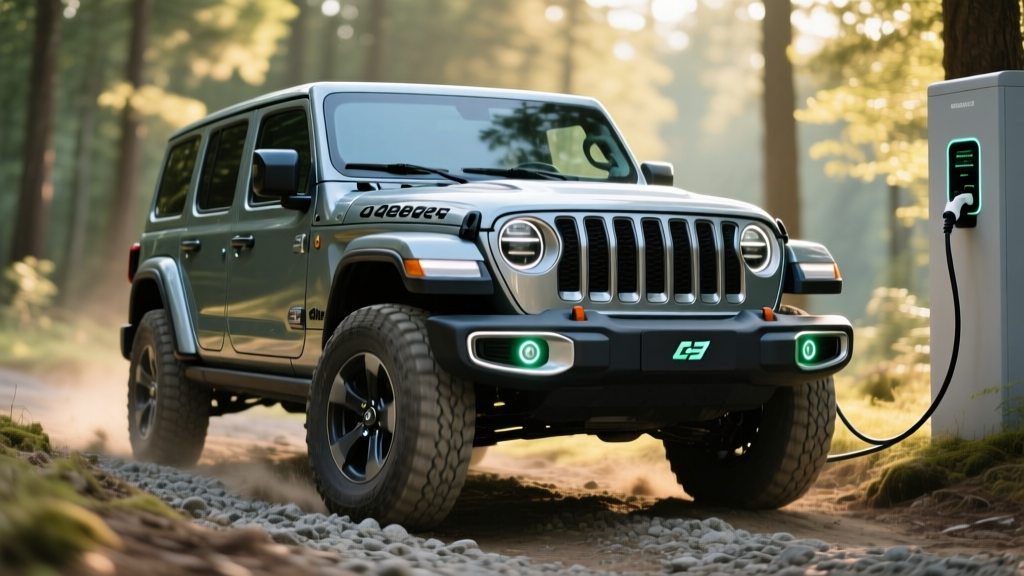
If you've been asking "does Jeep have an electric car?" the answer is yes — but the picture is more nuanced than a single model. As of 2026, Jeep offers one fully electric vehicle (the Wagoneer S) and a lineup of 4xe plug-in hybrids (Wrangler 4xe, Grand Cherokee 4xe, and Cherokee 4xe) that blend electric-only driving with a gas engine. There is no battery-electric Wrangler or Gladiator yet.
Quick Answer
Yes. The 2026 Jeep Wagoneer S is Jeep's first and only all-electric vehicle (BEV), built on Stellantis' STLA Large platform. It delivers an EPA-estimated 300+ miles of range, dual-motor AWD, and starts around $65,200 before incentives. If you want a Jeep badge with an electric motor but gas backup, the Wrangler 4xe and Grand Cherokee 4xe plug-in hybrids offer 25–35 miles of electric-only range before the gas engine kicks in.
The 2026 Jeep Wagoneer S: Jeep's Only All-Electric Vehicle
The Wagoneer S is the definitive answer for buyers who want a zero-tailpipe-emission Jeep. It rides on the STLA Large BEV platform — the same architecture underpinning the Dodge Charger Daytona EV — and targets the premium midsize SUV segment occupied by the Tesla Model X, BMW iX, and Genesis Electrified GV70.
| Spec | Value |
|---|---|
| EPA Range (est.) | ~300 miles |
| Battery Capacity | ~100 kWh usable (NMC chemistry) |
| Drivetrain | Dual-motor AWD |
| Horsepower | ~600 hp (Launch Edition) |
| 0–60 mph | ~3.4 seconds (Launch Edition) |
| Peak DC Fast Charge | ~200 kW (10–80% in ~28 min) |
| Level 2 Charge Rate | 11.5 kW (AC) |
| Connector | CCS1 (NACS adapter available) |
| Base MSRP | ~$65,200 |
| Battery/Powertrain Warranty | 8 years / 100,000 miles |
Real-World Range Expectations
The EPA sticker says ~300 miles, but real-world results depend heavily on conditions. Expect roughly 250–270 miles during sustained 75 mph highway driving and 220–240 miles in freezing temperatures (below 32°F) where battery heating and cabin climate draw heavily from the pack. City driving with regenerative braking can push closer to the EPA figure or slightly above.
Jeep 4xe Plug-In Hybrids: Electric-Assisted, Not All-Electric
For buyers who want Jeep's off-road capability with some electric driving, the 4xe (pronounced "four-by-e") lineup is the bridge. These are plug-in hybrids (PHEVs), not BEVs. You plug them in to get a modest electric-only range, then the turbocharged gas engine takes over.
| Model | Electric-Only Range | Combined MPGe | Gas-Only MPG | Battery (kWh) | Starting MSRP |
|---|---|---|---|---|---|
| Wrangler 4xe | ~22 mi | 49 MPGe | 20 mpg | ~17 kWh | ~$52,000 |
| Grand Cherokee 4xe | ~26 mi | 56 MPGe | 23 mpg | ~17 kWh | ~$60,000 |
| Cherokee 4xe | ~32 mi | 62 MPGe | 27 mpg | ~21 kWh | ~$42,000 |
The key trade-off: 4xe models give you the security of a gas tank for road trips while letting you handle short commutes on electricity alone. If your daily round-trip commute is under 25 miles and you can charge at home, you might use almost no gasoline on weekdays. But on long highway drives, a 4xe operates as a conventional hybrid — and the Wrangler 4xe's boxy aerodynamics mean gas-only fuel economy is mediocre at best.
Cost Breakdown: Wagoneer S vs. Gas Jeep Grand Cherokee
Comparing the all-electric Wagoneer S to a gas-powered Grand Cherokee reveals where EV ownership saves and where it costs more upfront. Here's a five-year cost estimate assuming 15,000 miles per year, home charging at the national average of $0.16/kWh, and gas at $3.50/gallon.
| Category | Wagoneer S (BEV) | Grand Cherokee V6 (Gas) |
|---|---|---|
| Purchase Price (base MSRP) | $65,200 | $43,000 |
| Federal Tax Credit (§30D) | Up to $7,500* | $0 |
| Effective Purchase Price | $57,700 | $43,000 |
| Energy Cost (5 yr / 75K mi) | ~$4,500 | ~$10,800 |
| Maintenance (5 yr) | ~$1,800 | ~$4,200 |
| Insurance (5 yr est.) | ~$12,500 | ~$9,500 |
| Estimated 5-Year Total | ~$76,500 | ~$67,500 |
*§30D credit eligibility depends on buyer income caps, MSRP caps (SUVs: $80,000), battery critical-mineral sourcing, and assembly requirements. Check IRS §30D guidelines for current-year rules. The Wagoneer S's North American assembly and Stellantis sourcing are subject to change — verify before purchase.
The BEV still costs more over five years primarily due to its higher sticker price and steeper insurance premiums (EV insurance averages 15–25% higher than equivalent gas models). However, the gap narrows significantly with higher annual mileage, cheaper electricity rates (e.g., solar-powered home charging at ~$0.06/kWh), or state-level rebates. At 20,000 miles/year with solar charging, the Wagoneer S could break even by year four.
Real-World Ownership: What First-Time Jeep EV Buyers Must Know
Buying an electric Jeep — or any EV — involves logistical decisions that gas-car buyers never face. Here are the practical realities.
Home Charging Is Non-Negotiable for Most Owners
Over 80% of EV charging happens at home. The Wagoneer S accepts 11.5 kW on Level 2, meaning a full charge from empty takes roughly 9–10 hours on a 48-amp home charger. Expect to pay $800–$2,000 for a quality Level 2 wallbox (e.g., ChargePoint Home Flex, Emporia Level 2) plus $500–$2,500 for electrician installation, depending on your panel capacity and run length. If your home has a 100-amp panel, a $1,500–$3,000 panel upgrade to 200 amps may be required.
For 4xe PHEV owners, Level 1 (standard 120V outlet) charging is viable because the batteries are small (~17–21 kWh). A full Level 1 charge takes 8–12 hours — fine for overnight top-ups. A Level 2 charger cuts that to 2–3 hours.
Public Charging: What to Expect on Road Trips
The Wagoneer S peaks at roughly 200 kW on DC fast charging, adding about 150 miles in 15 minutes under ideal conditions. Real-world charging curves taper above 80% State of Charge (SoC), so a 10–80% session takes approximately 28 minutes. The CCS1 connector works with Electrify America, EVgo, and ChargePoint DC stations. A Tesla NACS adapter opens access to the Supercharger network, which remains the most reliable public charging infrastructure in the U.S.
Cold Weather and Off-Road Use
Jeep buyers care about capability, and EVs behave differently in harsh conditions. Battery range drops 20–30% in sub-freezing temperatures due to cabin heating and reduced battery efficiency. The Wagoneer S uses a heat pump to mitigate this, but physics still applies. For off-road use, instant electric torque is an advantage (precise low-speed crawling), but be mindful that rock-crawling and low-speed technical terrain drain the battery faster than highway cruising. If you plan extended backcountry trips without charging access, a 4xe PHEV is the more practical choice today.
Common Misconceptions About Electric Jeeps
| Myth | Fact |
|---|---|
| "Jeep has a fully electric Wrangler." | No. The Wrangler is only available as a 4xe PHEV or conventional gas model. An all-electric Wrangler has been announced conceptually but has no confirmed production date. |
| "The Wagoneer S qualifies for the full $7,500 tax credit." | Eligibility depends on battery sourcing, buyer income, and MSRP caps — all of which shift. Verify on fueleconomy.gov before purchasing. |
| "4xe models are all-electric." | 4xe is a plug-in hybrid. It has a gas engine and a small battery. Electric-only range is 22–32 miles depending on the model. |
| "EV batteries need replacing every few years." | Modern NMC and LFP packs are warrantied for 8 years/100,000 miles. NHTSA data and long-term fleet studies show average degradation of 10–15% over 150,000 miles. |
| "You can't take an EV off-road." | Electric motors deliver instant torque at zero RPM, which is ideal for rock crawling. The Wagoneer S has terrain modes, though ground clearance and approach angles favor the Wrangler 4xe for serious trails. |
Decision Framework: Which Jeep Electrified Vehicle Is Right for You?
If-Then Buyer's Guide
- Choose the Wagoneer S (BEV) if: You want zero tailpipe emissions, have reliable home charging (Level 2), drive under 300 miles daily, and want a premium SUV with 600 hp performance. Budget: $65K+ before incentives.
- Choose the Wrangler 4xe (PHEV) if: You want serious off-road capability, can charge at home for short electric commutes, but need gas-engine range for weekend trail runs and road trips. Budget: $52K+.
- Choose the Grand Cherokee 4xe (PHEV) if: You want a family SUV with three rows (optional), daily electric commuting under 26 miles, and the flexibility for long road trips without charging stops. Budget: $60K+.
- Choose the Cherokee 4xe (PHEV) if: You want the most affordable entry into Jeep's electrified lineup, prioritize fuel savings on a shorter commute, and don't need hardcore off-road hardware. Budget: $42K+.
- Wait if: You specifically want an all-electric Wrangler or Gladiator. Jeep parent Stellantis has signaled these are coming, but no production timeline or specs are confirmed as of 2026.
Frequently Asked Questions
Is the Jeep Wagoneer S a good electric SUV compared to the Tesla Model X or Hyundai Ioniq 5?
The Wagoneer S competes on power (600 hp) and Jeep brand cachet but is newer to the EV market, so long-term reliability data is limited. The Model X offers more range (~348 mi EPA) and access to the Supercharger network natively. The Ioniq 5 charges faster (10–80% in ~18 min at 240 kW) and starts lower (~$45K). The Wagoneer S wins on brand identity and interior luxury; it's less proven on efficiency and charging infrastructure.
Can I charge a Jeep 4xe at a regular wall outlet?
Yes. The 4xe models have small enough batteries (~17–21 kWh) that a standard 120V Level 1 outlet will fully recharge them overnight (8–12 hours). This is one of the biggest advantages of PHEVs over BEVs for apartment dwellers or homes without dedicated EV circuits.
Does the Jeep Wagoneer S have a frunk (front trunk)?
Early Wagoneer S specifications indicate a modest front trunk, but exact cargo volume figures are listed on Jeep's official site. The STLA Large platform was designed with frunk space in mind.
What happens to a 4xe when the battery runs out?
The gas engine seamlessly takes over. The vehicle operates as a conventional hybrid, using regenerative braking to recapture small amounts of energy. You'll never be stranded — the gas tank provides 300+ additional miles of range depending on the model.
Will Jeep make an electric Wrangler?
Stellantis has shown the Wrangler Magneto concept (all-electric) multiple times and executives have confirmed an electric Wrangler is planned, but as of 2026 there is no announced production date, pricing, or confirmed spec sheet. The Wrangler 4xe PHEV remains the most electrified Wrangler you can buy today.