Why the J.D. Power 2022 Tesla Model 3 Consumer Rating Still Matters
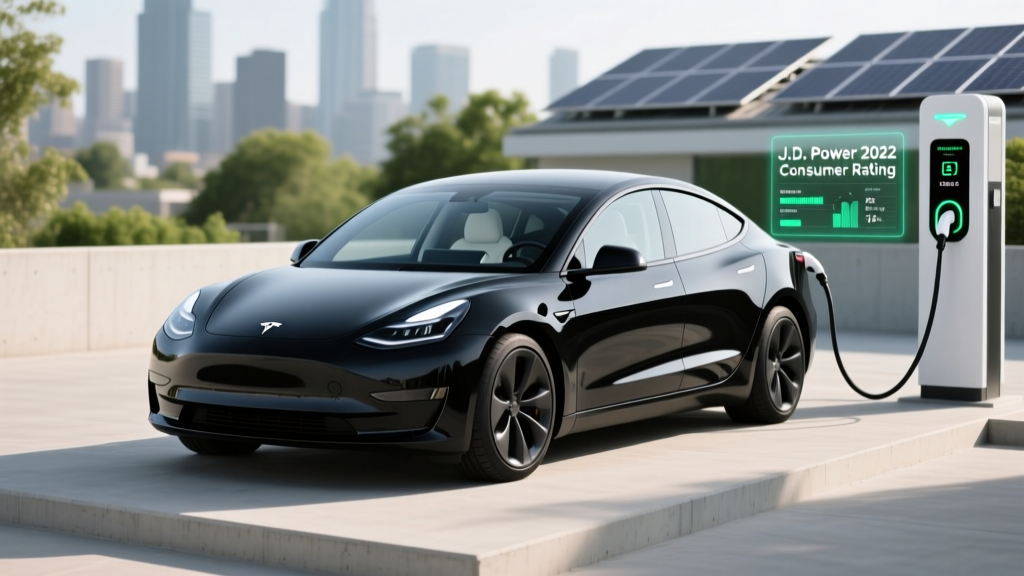
When J.D. Power published its 2022 Electric Vehicle Experience (EVX) Ownership Study, the Tesla Model 3 scored 777 out of 1,000 points — placing it above the premium electric car segment average but notably below owners' expectations in a few critical areas. For buyers in 2026 evaluating a used 2022 Model 3 or comparing it to the refreshed Highland-generation sedan, that consumer rating remains one of the most data-rich snapshots of real ownership satisfaction ever compiled for the vehicle.
But satisfaction scores alone don't tell you whether this car fits your life. In this review, we reconcile the J.D. Power findings with hard specs — EPA range, battery chemistry, DC fast-charge curves, IRS §30D tax-credit eligibility, and total cost of ownership — so you can decide based on numbers, not sentiment.
2022 Tesla Model 3 Core Specifications at a Glance
| Spec | Standard Range RWD | Long Range AWD | Performance |
|---|---|---|---|
| EPA Range | 272 mi | 358 mi | 315 mi |
| Battery (usable) | ~57.5 kWh (LFP) | ~75 kWh (NMC) | ~75 kWh (NMC) |
| Drivetrain | RWD, single motor | AWD, dual motor | AWD, dual motor |
| Horsepower | 283 hp | 346 hp | 450 hp |
| 0–60 mph | 5.8 sec | 4.2 sec | 3.1 sec |
| Max DC Fast Charge | 170 kW | 250 kW | 250 kW |
| 10–80% DC Time | ~30 min | ~28 min | ~28 min |
| Level 2 Home Rate | ~30 mi/hr (7.6 kW) | ~44 mi/hr (11.5 kW) | ~44 mi/hr (11.5 kW) |
| EPA Efficiency | 132 MPGe (25 kWh/100mi) | 131 MPGe (26 kWh/100mi) | 113 MPGe (30 kWh/100mi) |
| Cargo Volume | 23 cu ft (trunk + frunk) | 23 cu ft | 23 cu ft |
| Rear Legroom | 35.2 in | 35.2 in | 35.2 in |
| Original MSRP (2022) | $46,990 | $53,990 | $62,990 |
Source: EPA / fueleconomy.gov, Tesla 2022 spec sheets.
Real-World Range: What Owners Actually Experienced
The J.D. Power 2022 study found that range accuracy was one of the top satisfaction drivers for Model 3 owners — but also one of the top complaint areas for Standard Range buyers who hadn't accounted for highway and cold-weather losses. Tesla's onboard energy estimator is generally optimistic at higher speeds; third-party testing by outlets like Car and Driver has consistently shown the Model 3 Long Range achieving 85–90% of its EPA sticker on sustained highway runs at 70 mph.
The LFP (lithium iron phosphate) battery in the Standard Range RWD has a different discharge curve than the NMC packs in Long Range and Performance trims. LFP cells maintain voltage more linearly but offer less total energy density, which is why the Standard Range model's 272-mile EPA rating feels tighter on road trips. The upside: LFP chemistry tolerates regular 100% charging without the degradation concerns of NMC, making it ideal for daily commuters who charge at home nightly.
Charging Speed and Infrastructure: DC Fast, Level 2, and Home Setup
| Charging Level | Power (kW) | Miles Added per Hour | Notes |
|---|---|---|---|
| Level 1 (120V) | ~1.4 kW | ~3–5 mi/hr | Emergency/trickle only |
| Level 2 (240V, 32A) | 7.6 kW | ~30 mi/hr | Tesla Mobile Connector or Wall Connector on lower amp |
| Level 2 (240V, 48A) | 11.5 kW | ~44 mi/hr | Tesla Wall Connector, Long Range/Performance onboard charger max |
| DC Fast (V3 Supercharger) | Up to 250 kW | ~1,000+ mi/hr (peak) | 10–80% in ~28 min; tapers sharply above 80% |
| DC Fast (Standard Range) | Up to 170 kW | ~700 mi/hr (peak) | 10–80% in ~30 min; LFP charge curve is flatter |
The 2022 Model 3 uses the Tesla NACS connector natively, giving it seamless access to the Supercharger network — consistently rated the most reliable DC fast-charging network in the U.S. With the industry's shift to NACS as the standard, adapters are no longer needed for the Model 3 at CCS-equipped stations either (Tesla provides a CCS adapter, and many third-party options exist).
A critical ownership note from the J.D. Power data: owners who relied primarily on public DC fast charging reported lower satisfaction than those with home Level 2 setups. This tracks with physics — frequent 250 kW sessions generate more thermal stress on the battery. Tesla's thermal management system is robust, but home Level 2 charging at 7–11 kW remains the gold standard for long-term battery health. Budget $500–$1,500 for a professional 240V/48A home installation depending on your panel capacity and run length.
Pricing, Tax Credits, and Total Cost of Ownership
| 2022 Trim (Used Market, 2026) | Avg. Used Price | Used EV Credit (§25E) | Effective Cost |
|---|---|---|---|
| Standard Range RWD | ~$24,000–$28,000 | Up to $4,000 | ~$20,000–$24,000 |
| Long Range AWD | ~$29,000–$34,000 | Up to $4,000 | ~$25,000–$30,000 |
| Performance | ~$34,000–$40,000 | Up to $4,000 | ~$30,000–$36,000 |
Used prices reflect 2026 market averages. IRS §25E Used Clean Vehicle Credit provides 30% of the sale price up to $4,000, subject to income caps ($75K single / $150K joint) and dealer reporting requirements. The vehicle must be sold for $25,000 or less to qualify.
The original IRS §30D New Vehicle credit of up to $7,500 no longer applies to 2022 Model 3 purchases at new-vehicle MSRP, since these are now sold on the used market. However, the §25E used-EV credit is a powerful incentive: a 2022 Long Range purchased from a licensed dealer for $25,000 or less can net a $4,000 point-of-sale rebate, bringing effective cost well under $30,000 — a price point that competes directly with new compact EVs.
On the cost side, the Model 3's efficiency is a standout. At 25–30 kWh per 100 miles and a national average electricity rate of ~$0.16/kWh, fuel cost runs $4.00–$4.80 per 100 miles. A comparable gas sedan at 30 MPG with $3.50/gallon fuel costs $11.67 per 100 miles — a roughly 60% fuel savings that compounds over ownership.
What the J.D. Power Rating Revealed: Satisfaction and Pain Points
The J.D. Power 2022 EVX Ownership Study evaluated owners across 10 categories. The Model 3's 777/1,000 score placed it solidly above the premium electric car average. Here's where it excelled and where it fell short:
✓ Owner Satisfaction Strengths
- Driving dynamics: Instant torque, low center of gravity, and one-pedal regenerative braking scored highest
- Range accuracy: Long Range owners praised real-world range matching estimates in moderate conditions
- Supercharger network: Plug-and-charge reliability far outpaced third-party networks in owner surveys
- OTA updates: Owners valued continuous feature additions without dealer visits
- Operating cost: Fuel and maintenance savings were the top repurchase motivator
✗ Owner Complaint Areas
- Build quality: Panel gaps, paint imperfections, and interior rattles were the most cited issues
- Ride comfort: Firm suspension tuning drew criticism on rough pavement, especially with 19" wheels
- Rear seat space: 35.2 inches of legroom feels tight for adults on longer trips
- Service access: Mobile service availability and service-center wait times frustrated some owners
- Phantom braking: Autopilot's occasional unexpected deceleration on highways was a recurring safety concern
It's worth noting that the 2022 model year was the final year before Tesla's "Highland" refresh (introduced for the 2024 model year), which addressed several of these complaints with improved sound insulation, ventilated seats, rear touchscreen, and a softer ride. Buyers weighing a used 2022 against a new Highland should factor these quality-of-life differences into their decision.
Tech, Driver Assistance, and Interior
The 2022 Model 3's interior is minimalist by design — a single 15-inch center touchscreen handles navigation, climate, media, and vehicle settings. There is no instrument cluster; speed and range information lives in the upper-left corner of the main display. This polarizes buyers: some find it clean and distraction-free, others find it frustratingly reliant on a single screen.
Standard driver-assistance features include:
- Autopilot (adaptive cruise + lane centering) — SAE Level 2
- Automatic emergency braking with pedestrian detection
- Blind-spot monitoring and rear cross-traffic alert
- 8-camera surround-view system
Full Self-Driving (Supervised) was available as a $12,000 option (or $199/month subscription) in 2022. Despite the name, FSD remains an SAE Level 2 system requiring full driver attention. It adds automated lane changes, traffic-light and stop-sign recognition, and Navigate on Autopilot for highway interchanges. Real-world performance varies significantly by geography and road-marking quality.
Cargo space totals 23 cubic feet (19.8 cu ft trunk + 3.1 cu ft frunk), competitive with compact sedans but less than hatchback rivals like the Hyundai Ioniq 5 or Chevrolet Bolt EUV. The rear seats fold 60/40 for longer items, but the trunk opening is relatively narrow.
Battery Longevity, Warranty, and Degradation
Tesla warranties the 2022 Model 3 battery and drive unit for 8 years / 100,000 miles (Standard Range) or 8 years / 120,000 miles (Long Range and Performance), whichever comes first, with a minimum 70% capacity retention threshold. If the battery degrades below 70% State of Health within the warranty window, Tesla will repair or replace it.
Real-world degradation data from fleet analytics firm Recurrent Auto shows that 2022-era Model 3 batteries typically retain ~90–93% capacity after 50,000 miles and ~85–88% after 100,000 miles under normal charging habits. LFP packs in the Standard Range model show slightly slower degradation curves, partly because owners routinely charge them to 100% (which Tesla recommends for LFP), while NMC packs benefit from the 80% daily charge limit.
Out-of-warranty battery replacement for a 2022 Model 3 currently runs $12,000–$16,000 at Tesla service centers, including labor. However, given the degradation data, most owners will never need a full pack replacement within the vehicle's practical lifespan.
2022 Model 3 vs. Key Competitors: Is It Still Worth Buying?
Choose the 2022 Tesla Model 3 if:
- You want access to the Supercharger network without adapters
- Driving performance and efficiency are top priorities
- You primarily commute solo or with one passenger
- You value OTA software updates and a strong used-EV resale market
Consider a competitor if:
- You need more rear-seat room or cargo flexibility → Hyundai Ioniq 5, Kia EV6
- You prefer traditional controls and a softer ride → BMW i4, Polestar 2
- You want a lower used price with comparable range → Chevrolet Bolt EUV (2022–2023)
- You want the latest refinement and warranty → 2024+ Model 3 Highland (new)
Against the Hyundai Ioniq 5 (2022), the Model 3 wins on range (358 vs. 303 mi EPA for Long Range variants), Supercharger access, and performance. The Ioniq 5 counters with 800V ultra-fast charging (10–80% in ~18 min at 350 kW chargers), a more spacious cabin, and V2L capability. Against the BMW i4 eDrive40, the Model 3 is more efficient and cheaper to operate, while the i4 offers superior interior materials and a quieter ride.
Frequently Asked Questions
What is the real-world range of the 2022 Tesla Model 3?
The EPA rates the Long Range AWD at 358 miles, the Performance at 315 miles, and the Standard Range RWD at 272 miles. In real-world highway driving at 70 mph, expect approximately 290–320 miles (Long Range), 260–285 miles (Performance), and 220–245 miles (Standard Range). Cold weather below freezing can reduce range by 20–30% depending on cabin heat usage and whether you precondition the battery.
How fast does the 2022 Model 3 charge?
On a V3 Tesla Supercharger (250 kW peak), the Long Range and Performance trims charge from 10–80% in approximately 28 minutes. The Standard Range RWD peaks at 170 kW and takes about 30 minutes. At home on a 240V/48A Level 2 charger, expect roughly 44 miles of range added per hour for Long Range/Performance, or 30 miles per hour for the Standard Range (limited by its 7.6 kW onboard charger).
Does a used 2022 Tesla Model 3 qualify for any federal tax credit?
Yes — under the IRS §25E Used Clean Vehicle Credit, you may qualify for up to $4,000 (30% of the sale price) if the vehicle is purchased from a licensed dealer for $25,000 or less, and your modified adjusted gross income does not exceed $75,000 (single) or $150,000 (joint). The credit can be transferred at the point of sale. Consult a tax professional to confirm your eligibility, as rules are subject to change.
What is the biggest drawback of the 2022 Model 3?
Build quality is the most consistent complaint in owner surveys including the J.D. Power study. Panel-gap inconsistencies, paint defects, and interior rattles were more common in Fremont-built 2022 models than in competing vehicles at this price point. The firm ride, minimalist interior, and limited rear-seat legroom (35.2 inches) are also polarizing. The 2024+ Highland refresh addressed many of these issues.
Is the 2022 Model 3 still worth buying in 2026?
At used prices of $24,000–$40,000 (and potentially $4,000 less with the §25E credit), the 2022 Model 3 offers exceptional efficiency, access to the best charging network in the U.S., and strong performance for the money. If you can accept the build-quality quirks and firm ride, it remains one of the best-value used EVs available. Buyers who prioritize refinement and rear-seat comfort should test-drive the 2024+ Highland or a Hyundai Ioniq 5 before committing.
How long will the 2022 Model 3 battery last?
Tesla warranties the battery for 8 years / 100,000–120,000 miles (depending on trim) with a 70% capacity retention guarantee. Fleet data suggests most Model 3 batteries retain 85–93% capacity at 100,000 miles under normal use. With proper charging habits (daily limits of 80% for NMC, 100% acceptable for LFP), the battery should outlast 200,000+ miles before approaching the warranty threshold.