Jay Leno's Tesla Semi Drive: What the Headlines Miss
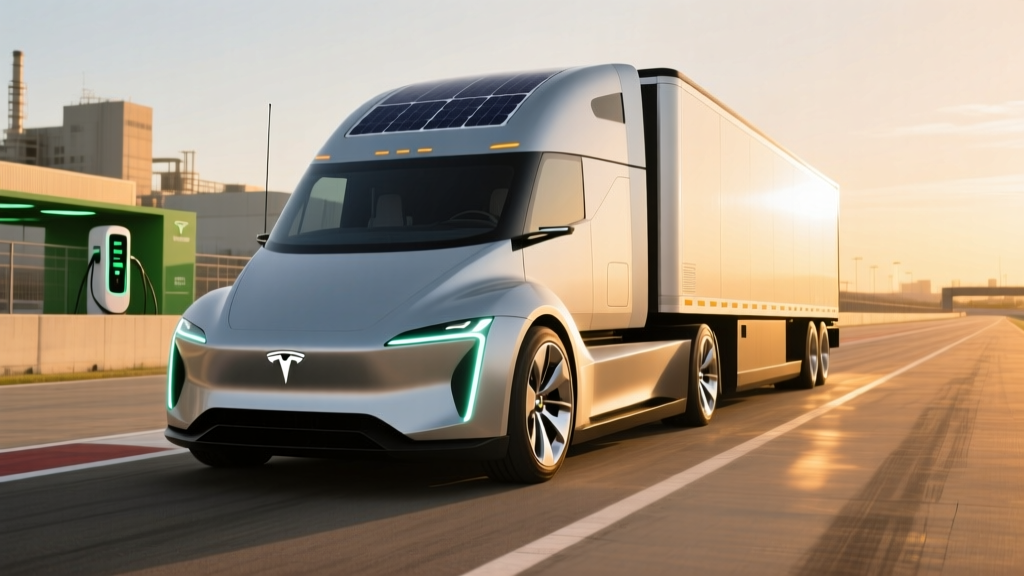
When Jay Leno took delivery of his Tesla Semi in late 2022 and subsequently put it through its paces on his Jay Leno's Garage channel, the internet fixated on the spectacle: a comedian-turned-car-enthusiast hauling a trailer through Southern California in an 82,000-pound GVWR electric rig. But behind the entertainment value sits a genuinely consequential commercial vehicle — one that, as of 2026, remains the only series-production battery-electric Class 8 semi-truck available at scale in North America.
This review dissects the Tesla Semi's actual specifications, real-world range behavior, charging infrastructure requirements, and ownership economics — informed by Leno's public drive data, Tesla's published specs, and fleet-operator reports. If you're researching the Tesla Semi beyond the viral clips, this is the technical breakdown.
Range, Battery, and the Real-World Efficiency Story
Real-World Expectation: Fleet operators report 380–460 miles at highway speeds (65–70 mph) with a full payload. Cold-weather runs in the 30°F range can drop usable range by 15–25%, yielding roughly 300–380 miles. City/regenerative-heavy routes push closer to the 500-mile sticker.
The Tesla Semi ships with an estimated ~900 kWh battery pack (Tesla has not published an official usable kWh figure, but teardown analyses and energy-consumption math from Tesla's own 2 kWh/mile claim confirm this ballpark). The chemistry is believed to be a mix of NMC (nickel manganese cobalt) cells for energy density in the long-range 500-mile variant, though Tesla's evolving cell strategy means some production runs may incorporate 4680-format cells with varying cathode chemistries.
| Specification | 500-Mile Variant | 300-Mile Variant |
|---|---|---|
| EPA Range (loaded) | 500 mi | 300 mi |
| Battery Capacity (est.) | ~900 kWh | ~540 kWh |
| Battery Chemistry | NMC (4680 format) | NMC (4680 format) |
| Efficiency | ~2 kWh/mi | ~2 kWh/mi |
| Energy per 100 mi | ~200 kWh/100mi | ~200 kWh/100mi |
| 0–60 mph (loaded) | ~20 sec | ~20 sec |
| 0–60 mph (unloaded) | ~5 sec | ~5 sec |
| Drivetrain | Tri-motor AWD | Tri-motor AWD |
| Peak Horsepower | ~1,000+ hp (combined) | ~1,000+ hp (combined) |
| Grade Capability | 65 mph at 5% grade | 65 mph at 5% grade |
Jay Leno's drive confirmed what Tesla claimed: the Semi maintains speed on grades that force diesel downshifts. The tri-motor setup — one motor on the steer axle's companion and two on the drive axles — delivers torque-vectoring that keeps the rig stable under load. Leno noted the regenerative braking was strong enough to eliminate most service-brake use on descents, a claim corroborated by PepsiCo's fleet data showing dramatically reduced brake wear.
Charging: Megacharger Speeds and Infrastructure Reality
This is where the Tesla Semi diverges most sharply from passenger EVs. You cannot plug an 82,000-lb rig into a standard CCS stall and expect meaningful turnaround times.
| Charging Level | Connector | Peak Power | Rate / Time |
|---|---|---|---|
| Tesla Megacharger (DC) | Proprietary Tesla (MCS-derived) | ~1,200 kW (1.2 MW) | ~70% in 30 min (~350 mi) |
| CCS2/MCS Public DC | MCS (Megawatt Charging System) | Up to 1,000 kW | ~60% in 30 min (site-dependent) |
| Depot Level 2 (AC) | Proprietary AC inlet | ~44–80 kW (3-phase) | ~20–40 mi/hr; full charge 12–20 hr |
| Standard J1772/CCS L2 | Adapter required | ~19.2 kW | ~10 mi/hr (impractical for daily ops) |
The critical number: ~1.2 MW peak DC fast-charge rate at Tesla Megachargers. Tesla demonstrated a 600-mile drive from Fremont to San Diego with a single 30-minute Megacharger stop — a feat Jay Leno replicated on a shorter Southern California route. The charge curve holds near peak power from roughly 10–60% SoC, then tapers significantly above 80%, as thermal management limits kick in to protect a pack this massive.
For fleet operators, the infrastructure calculus is non-trivial. A single Megacharger installation requires dedicated medium-voltage utility service (typically 1–2 MW per stall), transformer upgrades, and switchgear that can cost $200,000–$500,000+ per site before the chargers themselves. Most early Semi adopters (PepsiCo, Schneider, JB Hunt) are co-locating Megachargers at distribution centers where grid capacity already exists.
Performance and Drivetrain: Tri-Motor Torque
The Tesla Semi's three permanent-magnet synchronous motors produce a combined output estimated above 1,000 horsepower. The unloaded 0–60 time of roughly 5 seconds is a party trick (as Leno gleefully demonstrated), but the loaded 0–60 of ~20 seconds is the operationally relevant figure — and it's dramatically quicker than a loaded diesel Class 8, which typically needs 45–60 seconds.
The drivetrain is full-time AWD with independent torque control on each drive motor. This eliminates the need for a traditional transmission — there is no gearbox, no clutch, no shifting. The single-speed reduction gear keeps the Semi in its optimal torque band at all speeds, which is why it can maintain 65 mph on a 5% grade at full GVWR without the downshifting and speed loss that plague diesel trucks on mountain passes.
Leno highlighted the cabin visibility and low center of gravity (battery pack mounted between the frame rails) as handling advantages. The Semi's turning radius is tighter than comparable diesel cabs, and the centered driver seating position — a first for Class 8 — gives panoramic sight lines.
Pricing, Tax Credits, and Total Cost of Ownership
| Item | 500-Mile Variant | 300-Mile Variant |
|---|---|---|
| Base MSRP | $290,000 | $250,000 |
| Reservation Fee | $25,000 (applied to purchase) | |
| Federal §30D / 45W Credit | Up to $40,000 (commercial clean vehicle credit, §45W — not §30D consumer credit) | |
| Estimated After-Credit Price | ~$250,000 | ~$210,000 |
| California HVIP Voucher | Up to $120,000 (varies by fleet size and application) | |
A critical distinction for Semi buyers: the IRS §45W Commercial Clean Vehicle Credit applies here, not the consumer §30D credit. Section 45W provides up to $40,000 for qualified commercial EVs above 14,000 lbs GVWR, with no MSRP cap and no personal-income cap — but the vehicle must be used in a trade or business. Fleets purchasing the Semi can stack this with state incentives like California's HVIP voucher program, which can bring effective acquisition cost below comparable diesel when factoring in fuel and maintenance savings.
The TCO math is compelling for high-mileage routes: electricity at $0.12–$0.18/kWh translates to roughly $0.24–$0.36/mile in energy cost, versus $0.65–$0.85/mile for diesel at 2026 prices. Over a 5-year/500,000-mile ownership cycle, energy savings alone can exceed $200,000. Add in eliminated oil changes, DEF fluid, DPF maintenance, and dramatically reduced brake wear, and the Semi's higher upfront cost is recovered within 2–3 years on routes under 400 miles/day.
Tech, Cabin, and Driver-Assistance Features
The Semi's cabin borrows heavily from the Model S/X architecture but scales it for commercial use. Two 15-inch touchscreen displays flank the centered steering wheel — one for vehicle systems and navigation, one for cameras and media. The centered driver position (inspired by fighter-jet ergonomics) eliminates the traditional passenger-side blind spot.
Tesla's Enhanced Autopilot is standard, which is an SAE Level 2 driver-assistance system. It includes adaptive cruise control, lane-keeping, automatic emergency braking, and blind-spot monitoring via the camera suite. This is not self-driving — the operator must maintain hands-on-wheel awareness and full supervisory control at all times.
The Tesla Semi's Autopilot provides steering, acceleration, and braking assistance, but the driver must remain fully engaged. Tesla's "Full Self-Driving" branding does not change the SAE Level 2 classification. No production Tesla Semi operates at Level 3 or above.
Notable tech features include over-the-air software updates (Tesla has pushed performance and efficiency improvements to Semis post-delivery), a built-in route planner that factors in payload weight, elevation, and Megacharger availability, and Tesla's fleet management API for integration with existing logistics platforms.
Drawbacks: The cabin is spartan by Class 8 standards — no sleeper berth is offered (this is a day-cab only), storage space is limited compared to Freightliner or Volvo cabs, and the touchscreen-dependent HVAC and mirror-replacement controls draw criticism from veteran drivers who prefer physical knobs. The camera-based "mirror" system, while aerodynamically efficient, can suffer from glare and latency in heavy rain.
Who Should Buy the Tesla Semi (And Who Shouldn't)
- Your fleet runs daily routes under 400 miles with predictable depot-return patterns
- You have access to medium-voltage grid capacity for Megacharger installation
- You operate in states with strong EV truck incentives (CA, NY, NJ, CO)
- Driver retention is a priority — the Semi's performance and tech attract drivers
- ESG reporting and zero tailpipe-emission mandates apply to your operations
- You need sleeper-cab configurations for long-haul OTR routes exceeding 500 miles
- Your routes lack depot-charging infrastructure and public MCS stations are unavailable
- You need immediate delivery — Tesla Semi production slots remain constrained in 2026
- Your payloads regularly exceed 82,000 lbs GVWR (specialized heavy-haul not supported)
Pros and Cons
- 500-mile EPA range covers most regional-haul duty cycles
- ~1.2 MW Megacharging: 70% in 30 minutes
- ~2 kWh/mi efficiency undercuts diesel cost/mile by 50%+
- Tri-motor AWD: maintains highway speed on 5% grades at full load
- Massively reduced brake wear via regenerative braking
- Zero tailpipe emissions — CARB and EPA compliance simplified
- OTA updates improve performance post-purchase
- Centered driver position with excellent visibility
- $250,000–$290,000 MSRP before incentives
- Megacharger infrastructure requires $200K–$500K+ depot investment
- No sleeper cab — day-cab only limits long-haul use
- Public MCS charging network remains sparse in 2026
- Production availability still constrained; multi-month lead times
- Camera-based mirrors can struggle in heavy rain and glare
- Touchscreen-heavy controls draw veteran-driver criticism
- Cold-weather range loss of 15–25% on sub-40°F routes
How Does the Tesla Semi Compare to Diesel and Competing EVs?
The Semi's closest electric competitor is the Freightliner eCascadia (Class 8, ~230-mile range, ~400 kWh battery, ~$300,000 MSRP). The eCascadia benefits from Daimler's existing dealer/service network and CCS charging compatibility but falls well short on range. The Volvo VNR Electric offers ~275 miles and ~375 kWh, also with CCS. Neither matches the Semi's 500-mile capability or 1.2 MW charge rate.
Against diesel, the Semi trades upfront cost and infrastructure complexity for dramatically lower operating cost. A new diesel Class 8 (Freightliner Cascadia, Volvo VNL) runs $150,000–$200,000 — cheaper to buy, but $0.65–$0.85/mile in fuel alone versus the Semi's ~$0.30/mile. For fleets running 100,000+ miles/year, the payback period is typically 2–3 years.
Jay Leno's experience underscored this: his Semi operates on a short-haul Southern California route where depot charging is trivial, and the energy savings versus diesel are immediately visible. For owner-operators and small fleets in similar duty cycles, the math works.
Frequently Asked Questions
What is the real-world range of the Tesla Semi?
EPA-estimated at 500 miles (loaded, 82,000 lbs GVWR). Real-world fleet data shows 380–460 miles at sustained highway speeds, dropping to 300–380 miles in cold weather below 30°F. City and regenerative-heavy routes push closer to the 500-mile figure.
How fast does the Tesla Semi charge?
At a Tesla Megacharger (~1,200 kW peak), the Semi charges from 10–70% in approximately 30 minutes, adding roughly 350 miles of range. Depot Level 2 charging (44–80 kW AC, 3-phase) takes 12–20 hours for a full charge. Standard public CCS chargers are impractical for this battery size.
How much does the Tesla Semi cost after tax credits?
The 500-mile variant lists at $290,000 MSRP; the 300-mile at $250,000. The federal §45W commercial clean vehicle credit provides up to $40,000 back for qualified business use. With California HVIP vouchers (up to $120,000), effective cost can drop to $130,000–$170,000 — competitive with diesel. Consult a tax professional for eligibility specifics.
Does the Tesla Semi qualify for the federal EV tax credit?
Not the consumer §30D credit — it qualifies for the §45W Commercial Clean Vehicle Credit (up to $40,000 for vehicles over 14,000 lbs GVWR). There is no MSRP cap or personal income cap under §45W, but the vehicle must be used in a trade or business. Battery-sourcing requirements may apply; verify current-year rules with the IRS or a qualified tax advisor.
Is the Tesla Semi worth buying vs. diesel competitors?
For regional-haul fleets running under 400 miles/day with depot-charging access, the TCO strongly favors the Semi over diesel within 2–3 years. For long-haul OTR routes, sleeper-cab needs, or areas without MCS/Megacharger infrastructure, diesel remains more practical in 2026. The Semi is a duty-cycle-specific tool, not a universal diesel replacement.
What battery warranty does the Tesla Semi carry?
Tesla provides an 8-year or 1,000,000-mile battery and drive-unit warranty for the Semi — significantly longer than the passenger-vehicle warranty, reflecting commercial use expectations. The warranty covers capacity retention above a specified threshold (typically 70% of original capacity). Confirm exact terms with Tesla Commercial at purchase.
Can an individual (non-fleet) buy a Tesla Semi?
Yes — Jay Leno is proof. Tesla accepts orders from individuals, though the $25,000 reservation fee and $250,000+ MSRP make it impractical outside of enthusiast or owner-operator use cases. Individual buyers should note that §45W commercial credits require business use; personal purchases may not qualify.
Sources: Tesla Commercial specifications, IRS §45W Commercial Clean Vehicle Credit, fueleconomy.gov, fleet-operator published data (PepsiCo, Schneider). Jay Leno's Garage Tesla Semi episodes (2023–2025) for real-world drive observations.