Quick Verdict: The Workhorse That Commutes
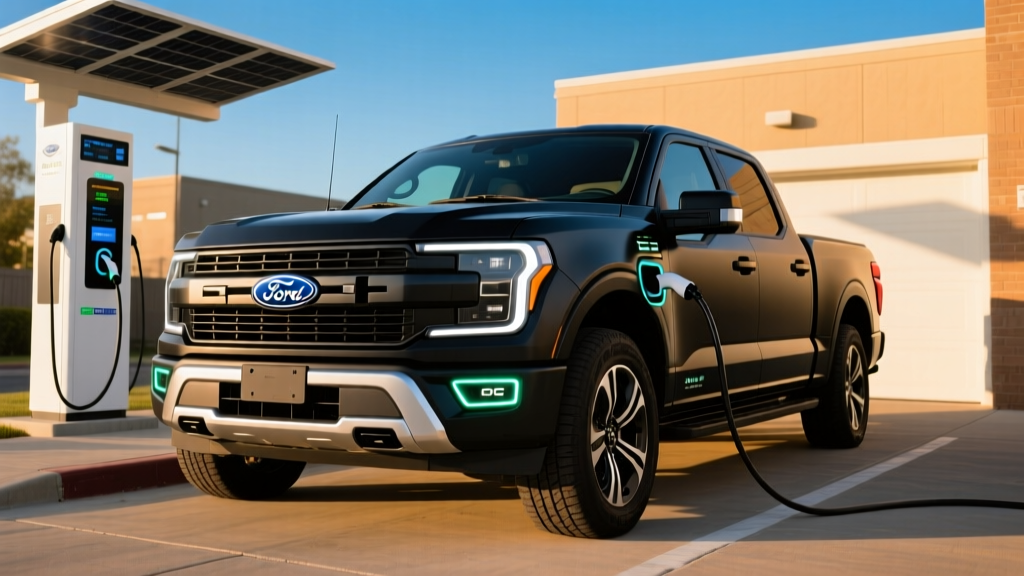
The 2025 Ford F-150 Lightning XLT occupies a rare position in the EV truck market: it's the most accessible full-size electric pickup that doesn't ask you to sacrifice utility for efficiency. With a starting MSRP of $54,995, dual-motor all-wheel drive, and a usable battery pack that supports genuine job-site duty, the XLT trim strikes the balance that fleet buyers and homeowner-truck owners actually need. It isn't the longest-range Lightning — that title belongs to the Extended Range variants on higher trims — but it delivers the core Lightning experience at a price point that keeps the federal tax credit within reach for many buyers.
| Spec | Value |
|---|---|
| EPA Range (Standard Range) | 240 miles |
| Battery Capacity (Usable) | 98 kWh (Standard Range pack) |
| Battery Chemistry | NMC (Nickel Manganese Cobalt) |
| Drivetrain | Dual-motor AWD |
| Horsepower | 563 hp |
| Torque | 775 lb-ft |
| 0–60 mph | ~4.0 seconds |
| Max DC Fast Charge | 150 kW (Standard Range) |
| 10–80% DC Charge Time | ~36 minutes |
| Level 2 Home Charging | 19.2 kW (80A) / ~30 mi/hr |
| MPGe (Combined) | 78 MPGe |
| Efficiency | 43 kWh/100 mi |
| Max Towing (w/ Max Trailer Tow) | 7,700 lbs |
| Max Payload | 1,800 lbs |
| Battery Warranty | 8 years / 100,000 miles |
| Base MSRP | $54,995 |
Range and Efficiency: What the EPA Number Doesn't Tell You
The Standard Range battery pack on the 2025 F-150 Lightning XLT carries an EPA-estimated 240 miles of range. That figure comes from the 98 kWh usable capacity NMC lithium-ion pack, which Ford pairs with a dual-motor all-wheel-drive system standard across all Lightning trims. Efficiency lands at 78 MPGe combined, translating to roughly 43 kWh consumed per 100 miles of driving.
Real-World Range Expectations
EPA sticker: 240 miles
Highway (70 mph, moderate weather): ~200–215 miles
Cold weather (below 32°F, mixed driving): ~160–185 miles
Towing (5,000 lb trailer, flat terrain): ~110–140 miles
Like all EVs, the Lightning loses range at sustained highway speeds and in cold temperatures. The truck's large frontal area creates significant aerodynamic drag above 65 mph, and the NMC battery's performance drops in freezing conditions despite Ford's liquid thermal management system. If you regularly tow, plan for range to roughly halve — this is physics, not a defect.
For daily commuting under 80 miles round-trip with home charging, the Standard Range pack is more than sufficient. Road trippers and those with long rural routes should strongly consider the Extended Range option (320 miles EPA) available on the XLT for an additional cost, though it pushes the MSRP higher and may affect tax credit eligibility.
Charging Speed: DC Fast, Level 2, and the Home Setup
Charging infrastructure compatibility is where the Lightning XLT proves practical for both fleet depots and residential garages. The Standard Range pack supports up to 150 kW peak DC fast charging via its CCS1 connector. In real-world conditions, expect a 10–80% session to take approximately 36 minutes at a capable station. The charge curve tapers noticeably above 80% SoC to protect battery longevity — a full 10–100% session will take closer to 55 minutes.
| Charging Level | Power | Speed (Approx.) | Use Case |
|---|---|---|---|
| Level 1 (120V household) | 1.4 kW | ~3 mi/hr | Emergency / trickle |
| Level 2 (240V, 32A mobile) | 7.7 kW | ~13 mi/hr | Overnight (basic) |
| Level 2 (240V, 48A Wall Charger) | 11.5 kW | ~19 mi/hr | Overnight (recommended) |
| Level 2 (240V, 80A Charge Station Pro) | 19.2 kW | ~30 mi/hr | Full overnight + Pro Power |
| DC Fast Charge (CCS1) | 150 kW peak | 10–80% in ~36 min | Road trips / fleet |
The 80A Ford Charge Station Pro is the standout home charging accessory. It requires a 100-amp dedicated circuit and professional installation by a licensed electrician — budget $1,500–$3,000 for the installation depending on your panel capacity and conduit run. The payoff is a full recharge in roughly 5 hours and access to Ford's Intelligent Backup Power (V2H), which can power your home during outages at up to 9.6 kW through a compatible transfer switch.
On public networks, the Lightning uses the CCS1 connector. Ford has begun providing NACS adapters for Tesla Supercharger access, and the 2025 model year continues to expand that compatibility. Peak charging at 150 kW is respectable for a Standard Range pack, though competitors like the Rivian R1T and Silverado EV achieve higher peak rates on larger packs. Preconditioning the battery via the FordPass app before arriving at a DC station is essential to hitting peak charge rates — skip this step and your first 10 minutes will taper well below 150 kW.
Performance and Drivetrain: 563 HP in a Work Truck
Every 2025 F-150 Lightning, including the XLT, comes standard with a dual-motor all-wheel-drive powertrain producing 563 horsepower and 775 lb-ft of torque. That's more power than the gas F-150's 3.5L EcoBoost V6, and the instant electric torque delivery makes it feel even more urgent. Ford estimates a 0–60 mph time around 4.0 seconds — quick for any vehicle, remarkable for a 6,500-pound pickup.
The AWD system is fully electric with no mechanical linkage between axles; each motor independently manages its axle. Traction in rain, snow, and loose gravel is excellent. The truck's low center of gravity (battery pack mounted under the floor) reduces body roll compared to the gas F-150, though the weight is noticeable during hard braking — expect longer stopping distances when loaded.
Towing capacity on the XLT with the Standard Range battery and available Max Trailer Tow Package reaches 7,700 pounds. Payload tops out at approximately 1,800 pounds. For context, that towing figure handles most boat trailers, medium campers, and equipment trailers comfortably, but falls well short of the gas F-150's maximum 14,000-pound rating. If heavy towing is your primary use case, the Lightning is a compromise — and range drops sharply under load.
Interior, Cargo, and Technology
The XLT trim steps up from the base Pro with a 12-inch touchscreen running Ford's SYNC 4 system (not the larger 15.5-inch vertical screen reserved for the Lariat and above). Wireless Apple CarPlay and Android Auto are standard, along with wireless phone charging, a 6-speaker audio system, and a 12-inch digital instrument cluster.
Interior space matches the gas F-150 SuperCrew configuration: 43.9 inches of front legroom and 43.6 inches of rear legroom. The flat floor (no transmission tunnel) makes the rear middle seat genuinely usable for a third adult. Behind the rear seats, you get 52.8 cubic feet of cargo volume in the 5.5-foot bed.
The front trunk (frunk) is a defining Lightning feature: 14.1 cubic feet of lockable, drainable, weather-sealed storage under the hood. It includes four 120V outlets and two USB ports, making it practical for job-site power tools or tailgate duty. The frunk alone provides more secure storage than many compact SUV trunks.
Ford's BlueCruise hands-free driving system is available on the XLT as part of an optional package. It operates on pre-mapped divided highways (over 130,000 miles of compatible roads in the US and Canada) and allows hands-off operation with driver monitoring via an infrared camera. Note that BlueCruise is an SAE Level 2 driver-assistance system — you must remain attentive and ready to take over at all times. It does not make the Lightning a self-driving vehicle.
BlueCruise Limitations
BlueCruise is a Level 2 hands-free driving assist, not an autonomous system. It requires eyes-on-road attention monitoring, operates only on pre-qualified divided highways, and will disengage in construction zones, poor weather, or unmapped areas. The driver remains fully responsible for vehicle operation at all times.
Pricing, Tax Credits, and Ownership Cost
The 2025 Ford F-150 Lightning XLT starts at $54,995 (plus a $2,095 destination charge) for the Standard Range 4x2 configuration — though all Lightnings are dual-motor AWD, so the "4x2" designation is effectively marketing. Key trim upgrades include:
- XLT Standard Range: $54,995
- XLT Extended Range (320 mi EPA): ~$67,495
- Popular options: Max Trailer Tow Pkg (~$1,200), BlueCruise ($2,100/3-yr), XLT High Equipment Group (~$5,000)
A realistically equipped XLT with the tow package and a few comfort options lands around $59,000–$62,000 before incentives.
| Item | Amount |
|---|---|
| Base MSRP (Standard Range) | $54,995 |
| Destination Charge | $2,095 |
| As-Tested (w/ options) | ~$61,500 |
| Federal §30D Credit (max) | Up to $7,500 |
| Effective Price After Max Credit | ~$54,000 |
Federal §30D Tax Credit Eligibility — Key Requirements
- MSRP cap: Trucks/vans/SUVs must be under $80,000 MSRP — the XLT qualifies.
- Buyer income cap: AGI must not exceed $150,000 (single), $225,000 (head of household), or $300,000 (joint filers).
- Battery sourcing: Critical minerals and battery components must meet phased-in thresholds per IRS rules — verify current compliance on IRS.gov before purchase.
- Point-of-sale transfer: As of 2024, eligible buyers can transfer the credit to the dealer at purchase for an immediate price reduction rather than waiting for tax filing.
- Final assembly: Vehicle must undergo final assembly in North America — the Lightning is built in Dearborn, Michigan.
Note: Battery sourcing and critical mineral requirements tighten annually. Confirm eligibility with your tax professional and the IRS Clean Vehicle Credit list before signing a purchase agreement.
On the ownership cost side, electricity at the US average of $0.16/kWh costs approximately $6.88 per 100 miles driven. A comparable gas F-150 4x4 at 20 MPG combined and $3.40/gallon burns $17.00 per 100 miles — a fuel savings of roughly $10 per 100 miles, or about $1,200 annually at 12,000 miles/year. Maintenance savings (no oil changes, fewer brake replacements due to regen) add another $400–$600 yearly. However, EV insurance premiums run 15–25% higher than gas equivalents, partially offsetting those gains.
Warranty and Long-Term Battery Outlook
Ford covers the 2025 Lightning's high-voltage battery and electric powertrain components for 8 years or 100,000 miles, whichever comes first. The warranty guarantees the battery will retain at least 70% of its original capacity during that period. If degradation exceeds 30% within the warranty window, Ford will repair or replace the pack.
The NMC chemistry in the Standard Range pack is well-proven across Ford's EV lineup. Based on data from 2022–2024 Lightning owners, typical degradation is running 3–5% after 30,000 miles — well within normal expectations. Best practices for longevity include avoiding frequent DC fast charging above 80% SoC, using Level 2 for daily charging, and enabling the truck's battery preconditioning features.
The bumper-to-bumper limited warranty covers 3 years / 36,000 miles, which is standard for the segment. Ford's roadside assistance runs 5 years / 60,000 miles.
Pros, Cons, and Who Should Buy
Pros
- Standard dual-motor AWD with 563 hp across all trims
- Massive 14.1 cu-ft frunk with onboard power outlets
- 19.2 kW Level 2 home charging capability (fastest in class)
- V2H backup power capability (9.6 kW) with Charge Station Pro
- Qualifies for up to $7,500 federal tax credit (verify sourcing)
- Competent towing up to 7,700 lbs with proper equipment
- Spacious SuperCrew cabin with flat rear floor
Cons
- 240-mile Standard Range is limiting for road trips and towing
- 150 kW peak DC charging trails newer competitors
- Highway and cold-weather range loss is significant
- XLT's 12-inch screen feels dated vs. Lariat's 15.5-inch
- Heavy vehicle weight affects braking and tire wear
- Extended Range upgrade pushes price toward $67,500+
- Insurance premiums 15–25% higher than gas F-150
Who Is the Lightning XLT For?
Choose the Lightning XLT if: You need a full-size truck for daily commuting, light-to-moderate towing, and job-site duty with reliable home charging. The XLT Standard Range is ideal if your round-trip commute is under 100 miles and you can charge overnight. The frunk and V2H capability make it uniquely practical for tradespeople and homeowners in areas with unreliable grid power.
Look elsewhere if: You regularly tow heavy loads over long distances (range becomes a serious limitation), you lack access to home or workplace Level 2 charging, or you need the longest possible range without paying Extended Range premiums — in that case, consider the Chevrolet Silverado EV (up to 440 miles EPA on higher trims) or the Rivian R1T (up to 420 miles with Max Pack).
Frequently Asked Questions
What is the real-world range of the 2025 F-150 Lightning XLT?
The EPA estimates 240 miles for the Standard Range pack. In real-world mixed driving at moderate temperatures, expect 200–220 miles. Highway-only driving at 70+ mph drops that to roughly 200 miles. In freezing temperatures, plan for 160–185 miles. Towing a 5,000-pound trailer can cut range to 110–140 miles depending on terrain and speed.
How fast does the Lightning XLT charge at home and on the road?
At a DC fast charger, the Standard Range pack peaks at 150 kW, reaching 10–80% in approximately 36 minutes. At home on a 240V Level 2 charger, speeds range from 13 mi/hr (32A mobile cord) to 30 mi/hr (80A Charge Station Pro). A full Level 2 charge from empty takes 5–8 hours depending on your equipment. Always precondition the battery via the FordPass app before DC fast charging to hit peak rates.
Does the 2025 F-150 Lightning XLT qualify for the $7,500 federal tax credit?
The Lightning XLT meets the MSRP cap (under $80,000 for trucks) and final assembly requirement (built in Dearborn, MI). Whether you receive the full $7,500 depends on your income (AGI caps apply), and whether the battery's critical minerals and components meet the current-year sourcing thresholds set by the IRS. These thresholds tighten annually. Check the IRS Clean Vehicle Credit page and consult a tax professional before purchasing.
How does the Lightning XLT compare to the Rivian R1T and Silverado EV?
The Rivian R1T starts higher (~$70,000+) but offers up to 420 miles of range and a more adventure-oriented platform. The Chevrolet Silverado EV offers longer range options (up to 440 miles EPA) and higher DC charging speeds (up to 350 kW on certain trims) but at higher price points. The Lightning XLT's advantage is its lower entry price, established dealer network, V2H home backup capability, and the familiar F-150 form factor that fits existing garages and workflows.
Is the F-150 Lightning XLT good for towing?
It's capable for moderate towing — up to 7,700 pounds with the Max Trailer Tow Package. The dual-motor AWD provides excellent low-speed traction for launching boats and moving equipment. The major limitation is range: expect range to drop by 40–55% when towing at highway speeds. For short tows (under 60 miles round-trip) with a charge available at the destination, the Lightning works well. For long-distance heavy towing, a diesel or gas truck remains more practical.
What does home charging installation cost?
For the recommended 48A Ford Wall Connector, budget $800–$1,200 for the unit and $800–$2,000 for electrician installation (240V/60A circuit). For the 80A Charge Station Pro, the unit runs ~$1,300 and installation typically costs $1,500–$3,000 due to the 100A circuit requirement. Older homes may need a panel upgrade ($2,000–$4,000 additional). Always get a quote from a licensed electrician before committing.