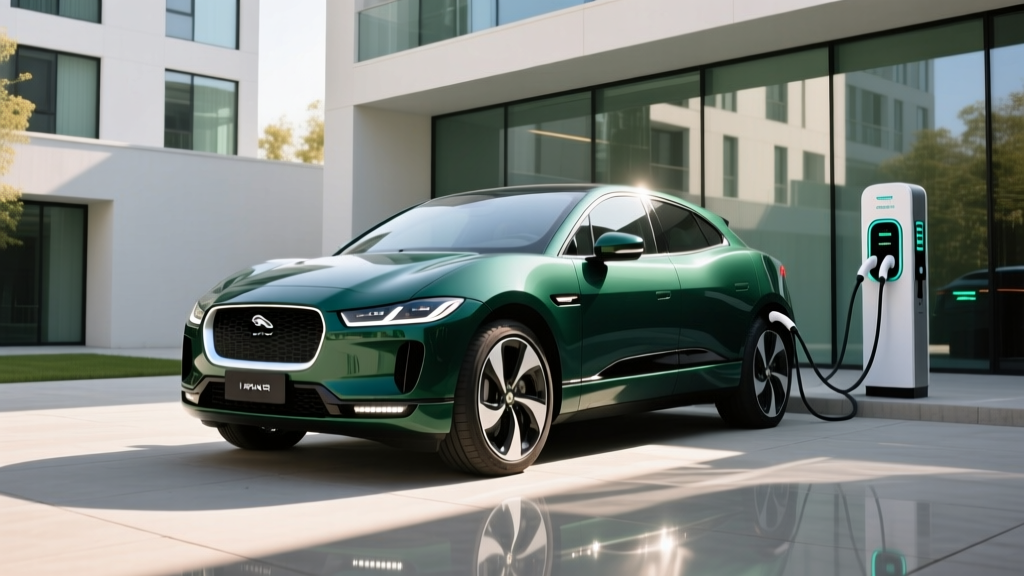
Quick Answer: The Jaguar I-Pace electric luxury SUV delivers 222–246 miles of EPA range, 394 hp, and a premium interior starting around $72,000. It's a compelling choice for luxury EV buyers who prioritize driving dynamics and design over maximum range. However, its 100 kW peak DC charging rate and real-world highway range of roughly 185–210 miles mean road-trippers should plan stops carefully. If you have home Level 2 charging and drive under 250 miles daily, the I-Pace offers a refined, engaging ownership experience with meaningful fuel savings over comparable gas luxury SUVs.
Real-World Range: What the EPA Sticker Doesn't Tell You
The Jaguar I-Pace carries a 90 kWh usable lithium-ion battery pack (NMC chemistry), delivering an EPA-estimated range that varies by model year and wheel configuration. The most recent configurations rate between 222 and 246 miles combined. But as any experienced EV owner knows, the EPA number is a starting point, not a guarantee.
EPA Range: 222–246 miles (depending on trim/wheels)
Real-World Highway (70 mph): ~185–210 miles
Cold Weather (below 32°F): ~155–185 miles
City/Moderate Driving: ~230–250 miles
The I-Pace's efficiency sits at approximately 76 MPGe combined, or roughly 44 kWh per 100 miles. That's notably thirstier than the Tesla Model Y (28 kWh/100mi) or the BMW iX xDrive50 (36 kWh/100mi). The trade-off is weight — the I-Pace tips the scales at over 4,800 lbs — and Jaguar's tuning priorities toward performance and comfort over maximum efficiency. On a fueleconomy.gov comparison, the I-Pace sits below most rivals in efficiency but holds its own in luxury feel.
Charging Speed and Infrastructure: The 100 kW Reality
The I-Pace's DC fast-charging capability is where honest assessment matters most. The vehicle peaks at 100 kW on a DC fast charger — respectable when it launched but now outpaced by rivals hitting 200–250 kW. Here's what that means in practice:
| Level | Power (kW) | Time | Miles Added |
|---|---|---|---|
| Level 1 (120V household) | ~1.4 kW | ~64 hours (0–100%) | ~3 mi/hr |
| Level 2 (240V home/public) | 7.2 kW | ~12.5 hours (0–100%) | ~18 mi/hr |
| DC Fast Charge (peak) | 100 kW | ~45 min (10–80%) | ~140 mi in 45 min |
The charge curve matters: the I-Pace sustains close to peak rate through roughly 50% state of charge, then tapers significantly. Expect a 10–80% session to take approximately 45 minutes at a 150 kW+ station. At a 50 kW CHAdeMO or CCS station, plan for 90+ minutes.
Connector-wise, the I-Pace uses CCS1 for DC fast charging in North America. With the industry's shift toward NACS (Tesla's connector), CCS remains widely supported at Electrify America, EVgo, and ChargePoint stations through 2026, but NACS adapters or future retrofit options may become relevant as Tesla Superchargers open to non-Tesla vehicles via adapter.
Cost of Ownership: I-Pace vs. Gas Luxury SUVs
Let's put hard numbers on what owning the I-Pace actually costs versus a comparable gas luxury SUV — say, the Porsche Macan or BMW X5 xDrive40i. We'll model a 5-year, 75,000-mile ownership period.
| Cost Category | Jaguar I-Pace (EV) | Gas Luxury SUV (e.g., BMW X5) |
|---|---|---|
| Purchase Price (base MSRP) | $72,000 | $67,000 |
| Federal Tax Credit (§30D) | Up to $7,500* | $0 |
| Effective Purchase | ~$64,500 | $67,000 |
| Fuel/Energy (75,000 mi) | $3,900 (home L2) / $6,200 (public DC mix) | $10,125 (18 mpg avg, $3.90/gal) |
| Maintenance (5 yr) | ~$1,800 | ~$4,500 |
| Insurance (5 yr avg) | ~$14,500 | ~$11,000 |
| Estimated Depreciation | ~$38,000 | ~$30,000 |
| 5-Year Total | ~$122,700–$125,000 | ~$122,625 |
*Federal EV tax credit eligibility under IRS §30D rules depends on buyer income caps, MSRP limits (the I-Pace's ~$72K MSRP exceeds the $80,000 SUV cap, so it may qualify — verify current-year battery sourcing and critical mineral requirements with a tax professional). Point-of-sale transfer is available for eligible buyers.
The takeaway: the I-Pace roughly breaks even with a gas luxury SUV over five years when you factor in fuel savings and lower maintenance against higher insurance premiums and steeper depreciation. The savings equation improves dramatically if you charge primarily at home on off-peak electricity rates ($0.12–$0.16/kWh) and worsens if you rely heavily on public DC fast charging ($0.35–$0.50/kWh).
Home Charging Setup: What First-Time Buyers Need
Home charging is the backbone of EV ownership. For the I-Pace's 90 kWh battery, Level 2 home charging is effectively mandatory — Level 1 (standard 120V outlet) adds only about 3 miles of range per hour, meaning a full charge takes over 60 hours.
| Item | Typical Cost Range |
|---|---|
| Level 2 Charger (40A–48A) | $400–$700 |
| Electrician Labor (240V/50A circuit) | $800–$2,500 |
| Electrical Panel Upgrade (if needed) | $1,500–$3,500 |
| Permit & Inspection | $100–$400 |
| Total (no panel upgrade) | $1,300–$3,600 |
| Total (with panel upgrade) | $2,800–$7,100 |
The I-Pace's onboard charger accepts up to 7.2 kW on Level 2. A 48-amp hardwired charger (like a ChargePoint Home Flex or Wallbox Pulsar Plus) will deliver the full rate. With a 240V/40A NEMA 14-50 outlet, you'll see roughly the same throughput. Always hire a licensed electrician and pull a permit — this protects your home warranty and insurance coverage.
If you live in an apartment or condo without charging access, the I-Pace becomes significantly harder to live with. Public DC charging at 100 kW peak means 45-minute sessions multiple times a week. Before purchasing, map your daily routine against available chargers using apps like PlugShare or A Better Routeplanner.
Common Misconceptions About the Jaguar I-Pace
| Myth | Fact |
|---|---|
| "The I-Pace qualifies for the full $7,500 tax credit automatically." | Eligibility depends on current-year IRS §30D battery sourcing, critical mineral, and buyer income requirements. Always verify at irs.gov before purchase. |
| "246 miles of range is enough for road trips." | Real-world highway range drops to ~185–210 miles. In winter, expect 155–185 miles. Plan DC stops every 160–180 miles on long trips. |
| "It charges as fast as other luxury EVs." | The 100 kW peak is well below the 200–250 kW rates of the Porsche Taycan, Hyundai Ioniq 5, or BMW iX. Expect longer stop times. |
| "EV batteries need replacing every few years." | Jaguar warranties the I-Pace battery for 8 years/100,000 miles against degradation below 70% capacity. Modern NMC packs typically retain 85–90% after 100,000 miles. |
| "Maintenance costs are zero." | No oil changes, but tires wear faster due to weight and instant torque. Budget $800–$1,200 for a tire set every 25,000–35,000 miles. Brake fluid, cabin filters, and wiper fluid still need service. |
Performance, Tech, and Daily Livability
The I-Pace's dual-motor all-wheel-drive powertrain produces 394 horsepower and 512 lb-ft of torque, launching it from 0–60 mph in approximately 4.5 seconds. The instant torque delivery and low center of gravity (battery pack mounted in the floor) make it genuinely engaging on winding roads — a rarity among electric SUVs.
Interior quality is a strong suit. The cabin uses premium materials, offers 25.3 cubic feet of cargo space behind the rear seats (51 cu ft with seats folded), and includes a small front trunk (frunk) for additional storage. The Pivi Pro infotainment system supports wireless Apple CarPlay and Android Auto, over-the-air updates, and a 12.3-inch digital instrument cluster.
Driver assistance includes adaptive cruise control, lane-keeping assist, blind-spot monitoring, and a 360-degree camera. These features constitute SAE Level 2 driver assistance — meaning you must remain fully engaged with hands on the wheel and eyes on the road. This is not autonomous driving.
ADAS Limitation Notice: The Jaguar I-Pace's driver-assistance suite is SAE Level 2. It supports steering and speed control on highways but requires continuous driver supervision. It does NOT handle construction zones, unmapped roads, or adverse weather autonomously. You are legally and operationally the driver at all times.
Decision Framework: Should You Buy the Jaguar I-Pace Electric?
Choose the Jaguar I-Pace if:
- You have reliable Level 2 home charging (or a workplace charger)
- Your daily commute is under 150 miles round-trip
- You prioritize driving dynamics and interior luxury over maximum range
- You want a distinctive design that doesn't look like every other EV crossover
- You accept 45-minute DC fast-charge stops on road trips
Look elsewhere if:
- You regularly drive 300+ miles between stops and want minimal charging downtime
- You lack home or workplace charging access
- Maximum efficiency (kWh/100mi) is a top priority — consider the Tesla Model Y or Hyundai Ioniq 5
- You want the latest ADAS technology — Tesla, GM (Super Cruise), or Ford (BlueCruise) offer more advanced hands-free highway systems
- You live in extreme cold climates where range loss below 32°F compounds the I-Pace's already modest efficiency
Frequently Asked Questions
What is the real-world range of the Jaguar I-Pace electric?
The EPA rates the I-Pace at 222–246 miles combined depending on model year and wheel size. In real-world highway driving at 70 mph, expect 185–210 miles. In sub-freezing temperatures, range can drop to 155–185 miles due to battery resistance and cabin heating demands. The I-Pace does not include a heat pump in all model years, which increases winter energy consumption compared to heat-pump-equipped rivals.
How does the I-Pace compare to a gas luxury SUV on fuel costs?
At a national average electricity rate of $0.16/kWh and the I-Pace's 44 kWh/100mi consumption, you'll spend about $7.04 per 100 miles charging at home. A gas luxury SUV averaging 20 mpg at $3.90/gallon costs $19.50 per 100 miles. Over 15,000 annual miles, that's a savings of roughly $1,870 per year with home charging. Public DC fast charging at $0.45/kWh narrows the gap to about $13.20 per 100 miles.
Does the Jaguar I-Pace qualify for the federal EV tax credit?
Potentially, but it depends on current-year IRS §30D rules. The I-Pace's MSRP falls under the $80,000 SUV cap, but eligibility also hinges on battery component and critical mineral sourcing requirements, plus buyer income limits ($300K joint / $150K single for new vehicles). Point-of-sale transfer allows dealers to apply the credit at purchase. Verify current eligibility at irs.gov or consult a tax professional before committing.
What does it cost to insure a Jaguar I-Pace?
EV insurance premiums are typically 15–25% higher than comparable gas vehicles due to higher repair costs, battery replacement risk, and specialized parts. Expect annual premiums of $2,600–$3,200 depending on your state, driving record, and coverage level. Shop quotes from EV-friendly insurers like Progressive, Geico, or Tesla Insurance before purchasing.
How long will the I-Pace battery last?
Jaguar warranties the high-voltage battery for 8 years or 100,000 miles, whichever comes first, against capacity loss below 70% of original. Industry data from similar NMC packs (Tesla Model S/X, Audi e-tron) shows typical degradation of 10–15% over 100,000 miles when DC fast charging is used moderately and the battery is not routinely held at 100% SoC. For longevity, charge to 80% daily and use DC fast charging for road trips rather than daily needs.
Is the I-Pace a good first EV?
It can be, provided you have home charging and realistic range expectations. The I-Pace is heavier, less efficient, and slower to charge than purpose-built EV platforms like Hyundai's E-GMP or Tesla's architecture. First-time EV buyers who want maximum range and charging speed may be better served by a Tesla Model Y, Hyundai Ioniq 5, or Kia EV6. But if luxury, design, and driving feel are your priorities, the I-Pace delivers a compelling package.