Quick Verdict: The BYD Lancaster at a Glance
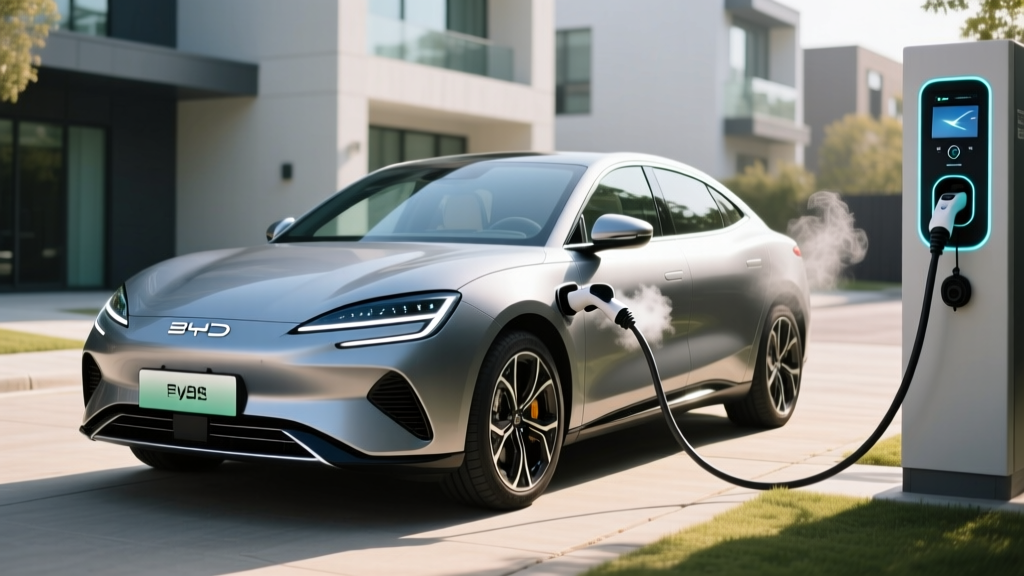
The BYD Lancaster is a mid-size electric SUV positioned squarely against the Tesla Model Y, Hyundai Ioniq 5, and Ford Mustang Mach-E. Built on BYD's e-Platform 3.0 with the company's proprietary Blade Battery (LFP chemistry), the Lancaster emphasizes durability, interior space, and value pricing over outright performance. For US buyers in 2026, the Lancaster represents BYD's most serious attempt to crack the mainstream American EV market — but tariff headwinds, limited dealer infrastructure, and a federal tax-credit picture that depends heavily on battery-sourcing rules make this a purchase that demands careful homework.
| Spec | Standard Range | Extended Range (AWD) |
|---|---|---|
| EPA Range | 295 mi | 330 mi |
| Battery (usable) | 72 kWh (LFP Blade) | 86 kWh (LFP Blade) |
| Drivetrain | RWD, single motor | Dual-motor AWD |
| Horsepower | 268 hp | 422 hp |
| 0–60 mph | 6.8 sec | 4.5 sec |
| Peak DC Fast Charge | 150 kW | 170 kW |
| 10–80% DC Time | ~32 min | ~30 min |
| Level 2 Home Charge | 11 kW (~38 mi/hr) | 11 kW (~38 mi/hr) |
| MPGe (combined) | 110 MPGe | 104 MPGe |
| kWh / 100 mi | 30 kWh | 32 kWh |
| Base MSRP | $42,990 | $49,490 |
| Battery Warranty | 8 yr / 100,000 mi | |
Range and Efficiency: EPA Numbers vs. Reality
The Extended Range AWD model carries an 86 kWh usable LFP Blade pack and wears an EPA sticker of 330 miles. The Standard Range RWD uses a 72 kWh pack for an EPA-rated 295 miles. Efficiency lands at 30–32 kWh/100 mi depending on trim — competitive with the Ioniq 5 but slightly behind the Model Y's class-leading ~28 kWh/100 mi.
Real-World Range Expectations
EPA Sticker: 330 mi (Extended AWD) / 295 mi (Standard RWD)
Highway (70 mph, 75°F): Expect ~270–290 mi on the Extended AWD; the boxy SUV profile creates more drag than sleeker competitors, and LFP packs tend to lose efficiency at sustained high speeds.
Cold Weather (30°F, highway): LFP chemistry is more resistant to cold-induced degradation long-term, but short-term range loss of 20–28% is typical. Budget ~230–250 mi in freezing conditions. The Lancaster includes a heat pump as standard, which mitigates cabin-heating energy draw.
City / Commute (mixed, moderate climate): You'll see close to the EPA number or slightly above, thanks to strong regenerative braking recovery in stop-and-go traffic.
BYD's LFP Blade cells are known for excellent cycle life — the company claims over 3,000 full charge cycles before significant capacity loss — but LFP's lower energy density means the pack is physically larger and heavier than an equivalent NMC pack, contributing to the Lancaster's ~4,850 lb curb weight.
Charging: DC Fast, Home Level 2, and Connector Details
Charging speed is where the Lancaster shows its most noticeable gap versus rivals. The Extended AWD peaks at 170 kW on a DC fast charger; the Standard RWD tops out at 150 kW. Compare that to the Hyundai Ioniq 5's 800V architecture enabling 240 kW peaks, or the Tesla Model Y at roughly 250 kW on V3 Superchargers.
| Charging Level | Power | Miles Added per Hour | Notes |
|---|---|---|---|
| Level 1 (120V household) | ~1.4 kW | ~4 mi/hr | Emergency / overnight trickle only |
| Level 2 (240V home, 48A) | 11 kW | ~38 mi/hr | Full charge in ~8–9 hours |
| DC Fast Charge (peak) | 150–170 kW | ~180 mi in 30 min (10–80%) | Tapers significantly above 80% SoC |
Charge curve reality check: The Lancaster's LFP pack holds near-peak charge rates up to roughly 55–60% State of Charge (SoC), then tapers progressively. The 10–80% time of ~30 minutes is respectable, but if you're a frequent road-tripper accustomed to 18–20 minute 10–80% stops in an Ioniq 5 or Model Y, the extra 10–12 minutes per stop adds up on long drives.
Connector: For the US market, the 2026 Lancaster ships with the NACS (North American Charging Standard) port natively, granting direct access to the Tesla Supercharger network — a significant advantage for a new entrant. No adapter is needed for Superchargers or other NACS-equipped public stations.
Performance and Driving Dynamics
The Extended AWD's dual-motor setup delivers 422 hp and a 4.5-second 0–60 mph time — quick by any measure, though the Model Y Performance still edges it at 3.5 seconds. The Standard RWD's 268 hp and 6.8-second sprint are adequate for merging and passing but won't win any stoplight drag races.
Ride quality is tuned toward comfort rather than sportiness. The Lancaster absorbs highway imperfections well, and cabin noise isolation is impressive for the price point. The steering is light and numb by enthusiast standards — this is clearly a family hauler, not a canyon carver. Regenerative braking offers two levels (standard and high) but lacks the true one-pedal driving mode some competitors provide, meaning you'll still use the friction brake pedal regularly in mixed traffic.
Interior, Cargo, and Technology
BYD has loaded the Lancaster's cabin with features that punch above its price class:
- Infotainment: 15.6-inch rotating center touchscreen (portrait or landscape), running BYD's DiLink system with wireless Apple CarPlay and Android Auto.
- Instrument cluster: 10.25-inch digital driver display plus a standard head-up display.
- Driver assistance: BYD's ADAS suite includes adaptive cruise control, lane-keeping assist, blind-spot monitoring, and automated emergency braking. This is a Level 2 (SAE) system — the driver must remain engaged and hands-on at all times. It is not self-driving.
- Unique feature: V2L (Vehicle-to-Load) capability with a 3.3 kW output, letting you power camping gear, tools, or tailgate equipment directly from the traction battery via a standard outlet adapter.
Cargo and passenger space:
| Dimension | BYD Lancaster | Tesla Model Y | Hyundai Ioniq 5 |
|---|---|---|---|
| Front legroom | 41.2 in | 41.8 in | 41.7 in |
| Rear legroom | 39.4 in | 37.7 in | 39.4 in |
| Cargo (rear seats up) | 32.5 cu ft | 30.2 cu ft | 27.2 cu ft |
| Cargo (rear seats folded) | 72.8 cu ft | 72.1 cu ft | 59.3 cu ft |
| Frunk | 2.1 cu ft | 4.1 cu ft | 0.85 cu ft |
The Lancaster leads this comparison in cargo volume with seats up — a genuine advantage for families who regularly haul strollers, groceries, and gear simultaneously. Rear legroom is also best-in-class here. The frunk, however, is modest at 2.1 cu ft, reflecting the packaging of onboard electronics beneath the hood.
Pricing, Tax Credits, and Total Cost
BYD has priced the Lancaster aggressively to undercut established competitors:
| Trim | MSRP | Est. Federal Credit (§30D) | Effective Price |
|---|---|---|---|
| Standard Range RWD | $42,990 | Up to $7,500* | ~$35,490* |
| Extended Range AWD | $49,490 | Up to $7,500* | ~$41,990* |
| Extended AWD Premium | $54,290 | Up to $7,500* | ~$46,790* |
*Critical tax-credit caveats (IRS §30D, 2026 rules):
- MSRP cap: SUVs must be priced at or below $80,000 — all Lancaster trims clear this easily.
- Buyer income cap: Modified AGI must not exceed $150,000 (single), $225,000 (head of household), or $300,000 (joint filers).
- Battery sourcing: The full $7,500 credit requires meeting both critical-mineral and battery-component sourcing thresholds. BYD manufactures its own cells in China, and as of early 2026, the Lancaster's battery sourcing is under IRS review. If it fails the battery-component test (due to Chinese-manufactured components), buyers may qualify for only $3,750 — or potentially zero if critical-mineral thresholds are also unmet. Confirm eligibility on the IRS qualified vehicles list before purchasing.
- Point-of-sale transfer: If eligible, you can transfer the credit to the dealer at purchase for an immediate price reduction rather than waiting to claim it on your tax return.
For authoritative credit details, consult the IRS clean vehicle credit page and verify with a tax professional.
Warranty and Long-Term Ownership
BYD backs the Lancaster with:
- Battery: 8 years / 100,000 miles (minimum 70% capacity retention)
- Powertrain: 8 years / 100,000 miles
- Bumper-to-bumper: 5 years / 60,000 miles
- Roadside assistance: 5 years / 60,000 miles
The 70% capacity retention threshold at 8 years/100k miles is industry-standard and matches Tesla and Hyundai. However, LFP batteries historically degrade more slowly than NMC packs in real-world fleet data, so most owners should expect to retain well above 80% capacity at the warranty boundary. BYD's Blade cell architecture — using large-format, single-cell LFP prismatic units — has demonstrated strong thermal stability and longevity in Chinese and European fleet applications.
One ownership concern: BYD's US dealer and service network is still nascent in 2026, with fewer than 120 authorized service centers nationwide. If you live outside a major metro area, warranty service could require a significant drive or flatbed tow. This is a real practical risk that established brands like Hyundai, Tesla, and Ford don't carry.
Pros, Cons, and Who Should Buy
Pros
- Class-leading cargo and rear-passenger space
- LFP Blade Battery offers exceptional cycle life and thermal safety
- Competitive pricing undercuts Model Y and Ioniq 5
- NACS port = native Supercharger access
- Standard heat pump and V2L capability
- Strong real-world city efficiency with regen braking
Cons
- DC fast-charge speed lags rivals (150–170 kW vs. 240–250 kW)
- Federal tax credit uncertain due to battery-sourcing rules
- Limited US dealer/service network
- No true one-pedal driving mode
- Heavy curb weight affects tire wear and handling agility
- ADAS is competent but not class-leading in smoothness
Who the BYD Lancaster suits best:
- Family commuters who prioritize interior space and cargo volume over charging speed and don't road-trip more than a few times a year.
- Home-charging owners with Level 2 access who can wake up to a full battery daily and rarely rely on DC fast charging.
- Value-oriented buyers who want premium-feeling interiors at a sub-$50k price point and are willing to accept a newer brand's growing-pains on service infrastructure.
Look elsewhere if: You take frequent 300+ mile road trips (the slower charge curve will cost you time), you live far from a BYD service center, or you need certainty on the full $7,500 federal tax credit before signing.
Frequently Asked Questions
What is the real-world range of the BYD Lancaster?
The EPA rates the Extended Range AWD at 330 miles and the Standard RWD at 295 miles. In real-world highway driving at 70 mph in moderate temperatures, expect roughly 270–290 miles from the Extended AWD. In freezing conditions, budget for 20–28% range loss, bringing usable range to approximately 230–250 miles.
How fast does the BYD Lancaster charge at home and on the road?
On a 240V Level 2 home charger, the Lancaster draws up to 11 kW, adding roughly 38 miles of range per hour — a full overnight charge takes about 8–9 hours. On a DC fast charger, it peaks at 150–170 kW (depending on trim), achieving a 10–80% charge in approximately 30–32 minutes. Charge speed tapers significantly above 80% SoC, so plan to unplug at 80% on road trips to avoid long waits for the final 20%.
Does the BYD Lancaster qualify for the $7,500 federal EV tax credit?
Possibly, but it's not guaranteed. The Lancaster's MSRP is well under the $80,000 SUV cap, and most buyers will meet the income requirements. However, BYD's in-house Chinese-manufactured LFP Blade Battery may not satisfy the IRS's battery-component and critical-mineral sourcing thresholds under §30D. As of early 2026, the Lancaster's credit status is partially qualified — buyers should verify the exact credit amount ($7,500, $3,750, or $0) on the IRS qualified vehicles list and consult a tax professional before relying on the credit in their purchase math.
Is the BYD Lancaster worth buying over the Tesla Model Y or Hyundai Ioniq 5?
It depends on your priorities. The Lancaster offers more cargo space and rear legroom than both rivals and undercuts them on price. However, the Model Y charges faster (250 kW peak), has a vastly larger Supercharger and service network, and currently qualifies more predictably for tax incentives. The Ioniq 5 charges even faster (240 kW via 800V architecture) and comes from an established US dealer network. If interior space and value matter most and you can charge at home, the Lancaster is a strong pick. If road-trip charging speed and service convenience are paramount, the Model Y or Ioniq 5 remain safer bets.
What is BYD's US service and warranty support like?
BYD offers an 8-year/100,000-mile battery and powertrain warranty with a 70% capacity retention guarantee — matching industry norms. However, the US dealer and authorized service network is still limited to roughly 120 locations as of 2026, concentrated in major metro areas. Buyers in rural or less-populated states should verify the nearest authorized service center before purchasing.
Does the Lancaster have a frunk and V2L capability?
Yes to both. The front trunk (frunk) offers 2.1 cu ft of storage — enough for a charging cable bag and small items. The V2L (Vehicle-to-Load) system provides up to 3.3 kW of AC power output, allowing you to run appliances, power tools, or camping equipment directly from the vehicle's traction battery.