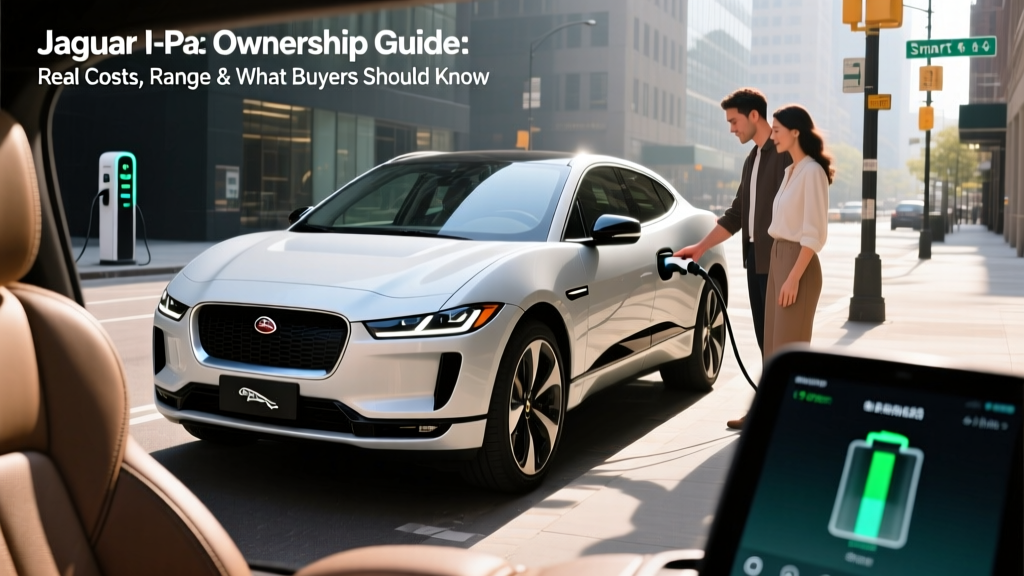
The Quick Answer: Is the Jaguar Electric I-PACE Worth Owning?
The Jaguar I-PACE delivers a refined, performance-oriented EV experience with an EPA-estimated 246 miles of range (90 kWh battery, NMC chemistry), 0-60 mph in 4.5 seconds, and peak DC fast charging at 100 kW (10-80% in roughly 45 minutes). For 2026, expect starting MSRPs around $73,000 before incentives. Real-world highway range drops to approximately 200-220 miles, and cold weather can shave another 15-20%. Total 5-year ownership costs are competitive with gas luxury SUVs like the BMW X5 or Porsche Macan when you factor in fuel and maintenance savings, but insurance and depreciation remain higher than average.
Range, Efficiency, and Real-World Expectations
The I-PACE carries a 90 kWh lithium-ion battery pack using NMC (nickel manganese cobalt) chemistry. The EPA rates it at 246 miles of combined range with an efficiency of 76 MPGe (44 kWh/100mi). Those numbers are useful baselines, but real-world driving tells a more nuanced story.
EPA Range: 246 miles (combined)
Real-World Highway (70-75 mph): ~200-220 miles
Cold Weather (below 32°F): ~175-200 miles
Mixed City/Suburban: ~230-245 miles (regen braking helps significantly)
The I-PACE lacks a heat pump, relying instead on resistive cabin heating. This design choice means winter range loss is more pronounced than in competitors like the Hyundai Ioniq 5 or Tesla Model Y, which use heat pumps to recycle waste heat. If you live in a cold climate — think Minnesota, Colorado, or New England — plan your trips around a 175-mile usable buffer in deep winter.
| Spec | Value |
|---|---|
| Battery Capacity | 90 kWh (NMC) |
| EPA Range | 246 miles |
| Efficiency | 76 MPGe / 44 kWh/100mi |
| Peak DC Fast Charge | 100 kW |
| 10-80% DC Charge Time | ~45 minutes |
| Level 2 Charge Rate | 11 kW (AC onboard charger) |
| Level 2 Full Charge Time | ~9-10 hours |
| Connector | CCS1 (DC) / J1772 (AC) |
| 0-60 mph | 4.5 seconds |
| Horsepower | 394 hp (combined dual motor) |
| Drivetrain | AWD (dual motor) |
| Battery Warranty | 8 years / 100,000 miles |
| Base MSRP (2025/2026) | ~$73,000 |
Charging Speed: The I-PACE's Biggest Limitation
The I-PACE peaks at 100 kW on DC fast chargers. In an era where the Hyundai Ioniq 5 charges at 240 kW and the Tesla Model Y at 250 kW, the Jaguar's charging speed is its most dated specification. On a 150 kW Electrify America or EVgo station, you'll be limited to the car's 100 kW ceiling, and the charge curve tapers significantly above 80% state of charge (SoC).
Here's what that means practically:
- 10-80%: Approximately 45 minutes at a 100+ kW DC station
- 80-100%: An additional 35-45 minutes (the taper is aggressive)
- Level 2 at home (11 kW): A full charge from empty takes about 9-10 hours — fine for overnight charging
- Level 1 (120V, 1.4 kW): Adds roughly 3-4 miles per hour — only viable as an emergency trickle
If your road trips regularly exceed 200 miles between stops, the I-PACE's charging speed will test your patience. Plan for longer stops than you'd take in a Tesla or an 800V-architecture vehicle.
Cost of Ownership: I-PACE vs. Gas Luxury SUV
Let's compare the I-PACE against a gas-powered luxury SUV in a similar price bracket — the BMW X5 xDrive40 (MSRP ~$66,000, 24 MPG combined). We'll model 5 years of ownership at 12,000 miles per year (60,000 miles total).
| Category | Jaguar I-PACE | BMW X5 (Gas) |
|---|---|---|
| Purchase Price (MSRP) | $73,000 | $66,000 |
| Federal Tax Credit (§30D)* | Check IRS eligibility | N/A |
| Fuel/Energy (60,000 mi) | $4,200 (home L2 @ $0.14/kWh) | $10,000 (gas @ $3.50/gal) |
| Maintenance (5 years) | $1,800 (no oil, fewer brake jobs) | $4,500 (oil, filters, brakes) |
| Insurance (5 years) | $12,500 (EV premium) | $9,500 |
| Estimated Depreciation | ~$38,000 (52%) | ~$30,000 (45%) |
| Total 5-Year Cost | ~$91,500 | ~$90,000 |
*Federal §30D tax credit eligibility depends on MSRP caps ($80,000 for SUVs), buyer income limits ($300,000 MFJ / $150,000 single), battery critical-mineral sourcing, and North American final assembly. The I-PACE is assembled in Austria, which may disqualify it from the full credit under current IRS rules. Always verify at irs.gov before purchasing.
The takeaway: the I-PACE roughly breaks even with a gas rival over five years. You save substantially on fuel and maintenance (~$8,500 combined), but those gains are offset by higher insurance premiums and steeper depreciation. The economics improve if you charge primarily on off-peak electricity rates or have access to free workplace/public charging.
EV vs. Gas: What Changes When You Switch
| Factor | Jaguar I-PACE (EV) | BMW X5 (Gas) |
|---|---|---|
| "Refueling" Time | 8-10 hrs overnight (home L2); 45 min road-trip stop | 5 minutes at any gas station |
| Home Fueling | Yes — wake up "full" every morning (if you have L2 access) | No — must visit gas stations |
| Energy Cost per Mile | ~$0.07/mi (home charging) | ~$0.17/mi (gasoline) |
| Maintenance Intervals | Cabin filter, tire rotation, wiper fluid | Oil changes, spark plugs, transmission fluid, brakes |
| Brake Wear | Minimal (regen braking does most work) | Normal wear; pad replacement every 30-50k mi |
| Cold Starts | Instant torque, no warm-up needed | Engine warm-up, reduced efficiency |
| Long Road Trips | Requires DC charging stops every ~180-200 mi | 400+ mi between fuel stops |
Real-World Ownership: What First-Time EV Buyers Should Know
Home Charging Is Non-Negotiable for Most Owners
The I-PACE ownership experience is dramatically different depending on whether you can install a Level 2 (240V) home charger. Without one, you're relying on public charging infrastructure, which adds time and cost to your routine.
Typical Level 2 home install cost:
- Level 2 charger hardware (e.g., ChargePoint Home Flex, Wallbox Pulsar Plus): $500-$700
- Electrician labor (240V/50A circuit, 40-foot run): $800-$2,000
- Electrical panel upgrade (if your panel is maxed at 100A): $1,500-$3,000
- Permits: $50-$200 depending on jurisdiction
- Total: $1,350-$5,900
Consult a licensed electrician for an accurate quote. The I-PACE's 11 kW onboard charger means it can fully utilize a 48A circuit, making it one of the faster Level 2 AC charging vehicles available.
Climate and Driving Patterns Matter
If you live in a mild climate (California coast, Texas, Florida) and drive primarily in the city or suburbs, the I-PACE's 246-mile EPA range is largely achievable. If you live in the upper Midwest or Northeast and commute on highways in January, plan around 175 miles of usable range and precondition the battery before DC fast charging to avoid painfully slow charge speeds in cold weather.
Public Charging Infrastructure
The I-PACE uses the CCS1 connector for DC fast charging and J1772 for Level 2 AC. This means you can access Electrify America, EVgo, and ChargePoint DC stations — but not Tesla Superchargers (which use NACS). As of 2026, CCS infrastructure remains robust, though NACS adoption is expanding rapidly. Plan road trips using apps like A Better Routeplanner or PlugShare.
Common Misconceptions About the I-PACE
| Myth | Fact |
|---|---|
| "The I-PACE gets 246 miles no matter what." | That's the EPA combined estimate. Highway driving at 75 mph yields ~200-220 miles; cold weather drops it to ~175-200 miles. |
| "EV batteries need replacing after a few years." | Jaguar warranties the I-PACE battery for 8 years/100,000 miles with a capacity-retention threshold of 70%. Most NMC packs degrade 10-15% over 8 years based on industry data. |
| "I'll save $7,500 with the federal tax credit." | The §30D credit has MSRP, income, and battery-sourcing requirements. The I-PACE's Austrian assembly and battery sourcing may limit or eliminate eligibility. Check IRS rules and consult a tax professional. |
| "The I-PACE charges as fast as other EVs." | At 100 kW peak, it charges roughly 2.5x slower than a Tesla Model Y or Hyundai Ioniq 5 at a DC fast charger. |
| "EVs cost more to insure, so it's never worth it." | Insurance is typically 15-30% higher for EVs, but fuel and maintenance savings often offset this over 5 years. |
Decision Framework: Should You Buy the Jaguar I-PACE?
Choose the Jaguar I-PACE if:
- You prioritize driving dynamics and luxury interior feel over maximum range or charging speed
- Your daily commute is under 120 miles round-trip and you have Level 2 home charging
- You rarely take road trips exceeding 400 miles in a single day
- You value the I-PACE's distinctive design and Jaguar's brand cachet
- You live in a moderate climate where range loss is manageable
Look elsewhere if:
- You need 300+ miles of real-world range (consider the Tesla Model Y Long Range at ~320 miles EPA or the BMW iX xDrive50 at ~324 miles)
- Fast DC charging is critical for your road-trip habits (the Ioniq 5 or Model Y charge in roughly half the time)
- You live in a region with extreme cold and no garage/preconditioning capability
- Federal tax credit eligibility is a dealbreaker and the I-PACE doesn't qualify under current sourcing rules
- You want access to the Tesla Supercharger network without an adapter
Frequently Asked Questions
Does the Jaguar I-PACE qualify for the $7,500 federal EV tax credit?
Eligibility under IRS §30D depends on multiple factors: the vehicle's MSRP must be under $80,000 (SUV cap), your modified adjusted gross income must fall below $300,000 (married filing jointly) or $150,000 (single), and the battery must meet critical-mineral and component sourcing thresholds. The I-PACE is assembled in Graz, Austria, and its battery sourcing may not meet current domestic-content requirements. Always check the latest eligibility list at fueleconomy.gov and consult a tax professional before relying on the credit.
How long does the I-PACE battery last?
Jaguar warranties the 90 kWh battery for 8 years or 100,000 miles, guaranteeing it will retain at least 70% of its original capacity. Industry data on NMC batteries suggests typical degradation of 10-15% over 8 years with normal use. Avoid routinely charging to 100% or draining below 10% to maximize longevity. Full battery replacement, if ever needed outside warranty, is estimated at $15,000-$25,000 based on current luxury EV battery pricing.
Can I use Tesla Superchargers with the I-PACE?
Not natively. The I-PACE uses the CCS1 connector, while Tesla Superchargers use NACS. Some third-party adapters (like the Tesla-approved CCS-to-NACS adapter) are becoming available, but compatibility varies. For 2026, Tesla has opened select Superchargers to non-Tesla EVs via the built-in Magic Dock connector at some locations — check the Tesla app for station-specific availability.
Is the I-PACE good in snow and winter conditions?
The dual-motor AWD system provides excellent traction in snow, and instant electric torque helps with low-speed grip. However, expect 15-25% range loss in sub-freezing temperatures due to the lack of a heat pump and the energy demands of cabin heating. Precondition the cabin and battery while plugged in to minimize range impact.
What maintenance does the I-PACE require?
Far less than a gas SUV. There are no oil changes, spark plugs, transmission fluid, or exhaust system to service. Routine maintenance includes cabin air filter replacement (~$100-$150 annually), tire rotation and replacement (EVs wear tires faster due to instant torque and heavier weight — budget $1,200-$1,800 for a set of premium tires every 30,000-40,000 miles), brake fluid flush every 2 years, and wiper fluid. Brake pads last significantly longer thanks to regenerative braking — often 80,000+ miles before replacement.