The luxury compact electric SUV segment is crowded, but the 2025 Genesis GV60 SUV continues to carve out a distinct position by pairing Hyundai Motor Group's proven E-GMP platform with an interior and feature set that punches well above its price class. After spending time with the GV60 across multiple drives and charging sessions, we have the exact numbers buyers need — from real-world range reconciliation to DC fast-charging curve behavior — to decide whether this EV deserves a spot in your garage.
Quick Verdict: Who the 2025 Genesis GV60 SUV Is For
The GV60 is a luxury daily driver and commuter first, road-tripper second. If your routine involves home Level 2 charging, a sub-40-mile round-trip commute, and occasional 200-mile weekend drives, the GV60's blend of ride refinement, cabin quality, and 240 kW peak charging is hard to beat at its price point. It is not the right pick if you need maximum cargo volume, frequent 300+ mile road trips without stopping, or the longest EPA range in the segment — the Tesla Model Y Long Range and Hyundai Ioniq 5 both edge it out on those metrics.
Range, Efficiency, and Real-World Expectations
The 2025 Genesis GV60 is offered in three trims, and range varies significantly depending on which you choose. The entry-level Standard Range model uses a smaller battery and rear-wheel drive, while the Advanced and Performance trims share the larger pack with all-wheel drive.
| Trim | Drivetrain | EPA Range | MPGe (Combined) | kWh/100 mi |
|---|---|---|---|---|
| Standard Range | RWD | 248 mi | 110 MPGe | 30 |
| Advanced | AWD (Dual-Motor) | 248 mi | 95 MPGe | 35 |
| Performance | AWD (Dual-Motor) | 235 mi | 90 MPGe | 37 |
Source: EPA / fueleconomy.gov
EPA estimates assume a mix of city and highway driving at moderate temperatures. In our experience, expect the following from the Advanced AWD trim (248 mi EPA):
- City-heavy commuting (under 55 mph): 240–260 miles achievable thanks to regenerative braking and low-speed efficiency.
- Sustained highway driving (70–80 mph): 200–220 miles. Aerodynamic drag at speed is the biggest range killer in any EV.
- Cold weather (below 32°F): 170–200 miles. The GV60 uses a heat pump (standard on Advanced and Performance trims), which mitigates cabin-heating losses, but battery chemistry still suffers in deep cold. Expect a 20–30% reduction from EPA in freezing conditions.
Battery, Chemistry, and the 800V Advantage
The GV60 rides on Hyundai Motor Group's Electric-Global Modular Platform (E-GMP), the same architecture underpinning the Hyundai Ioniq 5, Ioniq 6, and Kia EV6. Two battery sizes are available:
- Standard Range: ~58 kWh usable capacity, RWD single motor
- Advanced / Performance: ~77.4 kWh usable capacity, dual-motor AWD
Both packs use NMC (nickel-manganese-cobalt) lithium-ion chemistry, which offers higher energy density than LFP (lithium iron phosphate) but comes with different long-term care considerations. NMC packs benefit from avoiding repeated 100% charges — daily charging to 80–90% is ideal, with 100% reserved for road-trip days. Genesis provides a battery management system with active liquid thermal conditioning to manage cell temperatures during charging and heavy use.
The standout engineering feature is the E-GMP platform's 800-volt electrical architecture. Most competitors in this price range (BMW iX, Mercedes EQB, Audi Q4 e-tron) still run 400V systems. The higher voltage allows the GV60 to accept significantly higher DC fast-charge power without excessive current or cable weight, translating to shorter charging stops.
Charging Speed: DC Fast, Level 2, and Level 1
Charging capability is where the GV60's E-GMP platform delivers its most tangible advantage. Here is the full breakdown:
| Charge Level | Power / Rate | Connector | Time / Rate |
|---|---|---|---|
| DC Fast Charge (Peak) | 240 kW | CCS1 (NACS adapter available) | 10–80% in ~18 minutes* |
| DC Fast Charge (Sustained avg.) | ~170 kW | CCS1 | 10–80% realistic: ~22 minutes |
| Level 2 (Home / Public AC) | 10.9 kW (48A) | J1772 / CCS | ~7 hours 10–100%; ~30 mi/hr |
| Level 1 (120V household) | ~1.4 kW (12A) | J1772 | ~4 mi/hr; 50+ hours for full charge |
*Peak 240 kW rate is achievable only at 350 kW-class chargers (Electrify America, select EVgo stations) with battery preconditioned to optimal temperature. Sustained average is lower due to charge-curve taper above 60% SoC.
Understanding the charge curve: Like all EVs, the GV60 does not sustain its peak 240 kW rate for the full session. The pack accepts maximum power between roughly 10–55% state of charge (SoC), then tapers progressively. From 80–100%, charging slows dramatically to protect cell longevity — expect the final 20% to take nearly as long as the 10–80% session. This is why DC fast-charging times are quoted to 80%.
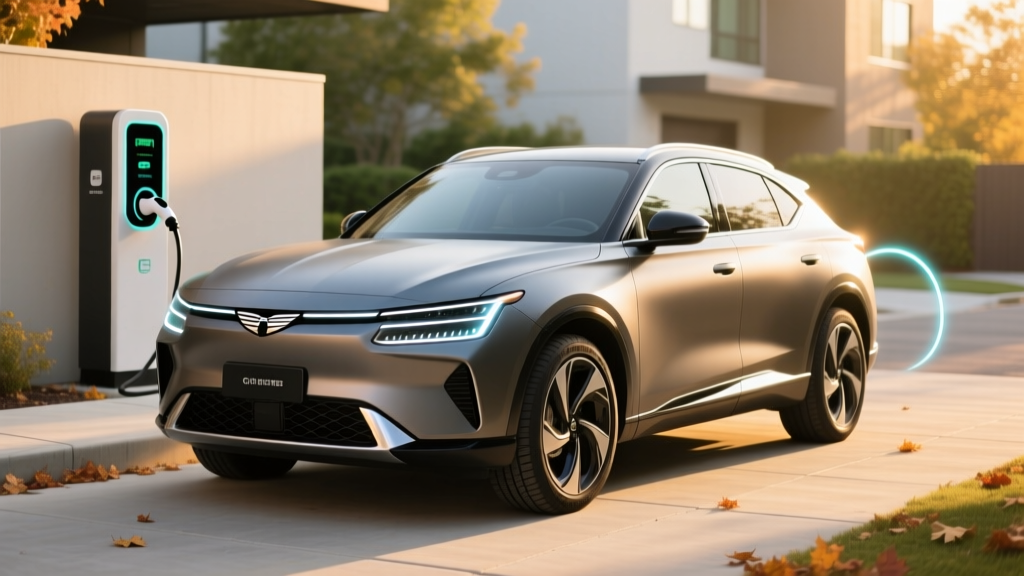
Home charging reality: With a 48-amp Level 2 home charger on a 240V/60A circuit, you'll add roughly 30 miles of range per hour of charging. A full overnight session (8 hours) replenishes approximately 240 miles — enough for a full battery. Most GV60 owners will rarely, if ever, need public charging for daily driving. Installation of a 48A hardwired Level 2 charger typically costs $500–$1,500 for the unit plus $800–$2,500 for licensed electrician labor, depending on your panel capacity and run distance. A 200-amp panel upgrade adds $1,500–$3,000 if needed.
Genesis also provides access to Electrify America's network, and with the industry-wide shift to NACS (Tesla's connector standard), a CCS-to-NACS adapter enables Supercharger access. Confirm adapter availability and compatibility with your specific model year through your dealer.
Performance: 0-60, Horsepower, and Drivetrain
| Trim | Motor Config | Horsepower | Torque (lb-ft) | 0–60 mph | Top Speed |
|---|---|---|---|---|---|
| Standard Range | Rear single motor | 168 hp | 258 | 7.3 sec | 115 mph |
| Advanced | Dual-motor AWD | 314 hp | 446 | 5.1 sec | 124 mph |
| Performance | Dual-motor AWD | 429 hp (483 w/Boost) | 446 (489 w/Boost) | 3.9 sec | 130 mph |
The Performance trim's Boost Mode (activated via a dedicated steering-wheel button) temporarily increases output for 10-second bursts, dropping the 0–60 time to 3.9 seconds — territory occupied by sports cars, not compact SUVs. Even the Advanced trim's 5.1-second sprint is brisk and more than adequate for highway merging and passing.
All trims feature one-pedal driving capability through adjustable regenerative braking (four levels, selectable via steering-wheel paddles). Level 3 regen provides strong deceleration that enables true one-pedal driving in city traffic, though it doesn't bring the vehicle to a complete hold without touching the brake — a minor quibble.
Interior, Cargo, and Technology
The GV60's cabin is where Genesis differentiates most sharply from its platform-mates (the Ioniq 5 and EV6). Materials, fit-and-finish, and design details are a clear step up, with available Nappa leather, real aluminum trim, and a crystal-sphere gear selector that rotates when the vehicle starts — a distinctive touch that never gets old.
Cargo and passenger dimensions:
- Cargo volume (rear seats up): 24.0 cu ft
- Cargo volume (rear seats folded): 54.7 cu ft
- Front trunk (frunk): 0.7 cu ft (enough for a charging cable bag, not much more)
- Rear legroom: 37.6 inches
- Front legroom: 41.3 inches
- Seating capacity: 5 passengers
The 24.0 cu ft cargo area is competitive with the Audi Q4 e-tron but trails the Tesla Model Y (30.2 cu ft) and Hyundai Ioniq 5 (27.2 cu ft). If cargo volume is a top priority, the GV60 is not the segment leader.
Infotainment and tech highlights:
- 12.3-inch digital instrument cluster + 12.3-inch touchscreen (dual-pane display)
- Wireless Apple CarPlay and Android Auto
- Available Bang & Olufsen 17-speaker audio system
- Digital Key 2 (use your smartphone as the key fob via NFC/UWB)
- Available facial recognition (Face Connect) on the B-pillar to unlock the vehicle
- Remote Smart Parking Assist — the car parks itself in tight spaces while you stand outside
- Over-the-air (OTA) software updates for powertrain, infotainment, and ADAS calibration
Driver assistance (Genesis Active Safety Control):
The GV60 comes standard with a comprehensive Level 2 (SAE) driver-assistance suite including:
- Highway Driving Assist II (adaptive cruise + lane centering, with lane-change assist)
- Navigation-based Smart Cruise Control (auto-slows for curves and speed zones)
- Forward Collision-Avoidance Assist with pedestrian/cyclist detection
- Blind-Spot Collision-Avoidance Assist
- Rear Cross-Traffic Collision-Avoidance Assist
- Surround View Monitor with 3D perspective
Highway Driving Assist II is a Level 2 driver-assistance system per SAE International. This means the driver must remain fully engaged — hands on or near the wheel, eyes on the road — at all times. It is not autonomous or self-driving. The system will issue warnings and disengage if driver attention is not detected.
Pricing, Trims, and Federal Tax Credit Eligibility
| Trim | Base MSRP | As-Tested (Typical Options) | Est. Federal Credit |
|---|---|---|---|
| Standard Range (RWD) | $53,350 | $54,500 | Up to $7,500* |
| Advanced (AWD) | $61,350 | $64,200 | Up to $7,500* |
| Performance (AWD) | $69,350 | $72,000 | Up to $7,500* |
*Federal EV tax credit eligibility under IRS §30D depends on multiple requirements. See checklist below.
The GV60 qualifies as an SUV under the IRS MSRP cap of $80,000, so all trims clear that hurdle. However, full credit eligibility requires ALL of the following:
- MSRP cap: ≤ $80,000 for SUVs ✓ (all GV60 trims qualify)
- Buyer income cap: Modified AGI ≤ $150,000 (single) / $225,000 (head of household) / $300,000 (joint) — check against your tax-year income
- Battery component sourcing: A percentage of battery components must be manufactured or assembled in North America (threshold increases annually; 100% for 2025)
- Critical minerals sourcing: A percentage of critical minerals must be sourced from the U.S. or a free-trade-agreement country (80% for 2025)
- Point-of-sale transfer: As of 2024, eligible buyers can transfer the credit to the dealer at purchase, receiving the benefit as an immediate price reduction rather than waiting for tax filing
The GV60's battery sourcing has been a moving target as Hyundai Motor Group shifts supply chains. Credit amounts can range from $0 to $7,500 depending on the specific vehicle's battery provenance. Always verify eligibility for your specific VIN at fueleconomy.gov and consult a tax professional before relying on the credit. Rules are subject to change — see IRS.gov §30D guidance for current requirements.
Warranty and Ownership Costs
Genesis provides one of the strongest warranty packages in the luxury EV space:
- Basic vehicle warranty: 5 years / 60,000 miles
- Powertrain warranty: 10 years / 100,000 miles
- Battery warranty: 10 years / 100,000 miles (covers capacity below 70% of original)
- Complimentary maintenance: 3 years / 36,000 miles (scheduled service)
- Roadside assistance: 5 years / unlimited miles
- Genesis Connected Services: 3 years of complimentary remote/telematics features
The 70% capacity-retention threshold is standard for the industry. In practice, NMC packs on the E-GMP platform with active liquid thermal management have shown minimal degradation in early real-world data — most owners report 93–97% state of health after two years of typical use. The 10-year/100,000-mile coverage provides substantial peace of mind against outlier degradation cases.
Insurance: Expect premiums 15–25% higher than a comparably priced gas SUV. The GV60's repair costs (especially body-panel and sensor recalibration) and EV-specific parts pricing drive this. Get quotes before purchasing — luxury EV insurance varies significantly by carrier and region.
Pros, Cons, and Key Competitors
- 240 kW peak DC fast charging (class-leading)
- Premium interior quality above price point
- Standard heat pump on upper trims
- 10-year/100,000-mile battery & powertrain warranty
- Distinctive design and crystal-sphere shifter
- Strong 0-60 performance (3.9s Performance trim)
- Comprehensive standard ADAS suite
- EPA range trails key rivals (Model Y LR: 310+ mi)
- Cargo space smaller than Model Y and Ioniq 5
- Small frunk (0.7 cu ft)
- CCS1 connector (NACS requires adapter for Superchargers)
- Higher insurance costs vs. gas equivalents
- Federal tax credit eligibility uncertain due to battery sourcing
- Standard Range trim's 168 hp feels underpowered for the price
Key competitors to cross-shop:
- Hyundai Ioniq 5: Same E-GMP platform and battery, lower price, more cargo room, less premium interior. Starts ~$42,000.
- Tesla Model Y Long Range: 310+ mi EPA range, NACS native Supercharger access, superior cargo space, sparser interior. Starts ~$48,000.
- BMW iX xDrive50: More range (324 mi EPA), larger cabin, but starts at $87,250 — a significant step up in price.
- Audi Q4 e-tron: Lower starting price (~$49,800), but slower DC charging (175 kW peak) and older platform.
- Cadillac Lyriq: Similar luxury positioning, 314 mi EPA range, but slower DC charging and larger footprint.
Frequently Asked Questions
What is the real-world range of the 2025 Genesis GV60?
The EPA rates the GV60 Advanced AWD at 248 miles, but real-world results vary. City commuters can expect 240–260 miles. Highway-heavy drivers at 70–80 mph should plan for 200–220 miles. In freezing temperatures (below 32°F), expect 170–200 miles despite the heat pump. The Performance trim drops to 235 miles EPA, with proportionally lower real-world figures.
How fast does the GV60 charge at home and on the road?
On a 350 kW-class DC fast charger, the GV60 peaks at 240 kW and charges from 10–80% in approximately 18–22 minutes (peak vs. sustained average). At home on a 48-amp Level 2 charger, it adds roughly 30 miles of range per hour, fully replenishing overnight in about 7–8 hours. Level 1 (120V) is only practical for emergencies, adding about 4 miles per hour.
Does the 2025 Genesis GV60 qualify for the $7,500 federal EV tax credit?
All GV60 trims fall under the $80,000 SUV MSRP cap, but full credit eligibility depends on your income (AGI limits apply), the specific vehicle's battery component and critical-mineral sourcing, and current IRS rules. Battery sourcing for the GV60 has been inconsistent — some vehicles qualify for the full $7,500, others for a partial credit or none. Always check your specific VIN at fueleconomy.gov and consult a tax professional. The credit can be transferred to the dealer at point of sale for an immediate price reduction if eligible.
Is the GV60 worth buying over the Tesla Model Y or Hyundai Ioniq 5?
It depends on your priorities. Choose the GV60 if you value interior luxury, ride refinement, and premium materials over maximum range and cargo volume. Choose the Model Y if range (310+ mi), Supercharger access, and cargo space are paramount. Choose the Ioniq 5 if you want the same E-GMP platform and 240 kW charging at a lower price, and can accept a less premium cabin. The GV60 is the "luxury boutique" pick in this platform family.
How long will the GV60's battery last?
Genesis covers the battery for 10 years / 100,000 miles against capacity loss below 70%. NMC chemistry with active liquid thermal management typically shows 3–7% degradation over the first two years of normal use, with the curve flattening thereafter. Most E-GMP-platform owners report strong long-term health. Avoiding frequent 100% charges and DC fast-charging only when needed will maximize longevity.
Does the GV60 have a frunk (front trunk)?
Yes, but it's small — just 0.7 cubic feet. It's useful for storing the mobile charging cable or a small bag, but don't expect meaningful extra storage. The main cargo area provides 24.0 cu ft behind the rear seats and 54.7 cu ft with seats folded.