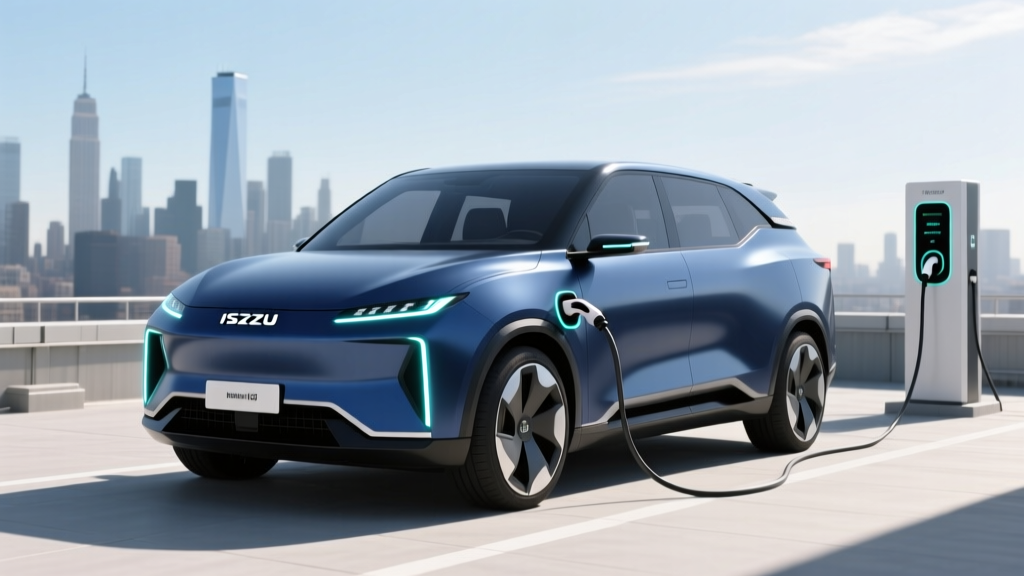
If you manage a medium-duty commercial fleet and are evaluating the Isuzu NRR EV for last-mile delivery or urban work routes, here's the direct answer: the 2026 Isuzu NRR EV offers an EPA-estimated 148 miles of range from its 132 kWh usable LFP battery, supports DC fast charging at up to 150 kW (10–80% in approximately 55 minutes), and carries a base MSRP around $110,000 before incentives. It's best suited for predictable routes under 120 miles per day with access to depot-based Level 2 or DC fast charging.
Quick Verdict: Who Should Buy the Isuzu NRR EV?
Buy it if: Your fleet runs fixed urban/suburban routes under 120 miles daily, you can install depot charging, and you want to eliminate diesel fuel costs and reduce maintenance downtime.
Pass if: Your trucks regularly exceed 150 miles per day, operate in extreme cold climates without preconditioning infrastructure, or lack access to reliable overnight charging.
Isuzu NRR EV Specs: Range, Battery, and Charging
The 2026 Isuzu NRR EV is built on Isuzu's proven N-Series cab-forward chassis, repowered with a fully electric drivetrain. Here are the exact specifications you need to evaluate fit for your operation.
| Specification | 2026 Isuzu NRR EV |
|---|---|
| EPA-Estimated Range | 148 miles |
| Battery Capacity (Usable) | 132 kWh (LFP chemistry) |
| Battery Chemistry | Lithium Iron Phosphate (LFP) |
| Max DC Fast Charge Rate | 150 kW peak |
| 10–80% DC Fast Charge Time | ~55 minutes |
| Level 2 AC Charging (19.2 kW) | ~7 hours (0–100%) |
| Motor Output | 255 hp / 620 lb-ft torque |
| GVWR | 19,500 lbs (Class 5) |
| Payload Capacity | ~9,500 lbs (varies by body config) |
| Base MSRP | ~$110,000 |
| Battery Warranty | 5 years / 75,000 miles |
| Powertrain Warranty | 5 years / 75,000 miles |
Real-World Range Expectations
The EPA rates the NRR EV at 148 miles, but commercial operations should plan conservatively:
- Mild weather, stop-and-go urban: 135–145 miles (regen braking helps recover energy)
- Highway-speed suburban routes (55–65 mph): 115–125 miles (aerodynamic drag dominates at speed)
- Cold weather (below 32°F): 95–115 miles (battery heating and cabin HVAC draw significant energy)
- Heavy payload (near GVWR): Subtract 10–15% from baseline estimates
For route planning, budget 110 miles as a safe daily usable range unless your trucks return to depot mid-shift for opportunity charging.
LFP Battery Chemistry: What Fleet Buyers Should Know
Isuzu chose lithium iron phosphate (LFP) cells for the NRR EV. LFP trades some energy density for major advantages in commercial duty:
- Longer cycle life: LFP cells typically sustain 3,000–5,000 full charge cycles before reaching 80% capacity, versus 1,000–2,000 for NMC. For a truck charged nightly, that's 8–13 years of service.
- Thermal stability: LFP is far less prone to thermal runaway — a critical safety consideration for depot-parked fleets.
- No cobalt or nickel: Simplifies supply chain ethics compliance and may ease sourcing requirements for commercial EV incentives.
The trade-off: LFP is heavier and bulkier than NMC for the same kWh, which slightly reduces payload capacity compared to a hypothetical NMC pack. For Class 5 work, the weight penalty is acceptable.
Charging the NRR EV: Depot Setup and Public Options
Unlike passenger EVs, medium-duty electric trucks live and die by depot charging. Here's what you need to plan for.
| Charging Level | Power (kW) | Miles Added per Hour | Use Case |
|---|---|---|---|
| Level 1 (120V) | 1.4 kW | ~2 mi/hr | Not practical for commercial use |
| Level 2 (240V, 40A) | 9.6 kW | ~14 mi/hr | Overnight top-up for light-duty days |
| Level 2 (208/240V, 80A) | 19.2 kW | ~28 mi/hr | Full overnight recharge (~7 hrs) |
| DC Fast (CCS1) | Up to 150 kW | ~140 mi/hr (peak) | Mid-shift opportunity charging |
Depot Charging Installation Costs
Installing commercial-grade Level 2 chargers at your depot is a significant capital expense, but it's the backbone of NRR EV operations.
| Component | Per-Stall Cost Range | Notes |
|---|---|---|
| Commercial Level 2 EVSE (19.2 kW) | $4,000–$7,000 | Networked units with fleet management software |
| Electrical Panel / Transformer Upgrade | $5,000–$25,000 | Depends on existing service capacity; multi-stall depots may need 480V 3-phase |
| Trenching / Conduit Run | $2,000–$10,000 | Distance from panel to parking stalls |
| Permits and Engineering | $1,500–$5,000 | Commercial electrical permits, load studies |
| Labor (Licensed Electrician) | $3,000–$8,000 | Varies by region and complexity |
| Total Per Stall | $15,500–$55,000 | Multi-stall installs reduce per-unit cost |
For DC fast charging at the depot (recommended if trucks need mid-shift top-ups), expect $80,000–$150,000+ per 150 kW charger installed, including utility service upgrades. Many fleets start with Level 2 overnight charging and add DC fast chargers as the fleet scales.
Note: the Commercial Clean Vehicle Credit (§45W) offers up to $40,000 for qualified commercial EVs — this is the fleet-equivalent incentive, separate from the consumer §30D credit. Consult a tax professional for your specific eligibility.
NRR EV vs. Diesel NRR: Total Cost of Ownership
The purchase price of the NRR EV (~$110,000) is roughly 2.5x the cost of a diesel NRR (~$45,000–$50,000). But total cost of ownership tells a different story when you factor in fuel, maintenance, and incentives.
| Cost Factor (5-Year / 75,000 mi) | Isuzu NRR EV | Isuzu NRR Diesel |
|---|---|---|
| Purchase Price | $110,000 | $48,000 |
| Federal Tax Credit (§45W) | −$40,000 | $0 |
| Net Purchase Cost | $70,000 | $48,000 |
| Fuel/Energy Cost | $5,625 (at $0.15/kWh) | $22,500 (at $4.00/gal, 5 mpg) |
| Maintenance | $3,000 | $12,000 |
| DEF Fluid / Emissions Service | $0 | $1,500 |
| Depot Charging Install (amortized) | $8,000 | $0 |
| 5-Year Total Cost | $86,625 | $84,000 |
| Cost Per Mile | $1.15 | $1.12 |
The numbers show near-parity at 5 years, with the EV pulling ahead in years 6–10 as maintenance savings compound and the diesel requires DPF/EGR service. Fleets running trucks for 7–10 years typically see $15,000–$25,000 in net savings per vehicle over the full lifecycle.
Energy Cost Breakdown
At the national commercial electricity average of ~$0.15/kWh (verify your local rate), charging the NRR EV's 132 kWh battery from 10–80% costs approximately $13.86. That delivers roughly 100 usable miles, or $0.14 per mile in energy cost.
Compare that to diesel at $4.00/gallon and 5 mpg: $0.80 per mile in fuel cost alone. The EV saves roughly $0.66 per mile in fuel, which scales dramatically across a high-mileage fleet.
Common Misconceptions About Electric Medium-Duty Trucks
| Myth | Fact |
|---|---|
| "EV batteries won't last in a commercial truck." | LFP batteries are rated for 3,000+ cycles. At one cycle per day, that's 8+ years before reaching 80% capacity. Isuzu warranties the pack for 5 years/75,000 miles. |
| "Charging takes too long for fleet operations." | Overnight Level 2 charging (7 hours) fully replenishes the battery. For multi-shift operations, a 55-minute DC fast charge during a driver break adds ~100 miles. |
| "Electric trucks can't handle cold weather." | Range drops 20–35% in sub-freezing temps, but depot preconditioning (plugging in while heating the battery and cab) mitigates most of the loss. Route planning for winter is essential but manageable. |
| "The grid can't handle a fleet of electric trucks." | Managed charging software staggers charge times to avoid peak demand charges. Many utilities offer commercial EV rate programs with off-peak incentives. |
| "There are no incentives for commercial EVs." | The §45W Commercial Clean Vehicle Credit provides up to $40,000 per qualified vehicle. Many states and utilities offer additional rebates. Check IRS guidelines for current rules. |
Real-World Ownership: What Fleet Managers Actually Deal With
Route Planning and Range Buffer
The single biggest operational adjustment when switching from diesel to electric is disciplined route-range matching. With diesel, you refuel in 10 minutes anywhere. With the NRR EV, you need to know that tomorrow's route fits within 110–130 real-world miles (with buffer). Fleet management software like Geotab or Samsara can integrate EV range modeling into dispatch.
Driver Training
Electric medium-duty trucks drive differently than diesel: instant torque, one-pedal regenerative braking, and no engine noise. Budget 2–4 hours of driver orientation per operator. Most drivers adapt within a week and prefer the smoother, quieter ride.
Insurance Considerations
Commercial EV insurance premiums are currently 10–20% higher than equivalent diesel trucks, primarily due to higher repair costs for battery damage and specialized technician requirements. Get quotes from your commercial carrier before finalizing your purchase decision.
Maintenance Reality
EV maintenance is dramatically simpler: no oil changes, no DPF regeneration, no DEF fluid, no transmission service, no exhaust system. Expect to maintain brakes (regen reduces wear), tires (heavier vehicle + instant torque), cabin air filters, and coolant loops. Isuzu's dealer network is expanding EV-certified service locations — verify coverage in your operating area.
Decision Framework: Is the NRR EV Right for Your Fleet?
Choose the Isuzu NRR EV If:
- Your daily routes are under 120 miles with predictable patterns
- You have (or can install) depot Level 2 charging with overnight dwell time of 8+ hours
- Your fleet operates primarily in urban or suburban environments with stop-and-go driving
- You plan to keep trucks 7+ years (maximizing TCO advantage)
- Your company has sustainability reporting goals or operates in areas with clean-air mandates (e.g., CARB states)
- You qualify for the §45W commercial credit and/or state incentives
Stick with Diesel (or Wait) If:
- Your routes regularly exceed 150 miles per day without mid-shift charging access
- You operate in extreme cold climates (sustained sub-zero temps) without heated depot parking
- Your depot electrical service cannot support Level 2 charging without a $50,000+ utility upgrade
- You need maximum payload and can't accept the ~500-lb battery weight penalty
- Your trucks need to travel long distances between job sites on rural highways
Isuzu NRR EV FAQ
What is the real-world range of the Isuzu NRR EV?
The EPA rates it at 148 miles. In real-world commercial use, plan for 110–130 miles depending on payload, speed, and temperature. Urban stop-and-go routes maximize range thanks to regenerative braking; highway-speed routes reduce it.
How long does it take to charge the Isuzu NRR EV?
On a 19.2 kW Level 2 charger, a full charge takes about 7 hours (overnight). On a 150 kW DC fast charger, 10–80% takes approximately 55 minutes. Note that charging slows significantly above 80% SoC to protect battery health — the charge curve tapers from peak 150 kW to under 40 kW above 85%.
Does the Isuzu NRR EV qualify for the $7,500 EV tax credit?
No — the consumer §30D credit does not apply to commercial fleet purchases. Instead, the §45W Commercial Clean Vehicle Credit offers up to $40,000 for qualified commercial EVs with GVWR above 14,000 lbs. Eligibility depends on sourcing requirements and your tax liability. Consult a tax professional.
What charging connector does the Isuzu NRR EV use?
The 2026 NRR EV uses the CCS1 connector for DC fast charging and J1772 for Level 2 AC charging. This is the standard for all non-Tesla commercial EVs in North America.
How does the NRR EV compare to the Ford E-Transit or Lightning Electric Class 5?
The NRR EV fills a specific niche: cab-forward medium-duty (Class 5) work. The Ford E-Transit is a lighter Class 2 cargo van with ~126 miles of range and lower payload. The Lightning Electric Class 5 was discontinued. The NRR EV's closest competitors are the Class 5 electric offerings from BYD and Hino, though availability varies by region.
Can I tow with the Isuzu NRR EV?
Isuzu has not published an official towing rating for the NRR EV at launch. Towing significantly reduces range (expect 30–40% loss). If your operation requires regular towing, discuss your specific use case with an Isuzu commercial dealer before ordering.
What happens if the battery fails out of warranty?
LFP batteries rarely fail catastrophically — they gradually lose capacity. If replacement is needed, expect $25,000–$40,000 for a refurbished pack, though this cost is expected to decline as the commercial EV service market matures. Individual module replacement may be possible at lower cost.