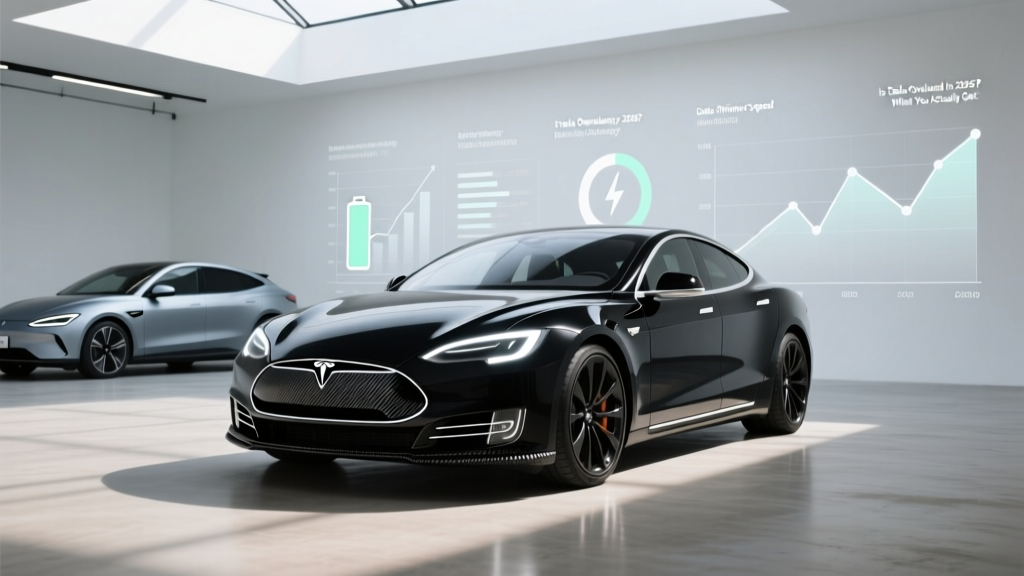
For years, Tesla has commanded a premium — both in stock-market valuation and in the minds of EV shoppers — that seems to defy conventional automotive logic. As legacy automakers flood the market with competitive electric vehicles and Tesla's own lineup ages in certain segments, a growing number of buyers are asking a pointed question: is Tesla overvalued when you strip away the brand mystique and look strictly at what you get for your money?
At AutoEdgeView, we don't trade on hype or sentiment. We test EVs, log real-world miles, time charging sessions at DC fast chargers, and cross-reference EPA data against our own highway loops. Below, we dissect Tesla's two volume sellers — the 2026 Model Y and Model 3 — against the cold, hard numbers that matter to buyers: range, charging speed, pricing after tax credits, and how they stack up against rivals like the Hyundai Ioniq 5, Ford Mustang Mach-E, and Chevrolet Equinox EV.
The Core Question: What Does "Overvalued" Actually Mean for an EV Buyer?
When financial analysts ask if Tesla is overvalued, they're talking about price-to-earnings ratios and market cap. But for an EV shopper, the question is more practical: am I paying a premium for the Tesla badge that I wouldn't pay for equivalent hardware from Hyundai, Ford, or GM?
To answer that, we need to compare apples to apples — same vehicle class, similar range targets, overlapping price bands. The two Teslas that matter most to mainstream buyers are:
- 2026 Tesla Model 3 Long Range AWD — the benchmark electric sedan
- 2026 Tesla Model Y Long Range AWD — the best-selling electric crossover in America
We'll use these as our primary reference points, then layer in the performance trims (Model 3 Performance, Model Y Performance) where pricing diverges sharply from competitors.
Range and Efficiency: EPA Numbers vs. Real-World Reality
Tesla has long led the industry in efficiency — the number of miles extracted per kilowatt-hour of battery. That engineering advantage still shows up on the EPA sticker, but real-world driving tells a more nuanced story.
| Model | Battery (kWh usable) | Chemistry | EPA Range | MPGe (combined) | kWh/100 mi |
|---|---|---|---|---|---|
| 2026 Model 3 Long Range AWD | ~75 kWh | NMC | 341 mi | 134 MPGe | 25 |
| 2026 Model 3 RWD | ~57.5 kWh | LFP | 272 mi | 132 MPGe | 26 |
| 2026 Model Y Long Range AWD | ~75 kWh | NMC | 320 mi | 122 MPGe | 28 |
| 2026 Model Y RWD | ~57.5 kWh | LFP | 260 mi | 119 MPGe | 29 |
Compared to the Hyundai Ioniq 5 (EPA 305 mi, Long Range AWD) or the Ford Mustang Mach-E Extended Range (EPA 320 mi), the Model 3 Long Range still holds an edge in raw range. But the gap has narrowed dramatically since 2020, when Tesla enjoyed a 60+ mile advantage over most rivals.
Charging Speed: Where Tesla's Supercharger Network Still Matters
Charging is where the "is Tesla overvalued" debate gets complicated. The hardware on the car is only half the equation — the network you plug into is the other half.
| Charging Level | Model 3 LR / Model Y LR | Model 3 RWD (LFP) |
|---|---|---|
| Level 1 (120V, 12A) | ~3 mi/hr (1.4 kW) | ~3 mi/hr (1.4 kW) |
| Level 2 (240V, 48A) | ~44 mi/hr (11.5 kW) | ~33 mi/hr (8.5 kW) |
| DC Fast Charge (peak) | 250 kW (CCS/NACS) | 170 kW |
| DC 10-80% time | ~25-28 min | ~30-33 min |
Tesla's peak 250 kW DC fast-charge rate on Long Range models is no longer class-leading. The Hyundai Ioniq 5 and Kia EV6, built on 800-volt architectures, can peak at ~350 kW and achieve 10-80% in approximately 18 minutes under ideal conditions. Tesla's 400-volt architecture charges quickly, but the curve tapers noticeably above 60% state of charge — a common limitation that Tesla hasn't addressed with a next-gen architecture yet in the Model 3/Y.
Where Tesla still wins is network reliability. The Tesla Supercharger network remains the most dependable DC fast-charging infrastructure in North America, with far higher uptime rates than Electrify America or EVgo. With the NACS (North American Charging Standard) connector now adopted by Ford, GM, Hyundai, and others, Supercharger access is opening up — but Tesla owners still enjoy seamless plug-and-charge integration that non-Tesla vehicles accessing Superchargers via adapters don't always experience as smoothly.
Pricing, Trim Levels, and the Federal Tax Credit Equation
This is where the "overvalued" question gets a dollar figure attached. Tesla has aggressively cut prices since 2023, and the 2026 lineup reflects a more competitive posture — but trim-level optioning can still push prices higher than buyers expect.
| Trim | Base MSRP | Federal Credit (§30D) | Effective Price* |
|---|---|---|---|
| Model 3 RWD | $38,990 | Up to $7,500 | ~$31,490 |
| Model 3 Long Range AWD | $45,240 | Up to $7,500 | ~$37,740 |
| Model 3 Performance | $52,990 | Up to $7,500 | ~$45,490 |
| Model Y RWD | $39,990 | Up to $7,500 | ~$32,490 |
| Model Y Long Range AWD | $46,630 | Up to $7,500 | ~$39,130 |
| Model Y Performance | $52,490 | Up to $7,500 | ~$44,990 |
*Effective price assumes full $7,500 §30D credit. Actual eligibility depends on buyer income, battery sourcing, and MSRP caps. See IRS rules below.
Federal EV Tax Credit Eligibility (§30D) — Key Rules
- MSRP cap: Sedans (Model 3) must be ≤$55,000; SUVs/trucks (Model Y) must be ≤$80,000. All current Model 3 and Model Y trims qualify on MSRP.
- Buyer income cap: Modified AGI must not exceed $150,000 (single), $225,000 (head of household), or $300,000 (joint). Check IRS §30D guidelines for current-year thresholds.
- Battery sourcing: The full $7,500 requires meeting both critical-mineral and battery-component requirements. Tesla sources LFP cells from CATL (China) for RWD trims, which may affect partial or full credit eligibility depending on current-year FEOC (Foreign Entity of Concern) rules. Long Range trims use NMC cells with more diversified sourcing. Always verify current eligibility on the IRS website or with a tax professional before purchasing.
- Point-of-sale transfer: As of 2024+, buyers can transfer the credit to the dealer at purchase, reducing the upfront price rather than waiting for a tax refund. Tesla supports this at checkout.
Performance, Drivetrain, and What You Feel Behind the Wheel
Tesla's performance credentials are well-established, but the numbers still impress — especially given the pricing.
| Model | Drivetrain | Horsepower | 0-60 mph | Top Speed |
|---|---|---|---|---|
| Model 3 RWD | Rear-Wheel Drive | 271 hp | 5.8 sec | 125 mph |
| Model 3 Long Range AWD | Dual-Motor AWD | 346 hp | 4.2 sec | 125 mph |
| Model 3 Performance | Dual-Motor AWD | 510 hp | 2.9 sec | 163 mph |
| Model Y RWD | Rear-Wheel Drive | 271 hp | 6.6 sec | 135 mph |
| Model Y Long Range AWD | Dual-Motor AWD | 384 hp | 4.8 sec | 135 mph |
| Model Y Performance | Dual-Motor AWD | 510 hp | 3.5 sec | 155 mph |
The dual-motor AWD system in Long Range and Performance trims provides excellent all-weather traction and torque-vectoring feel. The Model 3 Performance at $52,990 (before credit) delivers supercar-rivaling acceleration at a fraction of the cost. However, competitors like the Ford Mustang Mach-E GT (0-60 in ~3.5 sec, MSRP ~$59,990) and Hyundai Ioniq 5 N (0-60 in ~3.4 sec, MSRP ~$66,000) have closed the performance gap — though at higher prices.
Interior Space, Cargo, and Daily Practicality
Tesla's minimalist interior is polarizing. Some buyers love the clean aesthetic; others miss physical controls. But practicality is measured in dimensions, not design philosophy.
Model 3 (2026):
- Cargo volume: 23 cu ft (trunk) + 3.1 cu ft (frunk) = 26.1 cu ft total
- Rear legroom: 35.3 inches
- Front headroom: 40.3 inches
Model Y (2026):
- Cargo volume: 30.2 cu ft (behind 2nd row) + 4.1 cu ft (frunk) = 34.3 cu ft total
- Max cargo (2nd row folded): 72.1 cu ft
- Rear legroom: 41.6 inches (class-leading)
- Optional 7-seat configuration available (third row best suited for children)
The Model Y's rear legroom and cargo capacity are genuine advantages over the Mach-E (29.7 cu ft cargo) and Ioniq 5 (27.2 cu ft cargo). For families, this is where the Model Y earns its sales volume. The Model 3, by contrast, is tighter in the back seat than a Toyota Camry — acceptable for a sport sedan, but not a family hauler.
Technology, Autopilot, and the FSD Question
Tesla's 15.4-inch center touchscreen handles virtually every vehicle function — climate, media, navigation, vehicle settings, even glovebox release. The interface is responsive and well-designed, but the lack of physical stalks (turn signals are now steering-wheel buttons in the refreshed Model 3) remains a common complaint among new owners.
Standard Autopilot includes lane-centering and adaptive cruise control. It's a competent SAE Level 2 driver-assistance system, comparable to Ford BlueCruise or GM Super Cruise in capability but without the hands-free highway mapping of those competitors.
Whether FSD justifies its cost is the sharpest wedge in the "overvalued" debate. If you view it as a convenience feature that reduces highway fatigue, it has value. If you purchased it expecting imminent full autonomy, you've been waiting years for a capability that remains supervised and imperfect. Tesla's FSD revenue is a significant contributor to the company's valuation — which is why the overvalued question extends from the car to the stock.
Warranty and Long-Term Battery Outlook
Tesla's warranty coverage is competitive but not class-leading:
- Basic vehicle warranty: 4 years / 50,000 miles
- Battery & drive unit (Model 3/Y RWD with LFP): 8 years / 100,000 miles, ≥70% capacity retention
- Battery & drive unit (Model 3/Y Long Range & Performance, NMC): 8 years / 120,000 miles, ≥70% capacity retention
The 70% retention threshold is the industry standard, matched by Hyundai, Ford, and GM. Hyundai's 10-year/100,000-mile powertrain warranty is longer, which matters to buyers planning decade-long ownership. Tesla's real-world battery degradation data, however, is among the best-documented: most Model 3/Y batteries lose approximately 10-12% capacity over the first 100,000 miles, with the curve flattening significantly afterward. LFP batteries in RWD trims tolerate repeated 100% charging better than NMC, making them well-suited for daily commuters who charge at home every night.
Tesla vs. Key Competitors: Where the Value Proposition Lands
The honest verdict: Tesla is no longer overpriced at the base-trim level. A Model 3 RWD at ~$31,490 after the federal credit is one of the best value propositions in the EV market. A Model Y Long Range at ~$39,130 after credit offers range, space, and network access that no competitor matches in a single package.
Where the "overvalued" label still applies is in optioned-up Performance trims and FSD purchases. A Model 3 Performance with FSD, paint upgrades, and wheels pushes past $62,000 — entering BMW i4 and Mercedes EQB territory where build quality, sound insulation, and dealer service networks are markedly better. And paying $8,000 for FSD Supervised is a bet on future capability, not a purchase of current performance.
Look elsewhere if: You want the fastest DC charging (Ioniq 5/EV6), a longer warranty (Hyundai), hands-free highway driving (GM Super Cruise, Ford BlueCruise), a more traditional interior with physical controls, or if you object to paying for FSD's unfulfilled autonomy promises.
The Biggest Pros and Cons
- Class-leading efficiency (kWh/100 mi) translates to lower charging costs
- Supercharger network reliability remains best in North America
- Model Y cargo space and rear legroom lead the crossover segment
- Over-the-air updates continuously add features
- Strong resale value relative to most EVs
- LFP battery in RWD trims supports daily 100% charging without degradation concern
- 400V architecture limits DC charge speed vs. 800V rivals (Ioniq 5, EV6, Porsche Taycan)
- No physical controls — turn signals on steering wheel buttons are divisive
- FSD at $8,000 remains Level 2 supervised, not autonomous
- Build quality inconsistencies still reported (panel gaps, paint)
- Service center wait times can be lengthy in some markets
- Rear visibility in Model 3 is compromised by design
Frequently Asked Questions
What is the real-world range of the 2026 Tesla Model Y?
The Model Y Long Range AWD carries an EPA rating of 320 miles. In real-world highway driving at 70-75 mph, expect approximately 265-280 miles. In cold weather below 30°F, plan for 240-260 miles. The RWD model's 260-mile EPA rating drops to roughly 210-230 miles on the highway.
How fast does a Tesla Model 3 charge at home and on the road?
On a home Level 2 charger (240V, 48A), the Model 3 Long Range adds approximately 44 miles per hour of charging, or about 11.5 kW. A full overnight charge from 20% to 100% takes roughly 7 hours. On a Tesla Supercharger (DC fast charge), the Long Range model peaks at 250 kW and charges from 10-80% in approximately 25-28 minutes, though the rate tapers significantly above 60% SoC.
Does the 2026 Tesla Model 3 qualify for the $7,500 federal EV tax credit?
The Model 3 qualifies on MSRP (all trims are under the $55,000 sedan cap). However, full $7,500 eligibility depends on battery sourcing requirements under §30D, which are subject to FEOC (Foreign Entity of Concern) restrictions. The RWD trim's CATL-sourced LFP battery may face partial credit limitations depending on current-year rules. The Long Range AWD with NMC cells has historically qualified for the full credit. Always verify at IRS.gov before purchasing.
Is Tesla overvalued compared to Hyundai, Ford, or Chevrolet EVs?
At base and Long Range trims, Tesla's pricing after tax credits is highly competitive — the Model 3 RWD at ~$31,490 and Model Y LR at ~$39,130 offer strong value for the range, efficiency, and Supercharger access included. The "overvalued" label applies more to high-option Performance trims and FSD purchases, where competitors offer comparable or better hardware, faster charging, or longer warranties at similar or lower prices.
Is the Tesla Model Y a good family vehicle?
Yes. The Model Y offers 41.6 inches of rear legroom, 34.3 cu ft of cargo space (72.1 cu ft with seats folded), and an available third row for small children. Its 320-mile EPA range covers most family road trips with a single Supercharger stop. The main drawbacks are the lack of rear-seat entertainment screens, the all-touchscreen interface (not ideal for backseat passengers adjusting climate), and firm ride quality over rough roads.
How long will a Tesla battery last?
Tesla warranties its Long Range NMC batteries for 8 years/120,000 miles with ≥70% capacity retention. Real-world data from high-mileage owners shows approximately 10-12% degradation over 100,000 miles, with the loss curve flattening afterward. Many Model 3 and Model Y batteries are projected to retain 80%+ capacity at 200,000 miles. LFP batteries in RWD models may last even longer, as LFP chemistry tolerates full charge cycles better than NMC.