Quick Verdict: Yes, Tesla Is Overwhelmingly Made in America
If you've ever searched "is Tesla made in America" while researching your next EV purchase, the short answer is yes — the vast majority of Teslas sold in the United States are assembled at American factories, with a high percentage of US- and Canadian-sourced parts. Tesla operates three major vehicle assembly plants on US soil, and its cars consistently rank at or near the top of the American Automobile Labeling Act (AALA) content reports published by NHTSA.
But "made in America" means different things to different buyers. Some care about final assembly location, others about battery sourcing, and still others about how that origin story intersects with federal EV tax credit eligibility under IRS §30D. In this profile, we'll map exactly where each Tesla model is built, then dive into the specs, pricing, and ownership realities you need to make an informed 2026 purchase decision.
Where Are Teslas Built? Factory-by-Factory Breakdown
Tesla's global production footprint spans five vehicle assembly gigafactories, but the US-based plants handle the overwhelming majority of vehicles destined for North American buyers.
| Factory | Location | Models Produced | Status (2026) |
|---|---|---|---|
| Fremont Factory | Fremont, California | Model S, Model X, Model 3, Model Y | Operational |
| Giga Texas | Austin, Texas | Model Y, Cybertruck | Operational |
| Giga Nevada | Sparks, Nevada | Battery cells, drivetrain components | Operational |
| Giga Shanghai | Shanghai, China | Model 3, Model Y (non-US markets) | Operational |
| Giga Berlin | Grünheide, Germany | Model Y (European markets) | Operational |
For US buyers, the cars you'll find at your local Tesla delivery center almost certainly rolled off a line in Fremont or Austin. Giga Shanghai and Giga Berlin primarily serve their regional markets, though Tesla has occasionally exported Shanghai-built Model 3 vehicles to other regions during supply constraints. The VIN's first character tells the story: 5YJ indicates US assembly, while LRW signals China and XP7 signals Germany.
Tesla's AALA domestic content percentages have historically hovered between 65% and 75% for US-built models, among the highest in the industry — though exact figures shift yearly as supply chains evolve.
2026 Tesla Model Lineup: Range, Battery, and Performance Specs
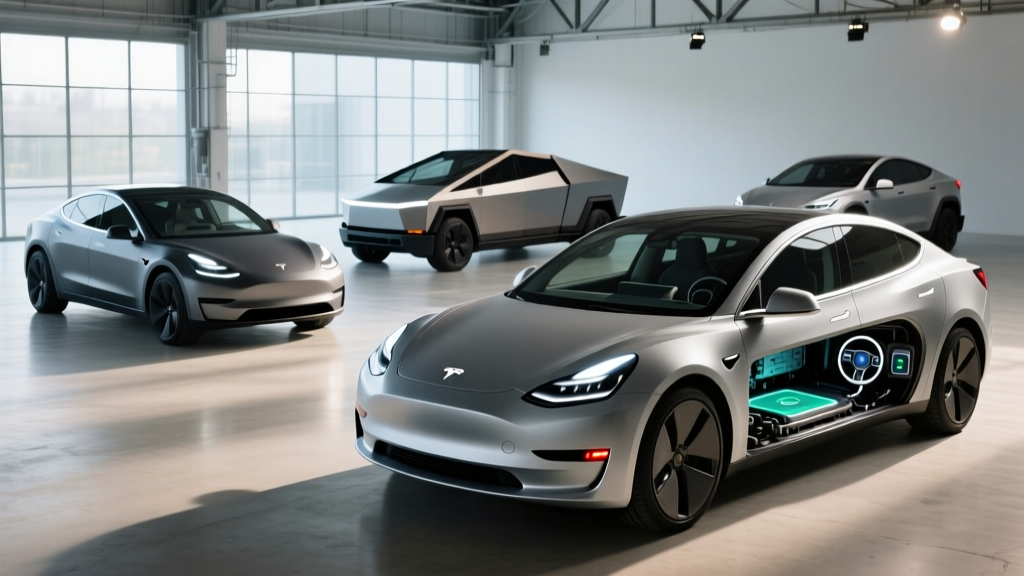
Here's a consolidated look at the current US-market Tesla lineup with the numbers that matter most to buyers.
| Spec | Model 3 Long Range AWD | Model Y Long Range AWD | Cybertruck AWD | Model S Long Range |
|---|---|---|---|---|
| EPA Range | 341 mi | 320 mi | 340 mi | 402 mi |
| Battery (usable) | ~79 kWh (NMC) | ~79 kWh (NMC) | ~123 kWh (NMC) | ~100 kWh (NMC) |
| Max DC Charge Rate | 250 kW | 250 kW | 350 kW (800V arch) | 250 kW |
| 10–80% DC Time | ~25 min | ~25 min | ~18 min | ~30 min |
| Level 2 Rate | 11.5 kW (~44 mi/hr) | 11.5 kW (~44 mi/hr) | 11.5 kW (~34 mi/hr) | 11.5 kW (~40 mi/hr) |
| 0–60 mph | 4.2 sec | 4.8 sec | 3.9 sec | 3.1 sec |
| Horsepower | ~346 hp | ~384 hp | ~600 hp | ~670 hp |
| Drivetrain | Dual-Motor AWD | Dual-Motor AWD | Dual/Tri-Motor AWD | Dual-Motor AWD |
| Efficiency (MPGe) | 132 MPGe | 122 MPGe | 76 MPGe | 124 MPGe |
| Cargo Volume | 23 cu ft (trunk+frunk) | 76 cu ft (max) | 67 cu ft (max bed) | 28 cu ft (trunk+frunk) |
| Base MSRP | $47,740 | $48,990 | $79,990 | $79,990 |
Sources: EPA fueleconomy.gov, Tesla.com specifications. Figures reflect 2026 model year data and may vary by trim.
Real-World Range: What the EPA Sticker Doesn't Tell You
EPA estimates represent a blended city/highway cycle under moderate conditions. Here's what to actually expect on the road:
- Highway-only at 75 mph: Expect ~80–85% of the EPA sticker (e.g., Model 3 LR: ~275–290 mi)
- Cold weather (below 32°F): Range drops 20–30% due to cabin heating and battery chemistry resistance
- City/regenerative driving: You may match or slightly exceed EPA numbers thanks to Tesla's aggressive regen
Tesla's thermal management system — including the standard heat pump across the lineup — mitigates cold-weather losses better than many competitors, but physics still wins. LFP-equipped Model 3 and Model Y RWD trims (which use lithium iron phosphate batteries) experience slightly more cold-weather range loss than NMC variants but can be charged to 100% daily without degradation concerns. NMC batteries, used in Long Range and Performance trims, are recommended to charge to 80% for daily use.
Charging Speed: From Home Level 2 to Supercharger V4
Tesla's Supercharger network remains the gold standard for public DC fast charging reliability, with over 6,000 V3 and V4 stalls across North America. Here's what charging looks like in practice:
| Charging Level | Power (kW) | Miles Added per Hour | Use Case |
|---|---|---|---|
| Level 1 (120V outlet) | ~1.4 kW | ~3–5 mi/hr | Emergency/trickle |
| Level 2 (240V, 48A) | 11.5 kW | ~34–44 mi/hr | Home overnight |
| DC Fast (V3 Supercharger) | Up to 250 kW | ~1,000+ mi/hr (peak) | Road trips |
| DC Fast (V4 Supercharger) | Up to 350 kW | ~1,300+ mi/hr (peak) | Cybertruck / future models |
Charging curve reality check: No EV sustains its peak charge rate for the full session. A Model 3 Long Range hitting 250 kW at 10% SoC will taper to ~150 kW by 50% and ~50 kW by 80%. The published 10–80% time of ~25 minutes accounts for this taper. Cybertruck's 800-volt architecture sustains higher rates longer, which is why its 350 kW peak yields a faster 10–80% time despite a much larger battery.
For home charging, Tesla's Wall Connector ($420) delivers up to 11.5 kW on a 60A circuit. Most owners with a 30–40 mile daily commute find that plugging in overnight at home eliminates any need for public charging during the work week. Budget roughly $500–$1,500 for professional installation depending on panel proximity and whether your home needs an electrical panel upgrade.
Pricing, Tax Credits, and What You'll Actually Pay
Tesla's pricing has shifted frequently, but here's where the 2026 lineup stands before and after potential federal incentives:
| Model / Trim | Base MSRP | §30D Credit Eligibility | Effective Price (if eligible) |
|---|---|---|---|
| Model 3 RWD | $38,990 | Up to $7,500 (point-of-sale) | ~$31,490 |
| Model 3 Long Range AWD | $47,740 | Up to $7,500 (point-of-sale) | ~$40,240 |
| Model Y Long Range AWD | $48,990 | Up to $7,500 (point-of-sale) | ~$41,490 |
| Cybertruck AWD | $79,990 | Not eligible (over MSRP cap) | $79,990 |
| Model S Long Range | $79,990 | Not eligible (over MSRP cap) | $79,990 |
Eligibility for the up-to-$7,500 credit is NOT automatic. Key requirements per IRS guidelines:
- MSRP cap: Sedans must be ≤$55,000; SUVs/pickups ≤$80,000
- Buyer income cap: AGI ≤$150,000 (single), ≤$300,000 (joint)
- Battery sourcing: Critical minerals and battery components must meet phased-in US/free-trade-agreement thresholds
- Point-of-sale transfer: You can apply the credit at purchase to reduce your down payment, even if you have no tax liability
Tesla's Model 3 and Model Y have historically qualified for the full or partial credit, but battery-sourcing requirements tighten annually. Always verify current eligibility on the IRS website or with your tax professional before purchasing.
Warranty, Safety, and Driver-Assist Technology
Tesla's warranty structure is competitive but not class-leading:
- Basic vehicle warranty: 4 years / 50,000 miles
- Battery & drive unit warranty: 8 years / 100,000 miles (Model 3/Y), 8 years / 150,000 miles (Model S/X/Cybertruck)
- Capacity retention threshold: Tesla warrants that the battery will retain at least 70% of its original capacity during the warranty period
On the safety front, Tesla vehicles consistently earn top marks. The Model 3 and Model Y hold 5-star NHTSA overall ratings and have earned IIHS Top Safety Pick+ designations in recent years.
Autopilot and FSD (Supervised): Every Tesla ships with Autopilot, a Level 2 driver-assistance system per SAE International classification. Full Self-Driving (Supervised) adds automated lane changes, traffic light recognition, and city street navigation for an additional $8,000 (or $99/month). Despite the name, FSD remains a Level 2 system — the driver must remain engaged, hands on the wheel, and eyes on the road at all times. This is not autonomous driving in the Waymo Level 4 sense.
Who Should Buy a Tesla — and Who Should Look Elsewhere?
- Best-in-class Supercharger network reliability
- Strong EPA range and efficiency across the lineup
- Over-the-air updates continuously add features
- US-assembled with high domestic parts content
- Point-of-sale tax credit lowers barrier to entry
- Industry-leading infotainment and app ecosystem
- No physical buttons — all controls via touchscreen
- Service center wait times can be long in some regions
- Panel gaps and build consistency still trail legacy OEMs
- FSD (Supervised) is expensive and still requires full attention
- Insurance costs run 15–30% higher than comparable EVs
- No Apple CarPlay / Android Auto support
- Choose Tesla Model 3 if you want a sporty commuter sedan with the best charging infrastructure and don't need massive cargo space.
- Choose Tesla Model Y if you need a practical family crossover with hatchback versatility and up to 76 cu ft of cargo room.
- Look at Hyundai Ioniq 5 or Ford Mustang Mach-E if you prefer physical controls, CarPlay integration, or want a competitive 800V charging architecture at a similar price.
- Look at Rivian R1S or Kia EV9 if you need three rows of seating — Tesla still offers no 3-row SUV (Model X is discontinued for 2026).
Frequently Asked Questions
Is every Tesla sold in the US made in America?
Almost all of them. US-market Teslas are assembled at the Fremont, California factory or Giga Texas in Austin. The VIN prefix 5YJ confirms US origin. A small number of vehicles may contain internationally sourced components (e.g., battery cells from Panasonic in Japan or CATL in China for LFP trims), but final assembly is domestic.
Does buying a US-made Tesla guarantee the full $7,500 tax credit?
No. US assembly is necessary but not sufficient. The §30D credit also depends on your income, the vehicle's MSRP, and whether the battery's critical minerals and components meet annual sourcing thresholds. Model 3 and Model Y have historically qualified, but verify current eligibility at irs.gov before purchasing.
How does Tesla's US production compare to other EV brands?
Tesla ranks among the highest in domestic content. By comparison, many EVs from legacy automakers are assembled in Mexico, South Korea, or Europe — though brands like Ford (Mach-E now moving to US production), GM (Ultium-platform vehicles in Tennessee and Michigan), and Rivian (Normal, Illinois) also manufacture stateside.
Are Tesla battery cells made in America?
Partially. Tesla sources cells from multiple suppliers. Panasonic produces cells at Giga Nevada, and Tesla manufactures its own 4680 cells at pilot facilities in California and at Giga Texas. However, some cells — particularly LFP prismatic cells from CATL — are imported from China for RWD trim levels.
What's the real-world range of the most popular Tesla, the Model Y?
The EPA rates the Model Y Long Range AWD at 320 miles. In real-world highway driving at 75 mph in moderate temperatures, expect roughly 260–280 miles. In winter conditions below freezing, plan for 220–250 miles of usable range before needing to charge.