Quick Verdict: Is Tesla a Luxury Car?
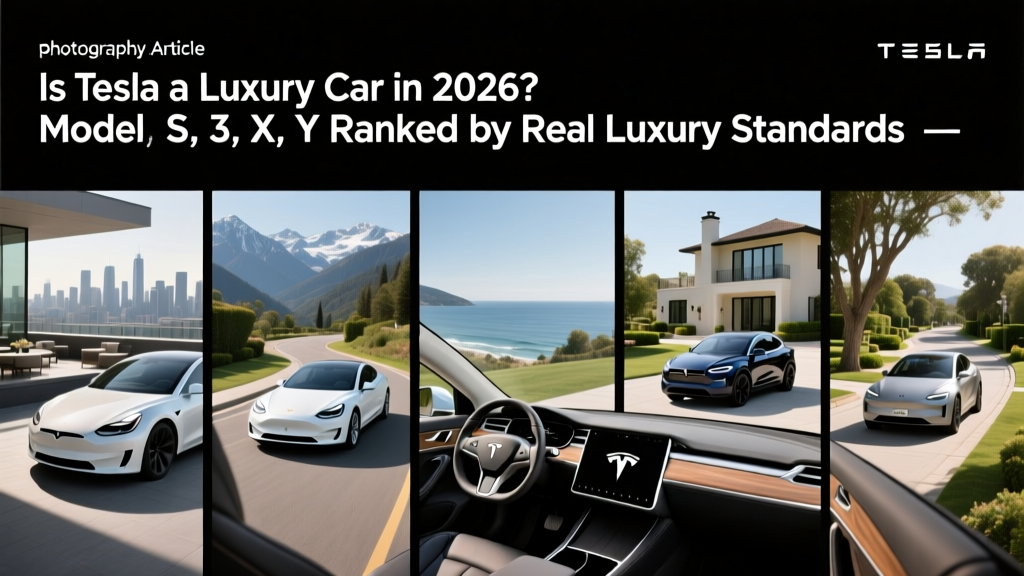
The answer depends entirely on which Tesla you're talking about — and how you define luxury. The Model S competes credibly with the Mercedes EQS, BMW i7, and Lucid Air on performance, range, and tech, earning its luxury badge through sheer capability. The Model 3 and Model Y are premium-priced mainstream EVs that trade traditional luxury hallmarks (plush ride, sound isolation, handcrafted interiors) for minimalism, efficiency, and software-driven features. The Model X sits in between — a luxury-priced SUV with some luxury-class features but build-quality inconsistencies that keep it from the top tier.
Below, we break down every current Tesla model against the criteria that actually define a luxury vehicle: ride refinement, interior materials, cabin quietness, performance, technology, and ownership experience — backed by hard specs, EPA data, and real-world ownership context.
2026 Tesla Lineup: Spec Comparison at a Glance
| Spec | Model 3 Long Range AWD | Model Y Long Range AWD | Model S Long Range | Model X Long Range |
|---|---|---|---|---|
| EPA Range | 363 mi | 320 mi | 402 mi | 348 mi |
| Battery (usable kWh) | ~75 kWh (NMC) | ~75 kWh (NMC) | ~95 kWh (NMC) | ~95 kWh (NMC) |
| Efficiency (MPGe / kWh/100mi) | 134 MPGe / 25 kWh | 122 MPGe / 28 kWh | 124 MPGe / 27 kWh | 109 MPGe / 31 kWh |
| 0–60 mph | 4.2 sec | 4.8 sec | 3.1 sec | 3.8 sec |
| Horsepower | ~384 hp | ~384 hp | ~670 hp | ~670 hp |
| Drivetrain | Dual-motor AWD | Dual-motor AWD | Dual-motor AWD | Dual-motor AWD |
| Max DC Fast Charge | 250 kW | 250 kW | 250 kW | 250 kW |
| 10–80% DCFC Time | ~28 min | ~28 min | ~30 min | ~30 min |
| Level 2 Home Charge (kW / mi/hr) | 11.5 kW / ~44 mi/hr | 11.5 kW / ~40 mi/hr | 11.5 kW / ~41 mi/hr | 11.5 kW / ~36 mi/hr |
| Cargo (rear seats up / folded, cu ft) | 23 / 64 | 30 / 76 | 28 / 79 | 88 / 92 (seats folded, varies by config) |
| Rear Legroom | 35.2 in | 37.0 in | 35.4 in | 40.9 in |
| Base MSRP | $47,740 | $48,240 | $79,990 | $84,990 |
| Battery Warranty | 8 yr / 120,000 mi | 8 yr / 120,000 mi | 8 yr / 150,000 mi | 8 yr / 150,000 mi |
Sources: EPA fueleconomy.gov, Tesla specifications. Prices reflect 2026 model year MSRP before destination fees and incentives.
Range and Efficiency: What the EPA Sticker vs. Real World Looks Like
EPA estimates are a starting point, not a guarantee. Here's what to actually expect:
- Model S LR (EPA 402 mi): Expect ~340–360 mi on mixed highway driving at 70 mph. In sub-30°F weather, plan for ~280–310 mi — cold impacts battery chemistry and cabin heating draws significant energy.
- Model 3 LR (EPA 363 mi): Real-world highway ~300–320 mi; cold weather ~250–280 mi. Its lighter weight and smaller frontal area give it the best efficiency in the lineup.
- Model Y LR (EPA 320 mi): Highway ~270–290 mi; cold weather ~220–250 mi. The taller, heavier SUV shape costs it ~10% efficiency vs. the Model 3.
- Model X LR (EPA 348 mi): Highway ~290–310 mi; cold weather ~240–270 mi. Falcon-wing doors add weight and the largest frontal area reduces highway efficiency.
Heat pumps are standard on all 2026 Teslas, which reduces (but doesn't eliminate) cold-weather range loss compared to older resistive-heater EVs.
Tesla's efficiency remains among the best in the industry. The Model 3's ~25 kWh/100 miles means you're spending roughly $3.50–$4.50 per 100 miles on average US electricity rates ($0.14–$0.18/kWh) — a fraction of a comparable gas sedan's fuel cost. This efficiency advantage is a genuine engineering achievement, even if it's not what most people think of when they hear "luxury."
Charging Speed and Infrastructure: Tesla's Strongest Luxury Argument
Charging convenience is where Tesla most credibly argues for luxury status. The Supercharger network — now exceeding 50,000 stalls globally — remains the most reliable, fastest, and most seamlessly integrated DC fast-charging network available. No competitor's charging experience comes close to the plug-and-charge simplicity of a Tesla at a Supercharger.
| Charging Level | Power (kW) | Approx. Miles Added per Hour | Typical Use Case |
|---|---|---|---|
| Level 1 (120V household) | ~1.4 kW | ~4–5 mi/hr | Emergency / trickle top-off |
| Level 2 (240V home, 48A) | 11.5 kW | ~36–44 mi/hr | Daily home charging (full overnight) |
| DC Fast Charge (Supercharger V3) | Up to 250 kW peak | ~1,000+ mi/hr at peak | Road trips; 10–80% in ~28–30 min |
| DC Fast Charge (Supercharger V4) | Up to 350 kW (future capable) | Higher rates expected | Newer installations; current Teslas limited by onboard architecture to ~250 kW |
Charging curve reality check: All current Teslas peak at 250 kW only at low state-of-charge (SoC) and taper significantly above 60%. The 10–80% time of ~28–30 minutes is realistic at a V3 Supercharger, but expect the last 20% to take as long as the first 50%. For road-trip planning, Tesla's in-car navigation accurately preconditions the battery when a Supercharger is set as your destination — this is a meaningful advantage over competitors that don't precondition or do so less effectively.
Home Level 2 charging with the Tesla Wall Connector ($420 for the unit, plus $500–$2,000+ for professional installation depending on your electrical panel) delivers a full overnight charge in 7–9 hours for any model. If your home has a 200A panel with sufficient spare capacity, installation is straightforward. Older homes with 100A service may require a panel upgrade ($1,500–$3,500) before adding a 48A circuit.
Performance: Where Tesla Unambiguously Delivers Luxury-Class Thrills
Acceleration is an area where every Tesla punches well above its price class. The Model S Long Range hits 0–60 mph in 3.1 seconds with ~670 hp from its dual-motor AWD powertrain — performance that matches or beats the Porsche Taycan, Mercedes EQS AMG, and BMW i7 M70 at a fraction of their price. Even the "entry-level" Model 3 Long Range at 4.2 seconds to 60 out-accelerates most luxury sport sedans from Audi, BMW, and Mercedes in their non-AMG/M trims.
The Plaid variants (Model S Plaid at 1,020 hp, 0–60 in 1.99 seconds; Model X Plaid at similar output) occupy hypercar territory, though at $94,990 and $99,990 respectively, they push well past any reasonable definition of value and deep into exotic-car pricing.
However, straight-line speed is not the same as luxury driving refinement. The Model S and X air suspension provides an adaptive ride that approaches true luxury comfort in its softest setting, but the Model 3 and Y use conventional coil springs that transmit more road imperfections into the cabin than a Genesis Electrified G80 or BMW i4 would. Road noise at highway speeds in the Model 3 and Y remains a common owner complaint, despite Tesla's acoustic glass improvements in recent refreshes.
Interior, Tech, and the "Minimalism vs. Luxury" Debate
This is where the luxury question gets most contentious. Tesla's interior philosophy is radical minimalism: a single central touchscreen (15.4" in Model 3/Y, 17" in Model S/X), no physical buttons for climate or media, no traditional instrument cluster, and sparse use of wood, leather, or metal trim compared to legacy luxury brands.
What Tesla does exceptionally well:
- Software and UX: Tesla's infotainment remains the most responsive, feature-rich, and regularly updated system in any car. Over-the-air updates add real features (new games, UI improvements, efficiency tweaks) years after purchase. No legacy automaker matches this cadence.
- Driver assistance: Autopilot (standard) provides capable adaptive cruise and lane-keeping. Full Self-Driving (Supervised) at $8,000 or $99/month adds automatic lane changes, traffic-light recognition, and city-street navigation. This is SAE Level 2 — you must remain fully engaged with hands on the wheel and eyes on the road. It is not autonomous driving.
- Convenience features: Sentry Mode (360° parking surveillance), Dog Mode (climate-maintained cabin for pets), theater-quality audio (especially the 17-speaker Model 3/Y Premium and 22-speaker Model S/X systems), and the Tesla app's remote features are genuinely best-in-class.
Where Tesla falls short of luxury expectations:
- Material quality: Model 3/Y use "vegan leather" (synthetic) and simple dashboard materials. At $47,000–$48,000, this is acceptable. At the Model S/X's $80,000–$85,000 price, buyers comparing to a Mercedes EQS interior with open-pore wood, Nappa leather, and massaging seats find Tesla's cabin stark by comparison.
- Build consistency: Panel gaps, paint imperfections, and interior rattles remain more common in Teslas than in German or Japanese luxury vehicles. This has improved significantly since 2023, but it's still a known ownership variable.
- Service experience: Tesla's service model relies heavily on mobile rangers and limited service centers. Luxury-brand buyers accustomed to white-glove dealer service with loaner vehicles often find Tesla's approach frustrating, especially for body repair where wait times can stretch weeks.
Tesla's Autopilot and Full Self-Driving (Supervised) are SAE Level 2 driver-assistance systems. They require continuous driver supervision. FSD can navigate city streets and highways but does not make the car self-driving. You are legally and practically responsible for all driving decisions. Only Level 4 robotaxi services like Waymo operate without a driver.
Pricing, Tax Credits, and Total Cost of Ownership
| Model | Base MSRP | §30D Federal Tax Credit | Effective Price (after credit) |
|---|---|---|---|
| Model 3 Long Range AWD | $47,740 | $7,500 (if eligible) | ~$40,240* |
| Model Y Long Range AWD | $48,240 | $7,500 (if eligible) | ~$40,740* |
| Model S Long Range | $79,990 | $0 (exceeds MSRP cap) | $79,990 |
| Model X Long Range | $84,990 | $0 (exceeds MSRP cap) | $84,990 |
*Effective price assumes full §30D credit eligibility. Actual eligibility depends on buyer income, battery sourcing, and point-of-sale transfer rules.
Federal tax credit (§30D) eligibility for 2026 — key rules:
- MSRP caps: Sedans (Model 3) must be under $55,000; SUVs, vans, and trucks (Model Y, Model X) must be under $80,000. The Model S at $79,990 is classified as a sedan and exceeds the $55,000 cap — it does not qualify. The Model X at $84,990 exceeds the $80,000 SUV cap — it does not qualify. The Model 3 and Model Y both fall under their respective caps and can qualify.
- Buyer income caps: Modified AGI must not exceed $150,000 (single), $225,000 (head of household), or $300,000 (joint filers).
- Battery sourcing requirements: The full $7,500 credit requires meeting both critical-minerals and battery-component sourcing thresholds that tighten annually. Tesla's US-built batteries with sourced materials have generally qualified for the full amount, but always verify current eligibility on IRS.gov before purchasing.
- Point-of-sale transfer: As of 2024, you can transfer the credit to the dealer at purchase, reducing your out-of-pocket cost immediately rather than waiting to claim it on your tax return.
5-Year ownership cost context: Tesla's electricity cost per mile is typically $0.04–$0.06 (home charging) versus $0.12–$0.18 for a comparable gas luxury sedan at 25 MPG and $3.50/gallon. Over 60,000 miles, that's roughly $3,600–$6,000 in fuel savings. Maintenance is minimal (no oil changes, fewer brake replacements due to regenerative braking). However, Tesla insurance premiums run 15–30% higher than comparable gas vehicles in most states — factor in $200–$400/year more for coverage. Depreciation on Teslas has been steep in recent years, particularly on Model S and X, which lose 40–55% of value over three years according to industry data.
So, Which Teslas Actually Qualify as Luxury?
✅ Luxury-Class Contenders
Model S: 402-mile range, 3.1-second 0–60, air suspension, 17" touchscreen, premium audio, spacious cabin. Competes directly with the Lucid Air, Mercedes EQS, and Porsche Taycan on specs. Falls short on interior material opulence and service experience but wins on efficiency and tech.
Model X: Falcon-wing doors, 348-mile range, optional 6/7-seat config, air suspension. A luxury-priced vehicle with genuine luxury features, though build-quality inconsistency and the high price relative to the Model Y keep it from the top luxury tier.
❌ Premium, Not Luxury
Model 3: Outstanding efficiency, tech, and performance for $47,740, but the interior materials, ride firmness, and cabin noise levels place it in the premium-sedan category alongside the BMW i4 and Hyundai Ioniq 6, not the Mercedes EQB or Genesis Electrified G80.
Model Y: America's best-selling EV for good reason — practical, efficient, well-priced. But calling a $48,240 crossover with synthetic leather and coil-spring suspension "luxury" stretches the term. It's a premium mainstream EV, competing with the Ford Mustang Mach-E and Hyundai Ioniq 5.
Who Should Buy a Tesla — and Who Should Look Elsewhere?
Decision Framework
Choose a Tesla if:
- Supercharger network access is a priority for road trips (still the most reliable fast-charging network)
- You value software features, OTA updates, and app integration above traditional luxury materials
- Performance-per-dollar matters — a Model 3 LR at ~$40k after credit out-accelerates most luxury sedans at twice the price
- You want the highest efficiency (lowest cost per mile) in the EV market
Look at legacy luxury brands if:
- Cabin quietness, ride comfort, and material quality are your top priorities (consider Genesis Electrified G80, BMW i5, Mercedes EQE)
- You want a traditional luxury service experience with a dedicated dealer and loaner vehicles
- You prefer physical controls, a head-up display, and a conventional instrument cluster
- Build-quality consistency is non-negotiable (Porsche Taycan, BMW iX are benchmarks here)
Pros and Cons: Tesla as a Luxury Brand
Pros
- Class-leading efficiency across the lineup (25–31 kWh/100mi)
- Supercharger network: most reliable DC fast-charging in the US
- Best-in-class software, OTA updates, and mobile app
- Strong performance at every price point (3.1–4.8 sec 0–60)
- Model 3/Y eligible for $7,500 federal tax credit (income permitting)
- Low running costs: ~$0.04–0.06/mile on home electricity
- Standard heat pump reduces cold-weather range loss
- 8-year battery warranty with strong degradation track record
Cons
- Model S/X do NOT qualify for federal tax credit (MSRP caps)
- Interior materials don't match legacy luxury at the $80k+ price point
- Build-quality consistency still lags German/Japanese luxury brands
- Road noise in Model 3/Y at highway speeds
- Firm ride on Model 3/Y (no air suspension option)
- Service-center availability and body-repair wait times
- Steep depreciation on Model S/X (40–55% over 3 years)
- FSD (Supervised) is expensive ($8,000) and still Level 2, not autonomous
- No Apple CarPlay or Android Auto (Tesla's system only)
Frequently Asked Questions
Is Tesla considered a luxury car brand by industry standards?
It depends on the source. Automotive publications like Car and Driver and Motor Trend classify Tesla as a luxury or premium brand. However, consumer surveys (J.D. Power, Consumer Reports) often rank Tesla below Lexus, Porsche, BMW, and Genesis in luxury attributes like build quality, ride comfort, and dealer service. The Model S and X compete in the luxury segment by price and performance; the Model 3 and Y compete in the premium-mainstream segment.
Does the Tesla Model 3 qualify for the $7,500 federal tax credit in 2026?
Yes, the Model 3 Long Range AWD ($47,740 MSRP) falls under the $55,000 sedan MSRP cap and has generally qualified for the full $7,500 credit, assuming the buyer meets IRS income limits ($150k single / $300k joint) and battery-sourcing requirements are met. The credit can be transferred at point of sale to reduce your purchase price immediately. Always verify current eligibility before buying — sourcing rules tighten annually.
What's the real-world range of the Tesla Model S in cold weather?
The Model S Long Range carries an EPA rating of 402 miles. In real-world highway driving at 70 mph in mild conditions, expect ~340–360 miles. In sub-30°F temperatures, range drops to approximately 280–310 miles due to battery chemistry limitations and cabin-heating energy draw. The standard heat pump mitigates some of this loss compared to older EVs using resistive heaters, but a 20–25% reduction in extreme cold is realistic. Preconditioning while plugged in helps preserve range.
How does Tesla's charging speed compare to competitors?
Tesla's 250 kW peak DC fast-charging is competitive but no longer class-leading. The Hyundai Ioniq 5 and Kia EV6 can peak at 350 kW on 800V architecture (10–80% in ~18 minutes vs. Tesla's ~28 minutes). The Lucid Air charges at up to 300 kW. However, Tesla's advantage is the Supercharger network's reliability and ubiquity — you'll find working chargers along virtually every major US highway, whereas third-party networks (Electrify America, EVgo) still have higher downtime rates in many regions.
Is a Tesla expensive to insure compared to other luxury cars?
Yes. Tesla insurance premiums average 15–30% higher than comparable gas-powered luxury vehicles, driven by higher repair costs (specialized body shops, aluminum panels, sensor recalibration) and strong acceleration that correlates with higher claim frequency. National average full-coverage premiums for a Model 3 run $2,200–$3,000/year; Model Y runs $2,400–$3,200/year; Model S can exceed $3,500–$4,500/year depending on state and driver profile. Tesla offers its own insurance product in many states that uses real-time driving data to set rates, which can be cheaper for safe drivers.
How long do Tesla batteries last?
Tesla warranties its NMC batteries for 8 years / 120,000 miles (Model 3/Y) or 8 years / 150,000 miles (Model S/X), guaranteeing at least 70% capacity retention. Real-world data from owner surveys and fleet studies shows Tesla NMC batteries typically retain 85–90% capacity at 100,000 miles, with degradation slowing significantly after the initial 10–15% loss in the first 20,000–30,000 miles. A replacement battery pack costs $12,000–$20,000 depending on the model, though most owners never need one within typical ownership periods.