Quick answer: Are electric commercial vehicles worth it for fleets in 2026?
Short answer: For last-mile delivery, shuttle, and urban service routes under ~150 miles/day with depot charging, electric commercial vehicles (ECVs) now beat diesel on total cost of ownership (TCO) in most U.S. metro markets. Expect 3–5 year payback driven by fuel and maintenance savings, offset by higher upfront cost and depot charging infrastructure. Long-haul and rural routes remain better served by diesel or hybrid until DC fast-charging corridors and 400+ mile Class 8 battery packs mature.
Key 2026 numbers to anchor on:
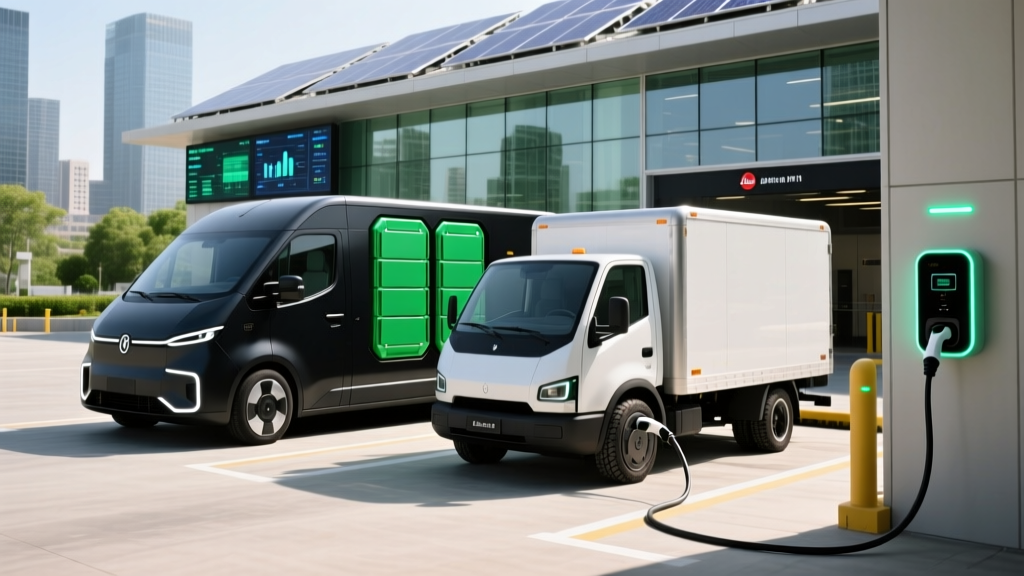
- Class 2b–3 vans (Ford E-Transit, BrightDrop Zevo 600, Rivian EDV): 150–270 mi EPA, 110–200 kWh packs, $45k–$75k base.
- Class 4–6 box trucks (Lightning eMotors, SEA Electric, Ford F-150 Lightning commercial, E-Transit cutaway): 130–200 mi real-world, 150 kW DC peak typical.
- Class 8 semis (Tesla Semi, Freightliner eCascadia, Volvo VNR Electric): 150–500 mi depending on pack, 250 kW–1 MW charging.
- Federal IRC §45W Commercial Clean Vehicle Credit covers up to $7,500 (GVWR <14,000 lb) or $40,000 (≥14,000 lb) for qualified business purchases.
What counts as an "electric commercial vehicle" (and what doesn't)
The term covers battery-electric vehicles (BEVs) purchased or leased for business use, from cargo vans and pickup trucks to step vans, box trucks, and Class 8 semis. It does not include consumer EVs used occasionally for work, nor does it include hydrogen fuel-cell trucks (FCEVs) or hybrids unless specifically labeled PHEV/HEV. For fleet procurement, the useful taxonomy is by GVWR class, because that determines payload, CDL requirements, and which tax credit applies.
| Class | GVWR | Typical body | 2026 examples | Max §45W credit |
|---|---|---|---|---|
| 2b | 8,501–10,000 lb | Cargo van, pickup | Ford E-Transit, Rivian EDV 700 | $7,500 |
| 3 | 10,001–14,000 lb | Cutaway, walk-in | BrightDrop Zevo 600 | $7,500 |
| 4–6 | 14,001–26,000 lb | Box/step van | Lightning eMotors, SEA Electric | $40,000 |
| 7–8 | >26,000 lb | Semi, refuse | Tesla Semi, Freightliner eCascadia, Volvo VNR Electric | $40,000 |
Note: §45W is a business credit, distinct from the consumer §30D credit. It is not refundable but can offset tax liability or, for some tax-exempt entities, be treated as a direct payment. Always confirm eligibility with your tax professional and the latest IRS guidance.
Electric vs diesel commercial vehicles: 5-year TCO compared
The buy decision for fleet managers comes down to TCO, not sticker price. Below is a representative comparison for a Class 2b cargo van running a 120-mile/day urban delivery route, 260 days/year, over 5 years (156,000 miles). Diesel priced at $4.10/gal, commercial electricity at $0.16/kWh, maintenance from fleet benchmark data.
| Line item | Diesel van (e.g., Transit 350) | Electric van (e.g., E-Transit) |
|---|---|---|
| Base MSRP / acquisition | $48,000 | $55,000 |
| §45W credit applied | $0 | –$7,500 |
| Net acquisition | $48,000 | $47,500 |
| Fuel / energy (156k mi) | $31,600 (18 mpg) | $7,500 (2.0 kWh/mi) |
| Maintenance (5 yr) | $9,200 | $3,800 |
| Depot charging install (amortized) | $0 | $4,200 |
| Insurance (5 yr) | $14,500 | $16,800 |
| Resale value (year 5) | –$14,000 | –$11,000 |
| Net 5-yr TCO | $89,300 | $68,800 |
| Cost per mile | $0.57 | $0.44 |
The electric van saves roughly $20,500 over five years, or $0.13/mile, even after including depot charger amortization and higher insurance premiums. Break-even typically occurs between year 2 and year 3 on high-utilization routes.
Real-world range and charging: what the spec sheets don't tell you
EPA range on commercial EVs is measured with a light payload on a standardized cycle. In fleet service, three factors compress that number materially:
- Payload and upfit: A fully loaded E-Transit (3,000 lb cargo + shelving) loses roughly 15–25% of sticker range versus the empty EPA test.
- Cold climate: At 20°F with cabin heat on, expect 25–40% range reduction on LFP packs without a heat pump; 15–25% with a heat pump.
- Highway vs urban: Regenerative braking in stop-and-go recovers meaningful energy. A van rated 126 mi EPA may deliver 140 mi in dense urban routes but only 95 mi at sustained 70 mph.
Charging speed matters as much as pack size. Most 2026 Class 2b–3 vans peak at 115–150 kW DC and taper sharply above 80% state of charge (SoC). A realistic 10–80% session is 35–45 minutes. Class 8 trucks using the Megawatt Charging System (MCS) can pull 750 kW–1 MW, but public MCS stations are still scarce; most fleets rely on private depot chargers at 40–180 kW per stall.
Common misconceptions, corrected
| Myth | Fact |
|---|---|
| "ECVs can't handle a full workday." | Average U.S. commercial van route is ~75 miles/day (DOV/EIA fleet data). A 126-mi EPA van covers 90%+ of routes with a 30% buffer. |
| "Battery replacement will bankrupt the fleet." | Commercial packs carry 8 yr/100,000–150,000 mi warranties at 70% capacity retention. LFP chemistry degrades slower than NMC and is now standard in many vans. |
| "Charging infrastructure is too expensive." | Level 2 depot install runs $4,000–$9,000 per stall; DC fast 60–180 kW runs $40,000–$110,000. Utility make-ready programs and DOE/AFDC state incentives often cover 50–80%. |
| "Diesel is still cheaper." | Only on routes >250 mi/day, rural corridors, or where depot power is unavailable. See TCO table above. |
First-time fleet buyer checklist: what to spec before you sign
First-time ECV buyers consistently underestimate three things: electrical lead times, telematics integration, and driver training. Use this sequence before issuing an RFP:
- Route audit: Pull 90 days of GPS data. Identify the 95th-percentile daily mile figure, not the average. That's your minimum usable range target.
- Payload profile: Weigh a representative loaded vehicle. Apply a 20% range derate to EPA for your spec.
- Climate factor: If your depot sees <32°F for 30+ days/year, require a heat pump and preconditioning capability.
- Depot power assessment: Engage your utility early. A 10-van Level 2 depot at 19.2 kW each is ~192 kW of continuous load — many panels need a transformer upgrade with a 6–12 month lead time.
- Charging strategy: Overnight L2 (cheapest, ~$0.06–$0.10/kWh off-peak) covers most fleets. Add one DC fast charger per 10–15 vehicles for mid-day top-ups.
- Telematics & managed charging: Software that staggers charge start times avoids demand charges, which can double your electricity bill in some utility territories.
- Driver training: One-pedal driving and regen habits reclaim 8–12% range. Budget two hours per driver.
Decision framework: which fleets should electrify now vs wait
Electrify now (2026) if:
- Daily 95th-percentile route is ≤150 miles
- Vehicles return to a single depot nightly
- Utility can deliver >200 kW to the depot within 12 months
- You operate in a state with make-ready or HVIP-style incentives (CA, NY, NJ, CO, MA, WA)
- Annual mileage per vehicle exceeds 20,000 (amortizes the upfront premium faster)
Wait or hybridize if:
- Daily routes exceed 250 miles or include multi-stop intercity legs
- Vehicles park on public streets without charging access
- Depot is in a utility-constrained area with >24 month upgrade lead time
- Your fleet is Class 7–8 long-haul and cannot absorb 5,000–8,000 lb of battery payload penalty
- You need towing >15,000 lb — current BEV pickups lose 30–50% range when max-towing
Consider PHEV/EREV (e.g., Ram 1500 Ramcharger, upcoming Silverado EREV) if: routes are mixed urban/highway and depot charging is partial; you want 40–70 mi electric-only for last-mile with a gas engine for the highway segment.
Frequently asked questions from fleet managers
Can I claim both the §45W commercial credit and a state incentive?
Generally yes. §45W is federal and stacks with most state vouchers (California HVIP, New York Truck Voucher, etc.) and utility rebates. It does not stack with the consumer §30D credit on the same vehicle. Confirm with a tax professional.
How long do commercial EV batteries last before replacement?
Most 2026 commercial packs are warrantied for 8 years / 100,000–150,000 miles at 70% retained capacity. Real-world data from early E-Transit and Lightning eMotors fleets shows ~85–92% State of Health at 100,000 miles with LFP chemistry and proper thermal management. Full pack replacement on a Class 2b van runs $15,000–$25,000 out of warranty; Class 8 semis can exceed $60,000.
Do electric commercial vehicles qualify for the $7,500 consumer tax credit?
No. Business-purchased vehicles fall under §45W, not §30D. The §45W credit is up to $7,500 for vehicles under 14,000 lb GVWR and up to $40,000 for heavier vehicles, subject to sourcing and qualified-manufacturer rules.
What's the biggest hidden cost of ECV adoption?
Demand charges from your utility. Charging 10 vans simultaneously at 19.2 kW each can trigger $15–$25/kW monthly demand charges in some territories — sometimes exceeding the energy cost itself. Managed-charging software that staggers sessions is not optional; it's payback-critical.
Are electric commercial vans slower or less capable than diesel?
No — typically quicker off the line. The E-Transit delivers 266 hp and 317 lb-ft of torque from 0 rpm, with 0–60 mph in the mid-7-second range empty. The trade-off is payload: batteries add 1,000–2,500 lb, which on a Class 2b van reduces usable cargo weight by roughly 500–1,000 lb versus a diesel equivalent.
Should I buy or lease commercial EVs?
Leasing transfers battery-degradation risk and often lets the lessor monetize the §45W credit, passing savings via a lower money factor. Buying makes sense if your tax liability can absorb the credit and you plan to hold the vehicle past the warranty period. Run both scenarios with your actual route data.
Bottom line for 2026 fleet procurement
Electric commercial vehicles have crossed the TCO break-even line for the majority of urban and last-mile duty cycles, supported by the §45W credit, maturing LFP packs, and expanding depot-charging supply chains. The decision is no longer "if" but "which routes first." Start with your shortest, highest-utilization loops, secure utility make-ready capacity, and expand as DC infrastructure and Class 8 range improve through 2027–2028.