Short Answer: Is Rivian Chinese?
No. Rivian is an American company, founded in 2009 by RJ Scaringe in Irvine, California. Its vehicles are engineered in California and manufactured at a 6.2-million-square-foot plant in Normal, Illinois — a former Mitsubishi facility that Rivian retooled for EV production. The company went public on NASDAQ (ticker: RIVN) in November 2021 and sources battery cells from Samsung SDI and, more recently, LG Energy Solution's U.S. operations.
The confusion occasionally surfaces in EV forums because Rivian's early financial backers include Amazon (which ordered 100,000 EDV delivery vans) and because some components, like many automotive electronics, originate from global suppliers. But the brand's headquarters, R&D, and production are firmly U.S.-based.
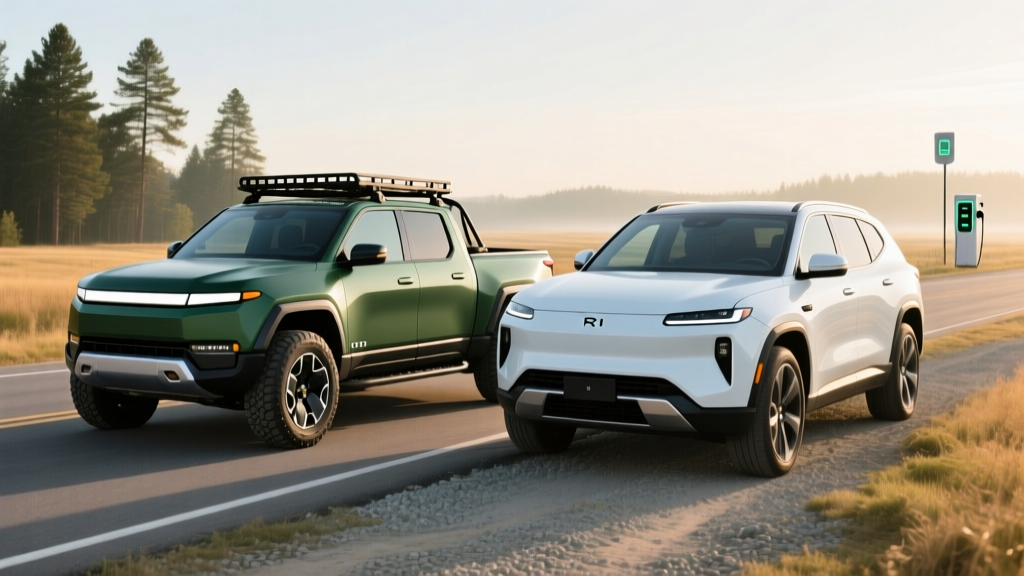
With origins clarified, the real question for buyers is whether Rivian's flagship consumer vehicles — the R1T pickup and R1S SUV — hold up against the competition in 2026. Below, we break down range, charging, pricing, and tax-credit eligibility with the exact numbers you need.
2026 Rivian R1T and R1S: Platform and Powertrain Overview
For the 2026 model year, both the R1T (crew-cab pickup) and R1S (three-row SUV) ride on Rivian's updated Generation 2 platform, which introduced a more efficient dual-motor drive unit, a redesigned thermal management system, and an upgraded interior with a faster infotainment processor.
| Spec | R1T (Pickup) | R1S (SUV) |
|---|---|---|
| Drivetrain | Dual-Motor AWD | Dual-Motor AWD |
| Horsepower | 665 hp | 665 hp |
| Torque | 829 lb-ft | 829 lb-ft |
| 0–60 mph | 3.4 seconds | 3.6 seconds |
| Battery (usable) | ~149 kWh (NMC) | ~149 kWh (NMC) |
| EPA Range | 420 miles | 390 miles |
| MPGe (combined) | 73 MPGe | 70 MPGe |
| kWh/100 mi | 46 | 48 |
| Max DC Fast Charge | 220 kW (peak) | 220 kW (peak) |
| 10–80% DC Time | ~30 minutes | ~30 minutes |
| Level 2 Home Charge | 11.5 kW (~25 mi/hr) | 11.5 kW (~25 mi/hr) |
| Towing Capacity | 11,000 lbs | 7,700 lbs |
| Battery Warranty | 8 yr / 175,000 mi | 8 yr / 175,000 mi |
Rivian offers three battery configurations for 2026: the Standard (~95 kWh, NMC), the Large (~119 kWh, NMC), and the Max Pack (~149 kWh, NMC). All use nickel-manganese-cobalt (NMC) chemistry, which delivers higher energy density than LFP but requires more careful state-of-charge management — Rivian recommends daily charging to 80–90% and periodic 100% calibration.
Real-World Range: What to Actually Expect
Rivian's EPA figures are competitive, but the R1T's brick-like aerodynamics (Cd ≈ 0.30) and 7,100-lb curb weight mean highway efficiency suffers compared to sleeker sedans. In our experience, sustained 75-mph interstate driving in moderate temperatures yields roughly 2.1–2.3 kWh/mile, translating to around 340–360 real-world miles from the Max Pack before you're hunting for a charger.
Cold weather compounds the loss. Without a dedicated heat pump in early Gen 1 models (Gen 2 introduced an improved resistive-plus-heat-pump hybrid system), expect 15–25% range reduction in sub-freezing temperatures. Preconditioning the battery while plugged in recovers some of this, but winter road-trippers should plan conservatively.
Charging Speed: DC Fast and Home Level 2
Rivian's Gen 2 platform supports up to 220 kW peak DC fast charging on the Max Pack. That's behind the Hyundai Ioniq 5's 350-kW peak and the Tesla Cybertruck's ~250-kW capability, but Rivian's large battery means the charge curve stays relatively flat for longer.
| Level | Power / Rate | Miles Added per Hour | Notes |
|---|---|---|---|
| Level 1 (120V) | 1.4 kW | ~3 mi/hr | Emergency/trickle only |
| Level 2 (240V, 48A) | 11.5 kW | ~25 mi/hr | Full overnight charge in ~13 hr (Max) |
| DC Fast (peak) | 220 kW | — | 10–80% in ~30 min (Max Pack) |
| DC Fast (sustained avg) | ~150 kW | — | Curve tapers significantly above 80% |
The 10–80% time of ~30 minutes is acceptable for road-trip stops, but the taper above 80% is steep — plan to unplug at 80% and drive rather than wait for a full top-off. On the Rivian Adventure Network, which the company is expanding along popular outdoor corridors, you'll find chargers optimized for Rivian's curve, but coverage remains sparse compared to Tesla's Supercharger network (which Rivian owners can now access via the NACS adapter included with 2025+ models).
For home charging, a 48-amp Level 2 station on a 60-amp circuit delivers the full 11.5 kW, adding roughly 25 miles per hour of charging. A Standard-pack R1T charges fully overnight in about 8 hours; the Max Pack requires closer to 13 hours. Budget $500–$1,500 for a quality Level 2 EVSE (ChargePoint Home Flex, Emporia Level 2, or Wallbox Pulsar Plus) and $800–$2,500 for electrician installation depending on panel proximity and local permit costs.
Pricing, Trims, and Federal Tax Credit Eligibility
The 2026 Rivian lineup starts at a more accessible point than earlier years, though it remains a premium offering:
| Model / Trim | Base MSRP | Federal §30D Credit | Effective Price |
|---|---|---|---|
| R1T Dual-Motor Standard | $69,900 | Up to $7,500* | ~$62,400 |
| R1T Dual-Motor Large | $75,900 | Up to $7,500* | ~$68,400 |
| R1T Dual-Motor Max | $84,900 | Up to $7,500* | ~$77,400 |
| R1S Dual-Motor Standard | $74,900 | Up to $7,500* | ~$67,400 |
| R1S Dual-Motor Max | $89,900 | Up to $7,500* | ~$82,400 |
*Federal tax credit eligibility under IRS §30D is not guaranteed for every buyer. Requirements include:
- MSRP cap: Pickup trucks (R1T) must not exceed $80,000 MSRP; SUVs (R1S) must not exceed $80,000. Max-pack R1S trims may exceed this threshold — verify window sticker pricing.
- Income cap: Modified AGI must not exceed $150,000 (single), $225,000 (head of household), or $300,000 (joint).
- Battery sourcing: A percentage of critical minerals and battery components must be sourced from the U.S. or FTA partners. Rivian has been progressively reshoring its supply chain, but the exact credit amount ($3,750 for minerals, $3,750 for components, up to $7,500 total) can vary by production batch and model year. Confirm with your tax professional.
- Point-of-sale transfer: As of 2024+, eligible buyers can transfer the credit to the dealer at purchase, reducing the purchase price directly rather than waiting for a tax refund.
Rivian's U.S. manufacturing in Normal, Illinois, gives it a structural advantage over imports for §30D qualification, but the MSRP cap on the R1S (classified as an SUV at the $80,000 ceiling) means top-trim models may lose eligibility. Always check the specific VIN on fueleconomy.gov before purchasing.
Cargo, Passenger Space, and Daily Practicality
The R1T's 4.5-foot bed (54.5 inches) is shorter than a full-size F-150's, but Rivian compensates with the Gear Tunnel — a lockable, full-width pass-through storage compartment behind the rear seats offering 11.7 cubic feet of space. Combined with the 11-cubic-foot frunk, total enclosed cargo capacity reaches roughly 43 cubic feet across bed, tunnel, and frunk.
The R1S offers three rows with seating for up to seven. Behind the third row, cargo volume is approximately 10.4 cubic feet; fold the third row for 46.7 cubic feet, and fold both rear rows for 104.7 cubic feet. Rear legroom in the second row is a generous 38.9 inches, though the third row is best suited for children on longer trips.
Both vehicles feature Rivian's distinctive Camp Kitchen option (R1T), an integrated slide-out kitchen module that fits the Gear Tunnel, and a powered tonneau cover that retracts into the bed wall. These lifestyle-oriented features differentiate Rivian from more utilitarian competitors.
Driver Assistance and Technology
The 2026 infotainment system runs on a 15.6-inch center display with a redesigned UI, native route planning that accounts for charging stops, and over-the-air updates. Apple CarPlay is supported (wireless), but Android Auto integration has historically been limited — Rivian prefers its native interface. The 12.3-inch digital instrument cluster and optional head-up display round out the tech suite.
Notable drawbacks: The R1T and R1S lack Apple CarPlay's full-screen navigation overlay in some firmware versions, and Rivian's mobile app has drawn mixed reviews for connectivity latency. The driver-assist system, while competent, trails GM's Super Cruise and Ford's BlueCruise in hands-free highway coverage area.
Pros, Cons, and Who Should Buy
Pros
- Class-leading 420-mile EPA range (R1T Max)
- U.S.-built, strong §30D credit eligibility potential
- 11,000-lb towing capacity (R1T) with integrated trailer brake controller
- Gear Tunnel and frunk offer versatile, enclosed storage
- 3.4-second 0–60 in a full-size pickup
- Strong OTA update cadence and active community
- NACS adapter included — Tesla Supercharger access
Cons
- DC fast charge peaks at 220 kW — slower than 800V rivals
- R1S Max Pack may exceed $80K SUV MSRP cap for tax credit
- Third-row space in R1S is tight for adults
- Service center network still expanding — rural wait times can be long
- No Android Auto; CarPlay integration can be inconsistent
- Real-world highway and cold-weather range drops are significant
Who Should Buy a Rivian?
Choose the R1T if you need a daily-drivable electric pickup with serious towing capability, love outdoor adventure features (Gear Tunnel, Camp Kitchen), and can install Level 2 home charging. It's ideal for one-truck households that tow boats or trailers on weekends and commute during the week.
Choose the R1S if you want a three-row electric SUV with more personality than a Tesla Model X and don't need the third row for full-time adult passengers. It competes directly with the Kia EV9 and BMW iX in price but offers more range and off-road capability.
Look elsewhere if you need the fastest possible DC charging (consider Hyundai Ioniq 5 or Kia EV6 with 800V architecture), require widespread dealer service access (consider Ford or GM), or need a sub-$50,000 entry price.
Frequently Asked Questions
Is Rivian made in China?
No. Rivian is headquartered in Irvine, California, and all consumer vehicles (R1T, R1S) are manufactured in Normal, Illinois. Some electronic components are globally sourced, as is standard across the auto industry, but the company is American-founded and American-built.
What is the real-world range of the Rivian R1T?
The EPA rates the R1T Max Pack at 420 miles. In mixed highway driving at 70 mph, expect 340–360 miles. Towing a 5,000-lb trailer drops that to roughly 280–310 miles. In sub-30°F conditions, plan for 300–330 miles with preconditioning.
How fast does the Rivian R1T charge?
On a DC fast charger, the Max Pack peaks at 220 kW, achieving a 10–80% charge in approximately 30 minutes. At home on a 48-amp Level 2 charger (11.5 kW), expect roughly 25 miles of range per hour of charging, or a full charge in about 13 hours for the Max Pack.
Does the Rivian R1S qualify for the $7,500 federal tax credit?
It depends on the trim. The R1S is classified as an SUV with an $80,000 MSRP cap under IRS §30D. Standard and Large battery trims typically fall under this cap, but a fully optioned Max Pack R1S may exceed it. Additionally, buyer income limits and battery-sourcing requirements apply. Verify the specific vehicle's eligibility on fueleconomy.gov and consult a tax professional.
Is the Rivian R1T worth it over the Ford F-150 Lightning?
The R1T offers more range (420 vs. 320 miles on top trims), faster acceleration (3.4 vs. ~3.8 seconds), and unique adventure features. The F-150 Lightning has a longer bed (5.5 ft), wider dealer/service network, and a lower starting price. If you prioritize range and performance, the R1T wins. If you need a traditional full-size bed and easy service access, the Lightning is more practical.
What battery chemistry does Rivian use?
Rivian currently uses NMC (nickel-manganese-cobalt) lithium-ion cells supplied by Samsung SDI and LG Energy Solution. NMC offers high energy density, which enables the Max Pack's 420-mile range, but it is more sensitive to sustained high state-of-charge than LFP chemistry. Rivian recommends daily charging to 80–90% for longevity.
How is Rivian's service and warranty coverage?
Rivian provides an 8-year/175,000-mile battery and drive-unit warranty, which is among the most generous in the industry (most competitors offer 8-year/100,000-mile). The bumper-to-bumper warranty is 5 years/60,000 miles. Service is handled through Rivian's own service centers and mobile service vans, though coverage in rural areas is still expanding as of 2026.