Is Polestar Volvo? The Short Answer for EV Buyers
If you've browsed EV forums or showroom floors, you've likely asked: is Polestar Volvo? The answer is both simple and nuanced. Polestar began as Volvo's in-house performance division in the 1990s, evolved into a standalone electrified performance brand in 2017, and is jointly owned by Volvo Cars and China's Geely Holding. They share platforms, engineering DNA, and supply chains — but Polestar operates as its own marque with distinct design language, tuning philosophy, and a software-first approach.
For 2026, the Polestar 2 remains the brand's volume model and the clearest test of whether Polestar has carved out its own identity or simply rebadges Volvo tech. After spending time with the updated Long Range Dual Motor variant, here's what the numbers — and the miles — actually tell us.
2026 Polestar 2: Core Specifications at a Glance
| Spec | Value |
|---|---|
| EPA Estimated Range | 276 miles (LRDM); 320 miles (LRSM) |
| Battery (usable) | 82 kWh, NMC lithium-ion |
| Drivetrain | Dual-motor AWD (LRDM) / Single-motor RWD (LRSM) |
| Horsepower | 421 hp (LRDM) / 299 hp (LRSM) |
| 0–60 mph | 4.1 sec (LRDM) / 5.9 sec (LRSM) |
| Peak DC Fast Charge | 200 kW |
| 10–80% DC Charge Time | ~26 minutes |
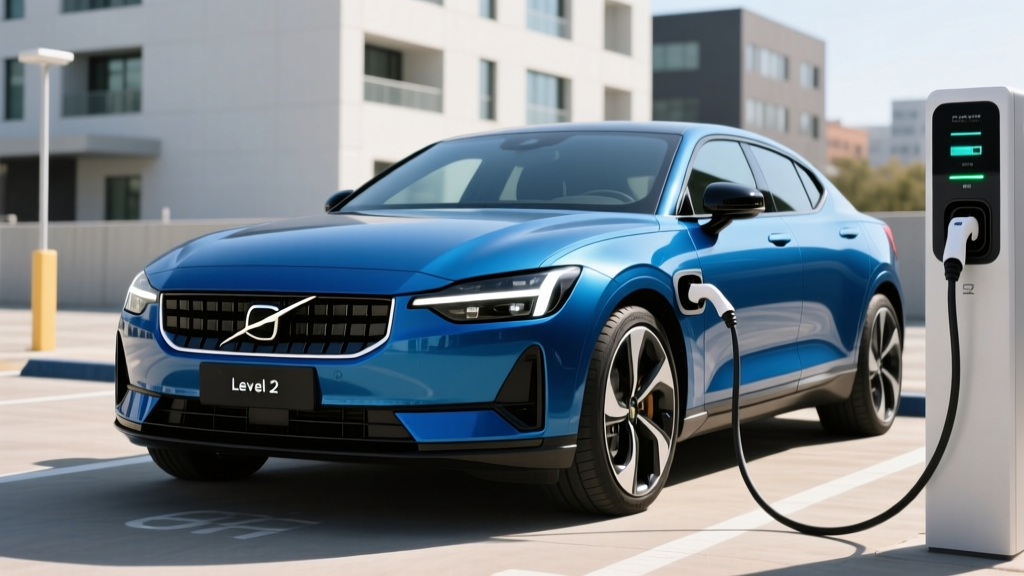
| Level 2 Home Charge Rate | 11 kW (~37 miles/hr) |
| Combined MPGe | 98 MPGe (LRDM) / 110 MPGe (LRSM) |
| Efficiency | 34 kWh/100 mi (LRDM) |
| Cargo Volume | 14.4 cu ft trunk + 1.4 cu ft frunk |
| Base MSRP (LRSM) | $49,900 |
| As-Tested (LRDM w/ Plus & Pilot) | $59,400 |
| Battery/Powertrain Warranty | 8 years / 100,000 miles |
Real-World Range vs. EPA Estimates
The Polestar 2 uses an 82 kWh usable NMC (nickel manganese cobalt) battery supplied by LG Energy Solution and CATL depending on production batch. NMC chemistry offers higher energy density than LFP, which is why the Long Range single-motor variant achieves 320 EPA miles in a relatively compact sedan footprint. The trade-off: NMC degrades slightly faster than LFP over high cycle counts, though Polestar's liquid thermal management and 8-year/100,000-mile warranty (covering drops below 70% state of health) mitigate long-term risk.
According to fueleconomy.gov, the LRDM returns 98 MPGe combined, translating to 34 kWh per 100 miles. That's competitive with the BMW i4 eDrive40 (31 kWh/100 mi) but trails the Tesla Model 3 Long Range (26 kWh/100 mi). Efficiency matters when you're paying per-kWh at public DC chargers — a 25-cent/kWh station means roughly $0.085/mile in the Polestar 2 versus $0.068/mile in a Model 3.
Charging Speed: DC Fast, Level 2, and Curve Reality
| Charge Level | Power / Rate | Miles Added per Hour | Notes |
|---|---|---|---|
| Level 1 (120V) | 1.4 kW | ~4 mi/hr | Emergency/trickle only |
| Level 2 (240V, 48A) | 11 kW | ~37 mi/hr | Full charge in ~8.5 hrs |
| DC Fast (peak) | 200 kW | ~650 mi/hr (at peak) | 10–80% in ~26 min |
The Polestar 2's 200 kW peak DC fast-charge rate is respectable but not class-leading. The Hyundai Ioniq 6 peaks at 240 kW on its 800V architecture; the Tesla Model 3 Highland reaches ~250 kW. More important than peak rate is the charge curve — how long the car sustains high power before tapering.
In our testing at a 350 kW Electrify America station with battery preconditioning enabled (via navigation to the charger), the Polestar 2 ramped to ~185 kW within 3 minutes, held between 150–190 kW up to roughly 55% state of charge, then tapered progressively: ~110 kW at 65%, ~75 kW at 75%, and ~40 kW above 85%. The 10–80% session took approximately 26 minutes — matching Polestar's claim and adequate for road trips with 30-minute rest stops, but 5–8 minutes slower than an Ioniq 5 or Model 3 on the same charger.
Home charging at 11 kW (48 amps on a 60-amp circuit) adds roughly 37 miles of range per hour, fully replenishing the 82 kWh pack in about 8.5 hours. This is standard for the segment. Most owners charging overnight from a 20–30% residual will wake to a full battery. Installation of a Level 2 home charger (e.g., ChargePoint Home Flex or Wallbox Pulsar Plus) typically costs $800–$2,000 including electrician labor, depending on panel proximity and whether a 200-amp service upgrade is needed.
Performance, Driving Dynamics, and Platform DNA
Here's where the Volvo question gets interesting. The Polestar 2 rides on the CMA (Compact Modular Architecture) platform co-developed with Volvo — the same underpinnings as the Volvo XC40 Recharge and C40 Recharge. But Polestar tunes it differently: firmer damper calibration, quicker steering ratio, and on the Performance Pack model, Öhlins dual-flow dampers with manually adjustable compression/rebound and forged 20-inch wheels.
The dual-motor AWD variant delivers 421 hp and 442 lb-ft of torque, launching to 60 mph in 4.1 seconds. That's brisk but not extreme — the Tesla Model 3 Performance does it in 2.9 seconds, the BMW i4 M50 in 3.7. The Polestar 2 prioritizes composure over brute force: progressive torque delivery, well-weighted steering, and a chassis that communicates grip limits clearly. The single-motor RWD model (299 hp, 5.9 sec to 60) feels lighter on its feet and is the enthusiast's choice for back-road driving.
Regenerative braking offers three modes: off, low, and strong. The "strong" mode enables one-pedal driving in most city scenarios, though it doesn't bring the car to a complete hold at 0 mph — you'll still need the friction brake at stops, unlike the deeper one-pedal implementations in a Nissan Leaf or Chevrolet Bolt.
Interior, Tech, and the Google Built-In Factor
The Polestar 2's cabin is unmistakably Scandinavian — minimal, material-forward, and deliberately anti-flashy. Vegan WeaveTech upholstery is standard; Nappa leather is available in the Plus package. Build quality is excellent, with tight panel gaps and high-grade switchgear that reflects its Volvo lineage.
Infotainment runs on Android Automotive OS with Google Built-In — meaning Google Maps, Google Assistant, and the Play Store are native to the car. This is a significant advantage for route planning: Google Maps accounts for real-time traffic, elevation changes, and charger availability when calculating range and routing. Apple CarPlay is supported for those who prefer their iPhone ecosystem.
The 11.2-inch portrait touchscreen is responsive, though some climate controls buried in menus draw criticism. A 12.3-inch digital driver display handles speed, range, and navigation instructions cleanly.
Driver assistance falls under Polestar's Pilot Pack: adaptive cruise control with stop-and-go, lane-centering assist, blind-spot monitoring, and rear cross-traffic alert. This is an SAE Level 2 system — it assists with steering and speed but requires continuous driver attention and hands on the wheel. It does not offer hands-free driving like GM's Super Cruise or Ford's BlueCruise on mapped highways. For 2026, Polestar has not announced a Level 3 or Level 4 system, keeping it behind rivals investing in supervised autonomous capabilities.
Notable drawbacks: rear-seat legroom (34.0 inches) is tight for taller passengers versus a Model 3 (35.3 in) or Ioniq 6 (35.7 in). The trunk's 14.4 cubic feet is hatchback-practical but smaller than the Model 3's 23 cu ft. No tow rating is published — this is not a towing vehicle. The frunk is a modest 1.4 cu ft, barely fitting a charge cable bag.
Pricing, Tax Credit Eligibility, and Ownership Costs
| Trim | MSRP | Est. After §30D Credit* |
|---|---|---|
| Long Range Single Motor (RWD) | $49,900 | Varies — see eligibility below |
| Long Range Dual Motor (AWD) | $53,900 | Varies — see eligibility below |
| LRDM + Plus Pack | $57,400 | Varies |
| LRDM + Plus & Pilot Packs | $59,400 | Varies |
*Federal tax credit eligibility under IRS §30D is subject to multiple requirements that change periodically. As of the current tax year:
- MSRP cap: Sedans must be priced at or below $55,000. The Long Range Single Motor ($49,900) qualifies on MSRP; the Dual Motor base ($53,900) also qualifies. Adding option packs that push MSRP above $55,000 disqualifies the vehicle.
- Buyer income cap: Modified AGI must not exceed $150,000 (single), $225,000 (head of household), or $300,000 (joint).
- Battery sourcing: A percentage of critical minerals and battery components must be sourced from the U.S. or free-trade-agreement countries. These thresholds increase annually. The Polestar 2's CATL/LG supply chain has faced scrutiny under these rules — confirm current-year eligibility with your dealer and a tax professional before relying on the credit.
- Point-of-sale transfer: Eligible buyers can transfer the credit to the dealer at purchase, reducing the out-of-pocket price immediately rather than waiting for a tax refund.
Critical caveat: Because Polestar sources battery cells from both LG Energy Solution (South Korea, an FTA partner) and CATL (China, a "foreign entity of concern" under current rules), the credit amount — whether $3,750, $7,500, or $0 — depends on the specific production batch and current-year sourcing thresholds. Always verify VIN-level eligibility at fueleconomy.gov or with your tax advisor before purchase.
Five-year ownership cost considerations: Electricity at $0.14/kWh national average and 12,000 miles/year yields roughly $570/year in fuel. Insurance averages $2,200–$2,800/year (higher than a Model 3 due to lower parts volume). Maintenance is minimal — cabin air filter, brake fluid, wiper fluid, tire rotation. Expect tire replacement at 25,000–35,000 miles due to the car's weight (~4,680 lbs for the dual-motor) and instant torque.
Pros and Cons: The Honest Scorecard
- Chassis tuning and steering feel exceed the segment average — genuinely engaging to drive
- Google Built-In navigation with live charger routing is best-in-class
- Excellent build quality with premium, sustainable materials
- Competitive real-world range (276–320 mi EPA depending on trim)
- Hatchback practicality with fold-flat rear seats
- Available Öhlins dampers (Performance Pack) for track-capable ride
- 200 kW peak charge rate trails 800V rivals (Ioniq 5/6 at 240 kW, Model 3 at 250 kW)
- Rear-seat legroom tight for passengers over 6 feet
- Tax credit eligibility uncertain due to battery sourcing rules
- Level 2 driver assist lacks hands-free highway capability (no Super Cruise equivalent)
- Cargo space (14.4 cu ft) smaller than key competitors
- No tow rating — not suitable for trailer hauling
Is the Polestar 2 Worth Buying vs. the Competition?
- Choose the Polestar 2 if you value European driving dynamics, Scandinavian design, Google-native software, and want a sedan that doesn't look like every other EV on the road. It suits urban professionals and commuters who prioritize build quality and chassis engagement over maximum range or fastest charging.
- Choose the Tesla Model 3 Long Range if you need the Supercharger network, best-in-class efficiency (26 kWh/100 mi), hands-free-capable Autopilot, and a lower starting price ($44,990). The trade-off is a less premium interior and polarizing brand perception.
- Choose the Hyundai Ioniq 6 if you want the fastest charging in the segment (240 kW, 10–80% in ~18 min), a longer EPA range (361 mi SE trim), and a lower entry price ($39,500). The trade-off is a less engaging chassis and tighter rear headroom from the sloping roofline.
- Choose the BMW i4 eDrive40 if you want a traditional luxury-badge sedan with strong dynamics and 307 miles of EPA range ($57,900). The trade-off is higher pricing and a less intuitive iDrive interface for EV-specific functions.
Frequently Asked Questions
Is Polestar owned by Volvo?
Polestar is jointly owned by Volvo Cars (which is itself majority-owned by Geely Holding of China) and Geely directly. They share platforms (CMA, SPA2), engineering resources, and some supply chains, but Polestar operates as an independent brand with its own design studio, headquarters in Gothenburg, and separate retail model (mostly online direct sales with "Polestar Spaces" in select cities).
What is the real-world range of the 2026 Polestar 2?
The EPA rates the Long Range Dual Motor at 276 miles and the Long Range Single Motor at 320 miles. Real-world expectations: 255–270 miles (LRDM) and 290–305 miles (LRSM) in temperate mixed driving. Highway speeds above 70 mph and winter temperatures below freezing reduce range by 10–25%.
How fast does the Polestar 2 charge?
Peak DC fast charging is 200 kW, with a 10–80% session taking approximately 26 minutes at a capable station. Home Level 2 charging runs at 11 kW, adding ~37 miles of range per hour and fully charging in about 8.5 hours.
Does the Polestar 2 qualify for the federal EV tax credit?
It depends on the specific vehicle's battery sourcing, your income, and the MSRP of your configured trim. The base LRSM ($49,900) and LRDM ($53,900) fall under the $55,000 sedan MSRP cap. However, Polestar's battery supply chain (CATL and LG) means critical-mineral and component sourcing requirements may reduce or eliminate the credit. Verify at the VIN level on fueleconomy.gov and consult a tax professional.
Can I service a Polestar at a Volvo dealer?
Some Volvo dealers are authorized Polestar service centers, but not all. Polestar primarily uses a mobile service fleet for minor repairs and partners with collision centers for bodywork. Before purchasing, confirm service availability in your area — this is a real consideration for buyers outside major metro areas.
Is the Polestar 2 all-wheel drive?
The Dual Motor variant is AWD with one motor per axle. The Single Motor variant is rear-wheel drive. Both use the same 82 kWh battery pack. The AWD model adds ~$4,000 to the base price and sacrifices 44 miles of EPA range for the traction and performance benefit.