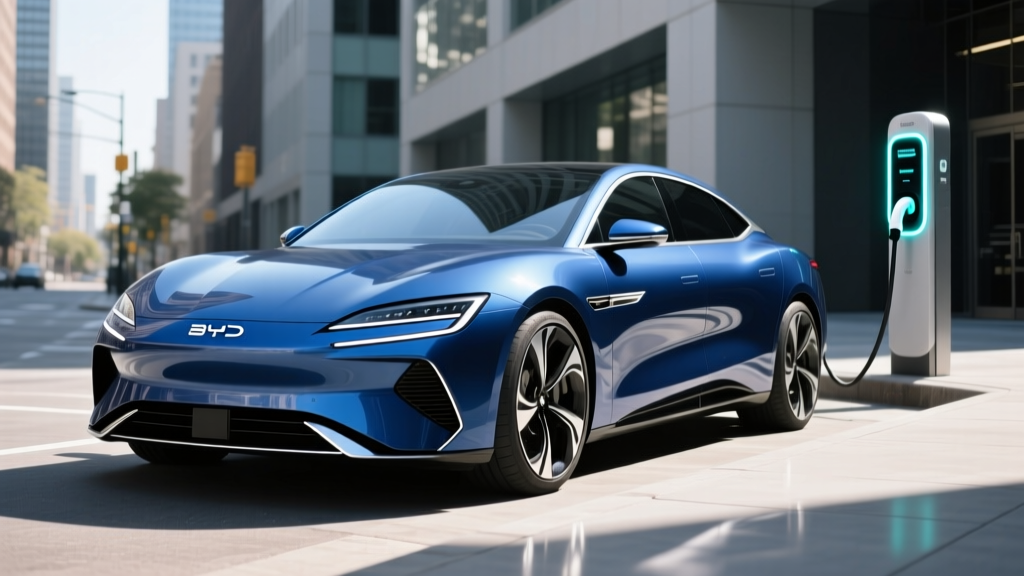
BYD (Build Your Dreams) is the world's largest manufacturer of plug-in electric vehicles, routinely trading the global sales crown with Tesla. Yet for American shoppers typing "is BYD sold in USA" into search engines, the answer remains frustratingly complex. As of early 2026, BYD does not sell passenger cars or SUVs to US consumers. You cannot walk into a US dealership and buy a BYD Seal, Dolphin, Atto 3, or Seagull.
However, BYD's footprint in the United States is real—and growing in adjacent sectors. The company operates a Lancaster, California factory that builds heavy-duty electric transit buses, and its batteries power everything from Tesla-built vehicles to grid-scale energy storage. Understanding BYD's American reality requires unpacking a web of tariffs, sourcing rules, and geopolitical friction that has kept the brand's consumer cars on the other side of the border.
Why BYD Passenger Cars Aren't Sold in the US (2026 Status)
Three compounding barriers keep BYD out of the US passenger-vehicle market:
- 100% tariff on Chinese-built EVs. In mid-2024, the Biden administration raised the Section 301 tariff on Chinese-manufactured electric vehicles from 25% to 100%, effective August 2024 and continuing through 2026. A $30,000 BYD Seagull effectively becomes a $60,000 car before it reaches a showroom floor—eliminating the price advantage that makes BYD disruptive in Europe, Southeast Asia, and Latin America.
- National security and data concerns. Connected vehicles from Chinese manufacturers face scrutiny under Department of Commerce rules targeting hardware and software that could transmit driver data to foreign adversaries. These proposed rules, introduced in 2024, effectively ban Chinese and Russian connected-vehicle tech from US roads.
- No US dealership network. Even absent tariffs, BYD has made no public commitment to establishing the franchise-dealer infrastructure required to sell, service, and warranty passenger cars across 50 states. BYD's US presence is limited to commercial vehicles.
BYD executives have confirmed in multiple interviews that the US passenger market is not a near-term priority. Instead, the company is aggressively expanding in Mexico, Brazil, Thailand, Australia, and the European Union—markets where tariffs are lower (though the EU imposed its own countervailing duties on Chinese EVs in late 2024).
BYD's Actual US Footprint: Buses, Batteries, and Supply Chain
BYD is not absent from America—it's just invisible to car shoppers.
- BYD Lancaster, California: Since 2013, this facility has manufactured battery-electric transit buses and motor coaches for US transit agencies. It employs roughly 750 workers and is one of the few EV manufacturing plants in California.
- Battery supply: BYD's Blade Battery (an LFP cell) supplies multiple automakers globally. Tesla's Berlin-built Model Y has used BYD LFP packs. Toyota's bZ3 sedan in China uses BYD batteries and motors. While these specific configurations don't reach US consumers directly, BYD cells flow into the global supply chain.
- Energy storage: BYD's Cube Pro and other utility-scale LFP battery systems are deployed in US grid-storage projects.
| Category | US Availability | Global Status |
|---|---|---|
| Passenger cars (Seal, Dolphin, Seagull) | Not sold | Sold in 70+ countries |
| SUVs (Atto 3 / Yuan Plus, Tang) | Not sold | Top sellers in EU, AU, LATAM |
| Pickups (Shark PHEV) | Not sold | Launched 2024–2025 in select markets |
| Transit buses (K-series, C-series) | Built in Lancaster, CA | Global leader |
| Battery supply (Blade LFP) | Indirect (via OEMs, storage) | Supplies Tesla, Toyota, others |
What a BYD Seal Would Cost in the US (Hypothetical Pricing)
Because BYD doesn't sell here, there's no official MSRP, EPA sticker, or §30D tax credit eligibility to quote. But we can model what a BYD Seal (the company's Tesla Model 3 competitor) would look like if tariffs didn't exist.
| Variant | China MSRP (≈ USD) | EU MSRP | Hypothetical US (no tariff) | Hypothetical US (100% tariff) |
|---|---|---|---|---|
| Seal Design (RWD, 82.5 kWh) | ~$27,500 | €45,000 (~$49,000) | ~$38,000 | ~$76,000 |
| Seal Excellence (AWD, 82.5 kWh) | ~$32,000 | €48,000 (~$52,000) | ~$43,000 | ~$86,000 |
| Seagull (compact, 38 kWh) | ~$10,000 | Not yet sold | ~$20,000 | ~$40,000 |
The math is brutal. The 100% tariff roughly doubles the landed cost, pushing even the budget Seagull into the price territory of a Chevrolet Equinox EV or Nissan LEAF—vehicles with US dealer networks, NHTSA crash-test data, and established parts supply. This is why BYD has publicly stated the US isn't on its 2025–2027 passenger-car roadmap.
BYD Seal: What We Know From Global Testing
For enthusiasts who might encounter a BYD abroad, or who are simply benchmarking the brand, here's what the Seal delivers in markets where it's actually sold.
| Spec | Design (RWD) | Excellence (AWD) |
|---|---|---|
| Battery | 82.5 kWh LFP Blade | 82.5 kWh LFP Blade |
| WLTP range | 354 mi (570 km) | 323 mi (520 km) |
| Estimated EPA range | ~300 mi | ~275 mi |
| Max DC charge rate | 150 kW peak | 150 kW peak |
| 10–80% DC time | ~26 min | ~26 min |
| Level 2 (AC) rate | 11 kW (≈ 30 mi/hr) | 11 kW (≈ 30 mi/hr) |
| 0–60 mph | 5.9 sec | 3.8 sec |
| Horsepower | 308 hp | 523 hp |
| Drivetrain | Rear-wheel drive | Dual-motor AWD |
The BYD Blade Battery is a cell-to-pack LFP design with exceptional thermal stability—BYD's famous nail-penetration test shows no thermal runaway. LFP sacrifices some energy density versus NMC (hence the Seal's ~4,100-lb curb weight), but delivers longer cycle life and reduced fire risk. BYD warranties the pack for 8 years/100,000 miles in most markets, with a 70% state-of-health retention threshold—comparable to Tesla and Hyundai's US warranties.
Federal Tax Credits Would Not Apply Anyway
Even if BYD established US sales, its vehicles would almost certainly fail to qualify for the §30D federal EV tax credit under current rules:
- Battery sourcing requirement: The credit phases in strict requirements for critical minerals and battery components to be sourced from the US or free-trade-agreement partners. BYD's vertically integrated Chinese supply chain would not meet these thresholds.
- Foreign Entity of Concern (FEOC) exclusion: Vehicles containing battery components from a FEOC (a designation broadly applied to Chinese battery manufacturers) are ineligible for any §30D credit beginning in 2024 for components and 2025 for critical minerals.
- MSRP caps: The Seal would likely land under the $55,000 sedan cap, but the sourcing disqualifier is the real barrier.
- Buyer income caps: AGI limits of $150K single / $300K joint still apply regardless of the vehicle.
Net result: A hypothetical US-spec BYD Seal would sticker around $38,000 to $43,000, receive $0 in federal tax credits, and carry a 100% import tariff. The math simply doesn't work for BYD or for American buyers.
What to Buy Instead: US-Market Alternatives to BYD Models
Shoppers intrigued by BYD's value proposition can find competitive—and actually purchasable—alternatives in the US market as of 2026:
If you want a BYD Seal → Buy a Tesla Model 3 RWD
- EPA 363 mi range vs. Seal's ~300 mi estimated
- 250 kW peak DC charging (10–80% in ~18 min)
- Eligible for up to $7,500 §30D credit at point of sale
- US Supercharger network access
- Base MSRP ~$38,990 before credit
If you want a BYD Atto 3 → Buy a Hyundai Kona Electric
- EPA 261 mi range
- 100+ kW DC charging
- US warranty, dealer network, IIHS Top Safety Pick
- Base MSRP ~$32,975
If you want a BYD Seagull → Wait or buy a used Bolt
- No sub-$25K new EVs are widely available in the US in 2026
- Used Chevy Bolt (2022–2023) offers 259 mi EPA from ~$18K
- Eligible for up to $4,000 used-EV credit (§25E)
The Bottom Line: BYD's US Passenger Future
As of 2026, BYD passenger vehicles are not sold in the United States, and no model-year launch has been announced. The combination of 100% tariffs, FEOC battery-sourcing rules, and geopolitical headwinds makes a US consumer launch unlikely before 2028 at the earliest. BYD's own executives have pointed to Mexico and Brazil as near-term growth markets, with the company building a passenger-vehicle factory in Thailand and planning one in Indonesia and Hungary.
For US shoppers, BYD remains relevant in two ways: as a benchmark for what value-oriented EVs could cost absent trade barriers, and as a battery supplier whose LFP Blade cells are quietly appearing in vehicles from other brands. If you encounter a BYD Seal on a European road trip or a BYD transit bus in your city, you're looking at the same engineering that would reshape the US market—if Washington ever opened the door.
Frequently Asked Questions
Is BYD sold in the USA in 2026?
No. BYD does not sell passenger cars or SUVs to US consumers. The company does manufacture electric transit buses in Lancaster, California, and supplies batteries to other OEMs and energy-storage projects, but no BYD-branded consumer vehicle is available through US dealerships.
Why aren't BYD cars available in America?
Three main factors: a 100% Section 301 tariff on Chinese-built EVs (effective August 2024), Department of Commerce rules restricting connected-vehicle hardware and software from China, and BYD's strategic decision to prioritize other export markets (EU, LATAM, Southeast Asia, Australia) where tariffs and regulatory barriers are lower.
Can I import a BYD from Mexico or Canada?
Practically, no. Individual vehicle imports must meet EPA emissions certification, NHTSA safety standards (FMVSS), and DOT bumper and lighting rules. BYD's global-spec vehicles are not FMVSS-homologated, and the importation process is expensive and typically requires the manufacturer's cooperation—which BYD does not offer for US consumer imports.
Will BYD ever sell cars in the US?
BYD has not announced any US passenger-vehicle launch timeline. Executives have indicated the company is monitoring the market but has no active plans. A US launch would require either (a) a reduction in tariffs, (b) local manufacturing outside the tariff zone (e.g., a Mexico or US plant producing vehicles with non-FEOC battery sourcing), or (c) a joint venture with an established US brand. None of these are in progress as of 2026.
Does BYD make batteries for Tesla?
Yes. Tesla's Berlin-built Model Y rear-wheel-drive variant has used BYD's Blade LFP battery pack. US-built Teslas use CATL or Panasonic cells depending on the model and factory. BYD's battery division supplies multiple global OEMs including Toyota, Kia (in select markets), and commercial-vehicle manufacturers.
What's the cheapest new EV I can actually buy in the US in 2026?
The Nissan LEAF S starts around $28,140 (EPA 149 mi range, CHAdeMO DC charging), while the Chevrolet Equinox EV and Hyundai Kona Electric land in the $33,000–$35,000 range with 250+ miles of EPA range. For sub-$20K, the used-EV market (Bolt, LEAF, early Model 3) remains the value play, with up to $4,000 in §25E used-EV credits available.
Is BYD's Blade Battery safer than other EV batteries?
BYD's Blade Battery is a lithium iron phosphate (LFP) cell in a cell-to-pack configuration that has demonstrated exceptional thermal stability in nail-penetration and crush tests—showing no thermal runaway or fire. LFP chemistry is inherently more stable than NMC/NCA, though at the cost of lower energy density and greater cold-weather range loss. Multiple independent tests confirm the Blade's safety credentials, which is why other OEMs have adopted it.