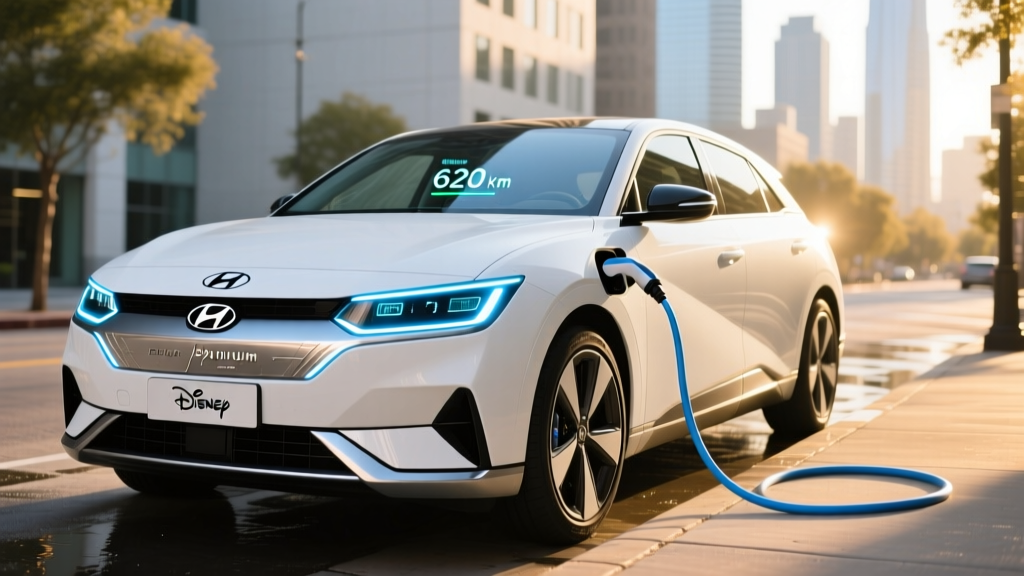
The Hyundai Ioniq 5 Disney100 Platinum Edition arrived as a limited-run tribute to The Walt Disney Company's centennial, wrapping Hyundai's most popular electric crossover in exclusive matte-gray paint, 20-inch alloy wheels, and a Houndstooth-patterned interior inspired by classic Disney animation. But beneath the commemorative badges and themed ambient lighting sits the mechanically identical Ioniq 5 Limited AWD — a 320-horsepower, dual-motor EV built on Hyundai's E-GMP 800-volt architecture. This review evaluates whether the Disney100 Platinum Edition earns its premium over the standard Limited trim, with hard data on range, charging, pricing, and federal tax credit eligibility.
EPA Estimated: 290 miles (Disney100 Platinum Edition / Limited AWD with 20" wheels)
Real-World Highway (70 mph, mild weather): ~245–260 miles
Real-World Highway (cold weather, below 32°F): ~200–220 miles
City/Mixed Commute: ~270–285 miles
Range, Battery, and Efficiency
The Disney100 Platinum Edition uses the same 77.4 kWh usable lithium-ion battery pack (NMC chemistry — nickel-manganese-cobalt) found in every long-range Ioniq 5. Hyundai does not offer an LFP (lithium iron phosphate) option in the U.S. market for this model, meaning you get higher energy density but should follow the 20–80% daily charging recommendation to maximize long-term battery health.
The EPA rates the AWD Limited — and by extension the Disney100 Platinum Edition, which shares the AWD powertrain and 20-inch wheels — at 290 miles of combined range. This is notably lower than the RWD Standard Range model's 303-mile rating, owing to the dual-motor's added weight, parasitic front-motor drag, and the rolling resistance of the 20-inch wheels.
Efficiency lands at 98 MPGe combined (105 city / 91 highway), translating to roughly 34 kWh per 100 miles in mixed driving, per fueleconomy.gov. On real-world highway loops at sustained 70–75 mph speeds, expect consumption to climb to 36–38 kWh/100mi, which compresses range to the 245–260 mile window. Cold weather (below freezing) with cabin heating active can push consumption past 42 kWh/100mi, dropping effective range to roughly 200–220 miles — a reality every prospective Ioniq 5 AWD buyer should plan around.
| Specification | Value |
|---|---|
| EPA Range | 290 miles (combined) |
| Battery (usable) | 77.4 kWh, NMC chemistry |
| Drivetrain | Dual-motor AWD |
| Horsepower | 320 hp |
| Torque | 446 lb-ft |
| 0–60 mph | 4.5 seconds |
| Max DC Fast Charge | 239 kW (peak) |
| 10–80% DC Charge Time | ~18 minutes (optimal conditions) |
| Level 2 Home Charge Rate | 10.9 kW (onboard charger) |
| Efficiency | 98 MPGe / 34 kWh/100mi |
| Cargo (behind rear seats) | 27.2 cu ft |
| Cargo (rear seats folded) | 59.3 cu ft |
| Rear Legroom | 39.4 inches |
| Front Trunk (Frunk) | 0.85 cu ft (AWD) |
| Towing Capacity | 2,300 lbs (with braked trailer) |
| Battery Warranty | 10 years / 100,000 miles |
| Vehicle Warranty | 5 years / 60,000 miles |
Charging Speed: DC Fast, Level 2, and the 800-Volt Advantage
The Ioniq 5's E-GMP platform supports 800-volt DC fast charging, a feature that remains rare outside of Porsche, Audi, and Kia's corporate sibling vehicles. On a 350 kW DC fast charger (such as those found at Electrify America stations), the Disney100 Platinum Edition peaks at approximately 239 kW, enabling a 10–80% charge in roughly 18 minutes under optimal conditions — meaning a warm battery, preconditioned via the navigation-linked charging prep system.
However, real-world charging is rarely optimal. The charge curve tapers significantly above 60% state of charge (SoC). Expect the 60–80% phase alone to take 6–8 minutes of that 18-minute total. If you arrive at a charger with a cold, un-preconditioned battery — say, on a winter road trip without using the nav-based battery prep — peak rates may initially be limited to 100–140 kW until the thermal management system warms the pack. Always precondition.
| Level | Power | Connector | Time / Rate |
|---|---|---|---|
| Level 1 (120V household) | ~1.4 kW | J1772 adapter | ~3–4 miles per hour |
| Level 2 (240V home) | 10.9 kW | J1772 (CCS1 inlet) | ~32 miles per hour; full charge in ~7.5 hrs |
| DC Fast (50 kW) | 50 kW | CCS1 | 10–80% in ~55 minutes |
| DC Fast (150 kW) | 150 kW | CCS1 | 10–80% in ~25 minutes |
| DC Fast (350 kW) | 239 kW peak | CCS1 | 10–80% in ~18 minutes (optimal) |
At home on a Level 2 wall connector or hardwired EVSE delivering the full 10.9 kW, the pack recharges from empty to full in approximately 7.5 hours — easily overnight. Note that the Ioniq 5 ships with a CCS1 (Combo) inlet. With Hyundai's announcement of NACS adoption for future models, current Ioniq 5 owners will need a CCS-to-NACS adapter (Hyundai has confirmed compatibility with Tesla Superchargers via adapter for eligible vehicles) to access Tesla's network.
Performance and Driving Dynamics
The dual-motor AWD powertrain produces 320 horsepower and 446 lb-ft of torque, launching the Disney100 Platinum Edition from 0–60 mph in 4.5 seconds. That's genuinely quick for a family crossover and matches sports-sedan territory from just a few years ago. The instant torque delivery makes highway merging and city stoplight acceleration effortless.
Ride quality leans firm but composed — the multi-link rear suspension manages broken pavement well, though the 20-inch wheels on the Disney100 Edition (and Limited trim) transmit more road texture than the 19-inch wheels on lower trims. Steering is light and precise rather than sporty, and the low center of gravity from the floor-mounted battery minimizes body roll in corners. Regenerative braking offers four levels adjustable via steering-wheel paddles, with Level 3 enabling near one-pedal driving in most conditions (the vehicle will creep to a stop but not hold without brake application in i-Pedal mode).
Noise insulation is excellent. At highway speeds, wind and tire noise remain muted, making the cabin feel more premium than the price suggests. The heat pump (standard on AWD trims) helps preserve range in cold weather by scavenging waste heat from the powertrain rather than relying solely on resistive cabin heating.
Disney100 Exclusive Features and Interior
What separates the Disney100 Platinum Edition from the standard Ioniq 5 Limited? The differences are cosmetic and thematic, not mechanical:
- Gravity Gold Matte exterior paint — exclusive to this edition, with a satin finish that requires specific care (no abrasive car washes, hand-wash recommended)
- 20-inch Paramount-style alloy wheels in a dark finish
- Houndstooth-patterned eco-leather seats — a retro-mod design cue referencing classic Disney animation aesthetics
- Disney100 badging on the exterior and branded door-sill plates
- Themed ambient lighting and startup animation on the dual 12.3-inch displays
- Platinum Edition key fob with Disney100 branding
The cabin itself is spacious and minimalist. The flat floor (no transmission tunnel) creates generous rear-seat room: 39.4 inches of rear legroom outstrips most midsize SUVs. The dual 12.3-inch panoramic display runs Hyundai's latest infotainment with wireless Apple CarPlay and Android Auto, navigation, and over-the-air update capability. The center console slides fore and aft ("Universal Island"), adding flexibility for front-seat storage. Cargo volume is 27.2 cu ft behind the rear seats and 59.3 cu ft with the rear seats folded — competitive with the Ford Mustang Mach-E and Volkswagen ID.4.
The AWD frunk is small — just 0.85 cu ft, enough for a charging cable bag but not much else. This is a known trade-off of the AWD layout, where front-motor packaging consumes the space.
Pricing and Federal Tax Credit Eligibility
The Ioniq 5 Disney100 Platinum Edition launched with an MSRP of approximately $62,950 (including destination), placing it near the top of the Ioniq 5 lineup. For reference, the standard Ioniq 5 Limited AWD typically starts around $58,200, meaning the Disney100 cosmetic package commands roughly a $4,750 premium.
| Item | Amount |
|---|---|
| Disney100 Platinum Edition MSRP (incl. destination) | $62,950 |
| Federal §30D Tax Credit (if eligible) | Up to $7,500 |
| Estimated After-Credit Price | ~$55,450 |
| Point-of-Sale Transfer Available? | Yes (dealer-dependent) |
Federal tax credit eligibility requires careful verification. Under current IRS §30D rules, the Ioniq 5 must satisfy multiple criteria:
- MSRP Cap: SUVs/crossovers must have an MSRP at or below $80,000 — the Disney100 Edition at ~$62,950 clears this.
- Buyer Income Cap: Modified AGI must not exceed $150,000 (single), $225,000 (head of household), or $300,000 (married filing jointly).
- Battery Sourcing: Critical minerals and battery components must meet phased-in percentages from U.S. or FTA-partner sources. Hyundai has shifted significant battery production to the Georgia Metaplant, but eligibility can change model year to model year.
- Point-of-Sale Transfer: Since 2024, buyers can transfer the credit to the dealer for an immediate price reduction rather than waiting to claim it on their tax return.
Always verify current eligibility on IRS.gov before purchasing, as battery-sourcing compliance can shift with supply-chain changes. Consult a tax professional for your specific situation.
ADAS and Driver Assistance
The Ioniq 5's Highway Driving Assist 2 (HDA2) is a Level 2 driver-assistance system. The driver must remain fully engaged, hands on or near the wheel, and eyes on the road at all times. This is NOT autonomous or self-driving.
Hyundai's HDA2 combines adaptive cruise control with stop-and-go, lane-centering steering assist, and navigation-linked speed adjustment (it slows for upcoming curves and interchanges). It works reliably on divided highways but requires consistent driver supervision. Lane changes must be initiated manually. The system includes a driver-monitoring camera that will issue escalating warnings and eventually bring the vehicle to a stop if it detects inattention.
Additional standard safety tech includes forward collision-avoidance assist with pedestrian/cyclist detection, blind-spot collision-avoidance, rear cross-traffic collision-avoidance, safe exit assist, and a surround-view monitor. The Ioniq 5 earned an IIHS Top Safety Pick+ rating and a 5-Star overall rating from NHTSA.
Pros, Cons, and the Competition
- 800V architecture enables class-leading 18-min DC fast charging
- Spacious cabin with 39.4" rear legroom and flat floor
- Strong 320-hp AWD performance (4.5s 0–60)
- Exclusive Disney100 aesthetics without mechanical compromise
- 10-year/100,000-mile battery warranty
- Heat pump standard on AWD (cold-weather efficiency)
- V2L (vehicle-to-load) capability — power devices from the vehicle
- 290-mile EPA range trails RWD trims and some competitors
- Real-world highway range drops to ~245 mi; cold weather compresses further
- Matte paint requires careful, specific maintenance
- Small frunk on AWD (0.85 cu ft)
- Disney100 premium (~$4,750 over Limited) is purely cosmetic
- No NACS port — requires adapter for Tesla Supercharger access
- 20" wheels increase road noise vs. 19" trims
Key competitors in the $55,000–$65,000 electric crossover space include the Ford Mustang Mach-E Premium AWD (EPA 290 mi, ~$56,000), Tesla Model Y Long Range AWD (EPA 310 mi, ~$50,000, NACS native), and Kia EV6 GT-Line AWD (EPA 274 mi, ~$58,000 — mechanical twin to the Ioniq 5). The Model Y wins on range and Supercharger access; the Mach-E offers a sportier driving feel; the EV6 shares the 800V platform but with a sportier silhouette and slightly less rear headroom.
Choose it if: You want a distinctive, limited-edition EV with top-tier fast charging, a spacious family cabin, and you value Hyundai's 10-year battery warranty. The Disney100 package appeals if you're a Disney enthusiast who wants an EV that stands out visually without sacrificing daily usability.
Skip it if: Maximum range is your priority (the RWD Ioniq 5 or Tesla Model Y LR deliver more miles), you need frequent access to Tesla Superchargers without adapter hassle, or you'd rather not pay a ~$4,750 premium for cosmetic exclusivity.
Ownership Costs and Warranty
Hyundai covers the Ioniq 5's battery and electric powertrain for 10 years or 100,000 miles, with a capacity-retention threshold of 70% — if the battery degrades below 70% of its original capacity within that window, Hyundai will repair or replace it. The bumper-to-bumper warranty runs 5 years / 60,000 miles, and complimentary maintenance is included for 3 years / 36,000 miles.
Electricity costs vary by region, but charging at the national average of ~$0.16/kWh, a full 77.4 kWh charge costs roughly $12.38 — delivering 290 miles of EPA range at approximately $0.043 per mile. Compare that to a 25-MPG gas crossover at $3.50/gallon ($0.14/mile), and the per-mile fuel savings are substantial. Home Level 2 installation typically costs $500–$2,000 depending on panel capacity and run length — budget for a 240V/50A circuit to deliver the full 10.9 kW.
Insurance premiums for the Ioniq 5 AWD tend to run 10–20% higher than comparable gas crossovers due to repair costs and battery replacement value. Get quotes before committing.
Frequently Asked Questions
What is the real-world range of the Ioniq 5 Disney100 Platinum Edition?
The EPA rates it at 290 miles combined. In real-world highway driving at 70 mph in mild weather, expect 245–260 miles. In cold weather (below 32°F) with cabin heating, plan for 200–220 miles. City driving with regenerative braking recovers more energy and can approach the EPA sticker.
How fast does the Ioniq 5 Disney100 Platinum Edition charge?
On a 350 kW DC fast charger with a preconditioned battery, it peaks at 239 kW and charges from 10–80% in approximately 18 minutes. On a home Level 2 charger at 10.9 kW, it adds roughly 32 miles per hour and fully charges in about 7.5 hours.
Does the Ioniq 5 Disney100 Platinum Edition qualify for the federal EV tax credit?
It likely qualifies for the full $7,500 under IRS §30D, given its MSRP (~$62,950, well under the $80,000 SUV cap) and Hyundai's U.S. battery production in Georgia. However, buyer income caps and battery-sourcing rules apply. Verify current eligibility on IRS.gov before purchase.
How much does it cost after tax credits?
At ~$62,950 MSRP with a $7,500 federal credit (if eligible), the effective price drops to approximately $55,450. Many dealers support point-of-sale credit transfer, applying the discount at purchase rather than on your tax return.
Is the Disney100 Platinum Edition worth buying vs. the standard Ioniq 5 Limited?
Mechanically, they're identical — same battery, motors, range, and charging. The ~$4,750 premium buys exclusive matte paint, 20-inch wheels, Houndstooth seats, and Disney100 branding. If those cosmetics matter to you as a collector or Disney fan, it's justified. If you prioritize value, the standard Limited AWD delivers the same EV experience for less.
What are the biggest pros and cons?
Pros: 18-minute DC fast charging, 320-hp AWD, spacious interior, 10-year battery warranty, exclusive styling. Cons: 290-mile EPA range is midpack, matte paint maintenance, cosmetic-only premium over Limited, no native NACS port, small frunk on AWD.