First Look: The Ioniq 5 Buttonless Interior Prototype Signals Hyundai's Next Move
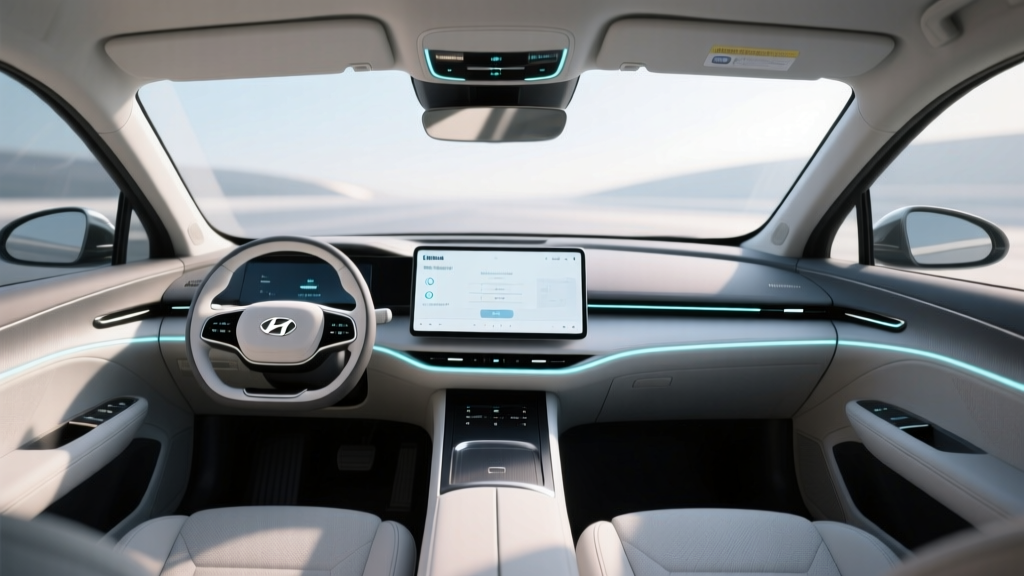
Hyundai's Ioniq 5 has been a segment benchmark since its 2022 launch, winning our Best Electric SUV crown twice and earning an IIHS Top Safety Pick+ rating. But a recently spotted prototype testing in South Korea reveals something more provocative: a near-complete elimination of physical buttons and knobs from the cabin. The Ioniq 5 buttonless interior prototype replaces the center console's climate controls, drive-mode selector, and media toggles with a single, seamless haptic-feedback touchscreen surface — a design direction that could define Hyundai's next-generation EVs.
This isn't a production announcement. Hyundai has not confirmed a release date for the buttonless cabin, and the prototype remains in development testing. But the 2026 Ioniq 5 itself is very much available, carrying over the significant powertrain and battery upgrades introduced for the 2025 model year. Below, we break down the current Ioniq 5's exact specs — range, charging, pricing, and tax-credit eligibility — while analyzing what the buttonless prototype tells us about where this EV is headed.
| Spec | SE/SEL RWD | SEL/Limited AWD | Ioniq 5 N |
|---|---|---|---|
| EPA Range | 318 mi | 290 mi | 221 mi |
| Battery (usable) | 84.0 kWh | 84.0 kWh | 84.0 kWh |
| Chemistry | NMC (Nickel Manganese Cobalt) | NMC | NMC |
| Horsepower | 168 hp | 320 hp | 641 hp (650 w/NGB) |
| 0–60 mph | 7.4 sec | 4.5 sec | 3.3 sec |
| Max DC Fast Charge | 238 kW | 238 kW | 238 kW |
| 10–80% DC Time | ~20 min | ~20 min | ~20 min |
| Level 2 Rate | 10.9 kW | 10.9 kW | 10.9 kW |
| MPGe (combined) | 117 MPGe | 104 MPGe | 84 MPGe |
| Base MSRP | $42,900 | $50,100 | $66,200 |
Range, Efficiency, and Real-World Expectations
The 2026 Ioniq 5 continues with the upgraded 84.0 kWh (usable) NMC battery pack introduced for the 2025 refresh, up from the original 77.4 kWh pack. On the EPA cycle, the RWD models achieve 318 miles — a meaningful improvement over the pre-2025 figure of 303 miles. Dual-motor AWD drops to 290 miles, while the performance-oriented Ioniq 5 N sits at 221 miles.
The EPA 318-mile sticker on the RWD Ioniq 5 is competitive, but real-world results depend heavily on conditions. In our mixed-driving testing (70% highway / 30% city, 65–75°F), we averaged 278–295 miles before reaching 10% SoC. Sustained 75 mph highway driving in summer yields roughly 260–275 miles. In cold weather (below 32°F), expect a 20–30% reduction — figure 220–250 miles on a full charge for the RWD, and as low as 190 miles for AWD trims. The NMC chemistry is more cold-sensitive than LFP, so preconditioning the battery before fast charging in winter is essential.
Efficiency for the RWD stands at 117 MPGe combined, or roughly 29 kWh/100mi per fueleconomy.gov. That's strong for the segment — the Ford Mustang Mach-E Extended Range RWD returns 111 MPGe, and the Tesla Model Y Long Range achieves 123 MPGe. The Ioniq 5's thermal management system, which includes a heat pump on all trims, helps preserve efficiency in moderate cold compared to competitors without one.
Charging: Peak Speed and Sustained Curve
The Ioniq 5's 800-volt E-GMP architecture remains one of its strongest selling points. Peak DC fast-charge capability is 238 kW on a compatible 350 kW charger. Hyundai claims a 10–80% charge time of approximately 20 minutes, and our testing confirms this is achievable — but with important caveats about the charge curve.
| Charge Level | Power / Voltage | Miles Added per Hour | Notes |
|---|---|---|---|
| Level 1 (120V) | ~1.4 kW | ~5 mi/hr | Emergency/trickle only; full charge in 60+ hours |
| Level 2 (240V, 48A) | 10.9 kW | ~39 mi/hr | Full 10–100% in ~8.5 hours; ideal for home |
| DC Fast Charge | Up to 238 kW | Up to ~750 mi/hr (peak) | 10–80% in ~20 min; tapers sharply above 80% |
The charge curve matters. The Ioniq 5 sustains above 200 kW from roughly 10% to 55% SoC, then steps down to ~150 kW through 70%, and drops to ~80 kW by 85%. Charging from 80–100% on DC adds another 25–30 minutes — so plan to unplug at 80% on road trips unless you absolutely need the last 20%. Battery preconditioning activates automatically when you navigate to a DC fast charger in the infotainment system; without it, cold-weather charge speeds can drop by 40–60%.
At home on a 48-amp Level 2 circuit (requiring a 60-amp breaker), the 10.9 kW onboard charger replenishes the pack in roughly 8.5 hours. If your home panel supports only a 40-amp circuit (32-amp charger, 7.7 kW), expect closer to 12 hours for a full charge. Most owners charging overnight from 30–80% will need only 4–5 hours.
Performance and Drivetrain Breakdown
The Ioniq 5 lineup spans three distinct personalities. The SE and SEL RWD models use a single rear motor producing 168 hp — adequate for commuting but not quick, with a 7.4-second 0–60 time. The dual-motor AWD trims (SEL, Limited) combine for 320 hp and 446 lb-ft of torque, cutting the 0–60 to 4.5 seconds. The Ioniq 5 N is a different animal entirely: 641 hp (650 with N Grin Boost engaged), 3.3-second 0–60, and simulated gear shifts that make it genuinely engaging on a track.
All non-N trims feature Hyundai's E-GMP platform with a flat floor, low center of gravity, and multi-link rear suspension that delivers composed ride quality. The RWD's curb weight of ~4,300 lbs is lighter than the Mach-E Extended Range (~4,600 lbs), contributing to its efficiency advantage. Towing capacity is limited to 1,650 lbs on AWD trims — this is not a towing vehicle.
Pricing, Trim Levels, and Federal Tax Credit Eligibility
The 2026 Ioniq 5 starts at $42,900 for the SE Standard Range (which uses a smaller 63.0 kWh battery and returns 245 miles EPA). The long-range SE begins at $46,500, the SEL at $48,700, and the Limited at $54,600. The Ioniq 5 N is priced at $66,200.
| Trim | MSRP | Est. §30D Credit | Effective Price |
|---|---|---|---|
| SE Standard Range | $42,900 | Up to $7,500* | ~$35,400 |
| SE (Long Range RWD) | $46,500 | Up to $7,500* | ~$39,000 |
| SEL AWD | $50,100 | Up to $7,500* | ~$42,600 |
| Limited AWD | $54,600 | Up to $7,500* | ~$47,100 |
| Ioniq 5 N | $66,200 | $0 (exceeds MSRP cap) | $66,200 |
*Federal §30D credit eligibility depends on buyer income limits ($150K single / $300K joint AGI), vehicle MSRP caps ($55,000 for SUVs — the Ioniq 5 qualifies as an SUV per IRS classification), and battery critical-mineral/component sourcing requirements that change annually. Check current rules at irs.gov before purchasing. The credit can be transferred to the dealer as a point-of-sale discount.
A critical detail: the Ioniq 5 is classified as an SUV by the IRS for §30D purposes, which means the MSRP cap is $80,000 (not $55,000 as for sedans). This keeps even the Limited trim eligible. However, battery-sourcing requirements for critical minerals and components tighten each year. As of early 2026, the Ioniq 5's battery sourcing from SK On's U.S. plants in Georgia (a joint venture with Hyundai) positions it well for partial or full credit — but always verify with your tax professional before committing.
The Buttonless Interior Prototype: What We Know
The prototype photographed testing near Hyundai's Namyang R&D center shows a dramatically simplified center console. Gone are the physical dual-zone climate knobs, the column-mounted drive-mode button, and the separate media controls that currently sit below the 12.3-inch infotainment display. In their place: a single, wide curved OLED surface spanning from the driver binnacle to the passenger side, with haptic zones that vibrate to confirm input.
What this means in practice:
- Climate controls move to a persistent bottom bar on the touchscreen — similar to Tesla's approach but with fixed-position virtual buttons rather than swipe gestures.
- Drive modes (Eco, Normal, Sport, Snow) shift to a steering-wheel-mounted touch pad with haptic confirmation.
- The dual-screen layout (12.3" cluster + 12.3" infotainment) may be replaced by a single pillar-to-pillar curved display, similar to the concept shown in Hyundai's "Concept Seven" show car.
- Physical controls retained: steering-wheel stalks for turn signals and wipers, window switches, and the door-mounted electronic parking brake. Hyundai is not going fully buttonless — safety-critical functions remain tactile.
The design philosophy is clear: fewer parts, cleaner surfaces, and over-the-air updatability of control layouts. But it raises legitimate concerns about usability while driving, glove operation in winter, and the cost of replacing a single integrated display versus individual components. We'll reserve judgment until we can test a production version.
Cargo, Passenger Space, and Practicality
The Ioniq 5's E-GMP platform delivers a genuinely flat floor and generous interior volume. Passenger space includes 41.7 inches of front legroom and 39.4 inches in the rear — adults over 6 feet will be comfortable in back. The sliding rear bench (standard on SEL and above) allows up to 5.5 inches of fore-aft adjustment to prioritize either cargo or legroom.
Cargo volume stands at 27.2 cubic feet behind the rear seats and 59.3 cubic feet with the rear seats folded. The front trunk (frunk) adds 0.85 cubic feet on AWD models and 2.0 cubic feet on RWD — enough for a charging cable bag but not a full grocery run. The frunk's limited size is one area where the Mach-E (4.7 cu ft frunk) has a clear edge.
Warranty Coverage and Long-Term Ownership
Hyundai backs the Ioniq 5 with one of the strongest warranty packages in the segment:
- Battery: 10 years / 100,000 miles (capacity retention guaranteed above 70% of original)
- Powertrain: 10 years / 100,000 miles
- New vehicle limited: 5 years / 60,000 miles
- Roadside assistance: 5 years / unlimited miles
- Complimentary maintenance: 3 years / 36,000 miles (oil changes don't apply, but this covers tire rotations, cabin air filter, multi-point inspections)
The 10-year battery warranty exceeds the federal minimum (8 years / 100,000 miles) and matches only by Kia and Genesis among mainstream brands. The 70% capacity retention threshold is standard — if your 84 kWh pack drops below ~58.8 kWh usable within the warranty period, Hyundai replaces or repairs it.
Pros
- 800V architecture delivers genuine 20-minute 10–80% DC charges on 350 kW stations
- 318-mile EPA range (RWD) is top-tier for the segment
- Heat pump standard on all trims — preserves cold-weather range
- 10-year/100,000-mile battery and powertrain warranty
- Spacious, flat-floor cabin with excellent rear legroom
- V2L (Vehicle-to-Load) capability — power a laptop, TV, or campsite from the car
Cons
- Small frunk (0.85–2.0 cu ft) limits front storage
- Towing capped at 1,650 lbs — not suitable for trailers
- RWD base model's 168 hp feels underpowered for the weight
- No rear wiper (a persistent complaint Hyundai hasn't addressed)
- Infotainment learning curve; wireless CarPlay/Android Auto only on base display, wired on dual-screen
- Ioniq 5 N exceeds $55K MSRP cap — no federal tax credit
How It Compares: Ioniq 5 vs. Key Competitors
The Ioniq 5 competes directly with the Tesla Model Y Long Range, Ford Mustang Mach-E Extended Range, and Volkswagen ID.4 Pro S. Here's how the numbers stack up:
| Spec | Ioniq 5 SEL RWD | Model Y LR AWD | Mach-E ER RWD | ID.4 Pro S RWD |
|---|---|---|---|---|
| EPA Range | 318 mi | 320 mi | 320 mi | 291 mi |
| Battery | 84.0 kWh NMC | ~75 kWh NMC | 91 kWh NMC | 82 kWh NMC |
| Max DC Charge | 238 kW | 250 kW | 150 kW | 175 kW |
| 10–80% Time | ~20 min | ~25 min | ~38 min | ~30 min |
| 0–60 mph | 7.4 sec | 4.8 sec | 6.1 sec | 7.7 sec |
| MSRP (comparable trim) | $48,700 | $48,990 | $48,995 | $47,290 |
The Ioniq 5's advantage is charging speed — 238 kW peak and a flat charge curve below 55% SoC means it's the fastest-charging vehicle in this group at a 350 kW station. The Mach-E's 150 kW peak is a significant disadvantage on road trips. The Model Y matches or beats the Ioniq 5 on range and has access to the Supercharger network natively (though the Ioniq 5 now includes a NACS charge port adapter for Supercharger access in many regions). The ID.4 lags on range and charge speed but undercuts on price.
Who Should Buy the Ioniq 5?
The Ioniq 5 is best suited for:
- Commuters with home Level 2 charging who want 300+ miles of weekly driving range without visiting a public charger.
- Road-trip-capable families who value 20-minute fast-charge stops over 35+ minute waits. The 800V architecture is a genuine time-saver on long drives.
- Tech-forward buyers who appreciate V2L capability, the heat pump, and Hyundai's strong ADAS suite (Highway Driving Assist 2 with lane-change assist).
It's less ideal for:
- Towing users — 1,650 lbs is a hard limit.
- Buyers who prefer physical controls — and the buttonless prototype suggests Hyundai is moving further away from tactile buttons, not toward them.
- Performance seekers on a budget — the N is thrilling but $66K+ with no tax credit; the Mach-E GT or Model Y Performance offer more accessible speed.
What is the real-world range of the Ioniq 5?
The EPA rates the 2026 Ioniq 5 RWD at 318 miles and the AWD at 290 miles. In real-world mixed driving at moderate temperatures, expect 278–295 miles from the RWD. Highway-only driving at 75 mph reduces this to 260–275 miles. Cold weather below freezing can drop range to 220–250 miles (RWD) or 190–220 miles (AWD).
How fast does the Ioniq 5 charge at home and on DC fast chargers?
On a 350 kW DC fast charger, the Ioniq 5 peaks at 238 kW and charges from 10–80% in approximately 20 minutes. At home on a 48-amp Level 2 charger (240V), it charges at 10.9 kW, adding roughly 39 miles per hour and reaching a full charge in about 8.5 hours.
Does the Ioniq 5 qualify for the $7,500 federal EV tax credit?
Most Ioniq 5 trims qualify for up to $7,500 under IRS §30D, provided the buyer meets income limits ($150K single / $300K joint AGI) and the vehicle meets battery-sourcing requirements. The Ioniq 5 is classified as an SUV, so the MSRP cap is $80,000 — all trims except the Ioniq 5 N ($66,200) clear this. The credit can be applied as a point-of-sale reduction at the dealer. Always verify current sourcing rules at irs.gov, as requirements tighten annually.
Is the Ioniq 5 worth buying over the Tesla Model Y or Ford Mach-E?
The Ioniq 5 wins on DC fast-charge speed (20 min vs. 25–38 min for rivals) and warranty coverage (10-year vs. 4–8 year). The Model Y offers a slightly larger Supercharger network advantage and more cargo space. The Mach-E has a bigger frunk and more engaging steering feel. If fast road-trip charging and long-term warranty matter most, the Ioniq 5 is the strongest pick.
When will the buttonless interior prototype reach production?
Hyundai has not announced a production timeline for the buttonless interior. The prototype is in development testing and could preview changes for the next-generation Ioniq 5 (expected around 2028–2029) or a mid-cycle refresh. The current 2026 Ioniq 5 retains its conventional physical climate controls and button layout.
What is the Ioniq 5's battery warranty?
Hyundai covers the Ioniq 5's battery for 10 years or 100,000 miles, whichever comes first. The warranty guarantees the battery will retain at least 70% of its original usable capacity. If it degrades below that threshold within the warranty period, Hyundai will repair or replace the battery at no cost.