The Tesla Cybertruck is one of the most polarizing vehicles on the road, and nowhere is that divide more apparent than when you open the door. The interior of Cybertruck strips away conventional pickup-truck design in favor of a brutalist, minimalist cabin that either feels like the future or like an unfinished prototype — depending on who you ask. But beyond the stainless-steel dashboard and 18.5-inch touchscreen, the Cybertruck is a serious electric workhorse with legitimate range, fast charging, and real utility. This review covers the full ownership picture: what the cabin is actually like to live with, how far it goes, how fast it charges, and whether it qualifies for the federal tax credit.
Tesla Cybertruck Specs at a Glance
| Specification | AWD | Cyberbeast |
|---|---|---|
| EPA Range | 340 miles | 320 miles |
| Battery Capacity (usable) | ~123 kWh (est.), NMC | ~123 kWh (est.), NMC |
| Max DC Fast Charge | 250 kW (peak) | 250 kW (peak) |
| 10–80% DC Charge Time | ~27 minutes | ~27 minutes |
| Level 2 Home Charging | 11.5 kW / ~37 mi/hr | 11.5 kW / ~37 mi/hr |
| 0–60 mph | 4.1 seconds | 2.6 seconds |
| Horsepower | 600 hp | 845 hp |
| Drivetrain | Dual-Motor AWD | Tri-Motor AWD |
| Efficiency | ~2.0 kWh/mi (est.) | ~2.1 kWh/mi (est.) |
| Towing Capacity | 11,000 lbs | 11,000 lbs |
| Base MSRP | $79,990 | $99,990 |
| Battery/Drive Unit Warranty | 8 yr / 120,000 mi | 8 yr / 120,000 mi |
The Interior of Cybertruck: Design, Materials, and First Impressions
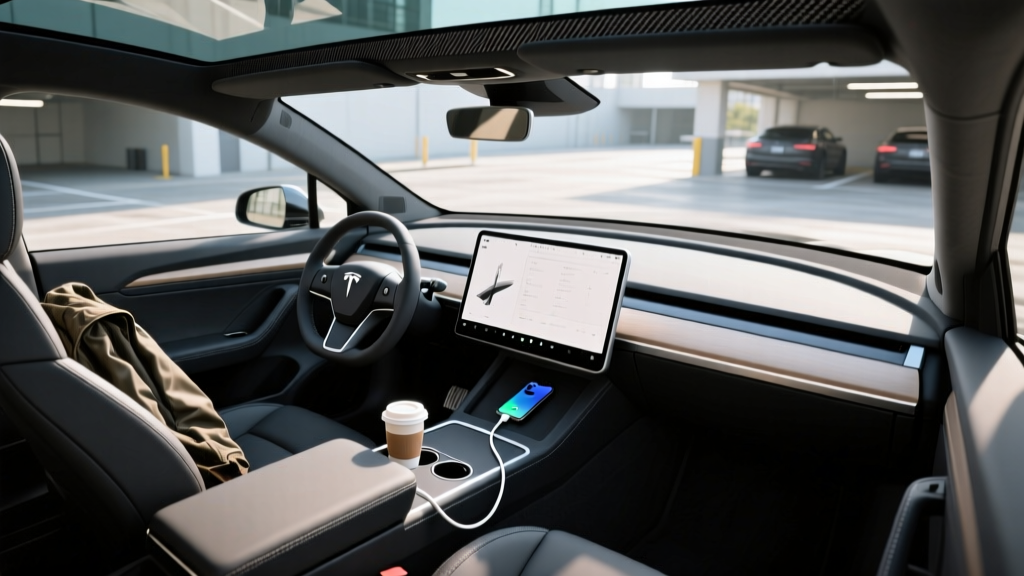
Step inside and the first thing that hits you is the dashboard — a single, cold-rolled stainless-steel slab that spans the full width of the cabin. There is no stitched leather, no wood trim, no soft-touch padding on the upper dash. Tesla calls this intentional minimalism; critics call it sparse. The reality, after living with it, falls somewhere in between.
The steering yoke (standard on all trims) takes about a week of daily driving to build muscle memory for. At low speeds — parking lots, three-point turns — the lack of a full wheel rim is noticeable and occasionally annoying. At highway speeds, the yoke recedes into the background and the unobstructed view of the road ahead becomes an advantage.
The 18.5-inch center touchscreen dominates the interior of Cybertruck and serves as the command center for virtually every vehicle function: climate, media, navigation, vehicle settings, camera views, and even the glovebox release. There are no physical buttons on the dash. Climate vents are hidden and digitally directed through the screen. Turn signals are on the yoke (with a backup button on the overhead console in early builds, later updated via software to steering-wheel buttons on 2025+ models).
Materials quality has improved since the first 2024 deliveries. The seats use a synthetic leather (Tesla calls it "vegan leather") that is durable and easy to clean — practical for a truck. The second row offers 38.2 inches of legroom, which is competitive with the Ford F-150 Lightning and Rivian R1T. Headroom is generous thanks to the angular roofline. However, the rear seat cushion sits relatively flat and low, which long-legged passengers notice on drives over two hours.
Range, Efficiency, and Real-World Expectations
Real-World Expectation: On a 70-mph highway run in moderate temperatures (65–75°F), expect roughly 280–310 miles from the AWD and 260–290 from the Cyberbeast before needing to charge. In cold weather (below 30°F), range drops to approximately 230–260 miles due to battery chemistry resistance and cabin heating load. The Cybertruck's large frontal area and angular shape create significant aerodynamic drag, which hits efficiency harder at highway speeds than in city driving where regenerative braking recovers energy.
According to fueleconomy.gov, the Cybertruck's efficiency is rated at approximately 67 MPGe combined for the AWD trim. In practical terms, this translates to roughly 2.0 kWh per mile driven — making the Cybertruck one of the less efficient EVs on the market per mile, which is the unavoidable trade-off for a 6,800+ lb. stainless-steel truck with the aerodynamics of a brick.
For daily commuting under 80 miles round-trip, the Cybertruck's battery is more than adequate and most owners will charge at home every two to three days. For road trips, the 340-mile EPA figure means you'll realistically plan Supercharger stops every 250–280 miles, which aligns well with Tesla's Supercharger network spacing on most major US corridors.
Charging Speed: DC Fast Charging and Home Level 2
The Cybertruck uses an 800-volt electrical architecture, which enables fast charging at higher power levels with lower current — reducing heat and cable weight. However, Tesla capped the peak DC fast-charge rate at 250 kW at V3 Superchargers (the most common type in the US network).
| Charging Level | Power | Speed (Approx.) | Notes |
|---|---|---|---|
| Level 1 (120V) | ~1.4 kW | ~4 miles/hour | Emergency/trickle only |
| Level 2 (240V, 48A) | 11.5 kW | ~37 miles/hour | Full charge in ~10–11 hours |
| DC Fast (V3 Supercharger) | 250 kW (peak) | 10–80% in ~27 min | Peak sustained only to ~50% SoC; tapers significantly above 80% |
| DC Fast (V4 Supercharger) | Up to 325 kW (est.) | 10–80% in ~22 min | Limited V4 availability as of 2025 |
A critical detail for prospective owners: the 250 kW peak rate is not sustained across the entire charge session. The Cybertruck's charge curve peaks early (between 10–50% state of charge) and then tapers progressively. From 80–100%, charging slows dramatically to protect the NMC battery chemistry — expect the final 20% to take nearly as long as the 10–80% session. For road-trip efficiency, the practical strategy is to charge from 10–80% and drive on.
At home on a Level 2 Tesla Wall Connector (48 amps / 11.5 kW), the Cybertruck adds roughly 37 miles of range per hour. A full overnight charge from 20% to 100% takes approximately 10–11 hours, which is well within a standard overnight window. Note that installing a 60-amp circuit for the Wall Connector typically requires a licensed electrician and may require a panel upgrade if your home has a 100-amp service panel.
The Cybertruck ships with the NACS (North American Charging Standard) connector natively, meaning it plugs directly into Tesla Superchargers without an adapter. For non-Tesla DC fast chargers using CCS, Tesla provides a CCS adapter (included with some trims, available for purchase separately for others).
Performance: Acceleration, Towing, and Drivetrain
The Cyberbeast's tri-motor setup produces 845 horsepower and delivers a 2.6-second 0–60 mph time — making it one of the quickest production vehicles ever sold, let alone a pickup truck. The dual-motor AWD trim is hardly slow at 4.1 seconds to 60 mph with 600 hp. Both trims feature adaptive air suspension with up to 16 inches of ground clearance in Off-Road mode and 12.3 inches in standard ride height.
Towing capacity is rated at 11,000 pounds for both trims, competitive with the F-150 Lightning (10,000 lbs) and below the Rivian R1T's 11,000-lb rating. However, towing at max capacity reduces range by approximately 40–50%, meaning a fully loaded Cybertruck on a highway will realistically deliver 150–180 miles between charges. This is the physics of moving 17,000+ combined pounds at 65 mph — no electric truck has solved this yet.
The steer-by-wire system (no mechanical connection between yoke and wheels) provides variable steering ratios — fewer than one full turn lock-to-lock at highway speed, which eliminates hand-over-hand maneuvering. It feels disorienting for the first few drives and then becomes natural. Low-speed parking requires trust in the system, and some drivers report fatigue from the hyper-responsive ratio in tight urban environments.
Cargo Space, Bed Utility, and Passenger Dimensions
The Cybertruck's bed (Tesla calls it the "vault") measures 6 feet long and 4 feet wide between the wheel wells, offering 67 cubic feet of cargo volume. The motorized tonneau cover is standard and can support up to 300 lbs of distributed weight — useful as a step or work platform. With the tailgate down, the vault extends to accommodate longer items, and the sail pillars (the angular rear roofline supports) include built-in channels for tie-downs and accessory mounting.
Front trunk (frunk) space is approximately 7.1 cubic feet — enough for a few grocery bags or a charging cable kit. It's smaller than the F-150 Lightning's 14.1-cu-ft Mega Power Frunk but still adds practical sealed storage.
Passenger dimensions:
- Front legroom: 41.0 inches
- Rear legroom: 38.2 inches
- Front headroom: 41.2 inches
- Rear headroom: 38.6 inches
- Seating capacity: 5 (2+3 bench)
The rear seat folds 60/40 to extend cargo capacity into the cabin. The vault also includes a 120V and 240V outlet (PowerShare), enabling the Cybertruck to power tools at a job site or appliances during an outage — a feature Tesla calls Powershare with up to 11.5 kW of bidirectional output.
Tech, Driver Assistance, and Standout Features
The Cybertruck runs Tesla's latest vehicle software on a custom AMD Ryzen-based processor, delivering fast map rendering, responsive media playback, and over-the-air updates that can add features post-purchase. The infotainment system includes streaming media, Tesla Arcade gaming, and a built-in trip planner that factors in Supercharger stops, elevation, and temperature for range estimation.
Camera coverage is extensive — the Cybertruck uses eight external cameras for Autopilot functionality plus a cabin camera for driver monitoring. The camera-based parking assist is essential given the truck's angular rear design and limited rearward visibility through the small rear window. The 360-degree camera view on the central screen is one of the best in any truck, providing clear sight lines for tight spaces and trailer hitching.
Notable tech drawbacks: the lack of Apple CarPlay and Android Auto continues to frustrate buyers who prefer their phone's native interface. Navigation is Tesla-only, and while it's functional, it doesn't match Google Maps or Waze for real-time traffic and POI data in many markets. AM radio is absent (Tesla removed it in favor of internet streaming), and there is no physical key — access is via phone Bluetooth or a key card.
Pricing, Trims, and Federal Tax Credit Eligibility
| Trim | Base MSRP | Federal §30D Credit | Effective Price (if eligible) |
|---|---|---|---|
| AWD (Dual-Motor) | $79,990 | Up to $7,500 | ~$72,490 |
| Cyberbeast (Tri-Motor) | $99,990 | Up to $7,500 | ~$92,490 |
Tax credit eligibility under IRS §30D is not automatic. Several requirements apply:
- MSRP Cap: Trucks and pickups must have an MSRP at or below $80,000 to qualify. The AWD trim at $79,990 falls under this cap; the Cyberbeast at $99,990 does NOT qualify for the new-vehicle credit.
- Buyer Income Cap: Modified adjusted gross income must not exceed $150,000 (single), $225,000 (head of household), or $300,000 (joint filing).
- Battery Sourcing: A percentage of critical minerals and battery components must be sourced from the US or free-trade-agreement countries. These thresholds increase annually. Check the latest DOE/Fuel Economy credit eligibility list for current compliance status.
- Point-of-Sale Transfer: As of 2024, buyers can transfer the credit to the dealer at purchase, reducing the out-of-pocket price directly rather than waiting for a tax refund.
The Cybertruck AWD is one of the few premium electric trucks that can qualify for the full $7,500 credit, but only if the buyer meets all income and sourcing requirements. The Cyberbeast, due to its MSRP, is ineligible for the new-vehicle §30D credit. Consult a tax professional before relying on credit eligibility for your purchase decision.
Who the Cybertruck Is For — and Who Should Look Elsewhere
- You want a fast, distinctive electric truck and don't need a conventional cab layout
- You primarily drive in areas with reliable Tesla Supercharger access
- You value bidirectional power (Powershare) for job-site or emergency backup use
- You're comfortable with a screen-centric, minimalist interior
Look elsewhere if:
- You need a full-size rear seat for three adults regularly (Rivian R1T or F-150 Lightning offer better rear comfort)
- You want Apple CarPlay / Android Auto integration
- You tow heavy loads long-distance frequently (range drops severely under load)
- You prefer physical buttons and conventional controls
Pros and Cons
- 340-mile EPA range (AWD) is best-in-class for electric trucks
- 250 kW DC fast charging with 10–80% in ~27 minutes
- 11,000-lb towing capacity with Powershare 240V outlet
- Cyberbeast's 2.6-second 0–60 is absurdly quick for any vehicle
- AWD trim qualifies for $7,500 federal tax credit (with caveats)
- Excellent 360-degree camera system for parking and trailering
- 8-year / 120,000-mile battery and drive unit warranty
- Interior materials and finish don't match the $80K+ price point
- Steer-by-wire and yoke require significant adaptation
- No Apple CarPlay or Android Auto
- Real-world highway range drops to ~280 miles; worse in cold
- Cyberbeast ($99,990) exceeds the $80K MSRP cap for tax credit
- Rear seat comfort is below competitors for long trips
- Build quality inconsistencies reported by early owners
- Large footprint and angular design make urban parking challenging
Frequently Asked Questions
What is the real-world range of the Cybertruck?
The EPA rates the AWD at 340 miles and the Cyberbeast at 320 miles. In real-world highway driving at 70 mph, expect approximately 280–310 miles (AWD) and 260–290 miles (Cyberbeast). In cold weather below 30°F, plan for 230–260 miles. Towing at max capacity cuts range roughly in half.
How fast does the Cybertruck charge?
On a Tesla V3 Supercharger, the Cybertruck peaks at 250 kW and charges from 10–80% in approximately 27 minutes. At home on a Level 2 Wall Connector (11.5 kW), it adds about 37 miles of range per hour, with a full charge taking roughly 10–11 hours.
Does the Cybertruck qualify for the federal EV tax credit?
The AWD trim at $79,990 MSRP falls under the $80,000 truck cap and can qualify for up to $7,500 under IRS §30D — provided the buyer meets income limits ($150K single / $300K joint) and battery-sourcing requirements are satisfied. The Cyberbeast at $99,990 exceeds the MSRP cap and does not qualify. Always verify current eligibility on IRS.gov before purchasing.
Is the Cybertruck worth buying over the F-150 Lightning or Rivian R1T?
It depends on priorities. The F-150 Lightning offers a more conventional truck experience, a massive frunk, and better rear-seat comfort at a lower starting price. The Rivian R1T is more refined off-road with a quad-motor option and better interior quality. The Cybertruck wins on EPA range (340 mi vs. Lightning's ~320 mi and R1T's ~352 mi for the Max pack), Supercharger network access, Powershare capability, and sheer acceleration. If you value convention and comfort, look at Ford or Rivian. If you want range, speed, and don't mind the unconventional interior, the Cybertruck is compelling.
What is the interior of the Cybertruck like for daily driving?
The interior of the Cybertruck is defined by its stainless-steel dash, yoke steering, and 18.5-inch touchscreen that controls nearly everything. It's clean, easy to wipe down, and tech-forward. The trade-off is a lack of physical controls, no CarPlay, and rear-seat comfort that falls short of body-on-frame competitors. Most daily drivers adapt within two weeks, but the minimalist approach isn't for everyone.
What warranty does Tesla offer on the Cybertruck battery?
Tesla covers the Cybertruck's battery and drive units for 8 years or 120,000 miles (whichever comes first), with a minimum 70% capacity retention guarantee over that period. The basic vehicle limited warranty is 4 years or 50,000 miles.