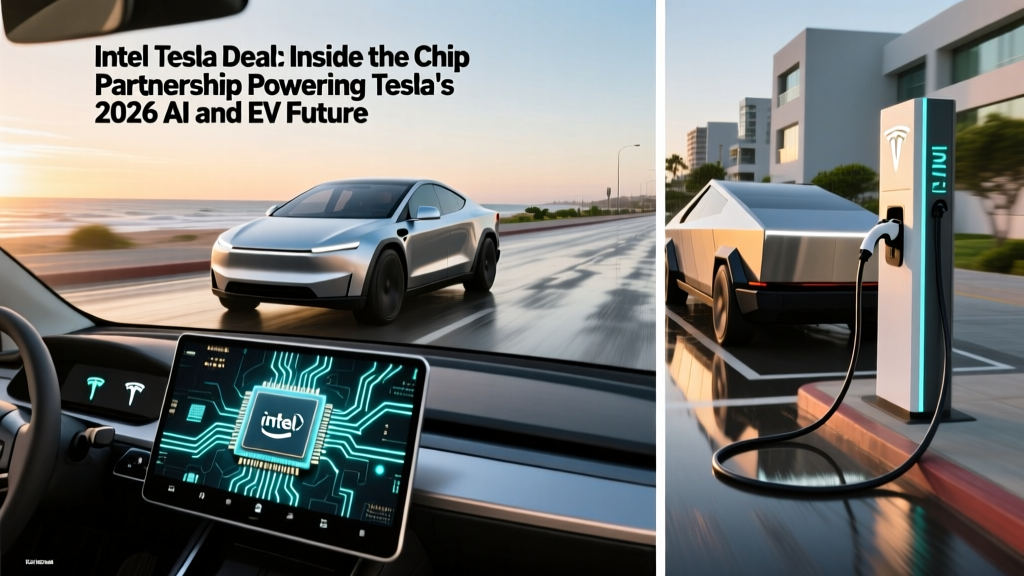
The phrase Intel Tesla deal has circulated through EV and semiconductor circles for years, but its real significance goes far beyond a simple supplier agreement. For Tesla owners and prospective buyers in 2026, Intel's role in Tesla's hardware stack touches everything from Full Self-Driving (FSD) processing to infotainment responsiveness — and indirectly influences the efficiency, range, and pricing of every vehicle Tesla builds. This article breaks down what the Intel-Tesla relationship actually means for the cars you can buy today, using the 2026 Tesla Model Y as the primary lens.
What the Intel Tesla Deal Actually Covers
Tesla's partnership with Intel centers on custom and semi-custom semiconductor components — primarily x86-based processors used in Tesla's infotainment system (MCU) and elements of its data-center AI training infrastructure. While Tesla designs its own FSD chips (fabricated by Samsung and TSMC), Intel has supplied processors for Tesla's media control units and has been linked to Tesla's Dojo supercomputer ecosystem for model training.
For buyers, this matters because the silicon under the touchscreen determines how fast your navigation renders, how smoothly streaming media plays, and how quickly over-the-air updates install. Intel's foundry and packaging services also give Tesla supply-chain diversification at a time when chip shortages have previously delayed deliveries for months.
2026 Tesla Model Y: The EV the Intel Partnership Powers
To make the Intel Tesla deal concrete for buyers, let's look at the vehicle it most directly affects: the 2026 Tesla Model Y Long Range AWD. The refreshed Model Y (internally called "Juniper") carries Intel-based MCU4 hardware, Tesla's HW4.0 FSD computer, and a host of efficiency improvements that push EPA range higher than the outgoing generation.
| Spec | Value |
|---|---|
| EPA Range | 320 miles |
| Battery (usable) | 78.1 kWh, NMC (nickel manganese cobalt) |
| Drivetrain | Dual-motor AWD |
| Horsepower | 384 hp combined |
| 0-60 mph | 4.8 seconds |
| Efficiency | 122 MPGe / 27 kWh/100 mi |
| Peak DC Fast Charge | 250 kW (Supercharger V3/V4) |
| 10-80% DCFC Time | ~25 minutes |
| Level 2 Home Charge | 11.5 kW / ~44 mi/hr |
| Cargo Volume | 72.0 cu ft (rear seats folded), 26.6 cu ft (behind 2nd row) |
| Rear Legroom | 41.6 inches |
| Base MSRP | $46,630 (Long Range AWD) |
| Battery/Drive Unit Warranty | 8 years / 120,000 miles |
Real-World Range: What to Expect Beyond the EPA Sticker
Real-World Highway (70 mph, moderate weather): ~270-285 miles
Real-World City/Mixed: ~290-310 miles
Cold Weather (below 32°F, highway): ~225-255 miles
Source: fueleconomy.gov and owner-reported data.
The 2026 Model Y Long Range's EPA sticker of 320 miles is a meaningful improvement over the pre-refresh generation, driven by a more aerodynamic body, improved heat pump efficiency, and slightly higher cell energy density. However, EPA tests use relatively low average speeds and include substantial city driving where regenerative braking recovers energy.
On sustained highway runs at 70-75 mph, expect to use about 27-29 kWh/100 mi, which translates to roughly 270-285 miles before the battery buffer kicks in. In winter conditions — especially below freezing with cabin heat running — range drops 20-30% even with Tesla's heat pump. The Model Y's thermal management system is among the best in the industry, but physics still governs: heating a cabin in 15°F weather draws substantial energy from the 78.1 kWh pack.
One ownership insight: preconditioning the battery before a Supercharger stop (automatic when you navigate to one) not only speeds charging but also slightly improves range accuracy by bringing the pack to optimal operating temperature.
Charging Speed: DC Fast, Level 2, and the NACS Advantage
Charging speed remains one of Tesla's strongest competitive advantages, and it's where the Supercharger network's reliability makes a tangible daily difference.
| Level | Power | Miles Added per Hour | Notes |
|---|---|---|---|
| Level 1 (120V) | 1.4 kW | ~4 mi/hr | Emergency/trickle only |
| Level 2 (240V, 48A) | 11.5 kW | ~44 mi/hr | Home Wall Connector ideal |
| DC Fast (Supercharger V3/V4) | Peak 250 kW | ~1,000 mi/hr at peak | 10-80% in ~25 min |
The 250 kW peak is only sustained briefly — typically between 10-30% State of Charge. Above 50%, the charge curve tapers significantly, and above 80%, it drops below 50 kW to protect the NMC cells. This is why Tesla (and all EV makers) quote 10-80% times rather than full charges. The last 20% can take as long as the first 70%.
At home on a Tesla Wall Connector wired to a 60A circuit (48A continuous), you'll add roughly 44 miles of range per hour, meaning a full overnight charge from 20% to 80% takes about 5 hours. Most owners who charge nightly at home never think about range anxiety — they wake up with a "full tank" every morning. Installation costs for a 240V/60A circuit typically run $800-$2,000 depending on panel proximity and local permitting, though some homes need a panel upgrade adding $1,500-$3,000.
The Model Y uses the NACS (North American Charging Standard) connector natively. With the broader industry adopting NACS for 2025-2026 models, Tesla owners now have access to growing numbers of non-Tesla chargers equipped with NACS cables, in addition to the 6,000+ Supercharger stalls across North America.
Performance, Tech, and the Intel-Powered Cabin
The 2026 Model Y Long Range AWD delivers 384 horsepower across its dual motors, reaching 0-60 mph in 4.8 seconds. That's quick enough for confident highway merging and genuinely fun off the line, though the Performance trim (3.5 seconds, 450+ hp) exists for enthusiasts willing to sacrifice about 20 miles of range.
Inside, Intel's contribution is most visible in the MCU4 infotainment system. The x86-based processor handles the 15.4-inch center touchscreen with minimal lag, runs Netflix and YouTube at full resolution while parked, and processes the vehicle's 360-degree camera rendering for parking visualization. The rear-seat 8-inch display added in the Juniper refresh also benefits from this compute headroom.
On the driver-assist front, Tesla's FSD (Supervised) remains an SAE Level 2 system — meaning you must keep your hands on or near the wheel and eyes on the road at all times. It is not self-driving. The HW4.0 computer uses Tesla-designed silicon (not Intel) with cameras as the sole sensor suite. FSD performs well on highways and has improved substantially in city streets, but it still struggles with construction zones, faded lane markings, and unprotected left turns. The $8,000 purchase option or $99/month subscription remains a personal value call.
Pricing, Tax Credits, and What You'll Actually Pay
| Trim | Base MSRP | Est. After §30D Credit | Destination |
|---|---|---|---|
| Long Range RWD | $44,130 | ~$36,630* | $1,390 |
| Long Range AWD | $46,630 | ~$39,130* | $1,390 |
| Performance AWD | $51,130 | ~$43,630* | $1,390 |
*Tax credit estimates assume full $7,500 eligibility under IRS §30D. Actual credit depends on your income, battery sourcing compliance, and MSRP caps. Verify at IRS.gov.
- MSRP Cap: SUVs/crossovers must be below $80,000 — all Model Y trims qualify.
- Income Cap: AGI must not exceed $150,000 (single), $225,000 (head of household), or $300,000 (joint).
- Battery Sourcing: Critical minerals and battery components must meet phased percentage thresholds from US/FTA partners. Tesla's supply chain has largely adapted, but confirm at purchase.
- Point-of-Sale Transfer: You can transfer the credit to Tesla at purchase for an immediate price reduction rather than waiting for a tax refund.
The point-of-sale transfer is a significant advantage introduced under the Inflation Reduction Act. Instead of claiming $7,500 on your tax return, you assign the credit to Tesla, and they reduce your purchase price by $7,500 on the spot. This effectively lowers your financed amount and monthly payment. Consult a tax professional to confirm your personal eligibility — income limits and sourcing requirements can shift.
How the Model Y Stacks Up Against Competitors
The Intel Tesla deal gives Tesla a supply-chain edge in infotainment silicon, but the real competition is on the lot. Here's how the 2026 Model Y Long Range AWD compares to its closest rivals:
| Spec | Tesla Model Y LR AWD | Hyundai Ioniq 5 SEL AWD | Ford Mustang Mach-E Premium AWD |
|---|---|---|---|
| EPA Range | 320 mi | 290 mi | 290 mi |
| Battery | 78.1 kWh NMC | 77.4 kWh NMC | 91 kWh NMC (extended) |
| Peak DCFC | 250 kW | 238 kW | 150 kW |
| 10-80% Time | ~25 min | ~20 min | ~38 min |
| 0-60 mph | 4.8 sec | 5.0 sec | 5.1 sec |
| Base MSRP (AWD) | $46,630 | $51,100 | $48,995 |
| Charging Network | NACS (Supercharger) | NACS (2026+) | NACS (adapter or native) |
The Model Y wins on range and Supercharger network access. The Ioniq 5 charges slightly faster thanks to its 800V architecture but sacrifices 30 miles of range. The Mach-E trails in charging speed and range but offers a more traditional interior with physical buttons. All three now support NACS, but only Tesla has native, mature Supercharger integration.
Who Should Buy the 2026 Model Y?
- You want the longest EPA range in the compact EV SUV segment (320 mi)
- Supercharger network reliability is a priority for road trips
- You value over-the-air updates and a minimal, screen-centric interior
- You want access to Tesla's growing FSD capability (with supervision)
- You can charge at home and want a one-car solution for commuting and family trips
- You prefer physical buttons and knobs (check the Ioniq 5 or Mach-E)
- You need third-row seating (consider the Kia EV9 or Model X)
- You want the fastest DC charging available (Ioniq 5's 800V architecture wins)
- You're uncomfortable with Tesla's camera-only approach to driver assists
Pros, Cons, and Bottom Line
- Class-leading 320-mile EPA range
- Supercharger network: most reliable DC fast-charging in North America
- Spacious cabin: 72 cu ft cargo, generous rear legroom
- Strong efficiency at 122 MPGe combined
- OTA updates continuously add features
- Point-of-sale tax credit transfer reduces upfront cost
- Intel-powered MCU4 delivers smooth, responsive infotainment
- No physical buttons — all controls on touchscreen
- FSD (Supervised) still requires full driver attention; $8,000 option
- 250 kW peak DCFC lags behind 800V competitors (Ioniq 5, Taycan)
- NMC battery chemistry degrades slightly faster than LFP if routinely charged to 100%
- Rear visibility is limited; relies heavily on cameras
- Insurance costs tend to be higher than segment average
Frequently Asked Questions
What does the Intel Tesla deal mean for my Model Y?
Intel supplies processors for Tesla's infotainment system (MCU) and backend AI infrastructure. In your car, this means a fast, responsive touchscreen, smooth media streaming, and reliable over-the-air updates. Intel does not supply Tesla's FSD or motor-control chips.
What is the real-world range of the 2026 Model Y?
EPA-rated at 320 miles. In real-world highway driving at 70 mph, expect 270-285 miles. In winter conditions below freezing, plan for 225-255 miles. City and mixed driving with regenerative braking gets closest to the sticker number.
How fast does the Model Y charge at home and on the road?
At home on a Level 2 Tesla Wall Connector (11.5 kW), you add about 44 miles per hour — a full overnight charge covers most needs. On a Supercharger, it peaks at 250 kW and charges 10-80% in roughly 25 minutes, with tapering above 50% SoC.
Does the 2026 Tesla Model Y qualify for the $7,500 federal tax credit?
All Model Y trims fall under the $80,000 SUV MSRP cap. Eligibility depends on your adjusted gross income (≤$150K single, ≤$300K joint) and battery sourcing compliance. You can transfer the credit at point of sale for an immediate price reduction. Confirm details at IRS.gov or with a tax professional.
Is the Model Y worth buying over the Ioniq 5 or Mach-E?
If range (320 mi), Supercharger access, and Tesla's software ecosystem are priorities, yes. If you prefer faster DC charging (Ioniq 5), physical controls (Mach-E), or a more conventional dealership experience, the competitors are strong alternatives. Test-drive all three before deciding.
Is Tesla's FSD self-driving?
No. FSD (Supervised) is an SAE Level 2 driver-assist system. You must remain fully engaged — hands near the wheel, eyes on the road. It handles many highway and city scenarios but requires human oversight at all times. True self-driving (Level 4) currently exists only in geofenced robotaxi services like Waymo.
How long will the Model Y battery last?
Tesla warranties the battery for 8 years or 120,000 miles (whichever comes first), guaranteeing at least 70% capacity retention. Real-world data from high-mileage Teslas suggests NMC packs retain 85-90% capacity at 100,000 miles with proper care — meaning avoiding routine 100% charges and frequent DC fast charging.
Sources: fueleconomy.gov, IRS §30D Clean Vehicle Credit, Tesla.com specifications. Pricing and credit rules reflect 2026 model year and current IRS guidance; verify at time of purchase.