Quick Verdict: Two Very Different Tesla SUVs
Search for "inside Tesla SUV" and you'll find two distinct vehicles wearing the same badge. The 2026 Tesla Model Y is the mass-market compact crossover that undercuts most rivals on price while delivering class-leading efficiency and access to the Supercharger network. The 2026 Tesla Model X is the flagship three-row luxury hauler with falcon-wing doors, up to 340 miles of EPA range, and a six-figure price tag. Both share Tesla's software-first interior, Supercharger access, and over-the-air updates — but they serve fundamentally different buyers. This review breaks down the real numbers that matter: actual range, sustained charging speeds, true out-of-pocket cost after tax credits, and the ownership trade-offs no spec sheet reveals.
Side-by-Side Spec Table: Model Y vs Model X
| Spec | 2026 Model Y Long Range AWD | 2026 Model X Long Range AWD |
|---|---|---|
| EPA Range | 320 miles | 340 miles |
| Battery (usable) | ~75 kWh, NMC | ~100 kWh, NMC |
| Peak DC Fast Charge | 250 kW | 250 kW |
| 10–80% DCFC Time | ~27 min | ~32 min |
| Level 2 Home Charge | 11.5 kW (~44 mi/hr) | 11.5 kW (~38 mi/hr) |
| 0–60 mph | 4.8 sec | 3.8 sec |
| Horsepower | 384 hp | 670 hp |
| Drivetrain | Dual-Motor AWD | Dual-Motor AWD |
| MPGe (combined) | 122 MPGe | 102 MPGe |
| Efficiency | 28 kWh/100 mi | 33 kWh/100 mi |
| Cargo (behind 2nd row) | 30.2 cu ft | 42.1 cu ft |
| Cargo (max, seats folded) | 72.1 cu ft | 85.1 cu ft |
| Seating | 5 (optional 7) | 5, 6, or 7 |
| Base MSRP | $44,990 | $79,990 |
| Battery Warranty | 8 yr / 120,000 mi | 8 yr / 150,000 mi |
Sources: fueleconomy.gov, Tesla official spec sheets.
Real-World Range: What the EPA Sticker Doesn't Tell You
Model Y Long Range AWD: EPA 320 mi → Expect ~270–290 mi highway at 70 mph; ~230–250 mi in sub-freezing weather with cabin heat.
Model X Long Range AWD: EPA 340 mi → Expect ~285–305 mi highway at 70 mph; ~245–265 mi in cold conditions.
The EPA combined cycle blends city and highway driving at moderate speeds. In practice, sustained highway travel at 70–75 mph consumes roughly 10–15% more energy than the EPA sticker implies. Cold weather compounds this: Tesla's heat pump helps, but battery chemistry slows and cabin heating still draws from the pack. On a 30°F winter road trip at highway speed, plan for 25–30% range reduction from the EPA number in both vehicles.
The Model Y's lighter curb weight (~4,400 lbs vs the Model X's ~5,100 lbs) gives it a meaningful efficiency edge. At 28 kWh per 100 miles, the Model Y is one of the most efficient electric crossovers sold in the U.S. — a figure that directly reduces your per-mile charging cost whether you're plugged in at home or paying per-kWh on the road.
Charging Speeds: Supercharger Access Is the Real Advantage
Both Tesla SUVs peak at 250 kW on V3 Superchargers, but peak rate is not sustained rate. The charge curve tapers significantly above 50% state of charge. Here's what real charging sessions look like:
| Charging Level | Model Y Long Range | Model X Long Range |
|---|---|---|
| Level 1 (120V, 12A) | ~1.4 kW / ~5 mi/hr | ~1.4 kW / ~4 mi/hr |
| Level 2 (240V, 48A) | 11.5 kW / ~44 mi/hr | 11.5 kW / ~38 mi/hr |
| DCFC peak | 250 kW | 250 kW |
| DCFC 10–80% | ~27 minutes | ~32 minutes |
| DCFC 10–50% (fastest segment) | ~14 minutes | ~17 minutes |
Key insight: The 10–50% window is where Tesla's NMC packs charge fastest. If you're road-tripping, charging to 50% and moving on is often quicker than waiting for the taper from 50–80%. Preconditioning the battery (automatic when you navigate to a Supercharger) is essential — arriving at a DC fast charger with a cold pack can cut peak speeds in half.
Home charging on a Level 2 Wall Connector at 48 amps adds roughly 44 miles per hour for the Model Y, meaning an overnight session (8 hours) replenishes about 350 miles — more than a full pack. The Model X adds about 38 miles per hour due to its lower efficiency, still enough for a full overnight charge. Installation typically costs $800–$2,000 depending on your electrical panel; a 200-amp panel upgrade can add $1,500–$3,000.
Inside the Cabin: Minimalist Tech, Maximum Software
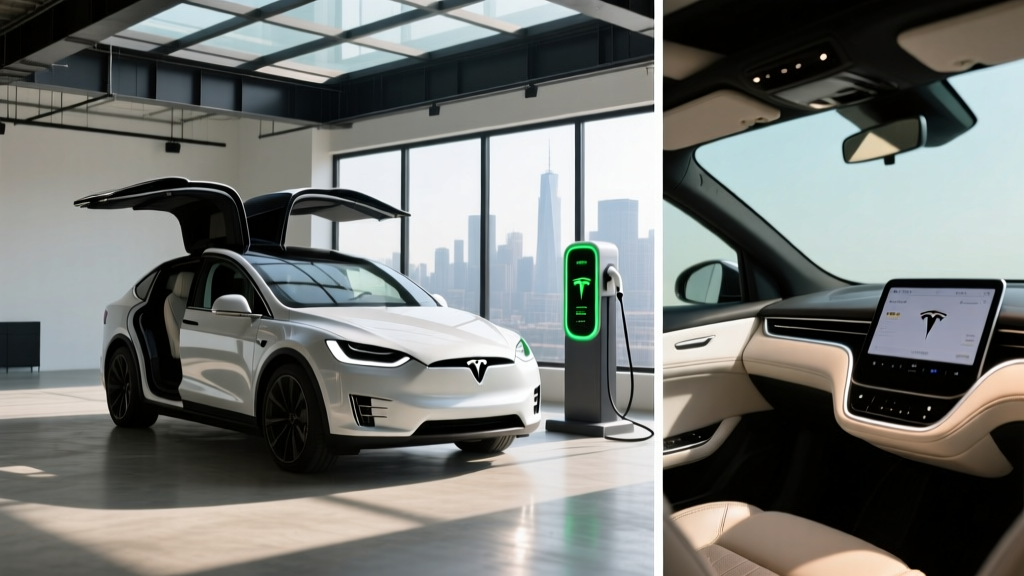
Step inside either Tesla SUV and the philosophy is identical: a single 15-inch landscape touchscreen dominates the dash, with no physical instrument cluster. The Model Y uses a 15.4-inch center display; the Model X adds a 12.2-inch driver-facing display behind the steering wheel — a meaningful improvement for glanceable speed and navigation info.
Model Y Interior Highlights
- Ventilated front seats and power-folding second row (post-2025 refresh)
- Ambient lighting and acoustic glass for improved cabin quietness
- 30.2 cu ft cargo behind second row; 72.1 cu ft max
- Rear-seat legroom: 39.4 inches
- Optional third row (very tight — best for small children only)
Model X Interior Highlights
- Falcon-wing rear doors with sensor-based obstacle detection
- Available second-row captain's chairs or bench
- 42.1 cu ft cargo behind second row; 85.1 cu ft max
- Second-row legroom: 38.4 inches; third row: 32.7 inches
- HEPA air filtration with Bioweapon Defense Mode
Both vehicles run Tesla's proprietary infotainment with Netflix, YouTube, Spotify, and a surprisingly capable gaming platform. Apple CarPlay and Android Auto remain unavailable — a dealbreaker for some buyers accustomed to phone projection. Tesla's native navigation and voice commands are competent, but the closed ecosystem is a deliberate choice.
Driver Assistance: Autopilot and FSD (Supervised)
Tesla Autopilot and Full Self-Driving (Supervised) are SAE Level 2 driver-assistance systems. The driver must remain fully engaged, hands on the wheel, eyes on the road at all times. Tesla's camera-only vision system handles lane centering, adaptive cruise, and automatic lane changes — but it does not replace the driver. Only Level 4 services like Waymo operate without a human driver.
Autopilot comes standard on both models and includes Traffic-Aware Cruise Control and Autosteer. FSD (Supervised) is an $8,000 add-on (or $99/month subscription as of 2026) that adds automatic lane changes, Navigate on Autopilot, traffic light/stop sign recognition, and Smart Summon. In testing, FSD handles highway interchanges competently but still requires intervention in construction zones and unprotected left turns. It's an impressive assist — not autonomy.
Pricing, Tax Credits, and True Cost
| Trim | MSRP | Federal Credit (§30D) | Effective Price |
|---|---|---|---|
| Model Y Long Range AWD | $44,990 | Up to $7,500 (if eligible) | ~$37,490 |
| Model Y Performance | $48,990 | Up to $7,500 (if eligible) | ~$41,490 |
| Model X Long Range | $79,990 | Not eligible (MSRP cap) | $79,990 |
| Model X Plaid | $94,990 | Not eligible (MSRP cap) | $94,990 |
Critical tax credit details: Under IRS §30D, the federal EV tax credit of up to $7,500 applies only to SUVs with an MSRP at or below $80,000. This eliminates the Model X entirely. For the Model Y, eligibility depends on:
- Buyer income caps: $150,000 single / $300,000 joint MAGI
- Battery sourcing: Critical minerals and battery components must meet phased percentage thresholds from U.S. or FTA-partner countries
- Point-of-sale transfer: As of 2024+, the credit can be applied at purchase rather than claimed on your tax return
Battery-sourcing requirements tighten annually. Always verify current eligibility on the IRS Clean Vehicle portal before purchasing. State incentives (California, Colorado, etc.) may stack on top — check your local DMV or energy office.
Who Should Buy Which Tesla SUV?
- You want the lowest total cost of ownership in a premium electric crossover
- Daily commuting and weekend road trips are your primary use
- You need 5-passenger comfort with adequate (not massive) cargo space
- Federal tax credit eligibility matters to your budget
- Efficiency and low per-mile charging cost are priorities
- You need genuine three-row seating for 6–7 passengers
- Falcon-wing doors and flagship status appeal to you
- You want 340+ miles of range and 670 hp without compromising
- Towing capacity (5,000 lbs) matters for your lifestyle
- Budget is not the primary constraint
Pros and Cons at a Glance
- Access to 25,000+ Superchargers — the most reliable DC network in North America
- Best-in-class software with continuous OTA improvements
- Strong efficiency figures reduce per-mile cost
- Excellent safety ratings (NHTSA 5-star, IIHS Top Safety Pick for Model Y)
- Minimal maintenance: no oil, spark plugs, or transmission fluid
- No Apple CarPlay or Android Auto
- Panel gaps and interior material quality still lag luxury competitors at this price
- Repair costs and insurance premiums above segment average
- FSD (Supervised) is expensive and still requires full driver attention
- Model X: falcon-wing doors add complexity and potential service issues
Frequently Asked Questions
What is the real-world range of the Tesla Model Y?
EPA-rated at 320 miles combined. In real-world highway driving at 70 mph, expect 270–290 miles. In freezing temperatures with cabin heating, plan for 230–250 miles. The Model Y's heat pump mitigates some cold-weather loss compared to resistive heaters in older EVs.
How fast does a Tesla SUV charge at home and on the road?
On a Level 2 home charger (48A/11.5 kW), the Model Y adds ~44 miles per hour; the Model X adds ~38 miles per hour. On a V3 Supercharger (250 kW DC), both charge from 10–80% in roughly 27–32 minutes. Actual speed depends on battery temperature — always precondition via navigation to a charger.
Does the Tesla Model X qualify for the federal EV tax credit?
No. The Model X exceeds the $80,000 MSRP cap for SUVs under IRS §30D. The Model Y, starting at $44,990, can qualify for up to $7,500 if the buyer meets income thresholds and the vehicle's battery sourcing meets current-year requirements.
Is the Tesla Model Y worth buying over the Hyundai Ioniq 5 or Ford Mustang Mach-E?
The Model Y wins on Supercharger network access, software ecosystem, and cargo space. The Ioniq 5 offers faster 10–80% charging (~18 min at 350 kW on 800V architecture), CarPlay support, and a more distinctive interior. The Mach-E offers a more traditional crossover feel. If Supercharger reliability and Tesla's software ecosystem matter most, the Model Y is the pick. If you value CarPlay and faster peak charging, test-drive the Ioniq 5.
What is the battery warranty on Tesla SUVs?
The Model Y battery and drive unit are covered for 8 years or 120,000 miles (whichever comes first), with a minimum 70% capacity retention guarantee. The Model X extends that to 8 years or 150,000 miles. Tesla's NMC packs have demonstrated strong longevity in fleet data, with typical degradation of 10–12% after 100,000 miles.
Can I tow with a Tesla SUV?
The Model Y is rated for 3,500 lbs of towing. The Model X can tow up to 5,000 lbs. Note that towing reduces range by roughly 30–50% depending on trailer aerodynamics and weight — plan Supercharger stops accordingly.