Quick Answer: What's Inside of an Electric Motor?
An EV electric motor contains two core components: a stator (stationary copper wire windings) and a rotor (a spinning shaft with magnets or induced magnetic fields). When alternating current flows through the stator windings, it creates a rotating magnetic field that pulls the rotor, converting electrical energy from the battery into mechanical rotation that drives the wheels. Unlike a gas engine with hundreds of moving parts — pistons, valves, camshafts, timing chains — a typical EV motor has essentially one moving part: the rotor. This simplicity is why EV motors convert 85–95% of electrical energy into motion, while internal combustion engines manage only 20–35% thermal efficiency, per the U.S. Department of Energy.
The Anatomy Inside of an Electric Motor
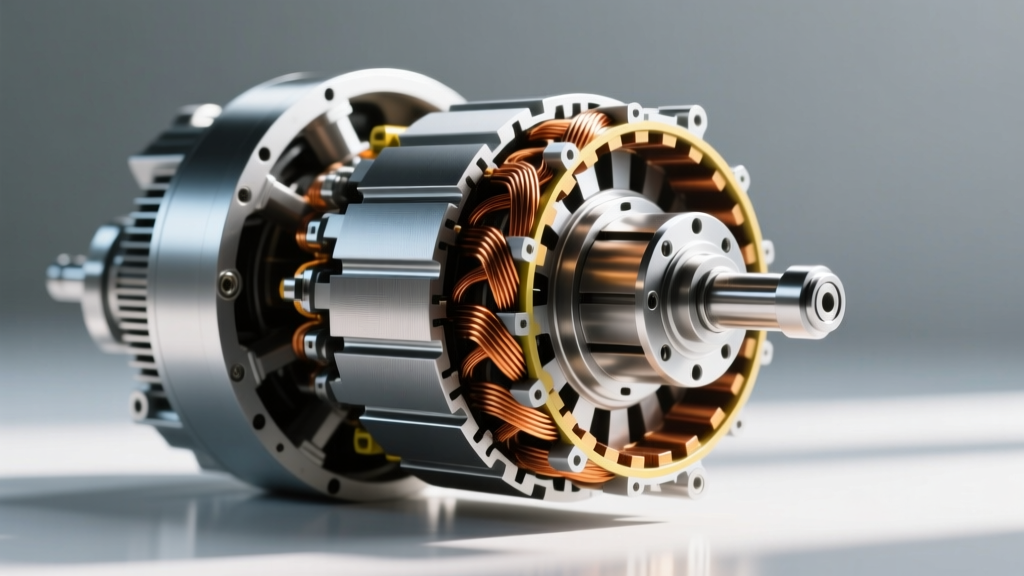
Open up the casing of a typical EV traction motor and you'll find an elegantly simple machine. Here's what each component does:
- Stator: A laminated steel core wrapped with copper (or sometimes aluminum) wire coils arranged in phases — typically three-phase in automotive applications. This is where electrical energy enters the motor.
- Rotor: The rotating element inside the stator. Its design varies by motor type (see below). It spins on bearings and connects to the drivetrain via a single-speed reduction gear.
- Bearings: Precision-sealed bearings support the rotor shaft, designed for 150,000+ mile lifespans with minimal friction.
- Cooling jacket: Liquid coolant channels surround the stator to manage heat during sustained high-power output — critical for repeat acceleration and sustained highway speeds.
- Resolver/position sensor: Tells the inverter the rotor's exact angular position thousands of times per second so the AC waveform stays synchronized.
- Inverter (external but integral): Converts DC from the battery into precisely timed three-phase AC. This is the "brain" that controls motor speed and torque.
The entire assembly is remarkably compact. Tesla's rear drive unit in the Model Y, for example, produces roughly 295 hp from a package smaller than a carry-on suitcase. The Hyundai Ioniq 5's rear motor delivers 225 hp from a similarly dense unit. Compare that to a 2.0L turbocharged four-cylinder gas engine — comparable output but with an engine block, cylinder head, intake manifold, exhaust manifold, turbocharger, intercooler, oil pump, water pump, and dozens of ancillary components.
The Three Motor Types You'll Find in Modern EVs
Not all electric motors are built alike. Automakers choose between three primary architectures, each with distinct trade-offs in cost, efficiency, and performance:
| Motor Type | How It Works | Used By | Pros | Cons |
|---|---|---|---|---|
| Permanent Magnet Synchronous Motor (PMSM) | Rotor uses rare-earth magnets (neodymium) for high torque density | Tesla (rear), Hyundai, Kia, BMW, most Chinese EVs | Highest efficiency (93–95%), excellent low-speed torque, compact | Relies on rare-earth supply chain; magnets can demagnetize at extreme heat |
| AC Induction Motor (ACIM) | Rotor has no magnets — magnetic field is induced by stator current | Tesla (front, older models), early Model S/X | No rare-earth materials; robust at high speed; can freewheel with zero drag | Slightly lower efficiency at partial load (88–92%); heavier for same output |
| Externally Excited Synchronous Motor (EESM) | Rotor uses copper windings energized by external current instead of magnets | BMW (Gen5 eDrive), Renault Megane E-Tech | No rare-earth magnets; adjustable field strength for highway efficiency | More complex rotor with slip rings or wireless power transfer; slightly heavier |
For 2026, PMSM remains the dominant choice — roughly 75% of new EVs sold in the U.S. use permanent magnet motors. The trend toward EESM (led by BMW and Renault) is a supply-chain hedge against neodymium price volatility, not a performance upgrade.
EV Motor vs. Gas Engine: Efficiency and Cost by the Numbers
The reason EVs cost less to "fuel" isn't just electricity vs. gasoline pricing — it's the fundamental physics inside of an electric motor versus an internal combustion engine.
| Metric | EV (Electric Motor) | Gas Car (ICE) |
|---|---|---|
| Energy conversion efficiency | 85–95% (battery to wheels) | 20–35% (fuel to wheels) |
| Moving parts in powertrain | ~1 (rotor + reduction gear) | 200+ (pistons, valves, crankshaft, cam, etc.) |
| Energy wasted as heat | 5–15% | 65–80% |
| Regenerative braking recovery | Yes — recaptures 15–25% of kinetic energy | No — 100% lost as brake heat |
| Idle energy consumption | Near zero (motor doesn't run when stopped) | 0.2–0.5 gal/hr idling |
| Peak torque availability | Instant from 0 RPM | Requires 2,000–4,500 RPM (turbo lag adds delay) |
| Typical maintenance over 150k miles | Coolant flush, cabin filter, brake fluid — ~$800–$1,200 | Oil changes, spark plugs, timing belt, transmission fluid — ~$4,500–$7,000 |
That efficiency gap translates directly to your wallet. Here's a realistic five-year cost comparison between a 2026 Tesla Model Y Long Range (EPA 320 miles, 28 kWh/100mi) and a comparably equipped 2026 Toyota RAV4 AWD (EPA 30 MPG combined):
| Cost Category (5 yr / 75,000 mi) | Tesla Model Y LR | Toyota RAV4 AWD |
|---|---|---|
| Purchase price (MSRP) | $44,990 | $34,500 |
| Federal tax credit (§30D, if eligible) | −$3,750 to −$7,500* | $0 |
| Fuel/energy cost (home L2 at $0.14/kWh avg) | $3,150 | $8,750 (at $3.50/gal) |
| Maintenance | ~$1,000 | ~$3,800 |
| Insurance (avg) | ~$9,500 | ~$7,200 |
| 5-yr total (pre-depreciation) | ~$51,140 – $54,890 | ~$54,250 |
*The §30D credit for 2026 depends on battery sourcing, critical-mineral requirements, MSRP caps ($55,000 sedans / $80,000 SUVs/trucks), and buyer income limits ($150K single / $300K joint). Check current eligibility at IRS.gov before purchasing. Point-of-sale transfer is available through registered dealers.
Real-World Ownership: What the Motor Means for Your Daily Drive
The simplicity inside of an electric motor shapes the entire ownership experience — but not every implication is universally positive. Here's what first-time buyers actually need to weigh:
The Good: Near-Zero Drivetrain Maintenance
With no oil, no spark plugs, no timing chain, no exhaust system, and no multi-speed transmission, your EV motor essentially runs itself. Most automakers recommend a coolant check every 4–5 years and a cabin air filter swap annually. Brake pad life often exceeds 100,000 miles because regenerative braking — the motor acting as a generator to slow the car — handles 80–90% of deceleration. Owners of the Chevrolet Bolt EUV and Hyundai Ioniq 5 routinely report original brake pads at 80,000+ miles.
The Trade-Off: Home Charging Access Is Non-Negotiable
The motor's efficiency only delivers cost savings if you can charge at home. Level 2 home charging (240V, 7.7–11.5 kW) costs roughly $0.10–$0.18/kWh depending on your utility rate — translating to $0.03–$0.05 per mile. Public DC fast charging (Electrify America, EVgo, Tesla Superchargers) typically costs $0.30–$0.55/kWh, pushing cost-per-mile to $0.09–$0.15, which narrows the gap with gasoline substantially.
Home Level 2 installation runs $800–$2,500 for a straightforward setup (NEMA 14-50 outlet or hardwired wall connector on an existing 200A panel). If your home has a 100A panel or the run from panel to garage exceeds 50 feet, expect $2,500–$5,000+ with potential panel upgrades. Always get a quote from a licensed electrician before committing to a purchase.
The Climate Factor: Cold Weather Doesn't Affect the Motor — It Affects the Battery
The motor itself performs identically at 10°F and 90°F. But the battery feeding it loses 20–40% of usable capacity in sustained sub-freezing temperatures because lithium-ion chemistry slows and energy is diverted to cabin heating. A 320-mile EPA-rated EV may deliver 200–250 real-world miles in a 20°F January commute. EVs with heat pumps (standard on most 2026 Hyundai, Kia, Tesla, and BMW models) reduce this penalty to roughly 15–25%.
Common Misconceptions About EV Motors — Fact-Checked
| Myth | Fact |
|---|---|
| "Electric motors wear out like gas engines" | EV traction motors have no consumable internal parts. Bearings are sealed for 200,000+ miles. Motor failure before 150,000 miles is statistically rare — most issues trace to the inverter or cooling system, not the motor itself. |
| "More horsepower means the motor will drain the battery faster" | Motor peak output (e.g., 480 hp in a dual-motor setup) is only drawn during hard acceleration. Cruising at 70 mph typically draws 15–25 kW regardless of peak rating. Efficiency is determined by driving style, not motor size. |
| "EV motors can't handle towing or sustained highway loads" | Modern liquid-cooled motors sustain high output indefinitely within thermal limits. The Ford F-150 Lightning's dual motors tow up to 10,000 lbs. The constraint is battery capacity under load, not motor capability — expect 50–60% of EPA range when towing near max capacity. |
| "Replacing an EV motor costs as much as a new car" | Motor replacement is uncommon and typically covered under the federally mandated 8-year/100,000-mile powertrain warranty. Out-of-warranty replacement runs $3,000–$7,000 for most mainstream models — far less than a gas engine rebuild. |
| "All EV motors are the same" | PMSM, ACIM, and EESM architectures differ significantly in efficiency curves, rare-earth dependency, and highway performance. Motor type affects real-world range by 3–7% at equivalent battery sizes. |
Decision Framework: Does Motor Tech Matter for Your Purchase?
Choose Your Path Based on Your Driving Profile
IF you commute under 40 miles daily with home charging:
Motor type is largely irrelevant. Any modern PMSM or ACIM will outlast the vehicle. Prioritize battery size (kWh), EPA range, and Level 2 charge rate over motor architecture. A Hyundai Ioniq 5 SE ($42,600 MSRP, 290 mi EPA, 77.4 kWh NMC battery) or a Chevy Equinox EV LT ($33,600 MSRP, 319 mi EPA) will serve you efficiently for 15+ years.
IF you regularly road-trip 300+ miles:
Motor efficiency at sustained highway speed matters. PMSM motors maintain higher efficiency above 70 mph than older AC induction designs. Look for vehicles with heat pumps and strong DC fast-charge rates (250+ kW peak). The Tesla Model Y Long Range (320 mi EPA, 250 kW peak, 10–80% in ~22 min) and Hyundai Ioniq 5 (290 mi EPA, 240 kW peak, 10–80% in ~18 min) remain benchmarks here.
IF you tow or haul frequently:
Dual-motor AWD configurations provide the torque and thermal headroom needed. The Rivian R1T Dual-Motor (352 mi EPA, 665 lb-ft, 11,000 lb tow) and F-150 Lightning Extended Range (320 mi EPA, 10,000 lb tow) use paired PMSM units with aggressive liquid cooling. Expect 50–60% range reduction under heavy loads — plan charging stops accordingly.
IF you live in an apartment without home charging:
The motor's efficiency advantage is diminished if you rely exclusively on public DC fast chargers at $0.35–$0.55/kWh. A PHEV like the Toyota RAV4 Prime (42 mi electric-only, 38 MPG combined after depletion) may be a more practical bridge until you gain charging access.
IF cold-weather range loss is your primary concern:
The motor isn't the variable — the battery and thermal management system are. Prioritize EVs with heat pumps and battery preconditioning (standard on Tesla, Hyundai E-GMP, BMW Gen5). LFP battery chemistry (used in base Tesla Model 3/Y and some Ford models) tolerates cold somewhat better at the cost of lower energy density.
What First-Time EV Buyers Should Know About the Powertrain
If you're transitioning from a gas vehicle, the motor experience will feel fundamentally different:
- Torque is instant. There's no downshift delay, no turbo spool-up, no RPM climb to peak torque. A 300-hp EV motor accelerates like a 400-hp gas car from a stoplight because 100% of torque is available at 0 RPM. This makes merging and passing effortless.
- One-pedal driving is optional but addictive. Lift off the accelerator and the motor reverses its role — becoming a generator that slows the car while sending energy back to the battery. Most EVs let you adjust regen strength or disable it entirely for a coasting feel closer to a gas car.
- The motor is silent. At low speeds, you'll hear only tire noise and a faint inverter whine. Federal regulations require an artificial pedestrian warning sound below 19 mph — you'll hear this as a soft hum when maneuvering in parking lots.
- Powertrain warranty coverage is strong. Federal law mandates a minimum 8-year/100,000-mile warranty on the battery and electric motor (10 years/150,000 miles in CARB states like California, New York, and others). Hyundai and Kia extend this to 10 years/100,000 miles nationwide. This covers motor failure, inverter failure, and battery capacity loss below 70% of original.
- The single-speed transmission is intentional. Because electric motors deliver usable torque from 0 to 10,000+ RPM, there's no need for gear ratios. The reduction gear (typically 9:1 to 10.5:1 ratio) is a sealed, maintenance-free unit filled with gear oil that lasts the life of the vehicle.
Frequently Asked Questions
How long does an electric motor in an EV last?
EV traction motors are designed to outlast the vehicle. With only one moving part and sealed bearings, there's no wear mechanism comparable to piston rings or valve seals in a gas engine. Real-world data from Tesla's high-mileage fleet and Nissan Leaf taxis shows motors running past 200,000 miles without rebuild. The NHTSA and manufacturer warranty structures reflect this — 8 years/100,000 miles minimum coverage is standard.
Can an EV motor be repaired or does it need full replacement?
Most motor-related failures involve external components: the inverter, the resolver sensor, or the cooling pump. These are individually replaceable. A full motor replacement is rare and typically covered under warranty. Out-of-pocket cost for a complete drive unit swap (motor + inverter + reduction gear) ranges from $3,000 to $7,000 at independent EV shops, less at OEM dealers under warranty.
Do electric motors lose power over time?
The motor itself does not degrade. If your EV feels slower over the years, the cause is battery degradation — reduced kWh capacity means less energy available for peak motor output. A battery at 85% state of health still lets the motor produce full peak power; it just can't sustain it as long or deliver the same total range. Battery degradation averages 1.5–2.5% per year for liquid-cooled NMC packs and ~1% per year for LFP chemistry, based on fleet data.
Why do some EVs have two motors?
Dual-motor configurations serve two purposes: all-wheel drive and power distribution. A front and rear motor enables torque vectoring for traction in rain and snow. Performance variants (like the Tesla Model Y Performance or Hyundai Ioniq 5 N) use dual motors to hit 0–60 mph in 3.5 seconds or less. Some dual-motor EVs can disconnect the front motor entirely during highway cruising to eliminate drag and improve efficiency by 2–4%.
Does motor type affect which EV I should buy?
For most buyers, no. The differences between PMSM, ACIM, and EESM are measurable in lab settings but translate to only 3–7% range variance in real driving. Your purchase decision should prioritize battery capacity (kWh), EPA range, DC fast-charge speed (kW), home charging access, and total cost — not motor architecture. Motor type matters mainly to buyers who want to avoid rare-earth supply chain concerns (favor ACIM or EESM) or who prioritize maximum efficiency at highway speeds (favor PMSM).
What happens if the electric motor fails while driving?
Catastrophic motor failure while driving is exceedingly rare. If the motor or inverter detects a fault, the system typically enters a reduced-power "limp mode" allowing you to pull over safely. You'll receive a dashboard warning. The vehicle will not suddenly stop — it will gradually reduce power. This is analogous to a gas car's check-engine limp mode and is covered under the powertrain warranty.