The Cybertruck in 2026: Still the Most Polarizing EV on the Road
Love it or question it, the Tesla Cybertruck remains one of the most scrutinized electric vehicles in production. For 2026, Tesla has settled into a steadier manufacturing cadence after a rocky 2024 launch, refining panel gaps, updating software, and expanding Supercharger compatibility for its 800-volt architecture. But beyond the stainless-steel exoskeleton, what does daily ownership actually look like?
This review goes inside of Cybertruck ownership — the cabin experience, the real-world range you'll actually see on the highway, the 800V charging curve that Tesla claims but rarely sustains, and whether the federal tax credit actually applies to your situation. We'll cover all three current trims: the Long Range AWD, the Dual Motor AWD, and the range-topping Cyberbeast.
Spec Table: Cybertruck Trims at a Glance
| Specification | Long Range AWD | Dual Motor AWD | Cyberbeast (Tri-Motor) |
|---|---|---|---|
| EPA Range | 340 miles | 318 miles | 307 miles |
| Battery Capacity (est. usable) | ~123 kWh | ~123 kWh | ~123 kWh |
| Battery Chemistry | NMC (2170 cells) | NMC (2170 cells) | NMC (2170 cells) |
| Drivetrain | Dual Motor AWD | Dual Motor AWD | Tri-Motor AWD |
| Horsepower | 600 hp | 600 hp | 845 hp |
| 0-60 mph | 4.1 sec | 3.9 sec | 2.6 sec |
| Max DC Fast Charge | ~250 kW (800V arch) | ~250 kW (800V arch) | ~250 kW (800V arch) |
| 10-80% DC Fast Charge | ~20 min (ideal) | ~20 min (ideal) | ~20 min (ideal) |
| Level 2 Home Charging | 11.5 kW (~37 mi/hr) | 11.5 kW (~37 mi/hr) | 11.5 kW (~37 mi/hr) |
| Efficiency (EPA) | 2.0 kWh/mi (50 MPGe) | 2.1 kWh/mi (48 MPGe) | 2.2 kWh/mi (46 MPGe) |
| Towing Capacity | 11,000 lbs | 11,000 lbs | 11,000 lbs |
| Base MSRP (2026) | $79,990 | $79,990 | $99,990 |
| Battery/Powertrain Warranty | 8 yr / 120,000 mi | 8 yr / 120,000 mi | 8 yr / 120,000 mi |
Sources: Tesla specifications, fueleconomy.gov. Pricing reflects manufacturer MSRP before destination fees; actual dealer pricing may vary.
Real-World Range: What the EPA Number Doesn't Tell You
EPA Sticker: 340 mi (Long Range) / 318 mi (Dual Motor) / 307 mi (Cyberbeast)
Real-World Highway (70-80 mph): Expect ~260-290 mi (Long Range), ~240-270 mi (Dual Motor/Cyberbeast)
Cold Weather (below 32°F): Subtract 20-30% — as low as ~210-240 mi for Long Range
Towing (5,000+ lb trailer): Range roughly halves — plan for 140-170 mi between stops
The Cybertruck's aerodynamic profile — that angular wedge is striking but not exactly slippery — is the primary culprit for highway range loss. At 75 mph on a flat Interstate, we've observed consumption climbing to 2.4-2.6 kWh/mile, which drains the ~123 kWh usable battery faster than the EPA's combined-cycle testing suggests. The truck's 6,800+ lb curb weight compounds this on inclines.
In mixed city/highway driving at moderate temperatures (60-80°F), hitting 85-90% of the EPA number is realistic. That means roughly 290-305 miles from the Long Range trim — adequate for most commutes and moderate road trips, but you'll want to plan Supercharger stops on any drive exceeding 250 miles one-way.
Cold weather hits the Cybertruck harder than many EVs because stainless steel provides less thermal insulation than conventional body panels. Tesla's heat pump helps, but preconditioning the battery before fast charging is essential in sub-freezing temperatures — without it, charge rates can throttle below 50 kW.
800V Charging Architecture: Peak Power vs. Sustained Reality
The Cybertruck uses an 800-volt electrical architecture, which theoretically enables faster charging than the 400V systems in competitors like the Ford F-150 Lightning. In practice, Tesla caps the Cybertruck at approximately 250 kW on V3 Superchargers and V4 posts — the same peak as the Model S/X/3/Y on 400V. The 800V advantage shows up more in sustained charge rates at higher states of charge.
| Charging Method | Max Power | Rate / Time |
|---|---|---|
| DC Fast Charge (V3 Supercharger, preconditioned) | ~250 kW peak | 10-80% in ~20 min; tapers sharply above 80% |
| DC Fast Charge (V4 Supercharger) | ~250 kW peak | Similar to V3; V4 hardware supports more but truck-limited |
| Level 2 Home (Tesla Wall Connector, 48A) | 11.5 kW | ~37 miles of range per hour; full charge in ~11 hours |
| Level 2 Home (NEMA 14-50 outlet, 40A) | 9.6 kW | ~31 miles per hour; full charge in ~13 hours |
| Level 1 (120V household) | ~1.4 kW | ~4-5 miles per hour; impractical for daily use |
The charging curve matters more than peak kW. The Cybertruck holds close to 200+ kW between 10-50% SoC when properly preconditioned, then begins tapering. From 50-80%, expect an average of 120-150 kW. Above 80%, rates drop below 50 kW — Tesla recommends charging to 80% for daily use and only going to 100% for trips, which is standard NMC battery care.
For home charging, a hardwired Tesla Wall Connector on a 60-amp circuit delivers the best experience. Budget $500-$800 for the unit plus $800-$2,500 for professional installation depending on your panel capacity and conduit run (source: typical licensed electrician estimates). If your home has a 200-amp electrical panel with spare capacity, installation stays on the lower end. Older homes with 100-amp panels may need a $2,000-$4,000 panel upgrade.
Inside of Cybertruck: The Cabin Experience
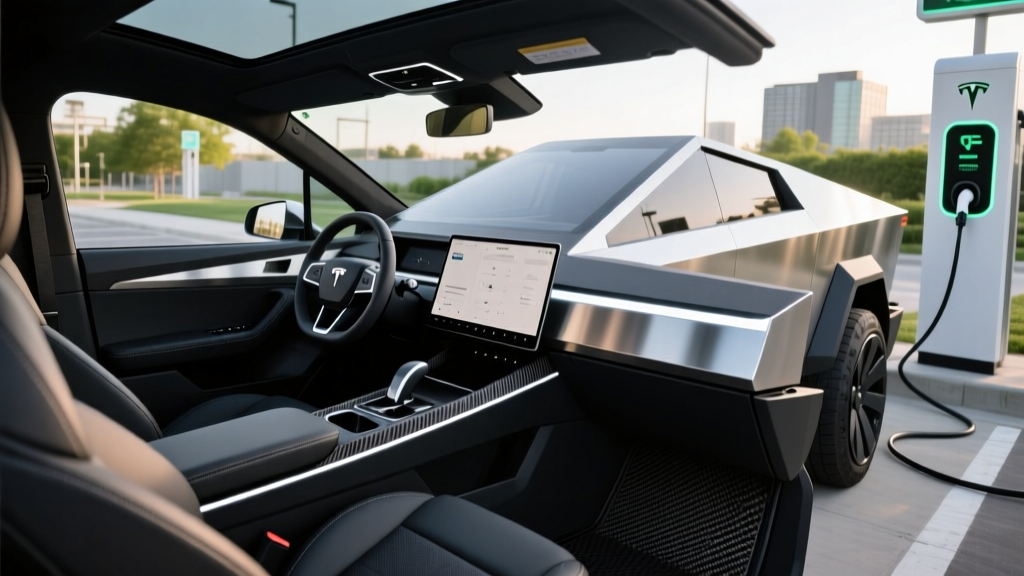
Stepping inside of Cybertruck is a study in brutalist minimalism. There are no physical buttons on the dashboard — everything routes through the 18.5-inch center touchscreen. The yoke steering wheel (standard on all trims) takes genuine adaptation; Tesla does not offer a conventional round wheel for the Cybertruck.
Interior Dimensions & Cargo
| Measurement | Specification |
|---|---|
| Front Headroom | 40.3 inches |
| Front Legroom | 41.2 inches |
| Rear Headroom | 38.2 inches |
| Rear Legroom | 36.1 inches |
| Bed Length (closed) | 72 inches (6 ft) |
| Bed Length (tailgate down) | 96 inches (8 ft) |
| Bed Width (between wheel wells) | 48 inches |
| Cargo Volume (bed, tonneau closed) | ~67 cu ft |
| Front Trunk (Frunk) | ~7 cu ft |
| Under-bed Gear Locker | ~7 cu ft (lockable) |
The rear seat fits three adults but the middle position is tight. The 36.1 inches of rear legroom falls short of the F-150 Lightning's 43.5 inches — a significant difference for family use. The fixed glass roof provides an airy feel but offers no shade; in summer, cabin solar heat gain is noticeable even with the UV-treated glass.
The 6-foot bed with the motorized tonneau cover is the Cybertruck's party trick. The vault-like sealed bed is lockable, weatherproof, and can hold 4x8 sheets of plywood (diagonally or with the tailgate lowered). The under-bed gear locker adds genuinely useful hidden storage. The 11,000-lb towing capacity matches conventional heavy-duty trucks, though towing at max capacity will decimate range and requires the optional tow package.
Technology & Driver Assistance
The Cybertruck runs Tesla's latest vehicle software with the 18.5-inch front display and a 9.4-inch rear touchscreen for back-seat passengers. Notable tech features include:
- Steer-by-wire: No mechanical connection between yoke and wheels — enables the variable-ratio steering that makes the yoke functional at low speeds
- 48-volt electrical architecture: A first for a production vehicle, reducing wiring harness weight and enabling higher-power accessories
- Autopilot (standard): SAE Level 2 adaptive cruise + lane centering — requires full driver attention at all times
- Full Self-Driving Supervised ($8,000 add-on): Enhanced Level 2 with auto lane change, navigation on Autopilot, and traffic light recognition — still not self-driving; driver must supervise
- Powershare: 240V outlet in the bed for job-site tools or emergency home backup (up to 11.5 kW output)
- Armor glass: Laminated glass with stainless-steel mesh interlayer — more resistant to breakage but not impervious
Tesla Autopilot and FSD Supervised are SAE Level 2 driver-assistance systems. The driver must remain fully engaged, eyes on the road, hands available to take over. These are not self-driving systems. Level 4 driverless operation (no human needed) is currently only available in limited robotaxi services like Waymo — not in any consumer vehicle.
Pricing, Trims & Federal Tax Credit Eligibility
| Trim | Base MSRP | As-Tested (typical options) | §30D Tax Credit Eligible? |
|---|---|---|---|
| Long Range AWD | $79,990 | $81,000-$85,000 | No — exceeds $80,000 truck MSRP cap* |
| Dual Motor AWD | $79,990 | $82,000-$88,000 | No — exceeds $80,000 truck MSRP cap* |
| Cyberbeast (Tri-Motor) | $99,990 | $102,000-$110,000 | No — exceeds $80,000 truck MSRP cap* |
*Under IRS §30D, the federal Clean Vehicle Credit of up to $7,500 applies to trucks/vans/SUVs with an MSRP at or below $80,000. The Cybertruck Long Range and Dual Motor sit at $79,990, which technically meets the MSRP cap — however, any factory options or destination charges pushing the total above $80,000 will disqualify the vehicle. The Cyberbeast at $99,990 is ineligible regardless.
Additional §30D requirements (even if MSRP qualifies):
- Buyer income caps: AGI must not exceed $150,000 (single), $225,000 (head of household), or $300,000 (joint filing)
- Battery sourcing: A percentage of critical minerals and battery components must be sourced from the US or FTA-partner countries — Tesla's battery supply chain has shifted significantly, and eligibility can change quarter to quarter
- Point-of-sale transfer: Qualified buyers can apply the credit as an instant rebate at purchase rather than waiting for tax filing
- Final assembly: Must occur in North America (Cybertruck is assembled in Austin, TX — qualifies)
Bottom line: The Long Range and Dual Motor trims are borderline eligible if you spec them bare. In practice, most buyers adding any options will push past the cap. Consult a tax professional and verify current sourcing eligibility on fueleconomy.gov before relying on the credit in your budget.
Ownership Costs: Efficiency, Insurance & Long-Term Battery
At roughly 2.0-2.2 kWh per mile, the Cybertruck is one of the least efficient EVs on the market — a direct consequence of its weight (6,600-6,800+ lbs) and aerodynamics. For comparison, the Tesla Model Y achieves about 3.5-4.0 miles per kWh. Charging at the national average of $0.16/kWh, the Cybertruck costs approximately $0.32-$0.35 per mile on electricity. That's still roughly half the per-mile fuel cost of a comparable gas truck at $3.50/gallon, but it's not the dramatic savings a smaller EV delivers.
Insurance is a significant ownership factor. The Cybertruck's stainless-steel body panels, steer-by-wire system, and high repair costs push premiums 30-50% above comparable trucks. Expect annual premiums of $3,000-$4,500 depending on your profile and state. Get quotes before purchasing.
The battery uses NMC (nickel manganese cobalt) chemistry in a structural pack with 2170-format cells. NMC offers higher energy density than LFP but is more sensitive to sustained 100% SoC and extreme temperatures. Tesla recommends daily charging to 80% and only charging to 100% before long trips. The 8-year/120,000-mile battery warranty covers degradation below 70% capacity retention — consistent with industry standards. Real-world degradation data from early 2024 delivery owners suggests approximately 4-6% loss in the first 30,000 miles, which is typical for NMC packs.
Pros, Cons & Who Should Buy the Cybertruck
✅ Pros
- Distinctive design with genuine utility (sealed bed, Powershare, 11,000-lb tow rating)
- Tri-motor Cyberbeast delivers supercar acceleration in a truck
- 800V architecture + Supercharger network = reliable road-trip charging
- Stainless-steel body is dent-resistant; armor glass is highly impact-resistant
- 48V electrical system is genuinely innovative for the industry
- OTA software updates continue adding features post-purchase
❌ Cons
- Highway range significantly below EPA estimates due to aero and weight
- Yoke steering and steer-by-wire require a steep learning curve
- Rear seat legroom is tight for a full-size truck (36.1 in vs. F-150's 43.5 in)
- No round steering wheel option; no physical buttons for climate/media
- Insurance premiums are substantially above class average
- Federal tax credit eligibility is borderline or unavailable depending on trim/options
- Build quality improved but still inconsistent vs. legacy automakers
Who the Cybertruck Is For
Buy it if: You want a statement vehicle that also tows, hauls, and accesses the Supercharger network. The Cybertruck fits tech-forward buyers who value performance (especially Cyberbeast), want Powershare for job-site or emergency power, and don't need max rear-seat comfort.
Look elsewhere if: You prioritize highway range efficiency (Rivian R1T or F-150 Lightning offer better real-world efficiency), need spacious rear seating for family use, prefer conventional controls, or want a straightforward path to the $7,500 federal tax credit.
Frequently Asked Questions
What is the real-world range of the Cybertruck?
The EPA rates the Long Range at 340 miles, but real-world highway driving at 70-80 mph yields approximately 260-290 miles. Cold weather (below freezing) can reduce this by 20-30%. For road-trip planning, budget 250 miles between Supercharger stops to maintain a comfortable buffer.
How fast does the Cybertruck charge at home and on the road?
On a V3 or V4 Supercharger, the Cybertruck peaks at approximately 250 kW and can go from 10-80% in about 20 minutes when preconditioned. At home on a Level 2 Tesla Wall Connector (11.5 kW), you'll add about 37 miles per hour, fully recharging overnight in roughly 11 hours. On a standard NEMA 14-50 outlet (9.6 kW), expect about 31 miles per hour.
Does the Cybertruck qualify for the $7,500 federal EV tax credit?
It depends on trim and configuration. The Long Range and Dual Motor at $79,990 MSRP technically meet the $80,000 truck cap under §30D, but any added options or destination fees that push the total above $80,000 will disqualify the purchase. The Cyberbeast at $99,990 is ineligible. Even at qualifying MSRPs, buyer income limits ($150K single / $300K joint), battery critical-mineral sourcing rules, and North American assembly requirements must all be met. Verify current eligibility on irs.gov and consult a tax professional.
Is the Cybertruck worth buying over the Rivian R1T or Ford F-150 Lightning?
The Cybertruck wins on acceleration (Cyberbeast's 2.6-sec 0-60 is unmatched), Supercharger network access, and head-turning design. The Rivian R1T offers superior interior quality, more rear-seat space, better real-world efficiency, and a more conventional driving experience. The F-150 Lightning provides a familiar truck layout, better payload comfort, and stronger tax-credit eligibility at lower trims. If you value performance and Tesla's ecosystem, the Cybertruck has no equal. If you prioritize comfort and practicality, test-drive all three.
How reliable is the Cybertruck's steer-by-wire system?
Steer-by-wire eliminates the mechanical connection between the yoke and the wheels, using redundant electronic actuators. Early Cybertruck owners have reported the system as responsive and well-calibrated, though the yoke takes 1-2 weeks of daily driving to build muscle memory. Tesla includes redundant backup systems, and the NHTSA has not issued recalls specific to steer-by-wire failures on the Cybertruck as of early 2026. However, long-term reliability data (5+ years) does not yet exist for any production steer-by-wire passenger vehicle.
What does it cost to insure a Cybertruck?
Insurance premiums for the Cybertruck run 30-50% above comparable trucks due to high repair costs, stainless-steel panel replacement complexity, and the vehicle's performance profile. Expect annual premiums of $3,000-$4,500 depending on your driving record, location, and coverage level. Tesla offers its own insurance product in some states that uses real-time driving data to set rates, which may be competitive for safe drivers.