Quick Answer: Does Infiniti Have an Electric SUV in 2026?
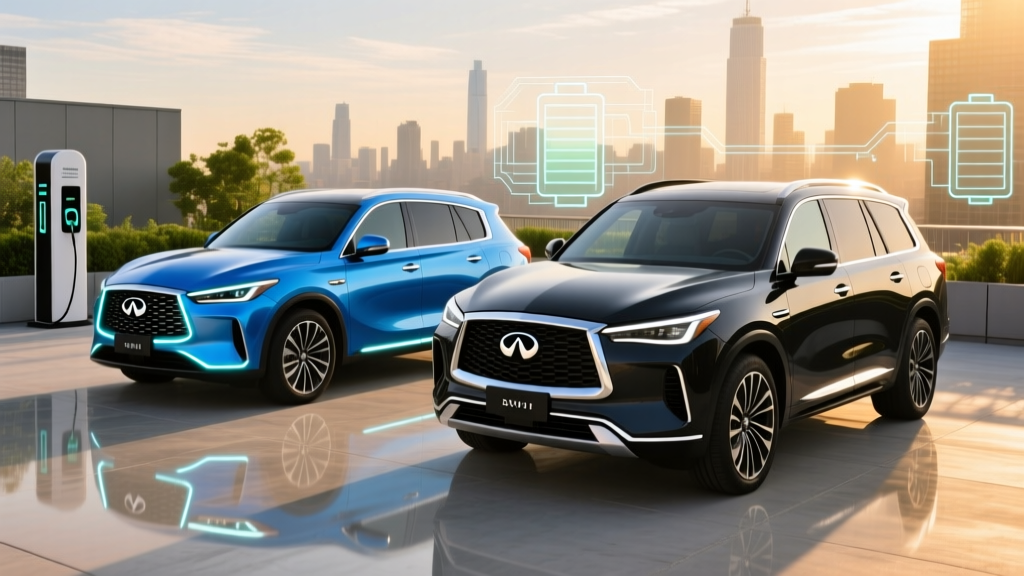
As of early 2026, Infiniti does not sell a fully electric SUV in the United States. The brand's electrified lineup consists of the QX60 (mild-hybrid V6) and the QX80 (twin-turbo V6 with 48-volt mild-hybrid assist). Infiniti has signaled future battery-electric models built on parent company Nissan's EV platforms, but no all-electric Infiniti SUV is currently available for purchase. Buyers searching for an "Infiniti electric SUV" today are most likely looking at the QX60 hybrid, waiting for an announced EV, or cross-shopping against luxury EV SUVs from Genesis, BMW, Cadillac, and Tesla.
Infiniti's Current Electrified SUV Lineup Explained
Infiniti's path to electrification has been slower than competitors. While Genesis offers the Electrified GV70, BMW sells the iX, and Cadillac has the Lyriq, Infiniti's showroom in 2026 still relies on internal combustion with hybrid assistance. Here's what is actually available:
| Specification | 2026 Infiniti QX60 (Mild Hybrid) | 2026 Infiniti QX80 (Mild Hybrid) | 2026 Genesis Electrified GV70 (BEV) |
|---|---|---|---|
| Powertrain | 2.0L VC-Turbo I4 + mild hybrid | 3.5L Twin-Turbo V6 + 48V mild hybrid | Dual-motor AWD, 77.4 kWh battery |
| Horsepower | 268 hp | 450 hp | 429 hp |
| EPA Combined MPG / MPGe | 23 MPG combined | 18 MPG combined | 89 MPGe |
| EPA Electric-Only Range | None (no plug) | None (no plug) | 236 miles |
| DC Fast Charge (peak kW) | N/A | N/A | ~200 kW (10-80% in ~18 min) |
| Starting MSRP | ~$53,000 | ~$82,000 | ~$68,000 |
| Federal Tax Credit (§30D) | Not eligible | Not eligible | Varies (sourcing/income rules) |
The QX60 and QX80 use mild-hybrid systems that cannot drive on electric power alone and have no plug. They recover small amounts of energy during braking and assist the gas engine during acceleration, yielding marginal efficiency gains — not the fuel savings of a plug-in hybrid (PHEV) or battery-electric vehicle (BEV).
What About the Promised Infiniti EV SUV?
Nissan (Infiniti's parent) has committed to launching multiple EVs on its upcoming CMF-EV and next-generation platforms. Industry reports and Nissan's "Ambition 2030" roadmap suggest an Infiniti-branded electric SUV could arrive by 2027-2028, potentially sharing architecture with the next-gen Nissan Ariya or a new dedicated luxury platform. However, as of this writing:
- No official model name, pricing, or EPA range has been published by Infiniti.
- No prototype has been spotted in U.S. testing with confirmed specs.
- No pre-order or reservation system is active.
Any specs circulating online for an "Infiniti electric SUV" are preliminary estimates based on Nissan platform sharing, not manufacturer-confirmed data. Buyers should not delay a purchase decision waiting for a vehicle that lacks a confirmed on-sale date.
Real Costs: Infiniti Hybrid SUV vs. a True Luxury EV
If you're cross-shopping the QX60 against a luxury electric SUV, the economics look very different over five years. Below is a cost comparison using the QX60 and the Genesis Electrified GV70 as representative models.
| Cost Category (5-Year Estimate) | 2026 QX60 Mild Hybrid | 2026 Genesis Electrified GV70 |
|---|---|---|
| Purchase Price (base MSRP) | $53,000 | $68,000 |
| Federal Tax Credit (§30D) | $0 | Up to $7,500 (if eligible*) |
| Effective Purchase Price | $53,000 | ~$60,500 |
| Fuel / Electricity (60,000 mi) | ~$7,800 (gas at $3.50/gal, 23 MPG) | ~$2,700 (home charging at $0.14/kWh) |
| Maintenance (5 yr) | ~$3,200 (oil, filters, brakes, transmission) | ~$1,100 (cabin filter, wipers, tires, brake fluid) |
| Estimated Insurance (5 yr avg) | ~$9,500 | ~$11,200 (EVs typically cost 10-20% more to insure) |
| Total 5-Year Cost | ~$73,500 | ~$75,500 |
*The §30D federal tax credit is subject to buyer income caps ($150K single / $300K joint), MSRP caps ($80K for SUVs), and battery critical-mineral and component sourcing requirements. Verify eligibility at IRS.gov or consult a tax professional. Point-of-sale transfer is available through registered dealers.
The takeaway: the QX60's lower sticker price keeps its five-year total cost competitive with a luxury EV SUV, even though the EV saves roughly $5,000 in fuel and maintenance. Higher EV insurance premiums and the upfront price gap largely offset those savings. The EV wins on running costs; the hybrid wins on purchase price and charging convenience for those without home charging access.
EV vs. Gas/Hybrid: Which Makes Sense for Your Situation?
The right choice depends entirely on your driving patterns, charging access, and climate. Here's a practical decision framework:
Should You Buy an Infiniti Hybrid SUV or Wait/Shop for an EV?
- Choose the Infiniti QX60/QX80 hybrid if: You lack reliable home or workplace charging, regularly tow over 5,000 lbs, frequently drive 400+ mile single-day trips through areas with sparse DC fast charging, or need three rows (the QX60 seats seven; most luxury EV SUVs seat five).
- Choose a luxury EV SUV (Genesis GV70, BMW iX, Cadillac Lyriq, Tesla Model X) if: You can install a Level 2 home charger (240V, 32-48 amp), your daily commute is under 80 miles, you want to minimize maintenance visits, and you qualify for the §30D federal tax credit.
- Wait for an Infiniti EV if: You're loyal to the brand, your current vehicle has 2+ years of life left, and you're comfortable with a 2027-2028 timeline — but understand that confirmed specs, pricing, and tax-credit eligibility are all unknowns.
Real-World Ownership Considerations Most Buyers Overlook
Whether you go with an Infiniti hybrid today or an EV from another brand, these factors affect your actual experience far more than brochure specs:
Home charging access is the single biggest variable. A Level 2 home charger (7-11 kW) delivers a full overnight charge for under $0.14/kWh in most U.S. markets — roughly 3-4 cents per mile. Without home charging, you'll rely on public DC fast chargers at $0.30-$0.50/kWh (8-12 cents per mile) or Level 2 public stations that may require hours of parking. If you live in an apartment or condo without charging infrastructure, a mild hybrid like the QX60 avoids this problem entirely.
Cold-weather range loss is real for EVs. Battery-electric SUVs lose 20-35% of their EPA-rated range in sustained sub-freezing temperatures, according to testing by fueleconomy.gov. A 236-mile EV SUV may deliver only 160-190 miles in a Minnesota winter. Hybrid SUVs lose efficiency too, but they don't face range reduction from the battery — only higher fuel consumption from cold starts and cabin heating.
DC fast charging curves taper significantly above 80%. A luxury EV SUV that advertises "200 kW peak charging" typically sustains that rate only from roughly 10-40% state of charge. From 80-100%, charge speed drops to 30-50 kW. On a road trip, plan to charge from 10-80% (the fast portion) and skip topping off unless your destination has overnight Level 2 charging.
Insurance costs more for EVs. According to industry data, EV insurance premiums run 10-20% higher than comparable gas vehicles due to higher repair costs (specialized body shops, battery replacement risk, and advanced sensor calibration after collisions). Factor this into your budget — roughly $200-$400 more per year for a luxury EV SUV.
Common Misconceptions About Infiniti and EVs
| Myth | Fact |
|---|---|
| "Infiniti has an all-electric SUV you can buy now." | As of 2026, no Infiniti BEV is on sale in the U.S. The QX60 and QX80 use mild-hybrid gas powertrains with no plug-in capability. |
| "The QX60 hybrid is a plug-in hybrid like the Toyota RAV4 Prime." | The QX60 is a mild hybrid (MHEV), not a PHEV. It cannot drive on electric power alone and has no charging port. Its electric motor only assists the gas engine. |
| "I'll save thousands on fuel with an Infiniti mild hybrid." | Mild hybrids improve fuel economy by roughly 1-2 MPG over a conventional gas model. At 23 MPG combined, the QX60 costs about $1,560/year in fuel — similar to non-hybrid competitors. Real savings come from BEVs or PHEVs. |
| "Infiniti will have an EV SUV by next year." | Nissan has announced electrification plans extending to 2030, but no Infiniti EV SUV has a confirmed U.S. on-sale date. Expect 2027-2028 at the earliest based on current platform timelines. |
| "EVs always cost less to own than gas cars." | EVs save on fuel and maintenance, but higher purchase prices, insurance premiums, and potential home-charging installation costs ($500-$2,000+) narrow the gap. Over 5 years, total cost of ownership is often comparable — the advantage shifts over 8-10+ years of ownership. |
If You're Set on an Infiniti: What to Buy Today
If brand loyalty matters and you need an Infiniti SUV in 2026, here's how the lineup breaks down:
2026 Infiniti QX60 (~$53,000-$65,000 MSRP): A three-row luxury crossover with a 268-hp VC-Turbo four-cylinder and mild-hybrid assist. EPA-rated at 23 MPG combined. It's a competent family hauler with a premium interior, but it is not meaningfully more efficient than non-hybrid competitors like the Acura MDX (22 MPG combined) or Genesis GV80 (23 MPG combined). Warranty covers 4 years/60,000 miles basic and 6 years/70,000 miles powertrain. No federal tax credit applies.
2026 Infiniti QX80 (~$82,000-$110,000+ MSRP): A full-size luxury SUV with 450 hp from a twin-turbo V6 with 48-volt mild-hybrid assist. EPA-rated at roughly 18 MPG combined. It competes with the BMW X7, Mercedes GLS, and Lincoln Navigator — all gas-powered rivals. No electric or plug-in hybrid variant exists. The mild-hybrid system smooths stop-start operation but does not deliver meaningful fuel savings in a 6,000-lb vehicle.
Frequently Asked Questions
Does Infiniti make any electric vehicle in 2026?
No. Infiniti does not currently sell any fully electric or plug-in hybrid vehicle in the United States. The brand's only electrified models are the QX60 and QX80, both of which use mild-hybrid systems that cannot operate on electric power alone and have no charging port.
When will Infiniti release an electric SUV?
Infiniti and parent company Nissan have announced electrification goals under the "Ambition 2030" plan, but no specific Infiniti electric SUV model has been confirmed for the U.S. market with a release date, pricing, or EPA-certified specs. Based on Nissan's platform development timeline, 2027-2028 is a reasonable estimate for a potential first Infiniti BEV, but this is not confirmed.
Is the Infiniti QX60 a hybrid like a Toyota Prius?
No. The QX60 uses a mild-hybrid system (MHEV), which is fundamentally different from a full hybrid (HEV) like the Prius or a plug-in hybrid (PHEV) like the RAV4 Prime. The QX60's small electric motor cannot propel the vehicle independently — it only assists the gas engine during acceleration and enables smoother stop-start operation. There is no electric-only driving mode and no plug.
Can I get a federal tax credit on an Infiniti SUV?
No. The §30D federal clean vehicle credit applies only to battery-electric vehicles (BEVs) and plug-in hybrids (PHEVs) that meet specific battery sourcing, MSRP, and buyer income requirements. Since Infiniti's current SUVs are mild hybrids with no plug-in capability, they do not qualify for any federal EV tax credit. Check current rules at IRS.gov.
What luxury electric SUV should I buy instead of an Infiniti?
Strong alternatives in 2026 include the Genesis Electrified GV70 (236 mi range, ~$68K, premium interior), BMW iX xDrive50 (~324 mi range, ~$87K, spacious cabin), Cadillac Lyriq (~314 mi range, ~$58K, strong value), and Tesla Model X (~335 mi range, ~$80K, three-row option). Each qualifies for varying levels of §30D tax credit depending on battery sourcing and buyer income. Cross-shop based on your priority: range, third-row seating, charging speed, or brand prestige.
What should a first-time EV buyer know before switching from Infiniti?
Three things matter most: (1) Install a Level 2 home charger before your EV arrives — expect $500-$2,000 for equipment and electrician labor, possibly more if your panel needs a 200-amp upgrade. (2) Understand real-world range: EPA estimates assume moderate conditions; highway driving at 75+ mph and cold weather both reduce range by 15-35%. (3) Plan for road trips differently: use apps like PlugShare or A Better Routeplanner to map DC fast charger stops, and expect 20-30 minute charging breaks every 200-250 miles. If these factors don't fit your lifestyle, a hybrid like the QX60 remains a practical choice.
Sources: fueleconomy.gov (EPA range and MPG data), IRS.gov (§30D tax credit rules), Infiniti USA official specifications.