Quick Answer: The Illinois EV Registration Fee in 2026
Illinois charges battery-electric vehicles (BEVs) a $248 annual registration fee as of 2026 — roughly double the ~$148 standard passenger-vehicle fee. The surcharge exists because EVs don't pay the state's 38.1¢/gallon motor fuel tax, which funds road maintenance. Plug-in hybrids (PHEVs) pay a lower $100 EV surcharge on top of the standard fee. The fee is collected at license-plate renewal each year, not at purchase. Despite the premium, most Illinois EV owners still come out ahead on total cost of ownership thanks to lower fueling and maintenance costs — but the math depends on how much you drive and how you charge.
Why Illinois Charges EV Owners More to Register
Every state funds highway and bridge maintenance through some combination of fuel taxes and registration fees. When a driver switches from a gas car to an EV, they stop buying gasoline — and stop contributing to the state's Motor Fuel Tax Fund. Illinois responded by instituting an EV-specific registration surcharge, codified under 625 ILCS 5/3-805.5 of the Illinois Vehicle Code.
The logic is straightforward: a gas car averaging 27 MPG and driving 12,000 miles per year burns about 444 gallons, generating roughly $169 in state fuel tax (at 38.1¢/gallon, excluding federal tax). The $248 EV fee actually exceeds what the average gas car contributes in state fuel tax — a point of contention among EV advocates who argue the fee is punitive rather than compensatory.
Illinois EV Registration Fee vs. Gas Car: The Full Cost Table
Here is how the annual registration cost compares across vehicle types in Illinois for 2026:
| Vehicle Type | Base Registration | EV Surcharge | Total Annual Fee | Est. Annual State Fuel Tax Paid |
|---|---|---|---|---|
| Standard Gas Car | $148 | $0 | $148 | ~$169 (at 27 MPG, 12k mi/yr) |
| Battery-Electric (BEV) | $148 | $100 | $248 | $0 |
| Plug-In Hybrid (PHEV) | $148 | $100 | $248 | ~$65 (partial gas use) |
| Hybrid (HEV, non-plug) | $148 | $0 | $148 | ~$112 (at 50 MPG, 12k mi/yr) |
Key takeaway: BEV and PHEV owners pay $100 more per year than gas-car owners in registration. HEV owners (like Prius drivers) pay the standard fee because they still buy gasoline and contribute to the fuel tax. The Illinois Secretary of State's office classifies any vehicle capable of plug-in charging as subject to the EV surcharge.
Real Cost of Ownership: EV vs. Gas in Illinois (5-Year Breakdown)
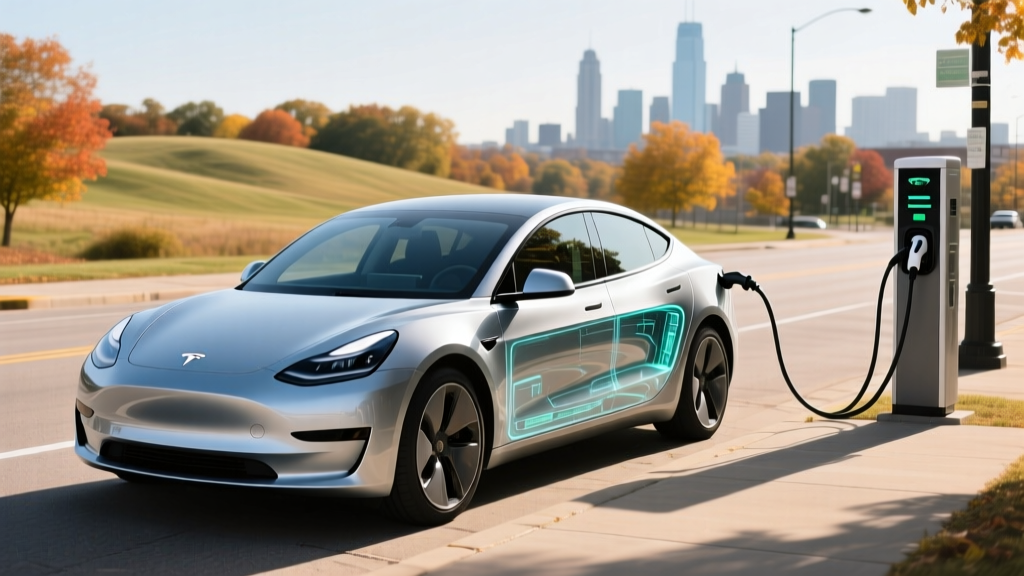
The registration fee is one line item. Here is a realistic 5-year ownership cost comparison for an Illinois driver covering 12,000 miles annually, using a 2026 Tesla Model 3 Long Range (EPA 363 mi, 28 kWh/100mi combined) versus a comparable 2026 Toyota Camry LE (EPA 32 MPG combined). Electricity priced at $0.15/kWh (ComEd average residential rate); gasoline at $3.65/gallon (Illinois average).
| Cost Category (5 Years) | Tesla Model 3 LR (BEV) | Toyota Camry LE (Gas) |
|---|---|---|
| Purchase Price (MSRP) | $42,130 | $29,995 |
| Federal Tax Credit (§30D, if eligible) | −$7,500 (point-of-sale) | $0 |
| Effective Purchase Price | $34,630 | $29,995 |
| Registration (5 years) | $1,240 ($248/yr) | $740 ($148/yr) |
| Fuel / Electricity (5 years, 60k mi) | $2,520 (home charging) | $6,844 |
| Maintenance (5 years) | ~$1,200 | ~$3,200 |
| Insurance (5-year est. avg) | ~$9,500 | ~$7,200 |
| Total 5-Year Cost | $49,090 | $47,979 |
| Cost per Mile | $0.82 | $0.80 |
What this shows: Even with the higher Illinois EV registration fee and pricier insurance, the Model 3's fuel and maintenance savings nearly erase the upfront and registration premium over five years. The gap widens in the EV's favor if gas prices rise, if you drive more than 12,000 miles/year, or if you charge on off-peak rates (ComEd's residential time-of-use programs can drop effective electricity cost to $0.08–$0.10/kWh).
Note on the §30D tax credit: Eligibility for the full $7,500 depends on MSRP caps ($55,000 for sedans), buyer income limits ($150k single / $300k joint AGI), and battery critical-mineral and component sourcing requirements that tighten annually. Confirm eligibility at IRS.gov and with your tax professional before purchase. As of 2026, the point-of-sale transfer option lets dealers apply the credit as a down-payment reduction.
Illinois EV Incentives That Offset the Registration Fee
Illinois has historically offered state-level incentives that can more than compensate for the higher registration fee:
- Illinois EV Rebate Program: When funded, this program has offered up to $4,000 rebates for new BEV purchases and $1,500 for used BEVs, administered by the Illinois EPA. Funding is appropriated by the legislature in cycles and can run out quickly — check the Illinois EPA Clean Transportation page for current availability.
- ComEd Residential EV Charging Rebate: Up to $1,000 toward the purchase and installation of a Level 2 home charger for ComEd customers.
- HOV Lane Access: Illinois does not currently offer state HOV-lane exemptions for EVs (unlike California or Virginia), so this is not a factor in the cost equation.
- Local Utility Time-of-Use Rates: ComEd and Ameren offer EV-specific rate plans that can cut charging costs by 30–50% compared to standard residential rates.
If you capture a $4,000 state rebate plus the $7,500 federal credit, that's $11,500 in incentives — enough to cover the Illinois EV registration fee surcharge for 115 years.
What First-Time Illinois EV Buyers Should Know
The registration fee is straightforward, but first-time EV buyers in Illinois should plan for these ownership realities:
Home Charging Is the Biggest Cost Variable
Charging at home on a standard 120V outlet (Level 1) adds roughly 3–5 miles of range per hour — adequate for PHEVs or low-mileage BEV drivers, but most BEV owners install a 240V Level 2 charger (7–11.5 kW) that adds 25–44 miles per hour. A Level 2 installation in the Chicago metro typically costs $800–$2,000, depending on whether your electrical panel needs an upgrade from 100A to 200A service (a $1,500–$3,500 additional expense for older homes).
Illinois Winters Cut Range by 20–35%
A Model 3 Long Range rated at 363 miles EPA will deliver roughly 250–290 miles in January highway driving at 70 mph with cabin heat on. Vehicles equipped with a heat pump (standard on Tesla, Hyundai/Kia E-GMP models, and most 2024+ EVs) mitigate this loss but don't eliminate it. If your daily round-trip commute exceeds 120 miles in winter, plan for midday charging or choose a BEV with 300+ EPA miles.
Public Charging in Illinois: Adequate but Uneven
The Chicago metro, I-55, I-80, and I-57 corridors have robust DC fast-charging coverage (Tesla Supercharger, Electrify America, EVgo). Rural southern and western Illinois remain underserved — drivers in areas like Quincy, Mount Vernon, or Effingham should map charging options before committing to a BEV and may be better served by a PHEV.
Myths vs. Facts: Illinois EV Registration and Ownership
| Myth | Fact |
|---|---|
| "The EV registration fee makes EVs more expensive to own than gas cars." | The $100/year surcharge is overwhelmed by $868/year in fuel savings (based on 12k mi/yr, home charging vs. $3.65/gal gas). |
| "Hybrids pay the EV registration surcharge too." | Only plug-in vehicles (BEVs and PHEVs) pay the surcharge. Standard hybrids (HEVs) like the Prius pay the standard $148 fee. |
| "Illinois EV owners pay nothing for roads." | EV owners pay $248/year in registration — more than the ~$169 in state fuel tax an average gas car contributes. |
| "The registration fee is charged at purchase." | It's an annual renewal fee, billed when you renew your license plates each year. |
| "You can't deduct the EV registration fee on taxes." | Vehicle registration fees may be partially deductible as personal property tax on federal Schedule A if you itemize — consult a tax professional. |
Decision Framework: Is an EV Worth It in Illinois?
Choose a BEV if:
- You can install a Level 2 charger at home (garage or driveway with 240V access)
- Your daily driving is under 150 miles (including winter range loss buffer)
- You drive 10,000+ miles per year (fuel savings scale with mileage)
- You qualify for the §30D federal tax credit (check income, MSRP, and sourcing rules)
- You live in or near a metro area with public DC fast-charging options
Choose a PHEV if:
- You lack reliable home charging (apartment, street parking)
- You frequently drive 200+ miles in a day or take long rural road trips
- You want EV commuting (25–45 electric-only miles) with gas-engine flexibility
- You want to pay the EV surcharge but hedge against charging-desert risk
Stick with a gas car or HEV if:
- You drive under 6,000 miles/year (fuel savings won't offset the purchase premium)
- Your home electrical panel can't support Level 2 charging without a costly upgrade
- You live in a rural area with no public charging infrastructure and no home charging option
Frequently Asked Questions
How much is the Illinois EV registration fee in 2026?
$248 per year for battery-electric and plug-in hybrid vehicles — composed of the standard $148 passenger vehicle fee plus a $100 EV surcharge.
Do I pay the EV fee when I buy the car or every year?
Every year, at your annual license plate renewal. It's not a one-time purchase tax.
Do standard hybrids like the Toyota Prius pay the EV surcharge?
No. Only vehicles that can be plugged in to charge (BEVs and PHEVs) are subject to the surcharge. Conventional hybrids that run solely on gasoline pay the standard $148 registration fee.
Is the Illinois EV registration fee higher than other states?
It's in the upper tier. For comparison, Ohio charges $200, Michigan $135, Indiana $150, Wisconsin $100, and Iowa $130 for EV registration surcharges (on top of their standard fees). Some states like Colorado charge $4.00/month ($48/year). Illinois's $100 surcharge is mid-to-high nationally.
Can I avoid the fee by registering my EV in another state?
No. Illinois law requires you to register your vehicle in the state where it is principally garaged. Registering an Illinois-garaged EV in a state with lower fees constitutes registration fraud and can result in penalties.
Does the $248 fee apply to electric motorcycles or e-bikes?
No. The EV surcharge applies to passenger vehicles, trucks, and vans. Electric motorcycles have separate registration schedules, and e-bikes are generally not subject to motor vehicle registration in Illinois.
Will the Illinois EV registration fee go up in the future?
The fee is set by statute and requires legislative action to change. As EV adoption grows and fuel-tax revenue declines further, additional fee adjustments are possible, but no increases have been enacted as of early 2026.