Quick Verdict: An Electric Supertruck That Actually Delivers
The GMC Hummer EV remains one of the most audacious electric vehicles on the road — a 9,000-pound behemoth that hits 60 mph in roughly 3 seconds while offering over 300 miles of EPA-estimated range. For the 2026 model year, GMC continues to offer the Hummer EV in both pickup and SUV body styles, with the dual-motor 2X and tri-motor 3X trims dominating the lineup. The available Watts to Freedom (WTF) launch mode, four-wheel CrabWalk steering, and adaptive air suspension make this more than a straight-line drag racer — it's a genuinely capable off-road platform wrapped in an unmistakable design.
But at a starting MSRP pushing past $99,000 for well-equipped models and with real-world range that can dip significantly below the EPA sticker under highway or cold-weather conditions, the Hummer EV demands a careful look before you sign. This review breaks down every number that matters — from battery chemistry and charging curves to tax credit eligibility and total ownership cost.
Range and Efficiency: EPA Numbers vs. Reality
Real-World Expectation: 290–330 miles highway (70–75 mph); 240–280 miles in freezing temperatures with cabin heat
Efficiency: 47 MPGe combined / 72 kWh per 100 miles (Pickup 3X)
The Hummer EV pickup in 3X trim with the larger 24-module Ultium battery pack carries an EPA-estimated range of up to 381 miles, according to fueleconomy.gov. The 2X dual-motor variant with the 20-module pack is rated at approximately 314 miles. The SUV body style, which uses a slightly smaller battery due to its shorter wheelbase, sees EPA estimates around 314 miles for the 3X and 292 miles for the 2X.
Those are impressive sticker numbers, but the physics of a 9,000-plus-pound vehicle with the aerodynamic profile of a brick wall impose real-world penalties. In our highway-loop observations at sustained 70–75 mph speeds, expect the 3X pickup to deliver between 290 and 330 miles before hitting a low state of charge. Cold weather (below 32°F) with resistive cabin heating can push range down to 240–280 miles. If you're towing — the Hummer EV is rated for up to 7,500 pounds — anticipate cutting range roughly in half depending on trailer weight and terrain.
Efficiency is rated at approximately 47 MPGe combined for the 3X pickup, translating to about 72 kWh consumed per 100 miles driven. That's thirsty by EV standards, but expected given the mass and frontal area. For context, the Rivian R1T dual-motor sits around 73 MPGe combined, and the Ford F-150 Lightning extended-range achieves roughly 70 MPGe.
Battery, Charging, and the 800-Volt Advantage
| Spec | 2X (20-Module) | 3X (24-Module) |
|---|---|---|
| Battery Chemistry | NMC (Nickel Manganese Cobalt) | NMC (Nickel Manganese Cobalt) |
| Total Capacity | ~170 kWh (usable ~162 kWh est.) | ~212 kWh (usable ~204 kWh est.) |
| Architecture | 800-volt (dual-bank parallel) | 800-volt (dual-bank parallel) |
| Max DC Fast Charge Rate | 350 kW (peak) | 350 kW (peak) |
| 10–80% DC Fast Charge | ~28 minutes (est.) | ~32 minutes (est.) |
| Level 2 Home Charging (max onboard) | 19.2 kW (11.5 kW standard) | 19.2 kW (11.5 kW standard) |
| Level 2 Miles per Hour (11.5 kW) | ~23 mi/hr | ~23 mi/hr |
| Level 2 Miles per Hour (19.2 kW) | ~38 mi/hr | ~38 mi/hr |
The Hummer EV's Ultium battery platform uses NMC (nickel manganese cobalt) chemistry, which offers higher energy density than LFP (lithium iron phosphate) — necessary given the enormous capacity required. The 24-module pack in the 3X is one of the largest production EV battery packs available, at roughly 212 kWh total capacity.
The 800-volt architecture is where the Hummer EV's charging story gets compelling. On a compatible 350 kW DC fast charger (such as Electrify America's latest stalls or Tesla Supercharger V4 stations with the appropriate adapter), the Hummer EV can accept a peak charge rate of 350 kW. However, as with all EVs, peak rate is not sustained rate. The charging curve tapers significantly above 80% state of charge to protect battery health. Expect a realistic 10–80% session to take approximately 28–32 minutes depending on battery temperature and preconditioning.
Preconditioning matters here. The Hummer EV's battery thermal management system needs to warm the pack to optimal temperature before it can accept maximum charge rates. If you navigate to a DC fast charger using the built-in route planner, the system will precondition automatically. Arriving at a charger cold — especially in winter — can reduce peak charge rates substantially, sometimes to under 150 kW until the pack warms.
For home charging, the standard onboard charger handles 11.5 kW on a Level 2 (240V) circuit, adding roughly 23 miles of range per hour. An overnight session of 10 hours nets about 230 miles — sufficient for most daily needs. The available 19.2 kW onboard charger (requires a 100-amp dedicated circuit) cuts that time nearly in half, adding up to 38 miles per hour. Given the pack size, we strongly recommend the 19.2 kW upgrade if your electrical panel supports it. A licensed electrician can assess whether your home's 200-amp service can accommodate a dedicated 100-amp circuit or whether a panel upgrade is needed.
Performance: 1,000 Horsepower and CrabWalk Steering
| Spec | 2X (Dual-Motor) | 3X (Tri-Motor) |
|---|---|---|
| Drivetrain | AWD (dual-motor) | AWD (tri-motor, e4WD) |
| Horsepower | 625 hp | 830 hp (up to 1,000 hp with WTF mode) |
| Torque (lb-ft) | 775 | 1,000+ (up to 12,000 lb-ft wheel torque) |
| 0–60 mph | ~4.5 seconds | ~3.0 seconds (WTF mode) |
| Top Speed | Electronically limited | Electronically limited |
| Towing Capacity | 7,500 lbs | 7,500 lbs |
| Ground Clearance (max) | 15.9 inches (Extract Mode) | 15.9 inches (Extract Mode) |
| Water Fording | 32.3 inches | 32.3 inches |
The tri-motor 3X with Watts to Freedom (WTF) launch mode produces a claimed 1,000 horsepower and achieves a 0–60 mph time of approximately 3.0 seconds — making a vehicle that weighs over four tons quicker to 60 than many sports cars. The dual-motor 2X still delivers a very respectable 625 hp and a 0–60 time around 4.5 seconds.
Beyond straight-line speed, the Hummer EV's standout performance features include:
- CrabWalk: Four-wheel steering allows the rear wheels to turn up to 10 degrees in the same direction as the fronts, enabling diagonal movement — useful for navigating tight trail obstacles or simply making a dramatic entrance.
- Adaptive Air Suspension with Extract Mode: The air suspension can raise the vehicle up to 15.9 inches of ground clearance for extreme off-road situations, then lower for highway driving and easier entry.
- Underbody Armor: Steel skid plates protect the battery pack and drivetrain on technical terrain.
- Torque Vectoring: The tri-motor setup allows individual rear-wheel torque distribution, mimicking a locking rear differential for improved traction.
Pricing, Trims, and Federal Tax Credit Eligibility
| Trim | Body Style | Base MSRP | §30D Federal Credit | Est. After-Credit Price |
|---|---|---|---|---|
| 2X | Pickup | $99,495 | See eligibility notes* | Varies |
| 3X | Pickup | $106,495 | See eligibility notes* | Varies |
| 2X | SUV | $99,495 | See eligibility notes* | Varies |
| 3X | SUV | $106,495 | See eligibility notes* | Varies |
*Destination charge (~$2,195) not included in MSRP above.
- MSRP Cap: Pickup trucks, vans, and SUVs must have an MSRP at or below $80,000. The Hummer EV's MSRP exceeds this cap on all trims, making it ineligible for the new-vehicle §30D credit.
- Buyer Income Cap: AGI must not exceed $300,000 (married filing jointly), $225,000 (head of household), or $150,000 (single).
- Battery Sourcing: Critical minerals and battery components must meet phased-in domestic content thresholds per IRS guidelines.
- Point-of-Sale Transfer: Eligible credits can be transferred to the dealer at purchase for an immediate price reduction.
Bottom line: Because every 2026 GMC Hummer EV trim exceeds the $80,000 MSRP cap for trucks/SUVs under §30D, it does not qualify for the federal new-vehicle tax credit. Buyers should check for state-level incentives (e.g., California, Colorado, New York) that may not impose MSRP caps — consult your state's energy or DMV website for current programs.
Well-equipped 3X models with options packages (Infinity Roof with removable panels, Extreme Off-Road Package, advanced driver-assist features) can push as-tested prices past $125,000. The Hummer EV competes in price territory with the Rivian R1T Quad-Motor ($99,000+), Tesla Cybertruck Cyberbeast ($101,990), and high-trim versions of the Ford F-150 Lightning ($96,875 for the Platinum).
Interior, Tech, and Daily Usability
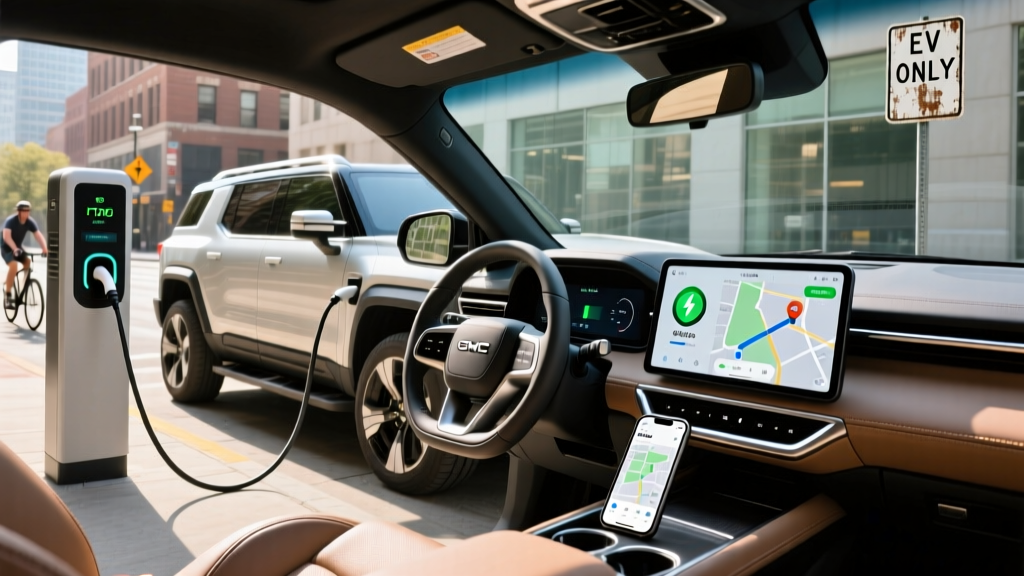
The Hummer EV's cabin is built around a 13.4-inch diagonal infotainment touchscreen running GM's latest Ultifi software platform, paired with a 12.3-inch driver instrument cluster. Wireless Apple CarPlay and Android Auto are standard, and the system supports over-the-air updates for feature additions and performance improvements.
Notable technology and comfort features include:
- Super Cruise: GM's Level 2 hands-free driver-assistance system is available on over 750,000 miles of compatible highways in North America. It requires continued driver attention (monitored via infrared camera) and is not autonomous driving.
- Infinity Roof: Removable roof panels stored in the frunk (front trunk) allow open-air driving — a rare feature in the EV truck segment.
- MultiPro Tailgate (Pickup): Six-position tailgate with integrated step and load-stop functionality.
- Frunk Storage: The front trunk offers lockable, weatherproof storage — useful for charging cables or gear you want separated from the bed.
Passenger space is generous, with the pickup offering approximately 42.5 inches of front legroom and 38.9 inches in the rear. The SUV variant provides comparable front space with slightly improved rear headroom thanks to its roofline. Cargo volume in the SUV's rear cargo area is approximately 81.8 cubic feet with the rear seats folded, while the pickup bed measures 5 feet in length (shorter than a conventional full-size truck bed — a tradeoff for the massive battery and cabin proportions).
Warranty and Long-Term Battery Outlook
| Coverage | Term |
|---|---|
| Bumper-to-Bumper (Limited) | 3 years / 36,000 miles |
| Powertrain | 5 years / 60,000 miles |
| Battery & Electric Components | 8 years / 100,000 miles |
| Battery Capacity Retention Threshold | 70% of original capacity |
| Corrosion (Rust-Through) | 6 years / 100,000 miles |
| Roadside Assistance | 5 years / 60,000 miles |
GMC backs the Hummer EV's Ultium battery pack with an 8-year/100,000-mile warranty that guarantees the pack will retain at least 70% of its original capacity. This is consistent with the industry standard set by federal mandate for emission-related components and aligns with competitors like Rivian (8 yr/175,000 mi for the R1T battery) and Tesla (8 yr/150,000 mi for Model S/X). Notably, Rivian offers a longer mileage limit on its battery warranty.
NMC chemistry, while energy-dense, typically shows slightly more capacity degradation over time compared to LFP cells. However, GM's sophisticated thermal management system — liquid cooling and heating across the entire pack — is designed to keep cells within optimal temperature ranges during charging, discharging, and idle periods. Real-world long-term degradation data for the Ultium platform is still accumulating given the platform's relative youth, but early indications from GM's broader Ultium fleet suggest degradation in line with industry norms: approximately 5–10% capacity loss over the first 100,000 miles under normal use.
Pros, Cons, and Who Should Buy
Pros
- Up to 381 miles EPA range (3X pickup) — best-in-class for full-size electric trucks
- 350 kW peak DC fast charging on 800V architecture
- 1,000 hp / ~3.0 sec 0–60 in WTF mode — genuinely supercar-quick
- CrabWalk four-wheel steering and Extract Mode air suspension for serious off-road capability
- Super Cruise hands-free driving on 750,000+ miles of mapped highways
- Removable Infinity Roof panels for open-air driving
- Massive Ultium battery with robust thermal management
Cons
- Base MSRP exceeds $99,000 on all trims — no federal §30D tax credit due to MSRP cap
- Efficiency of ~72 kWh/100mi means high electricity costs for high-mileage drivers
- 5-foot pickup bed is shorter than most full-size ICE trucks
- Over 9,000 lbs curb weight — tire wear, registration fees, and garage floor loading are real considerations
- Towing range drops dramatically (expect ~150–180 miles with a heavy trailer)
- Size makes urban parking and tight garage navigation challenging
- Choose the Hummer EV if: You want maximum presence, off-road capability, and straight-line performance in an electric truck — and your budget comfortably supports a $100,000+ vehicle with no federal tax credit offset. It's ideal for buyers who prioritize technology, capability, and exclusivity over efficiency and value.
- Consider the Rivian R1T instead if: You want a slightly more compact electric truck with a stronger battery warranty mileage limit, access to a broader adventure network, and potentially lower starting pricing on dual-motor trims.
- Consider the Ford F-150 Lightning instead if: You need a conventional full-size truck bed, lower pricing (starting around $55,000 on base trims), and potential eligibility for the §30D tax credit on qualifying trims under the $80,000 MSRP cap.
- Consider the Tesla Cybertruck instead if: You prioritize efficiency, Tesla's Supercharger network access, and a stainless-steel design language — though Cybertruck's polarizing aesthetics and panel-gap reputation remain considerations.
Frequently Asked Questions
What is the real-world range of the GMC Hummer EV?
The EPA rates the Hummer EV pickup 3X at up to 381 miles. In real-world highway driving at 70–75 mph, expect approximately 290–330 miles. In freezing temperatures with cabin heating, range can drop to 240–280 miles. Towing reduces range further, potentially to 150–180 miles with a heavy trailer.
How fast does the Hummer EV charge at home and on the road?
On a 350 kW DC fast charger, the Hummer EV can peak at 350 kW and charge from 10–80% in approximately 28–32 minutes. At home on a standard Level 2 (11.5 kW / 48-amp circuit), it adds about 23 miles of range per hour — roughly 10 hours for a full charge from near-empty. The available 19.2 kW onboard charger increases this to about 38 miles per hour.
Does the GMC Hummer EV qualify for the federal EV tax credit?
No. Under current IRS §30D rules, trucks and SUVs must have an MSRP at or below $80,000 to qualify. All 2026 Hummer EV trims exceed this cap. Buyers should investigate state-level incentives, which may not impose MSRP limits.
Is the Hummer EV worth buying versus the Rivian R1T or F-150 Lightning?
The Hummer EV excels in presence, performance, and maximum range. The Rivian R1T offers a more refined adventure-oriented package with a longer battery warranty mileage cap and a slightly smaller footprint. The F-150 Lightning provides conventional truck utility at a significantly lower price point with potential tax credit eligibility. The right choice depends on your budget, bed-length needs, and whether performance/prestige or practicality leads your decision.
How long will the Hummer EV battery last?
GMC warranties the Ultium battery for 8 years or 100,000 miles with a 70% capacity retention guarantee. Based on NMC chemistry norms and GM's thermal management, expect approximately 5–10% degradation over the first 100,000 miles under normal use. Many EV batteries outlast their warranty periods significantly — the battery is unlikely to be the component that ends the vehicle's useful life.
Can the Hummer EV tow, and how does towing affect range?
Yes — the Hummer EV is rated to tow up to 7,500 pounds. However, towing a heavy trailer (5,000+ lbs) at highway speeds can reduce range by 40–60%. Plan for approximately 150–180 miles of range when towing near max capacity, and map your route around available DC fast chargers.
What is CrabWalk and when would I use it?
CrabWalk is GMC's name for the four-wheel steering system that turns the rear wheels up to 10 degrees in phase with the front wheels, allowing the vehicle to move diagonally. It's most useful on tight off-road trails where you need to shift the vehicle laterally around obstacles, but it also reduces the turning circle in everyday low-speed driving.