Searches for "illegal electric bikes" have surged as regulators crack down on unregistered, overpowered, and non-compliant two-wheelers flooding city streets. But what actually makes an electric bike illegal — and how do the rules extend to electric scooters, mopeds, and even small electric cars? Here's the direct answer:
Quick Answer: What Makes an Electric Bike Illegal?
An electric bike becomes illegal for street use in the U.S. when it exceeds 750 watts of motor power, has a motor-only top speed above 28 mph (Class 3 e-bike limit), lacks required pedals, or is operated without registration, insurance, or a license where local law demands it. Many imported e-bikes and e-scooters sold online exceed these limits and are classified as unregistered motor vehicles — making them illegal on roads, bike lanes, and often sidewalks.
At AutoEdgeView, we focus on four-wheeled EVs, but the legal gray zone around electric bikes and scooters directly affects EV buyers: many shoppers cross-shop a small electric car (like a Chevrolet Equinox EV or Nissan Leaf) against a high-powered e-bike or electric moped for urban commuting. Understanding where the legal lines fall can save you from fines, confiscation, and liability exposure — and help you decide whether a real EV is the smarter, legal path.
The Three Legal E-Bike Classes (and Where They Break Down)
The U.S. Consumer Product Safety Commission and most states recognize a three-class system for low-speed electric bicycles, as defined under CPSC guidelines and adopted by 40+ states:
| Class | Motor Assist Type | Max Assisted Speed | Max Motor Power | Typical Legal Access |
|---|---|---|---|---|
| Class 1 | Pedal-assist only (no throttle) | 20 mph | 750W | Bike lanes, paths, most trails |
| Class 2 | Throttle-assisted | 20 mph | 750W | Bike lanes, roads; restricted on some paths |
| Class 3 | Pedal-assist (throttle limited) | 28 mph | 750W | Roads and bike lanes; often banned from trails |
Where it goes wrong: Many e-bikes sold on Amazon, AliExpress, and direct-to-consumer sites ship with 1,000W, 1,500W, or even 2,000W hub motors and top speeds of 30-45 mph. These are not Class 1-3 e-bikes under federal law. They are unregistered motor vehicles — effectively electric motorcycles without VINs, titles, insurance, or DOT-compliant lighting and brakes. Riding one on a public road can result in vehicle impoundment, citations for unlicensed operation, and personal liability in a crash.
Illegal Electric Bikes vs. Legal EVs: A Cost and Risk Comparison
For urban commuters weighing a high-powered (and likely illegal) e-bike against a legitimate electric vehicle, the numbers tell a clear story about total risk-adjusted cost:
| Factor | Illegal/Overpowered E-Bike ($1,200-$3,000) | 2026 Chevrolet Equinox EV 2LT ($33,600 MSRP) | 2026 Nissan Leaf S ($28,140 MSRP) |
|---|---|---|---|
| Purchase Price | $1,200–$3,000 | $33,600 | $28,140 |
| Federal Tax Credit (§30D) | None | Up to $7,500 (income/sourcing rules apply) | Up to $7,500 (income/sourcing rules apply) |
| EPA Range | 20–40 mi (battery ~0.5–1.0 kWh) | 319 mi (85 kWh usable, NMC) | 212 mi (60 kWh usable, NMC) |
| Registration/Title | Not possible (no VIN/MCO) | Required, ~$100–$300/yr | Required, ~$100–$300/yr |
| Insurance (annual) | Not insurable for road use | ~$1,600–$2,200 | ~$1,400–$1,900 |
| Legal Road Access | None — fines, impound risk | Full legal access | Full legal access |
| Crash Liability | Personal; no coverage | Insured; vehicle safety systems | Insured; vehicle safety systems |
| Weather/Season Use | Fair-weather only | Year-round, climate-controlled | Year-round, climate-controlled |
The e-bike looks cheap until you factor in a single impound ($500–$1,500 in fines and fees), a crash without insurance (medical bills averaging $15,000–$60,000 for e-bike injuries per emergency-room data), or a civil judgment if you injure a pedestrian. A compliant EV, after the §30D federal tax credit and lower fueling costs, closes the gap quickly for daily commuters.
Why So Many Electric Bikes Are Illegal (And Buyers Don't Know)
| Myth | Fact |
|---|---|
| "If I can buy it online, it's street-legal." | Marketplace compliance is not enforced at point of sale. Many 1,000W+ e-bikes ship directly from overseas manufacturers bypassing CPSC import checks. |
| "It's just a bicycle — no registration needed." | Above 750W or 28 mph motor-assist, federal law classifies it as a motor vehicle requiring registration, insurance, and licensing — which most cannot obtain. |
| "Cops don't ticket e-bike riders." | NYC, San Francisco, London, and other cities have conducted mass confiscation campaigns since 2023. NYPD alone seized 1,000+ illegal e-bikes in 2024 operations. |
| "A throttle e-bike is the same as a Class 2." | Class 2 is throttle-limited to 20 mph and 750W. Many "throttle e-bikes" sold online hit 35+ mph — making them unregistered mopeds or motorcycles. |
| "My e-bike battery fire is covered by insurance." | Homeowners/renters policies increasingly exclude uncertified lithium batteries. NYC has linked 100+ fires and 18+ deaths to non-UL-certified e-bike batteries since 2022. |
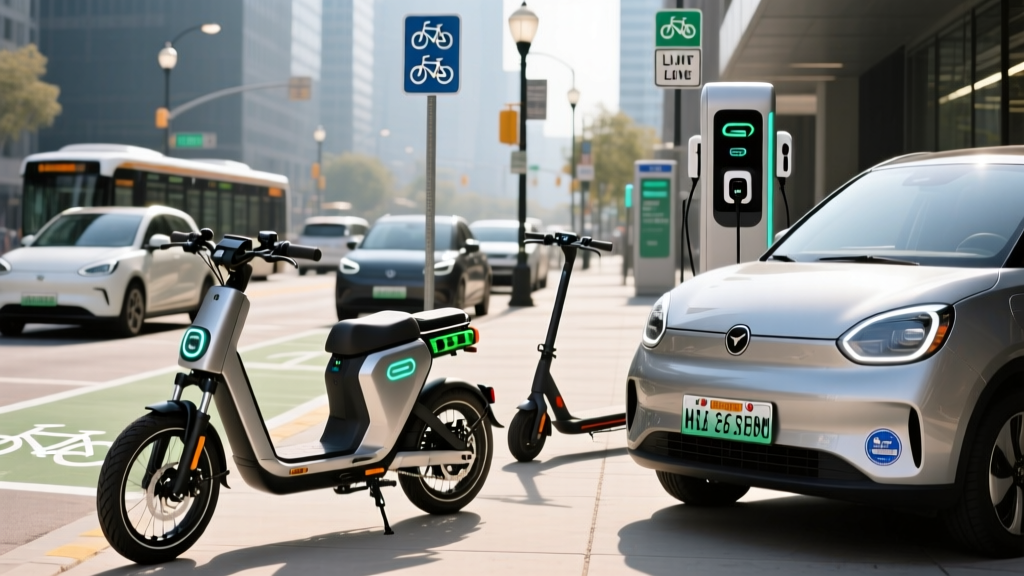
Electric Scooters, Mopeds, and Neighborhood EVs: The Same Problem
The "illegal electric bike" problem extends to the broader micromobility and small-EV market:
- Electric scooters (stand-up): Most states cap legal e-scooters at 15–20 mph and 1,500W. Higher-powered models sold online are classified as mopeds requiring registration — which they cannot receive.
- Electric mopeds (sit-down, no pedals): If the vehicle has no pedals and exceeds 20 mph, it's a moped or motorcycle under state law. It needs a VIN, title, DOT-compliant equipment, and insurance.
- Neighborhood Electric Vehicles (NEVs / LSVs): These are legal but limited to roads with speed limits of 35 mph or less, require a VIN, seatbelts, and state registration. Many imported "electric cars" from Alibaba lack NHTSA FMVSS compliance and cannot be titled.
Real-World Ownership: When an EV Beats the E-Bike (and Vice Versa)
The decision between an e-bike and a small EV isn't just legal — it's practical. Here's a realistic framework based on driving patterns, climate, and housing:
Decision Framework: E-Bike, E-Scooter, or EV?
- Choose a legal Class 1–3 e-bike if: Your commute is under 15 miles, you live in a mild climate, you have secure indoor storage (to protect the battery), and you can ride year-round. Budget: $1,500–$3,500 from a reputable brand (Rad Power, Trek, Specialized) with UL 2849 certification.
- Choose a registered electric moped/scooter if: Your commute is 10–30 miles, you want sit-down comfort, and your state offers easy moped registration. Budget: $3,000–$6,000 from a DOT-compliant brand (NIU, Vespa Elettrica, Super73 with proper titling).
- Choose a small EV (Nissan Leaf, Equinox EV, Hyundai Kona Electric) if: Your commute exceeds 20 miles, you face cold winters (e-bike batteries lose 30–50% range below 32°F), you need passenger/cargo capacity, you lack secure bike storage, or you want full insurance protection and crash safety. Budget: $28,000–$35,000 before tax credits; as low as $20,000–$27,000 after §30D credit if eligible.
Cold-weather reality check: A Class 3 e-bike rated for 40 miles of range typically delivers 20–25 miles at 25°F due to lithium-ion internal resistance increase and rider energy demand. An EV like the 2026 Hyundai Kona Electric (EPA 261 mi, 64.8 kWh NMC battery, heat pump equipped) retains roughly 75–80% of its range in the same conditions — still 195+ miles, vastly outperforming any two-wheeler.
Charging and Fueling Costs: E-Bike vs. EV vs. Gas Car
| Metric | Legal Class 3 E-Bike | 2026 Nissan Leaf S (EV) | 2026 Honda Civic (Gas Baseline) |
|---|---|---|---|
| Energy Capacity | ~0.5 kWh (battery) | 60 kWh usable (NMC) | 12.4 gal fuel tank |
| Range per Full Charge/Tank | 25–40 mi | 212 mi (EPA) | 396 mi (32/41 mpg EPA) |
| Cost to "Fill" (avg US rates) | ~$0.08 (home, $0.16/kWh) | ~$7.80 (home) / ~$18 (DC fast) | ~$37 ($3.00/gal) |
| Cost per Mile (energy only) | ~$0.002/mi | ~$0.037/mi (home) | ~$0.094/mi |
| Annual Energy Cost (12,000 mi) | $24 (but limited range) | $444 (home charging) | $1,128 |
| Maintenance (annual avg) | $100–$200 (tires, brakes, battery replacement every 3–5 yr) | $300–$500 (tires, cabin filter, brake fluid) | $600–$900 (oil, filters, belts, brakes) |
The e-bike wins on raw energy cost, but only for short fair-weather trips. The EV delivers year-round, all-weather utility at roughly 60% lower fueling cost than gas — and with far lower legal and financial risk than an illegal e-bike.
What First-Time EV Buyers Should Know (Before Cross-Shopping an E-Bike)
If you're considering a small EV as a legal, practical alternative to a high-powered e-bike, here are the non-negotiable ownership factors:
- Home charging access is essential. A Level 2 home charger (240V, 32–48A, 7.7–11.5 kW) costs $500–$1,500 for equipment plus $800–$2,500 for electrician installation. If you need a 200-amp panel upgrade, add $1,500–$3,500. Without home charging, public DC fast charging costs 2–3× more and adds time to your routine.
- Federal tax credit eligibility is narrow. The §30D credit offers up to $7,500, but requires: MSRP under $55,000 (sedans) or $80,000 (SUVs/trucks), buyer AGI under $150K (single) / $300K (joint), and battery critical-mineral and component sourcing thresholds that tighten annually. As of 2026, many vehicles qualify for only $3,750 or zero. Check the fueleconomy.gov tax credit database before buying.
- Real-world EV range is 70–85% of EPA in winter. A 212-mile Leaf delivers ~150–170 miles at 20°F on highway trips. Plan charging stops accordingly.
- Insurance costs more for EVs. Expect 15–25% higher premiums than comparable gas cars due to battery replacement costs. Get quotes before committing.
- Battery degradation is slow but real. Modern NMC and LFP batteries lose roughly 10–15% capacity over 8 years / 100,000 miles. Federal warranty minimum is 8 years / 100,000 miles for the battery pack.
Frequently Asked Questions
Is a 1,000W electric bike illegal in the United States?
Yes, for use as a bicycle. Federal law (CPSC) defines a low-speed electric bicycle as having a motor under 750W and a motor-only top speed under 20 mph. A 1,000W e-bike exceeds this and is classified as a motor vehicle — requiring registration, insurance, and licensing that most cannot obtain because they lack a VIN and DOT compliance.
Can I get fined for riding an illegal electric bike?
Yes. Fines vary by jurisdiction but typically range from $100 to $1,000 per offense. In cities like New York, illegal e-bikes can be confiscated and destroyed. Riders involved in crashes on illegal e-bikes face personal liability with no insurance coverage.
Are electric bikes with throttles illegal?
Not inherently. A throttle-equipped e-bike is legal as a Class 2 if it is limited to 20 mph and 750W. The problem is that many "throttle e-bikes" sold online exceed both limits, making them unregistered motor vehicles.
What's the cheapest legal EV alternative to an e-bike for commuting?
The 2026 Nissan Leaf S starts at $28,140 MSRP and may qualify for up to $7,500 in federal tax credits, bringing the effective price to ~$20,640 for eligible buyers. It offers 212 miles of EPA range, DC fast charging (peak 100 kW, 10–80% in ~40 minutes via CHAdeMO), and full legal road access with insurance.
Do I need a license to ride a Class 3 electric bike?
In most states, no — Class 3 e-bikes (28 mph pedal-assist, 750W max) do not require a driver's license, registration, or insurance. However, some states (like Alabama and Alaska) do require licensing. Check your state's specific e-bike laws before purchasing.
How do I know if an e-bike I'm buying online is legal?
Verify three things: (1) Motor is rated at 750W or less, (2) top motor-assisted speed is 20 mph (Class 1/2) or 28 mph (Class 3), and (3) the bike has functional pedals. Look for UL 2849 certification for fire safety. Buy from established brands with U.S. dealer networks — avoid direct-from-China listings that advertise 1,000W+ motors or 30+ mph speeds.