Quick Answer: The Hyundai Staria EV is an all-electric minivan built on Hyundai's E-GMP platform, offering an estimated 84 kWh usable battery, approximately 250–280 miles of EPA-estimated range, and DC fast charging up to ~220 kW (10–80% in roughly 20 minutes). Expected U.S. pricing starts around $48,000–$52,000 before incentives. It targets families who need three-row seating and cargo volume but want to eliminate gasoline costs. Federal §30D tax credit eligibility depends on battery sourcing, buyer income, and MSRP caps — check IRS rules before committing.
What the Hyundai Staria EV Actually Is
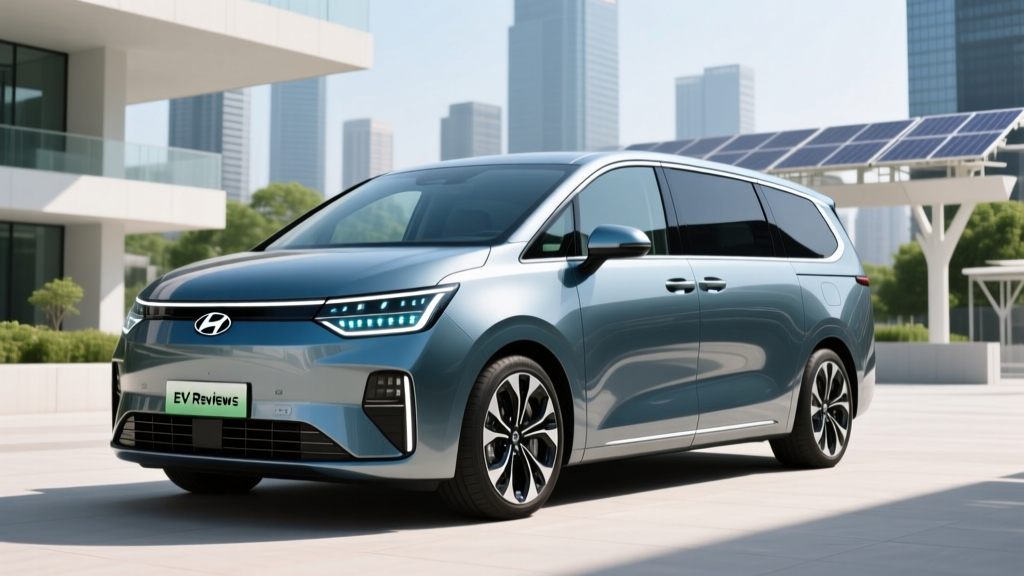
The Hyundai Staria EV electrifies the boxy, space-maximized Staria minivan that has sold globally since 2021. While the internal-combustion Staria has been available in markets like South Korea, Australia, and Southeast Asia, the EV variant represents Hyundai's push into the electric people-mover segment — a space currently dominated in the U.S. by the Chrysler Pacifica PHEV and the Kia Carnival Hybrid (non-plug-in).
Built on a variant of Hyundai's Electric-Global Modular Platform (E-GMP) — the same architecture underpinning the Ioniq 5, Ioniq 6, and Ioniq 9 — the Staria EV is expected to feature an 800V electrical system, enabling ultra-fast DC charging at compatible 350 kW stations. For U.S. buyers, this is a minivan that prioritizes interior volume (think three rows, a flat floor, and a usable frunk) while delivering competitive efficiency in the ~3.5–4.0 kWh/mile range.
Range, Battery, and Charging: The Numbers That Matter
For any family hauler, range and charging speed determine whether road trips are practical or painful. Here's what we know based on Hyundai's E-GMP platform data and preliminary Staria EV specifications:
| Specification | Hyundai Staria EV (Est.) |
|---|---|
| Battery Capacity (usable) | ~84 kWh (NMC chemistry) |
| EPA-Estimated Range | ~250–280 miles |
| Real-World Highway Range | ~210–240 miles (70+ mph) |
| Cold-Weather Range (20°F) | ~180–210 miles |
| Efficiency | ~3.5–4.0 kWh/mile (~84–95 MPGe) |
| Peak DC Fast Charge Rate | ~220 kW |
| 10–80% DC Charge Time | ~18–22 minutes |
| Level 2 Charge Rate (AC) | 10.9 kW |
| Level 2 Full Charge Time | ~8 hours |
| Connector (U.S.) | NACS (Tesla Supercharger compatible via adapter) |
| Drivetrain | RWD (AWD optional on higher trims) |
| 0–60 mph | ~7.5–8.5 seconds |
Real-World Range Reality: The EPA sticker may read ~270 miles, but minivans are heavy and aerodynamically challenged. Expect 210–240 miles on a highway road trip at 75 mph, and plan charging stops accordingly. In sub-freezing temperatures, lithium-ion chemistry and cabin heating can reduce range by 20–30%. Preconditioning the battery while plugged in — a feature Hyundai includes via the Bluelink app — mitigates charging-speed loss in cold weather but won't fully recover range lost to heating demands. A heat pump, expected as standard or available equipment, helps significantly.
Understanding the Charge Curve
The Staria EV's peak 220 kW rate applies only at low state of charge (SoC), typically between 10–40%. Above 60% SoC, the charge rate tapers to protect battery health, dropping to roughly 80–100 kW. Above 80%, expect 40–50 kW. This is normal for all lithium-ion EVs and is why the "10–80% in 20 minutes" metric is the industry standard — the final 20% takes almost as long as the first 60%. On road trips, plan to charge to 80% and drive on rather than waiting for a full battery.
Staria EV vs. Gas and Hybrid Minivans: Cost Comparison
The Staria EV competes against established minivans that burn gasoline. Here's how the math works over five years and 75,000 miles of driving:
| Cost Factor | Hyundai Staria EV | Honda Odyssey (Gas) | Chrysler Pacifica PHEV |
|---|---|---|---|
| Base MSRP (est.) | $49,500 | $39,800 | $51,000 |
| Federal Tax Credit (§30D) | Up to $7,500* | $0 | Up to $7,500* |
| Effective Purchase Price | ~$42,000 | $39,800 | ~$43,500 |
| Fuel/Energy Cost (5 yr / 75k mi) | ~$4,500** | ~$9,750*** | ~$5,200**** |
| Maintenance (5 yr) | ~$1,500 | ~$3,800 | ~$3,200 |
| 5-Year Total (purchase + fuel + maint) | ~$48,000 | ~$53,350 | ~$51,900 |
* §30D credit eligibility requires battery sourcing compliance, buyer income under $150K (single) / $300K (joint), and MSRP under $80,000 for vans/SUVs. Credit can be transferred at point of sale as a discount. Verify at irs.gov.
** Based on $0.14/kWh national average home electricity rate and 85% home charging.
*** Based on $3.50/gallon and 22 MPG combined.
**** Pacifica PHEV assumes 60% electric miles at $0.14/kWh, 40% gasoline miles at 30 MPG combined.
The Staria EV's higher sticker price is offset within 4–5 years by dramatically lower fuel and maintenance costs — electric motors don't need oil changes, transmission fluid, or spark plugs. Brake pad life is extended significantly by regenerative braking. However, insurance premiums for EVs run 15–25% higher on average due to repair-cost structures; budget roughly $200–$400/year more than a gas minivan equivalent.
Real-World Ownership: What First-Time EV Buyers Need to Know
Home Charging Is Non-Negotiable for Most Owners
Over 80% of EV charging happens at home. If you can install a Level 2 (240V) charger, the Staria EV's 10.9 kW onboard charger will refill the battery from empty in about 8 hours — plug in at night, wake up to a full battery every morning. A Level 2 home installation typically costs:
| Item | Cost Range |
|---|---|
| Level 2 Charger (40A–48A, hardwired) | $400–$700 |
| Electrician Labor (240V circuit, 50A breaker) | $500–$1,500 |
| Permit & Inspection | $100–$300 |
| Electrical Panel Upgrade (if needed, 200A) | $1,500–$3,500 |
| Total (typical, no panel upgrade) | $1,000–$2,500 |
If you live in an apartment, rely on street parking, or lack a garage, public charging becomes your primary refueling method. This is livable but less convenient and more expensive — DC fast charging at networks like Electrify America or Tesla Superchargers costs $0.30–$0.50/kWh, roughly doubling your per-mile energy cost versus home charging. Before buying, confirm your daily driving route has reliable charging infrastructure.
Climate and Driving Patterns Matter
The Staria EV's ~270-mile EPA range is adequate for most daily driving (the average American drives ~37 miles/day). But context matters:
- Urban/suburban commuters with home charging: ideal use case. You'll rarely visit a public charger.
- Frequent road-trippers (300+ mile drives): plan 1–2 DC fast-charge stops per trip. Hyundai's 800V architecture keeps stops short (~20 minutes), but charger availability varies by region.
- Cold-climate owners (Upper Midwest, Northeast): budget 20–30% range loss in winter. A garage-kept Staria EV will precondition more efficiently than one parked outside.
- Towing: EV towing range drops dramatically — expect 50% or more range reduction when pulling a loaded trailer. The Staria EV's towing capacity (estimated 2,000–3,500 lbs) is adequate for a small utility trailer but not a camper.
Common Misconceptions About the Staria EV
| Myth | Fact |
|---|---|
| "The battery will need replacing in 5 years." | Hyundai's EV battery warranty covers 10 years / 100,000 miles with a capacity retention threshold of 70%. Real-world E-GMP data shows ~5–8% degradation after 100,000 miles. Most EV batteries outlast the vehicle. |
| "EVs are worse for the environment because of electricity generation." | Even on coal-heavy grids, EVs produce fewer lifecycle emissions than gasoline vehicles within 1–2 years of driving. On the average U.S. grid mix, the Staria EV's carbon footprint is roughly 50–60% lower per mile than a gas minivan (EPA data). |
| "Charging takes too long for road trips." | A 10–80% charge in ~20 minutes at a 350 kW station aligns with a typical rest stop. The real bottleneck is charger availability and reliability, not speed. Plan routes using A Better Routeplanner or PlugShare. |
| "The Staria EV qualifies for the full $7,500 tax credit automatically." | Credit eligibility depends on critical-mineral sourcing, battery-component manufacturing, buyer income, and MSRP caps. The credit amount may be $3,750, $7,500, or $0 depending on the model year's compliance. Always verify before purchase. |
Decision Framework: Is the Staria EV Right for You?
Choose the Hyundai Staria EV if:
- You need three-row seating and maximum cargo volume (minivan use case)
- You have access to home Level 2 charging (garage or driveway with a 240V outlet)
- Your daily driving is under 200 miles and road trips are 1–3 times per month
- You want to eliminate gasoline costs and reduce maintenance visits
- You value quiet, smooth electric powertrain refinement in a family vehicle
Consider a gas or hybrid minivan instead if:
- You cannot install home charging and public infrastructure is sparse in your area
- You regularly tow heavy loads (campers, large boats) where EV range collapses
- Your budget is firmly under $40,000 and you cannot absorb the upfront premium
- You drive in extreme cold (-10°F or below) for extended periods without garage access
- You need a vehicle available for immediate purchase today (verify Staria EV U.S. availability at your local dealer — it may still be in limited-market rollout)
Consider the Chrysler Pacifica PHEV if:
- You want electric-only commuting (~32 miles) but gasoline flexibility for long trips without charging stops
- You're not ready to commit to a full BEV but want meaningful fuel savings
Pricing, Trims, and What's Included
Based on Hyundai's global pricing patterns and E-GMP platform costs, here's the expected U.S. trim structure for the Staria EV:
| Trim | Est. MSRP | Key Features |
|---|---|---|
| SE (base) | $48,500 | 84 kWh battery, RWD, 10.9 kW AC charging, cloth seats, basic ADAS |
| SEL | $52,500 | Heated front seats, power liftgate, enhanced ADAS, leatherette |
| Limited | $58,000 | AWD, premium audio, ventilated seats, head-up display, Highway Driving Assist 2 |
| Calligraphy (top) | $63,000 | Nappa leather, dual-panel sunroof, digital side mirrors, parking collision avoidance |
All trims are expected to include Hyundai's comprehensive warranty: 5-year/60,000-mile new vehicle, 10-year/100,000-mile powertrain, and 10-year/100,000-mile battery coverage (70% capacity retention threshold). Hyundai's Bluelink connected services provide remote preconditioning, charge scheduling, and state-of-health monitoring via smartphone app.
FAQ: Hyundai Staria EV Ownership Questions
Is the Hyundai Staria EV available in the United States?
Hyundai has announced the Staria EV for select global markets. U.S. availability depends on Hyundai America's product strategy, which has prioritized the Ioniq 9 three-row SUV. Check with your local Hyundai dealer for the latest U.S. launch timeline — it may arrive as a 2026 or 2027 model. The Staria EV is currently confirmed for markets including South Korea and Australia.
How much does it cost to charge the Staria EV at home?
At the national average electricity rate of ~$0.14/kWh, a full 84 kWh charge costs approximately $11.76. That delivers ~250–270 miles of range, or roughly $0.045–$0.05 per mile. Compare that to a gas minivan at $3.50/gallon and 22 MPG: $0.16 per mile. Home charging saves approximately $0.11 per mile, or ~$825 per year at 7,500 miles driven.
Can the Staria EV use Tesla Superchargers?
Hyundai has adopted the NACS (North American Charging Standard) connector for new U.S. EVs starting with 2025 models. If the Staria EV launches in the U.S. with NACS, it will access Tesla Superchargers natively. If it launches with CCS1, a Hyundai-provided NACS adapter will enable Supercharger access at V3 and V4 stalls. Confirm the connector at purchase.
What happens if the battery degrades over time?
Hyundai warranties the battery for 10 years / 100,000 miles against falling below 70% state of health. Real-world data from E-GMP vehicles (Ioniq 5, Ioniq 6) shows degradation of roughly 5–8% over the first 100,000 miles when owners follow best practices: avoid routinely charging to 100%, limit DC fast charging to road trips, and use preconditioning in extreme temperatures. A full battery replacement outside warranty would cost $12,000–$18,000, but this scenario is rare within the first decade.
Does the Staria EV have a frunk (front trunk)?
E-GMP-based vehicles typically include a small front trunk. In the Staria EV, expect a modest frunk (~1.0–1.5 cubic feet) suitable for charging cables and small bags — the primary cargo volume remains in the rear, where the flat floor and boxy shape deliver minivan-class space (estimated 100+ cubic feet with second and third rows folded).
How does the Staria EV compare to the Kia Carnival Hybrid?
The Kia Carnival Hybrid (HEV, not plug-in) gets approximately 33 MPG combined and starts around $42,000 — no charging needed, no tax credit. Over 75,000 miles, it burns roughly $7,950 in fuel. The Staria EV costs less to operate but more upfront. If you can charge at home and qualify for the §30D credit, the Staria EV wins on total cost of ownership. If you lack charging access or need guaranteed 400+ mile range without stops, the Carnival Hybrid is the pragmatic choice.
Sources: fueleconomy.gov for EPA efficiency data; IRS §30D Clean Vehicle Credit for tax credit rules; Hyundai News for manufacturer specifications. All pricing and specs are estimates based on available platform data and are subject to change upon official U.S. launch. Verify final figures with your dealer.