Quick Answer: Does Hyundai Make an Electric Minivan?
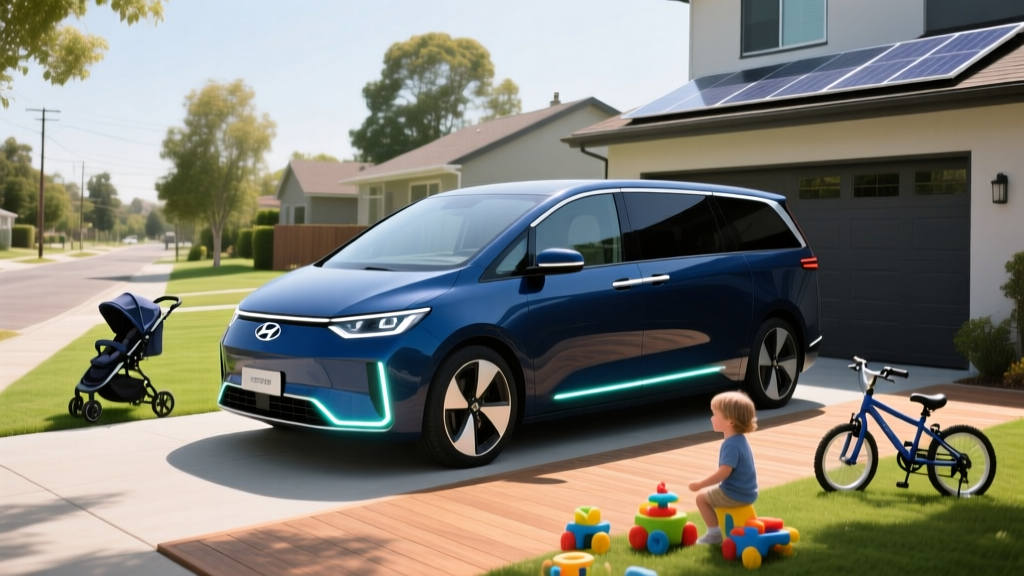
As of early 2026, Hyundai does not sell a dedicated electric minivan in the United States. The closest offering is the Hyundai ST1, a purpose-built electric van announced for global markets and expected to reach U.S. dealers by late 2026 or early 2027 in commercial and passenger configurations. If you need an electric people-mover today, the Kia EV9 (three-row SUV, up to 304 miles EPA, starting ~$54,900) or the Chrysler Pacifica PHEV (32 miles electric-only, then hybrid) remain the closest alternatives. The ST1 is promising but still preliminary for U.S. buyers — here's what we know, what it costs, and whether waiting makes sense.
What We Know About the Hyundai ST1 Electric Van
Hyundai unveiled the ST1 (Service Type 1) on its E-GMP-derived electric van platform in 2024, with production beginning in South Korea for commercial fleet use. The passenger-oriented variant — the one family buyers actually want — has been confirmed for global markets but carries no firm U.S. EPA certification or MSRP as of this writing. All specs below are preliminary estimates based on Hyundai's published platform data and Korean-market filings.
| Spec | Hyundai ST1 (Preliminary/Estimated) |
|---|---|
| Battery (usable) | ~84 kWh (NMC) |
| EPA Range (est.) | ~260–290 miles (final TBD) |
| Peak DC Fast Charge | Up to 350 kW (800V architecture) |
| 10–80% DC Charge Time | ~18 minutes (under ideal conditions) |
| Level 2 AC Charging | 10.9 kW onboard charger |
| Horsepower | ~215 hp (single-motor RWD); ~320 hp (dual-motor AWD est.) |
| 0–60 mph | ~6.5 sec (RWD), ~5.0 sec (AWD est.) |
| Seating | Up to 7–8 passengers (config-dependent) |
| Estimated U.S. MSRP | ~$52,000–$65,000 (before incentives) |
| Battery/Powertrain Warranty | 10 yr / 100,000 mi (Hyundai standard) |
The 800V electrical architecture is the headline spec. Borrowed from the Ioniq 5 and Ioniq 6, it allows the ST1 to accept up to 350 kW at a compatible DC fast charger, meaning a 10–80% top-up in roughly 18 minutes — assuming the charger delivers full power and the battery is preconditioned. Real-world charging curves taper significantly above 80%, so plan for 25–30 minutes at a public station for a meaningful road-trip stop.
Real-World Range Expectations
An estimated EPA range of 260–290 miles sounds adequate for family road trips, but real-world conditions compress that number. Expect ~210–240 miles on the highway at 70–75 mph, and ~180–210 miles in sub-freezing temperatures due to cabin heating demand and battery chemistry limitations. A heat pump — standard on most Hyundai EVs — helps mitigate cold-weather losses by roughly 10–15% compared to resistive heating.
ST1 vs. Gas Minivan vs. Three-Row EV SUV: Cost Comparison
The family-hauler market is dominated by the Toyota Sienna (hybrid-only, 36 MPG combined), Honda Odyssey (~22 MPG combined), and Chrysler Pacifica (gas and PHEV). Here's how the ST1 stacks up on total cost over five years and 75,000 miles of mixed driving, assuming $0.15/kWh home charging and $3.40/gallon gas.
| Cost Factor (5 yr / 75k mi) | Hyundai ST1 (Est.) | Toyota Sienna Hybrid | Honda Odyssey |
|---|---|---|---|
| Purchase Price (base MSRP) | ~$55,000 | ~$38,000 | ~$39,500 |
| Federal Tax Credit (§30D) | Up to $7,500 (if eligible) | $0 | $0 |
| Effective Purchase Price | ~$47,500 | ~$38,000 | ~$39,500 |
| Fuel/Energy Cost | ~$2,700 (home charging) | ~$5,900 | ~$7,700 |
| Maintenance (est.) | ~$1,200 | ~$2,800 | ~$3,200 |
| Insurance (est. avg) | ~$9,500 | ~$7,200 | ~$7,400 |
| 5-Year Total | ~$60,900 | ~$53,900 | ~$57,800 |
Key takeaway: The ST1's higher upfront cost is partially offset by dramatically lower fuel and maintenance expenses. Over five years, you'd save roughly $3,200 in energy costs and $1,600–$2,000 in maintenance versus a gas minivan. However, EV insurance premiums typically run 15–25% higher, and the net five-year cost still favors the Sienna hybrid unless you qualify for the full federal credit and drive predominantly on cheap home electricity.
Federal Tax Credit Eligibility: What You Need to Know
The §30D Clean Vehicle Credit offers up to $7,500 for qualifying new EVs, but eligibility hinges on multiple factors that change frequently. As of 2026, the IRS rules require:
- MSRP cap: Vans, SUVs, and pickups must be under $80,000 — the ST1 should clear this easily.
- Buyer income cap: Modified AGI must not exceed $300,000 (joint), $225,000 (head of household), or $150,000 (single).
- Battery sourcing: Critical minerals and battery components must meet escalating domestic/free-trade-partner thresholds. This is the biggest wildcard for the ST1, as Hyundai's supply chain may or may not satisfy 2026 percentages.
- Point-of-sale transfer: You can apply the credit as a dealer discount at purchase rather than waiting for tax filing.
The ST1's tax-credit eligibility is unconfirmed until Hyundai certifies the U.S. version and the IRS updates its qualifying vehicle list. Do not assume $7,500 off — consult a tax professional before committing.
Real-World Ownership: Charging, Climate, and Daily Life
Buying an electric minivan isn't just about specs — it's about whether your daily life supports EV ownership. Here's an honest assessment.
Home Charging Is Almost Essential
A Level 2 home charger (240V, 40–48 amps) delivers roughly 10.9 kW to the ST1, adding about 30–35 miles of range per hour. A full overnight charge from 20% to 80% takes roughly 5 hours — ideal for daily use. Installation costs typically run $800–$2,500 depending on panel capacity and wiring distance, though a 200-amp panel upgrade can add $1,500–$3,000. Without home charging, relying on public DC fast chargers at $0.35–$0.55/kWh roughly doubles your energy cost and adds significant inconvenience for a family vehicle used daily.
Climate Matters More Than You Think
If you live in Minnesota, Chicago, or anywhere with sustained sub-30°F winters, expect 20–30% range reduction. The ST1's heat pump helps, but battery chemistry inherently slows in cold. Preconditioning the battery while plugged in mitigates this somewhat. In contrast, Southern California, Texas, and Southeast owners will see range figures very close to EPA estimates.
Road Trips Require Planning
With ~260 miles of estimated real-world highway range, the ST1 needs a charging stop every 3.5–4 hours on long trips. Hyundai's 800V platform means those stops are short (~20 minutes at a 350 kW charger), but charger availability varies wildly. Electrify America, EVgo, and Tesla Superchargers (now open to NACS-equipped or adapter-compatible Hyundais) cover most interstate corridors, but rural routes in the Mountain West and Great Plains remain sparse.
Common Misconceptions About Electric Minivans
| Myth | Fact |
|---|---|
| "EV batteries need replacing every few years." | Hyundai warranties the ST1 battery for 10 years/100,000 miles with a capacity-retention threshold (typically 70%). Real-world NMC degradation averages 10–15% over 150,000 miles based on data from Ioniq 5 owners. |
| "Charging takes too long for family trips." | At a 350 kW DC charger, 10–80% takes ~18 minutes — comparable to a rest stop with kids. The issue is finding a working 350 kW charger, not the charge speed itself. |
| "An electric minivan can't tow." | The ST1's E-GMP platform supports towing, likely rated around 2,500–3,500 lbs (final U.S. spec TBD) — enough for a small trailer or bike rack, though towing cuts range by 30–50%. |
| "EVs cost more to insure and always will." | EV insurance premiums are currently 15–25% higher, but the gap is narrowing as repair data matures and more shops gain EV certification. Shop quotes from multiple carriers. |
Decision Framework: Should You Wait for the ST1 or Buy Now?
Choose the Kia EV9 now if: You need a three-row electric vehicle immediately, want confirmed EPA range (up to 304 miles), confirmed §30D eligibility on certain trims, and can accept SUV styling rather than minivan sliding doors. Starting at ~$54,900, it's the closest proven alternative.
Choose the Chrysler Pacifica PHEV now if: You want people-mover practicality with sliding doors, have a short commute (under 32 miles) that can run on electric-only, but need gas flexibility for road trips. It starts around $49,000 and qualifies for a partial federal credit on some trims.
Wait for the Hyundai ST1 if: You specifically want a true electric minivan/van with sliding doors, can wait until late 2026 or 2027, have reliable Level 2 home charging, and your household falls within the §30D income caps. The 800V charging architecture and Hyundai's 10-year warranty make it a compelling package — if the U.S. version arrives as promised.
Stick with the Toyota Sienna Hybrid if: Total cost of ownership is your top priority, you lack home charging, or you frequently drive routes with limited charging infrastructure. At 36 MPG combined and ~$38,000 to start, it remains the most economical family hauler on the market.
Frequently Asked Questions
Does Hyundai currently sell an electric minivan in the U.S.?
No. As of early 2026, Hyundai does not offer a dedicated electric minivan in the United States. The ST1 electric van is in production for global commercial markets, with a U.S. passenger variant expected no earlier than late 2026 or 2027.
Will the Hyundai ST1 qualify for the $7,500 federal tax credit?
It's too early to confirm. Eligibility depends on battery-sourcing and critical-mineral requirements that are still evolving. Hyundai's U.S.-built vehicles (like the Ioniq 5 from the Georgia plant) have fared well under §30D rules, but the ST1's manufacturing location and supply chain will determine its status. Check the IRS qualifying list closer to launch.
How does the ST1 compare to the Kia EV9 for families?
The EV9 is a three-row SUV with confirmed EPA range (279–304 miles depending on trim), available now, and starting at ~$54,900. The ST1 will likely offer more interior volume and minivan-style access (sliding doors, lower floor), but with slightly less range due to its boxier aerodynamics. If sliding doors are a must-have, wait for the ST1. If you need a vehicle today, the EV9 is proven.
What will it cost to charge the ST1 at home?
Assuming a national average electricity rate of $0.15/kWh and an 84 kWh battery, a full charge costs roughly $12.60. For a typical family driving 12,000 miles per year at ~3.0 miles/kWh, expect annual home charging costs of approximately $600 — versus $1,800–$2,200 in gasoline for a comparable gas minivan.
Is the ST1's 800V charging really that much faster?
Yes, in practice. Most 400V EVs peak at 150–200 kW and take 25–35 minutes for a 10–80% charge. The ST1's 800V system can sustain higher charge rates longer, achieving 10–80% in roughly 18 minutes at a 350 kW station. However, you need a compatible charger — many public stations max out at 150 kW, where the advantage shrinks to a few minutes.