The Short Answer on the Hyundai Santa Fe EV
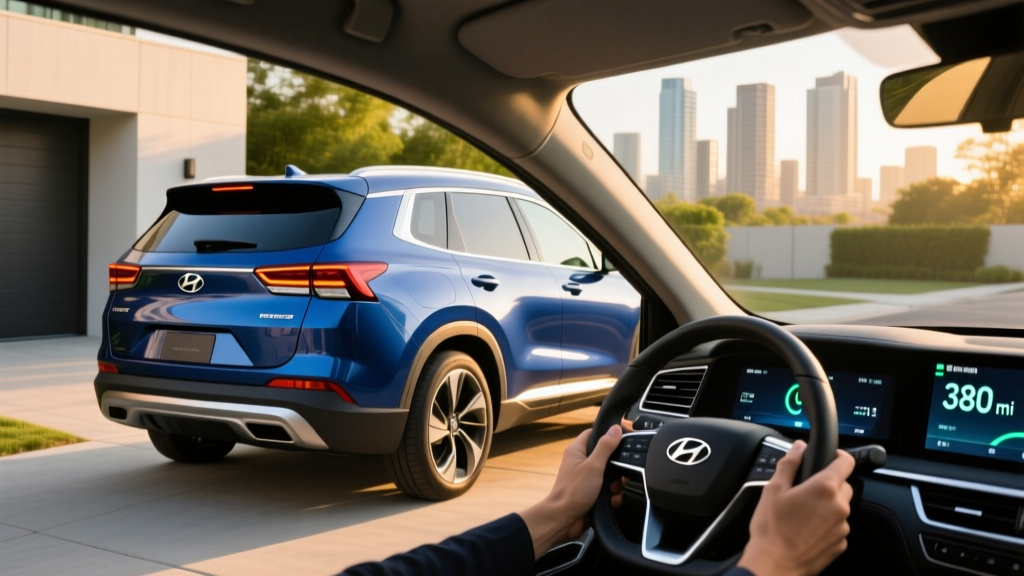
The Hyundai Santa Fe EV is a three-row electric SUV built on Hyundai's E-GMP platform (shared with the Ioniq 5 and Kia EV9). For the 2026 model year, it targets buyers who need family hauling capacity with genuine road-trip range. Expect an EPA-estimated range of approximately 280–310 miles depending on trim and wheel size, a usable battery around 84–100 kWh (NMC chemistry), and peak DC fast-charging speeds up to 350 kW on compatible chargers — enabling a 10–80% session in roughly 18–22 minutes. Pricing is anticipated to start in the low-to-mid $50,000s before incentives. Federal §30D tax credit eligibility depends on battery sourcing, buyer income, and MSRP caps — check the IRS guidelines before assuming a flat $7,500 discount.
Range, Battery, and Efficiency: What the Sticker Doesn't Tell You
The EPA range sticker is a starting point, not a guarantee. Hyundai's E-GMP architecture has proven efficient in the Ioniq 5 and Ioniq 9, and the Santa Fe EV should follow suit with an estimated combined efficiency of 2.5–2.8 kWh/mile (roughly 120–130 MPGe combined, per fueleconomy.gov methodology).
Real-World Range Expectations
| Condition | Estimated Range | Notes |
|---|---|---|
| EPA Combined (sticker) | ~280–310 mi | Varies by trim/wheel size |
| Highway (70–75 mph, 72°F) | ~240–270 mi | Aero drag reduces efficiency ~12–15% |
| Cold Weather (20°F, heater on) | ~200–240 mi | Heat pump helps; expect 20–30% loss |
| City/Stop-and-Go (regen heavy) | ~290–320 mi | Regen recovers energy in traffic |
The Santa Fe EV's boxy, rugged styling creates more aerodynamic drag than a crossover like the Ioniq 5. Highway range will take a bigger hit than sleeker EVs. Plan road trips around 220–240 miles between charges to maintain a safety buffer.
Charging Speed and Infrastructure: kW vs. kWh Explained
One of the most common points of confusion for first-time EV buyers is the difference between kW (kilowatts) and kWh (kilowatt-hours). Think of it this way: kWh is the size of your fuel tank (energy capacity), while kW is how fast the pump can fill it (charge rate). The Santa Fe EV's battery will likely be in the 84–100 kWh range, and it supports peak charging at up to 350 kW.
| Charging Level | Power (kW) | Miles Added per Hour | Typical Use Case |
|---|---|---|---|
| Level 1 (120V household) | ~1.4 kW | ~4–5 mi/hr | Overnight trickle; emergency top-off |
| Level 2 (240V home/public) | 7.2–11.5 kW | ~25–40 mi/hr | Daily home charging; full overnight refill |
| DC Fast Charge (CCS/NACS) | 50–350 kW (peak) | ~150–600+ mi/hr | Road trips; 10–80% in ~18–22 min |
Charging curve reality check: The 350 kW peak only applies at low state-of-charge (SoC) and on compatible ultra-fast chargers. Like all EVs, the Santa Fe EV will taper charge speed significantly above 80% SoC to protect battery health. A 10–80% session might take 18–22 minutes, but pushing from 80–100% could add another 20–30 minutes. On road trips, charge to 80% and move on.
Hyundai has been transitioning to the NACS (Tesla-style) connector on new models. The 2026 Santa Fe EV is expected to ship with a NACS port, granting native access to Tesla Superchargers (now the largest reliable DC network in the US). For legacy CCS stations, an adapter will likely be included or available.
EV vs. Gas Santa Fe: The Real Cost Comparison
The gasoline Hyundai Santa Fe (2025/2026 model year) with the 2.5L turbocharged engine gets an EPA-estimated 22–24 MPG combined. Let's compare the total operating cost over 5 years and 75,000 miles.
| Cost Factor | Gas Santa Fe (2.5T AWD) | Santa Fe EV (est.) |
|---|---|---|
| Base MSRP | ~$38,000–$42,000 | ~$52,000–$58,000 (est.) |
| Fuel/Energy (75k mi) | ~$10,500 ($3.50/gal, 23 MPG) | ~$4,200 ($0.14/kWh, 2.7 kWh/mi) |
| Maintenance (5 yr) | ~$3,500 (oil, filters, brakes) | ~$1,200 (cabin filter, tire rotation, fluid top-off) |
| Federal Tax Credit | $0 | Up to $7,500 (§30D, if eligible) |
| Insurance (5 yr avg.) | ~$8,500 | ~$9,800 (EVs typically 10–15% higher) |
| 5-Year Total (est.) | ~$60,500 | ~$62,700–$66,500 (pre-credit) |
The takeaway: The Santa Fe EV has a higher upfront cost, but the fuel and maintenance savings close the gap significantly over 5 years. If you qualify for the full §30D credit and can charge at home on off-peak electricity rates, the EV can break even or come out ahead — especially if gas prices rise. If you only drive 8,000 miles/year and rely on expensive public DC charging, the gas model may still win on pure economics.
Home Charging Access: The Make-or-Break Factor
Home charging is where EV ownership either shines or becomes a burden. If you can install a Level 2 (240V) charger at home, the Santa Fe EV becomes remarkably convenient — plug in at night, wake up with a full battery every morning, and rarely visit a public charger except on road trips.
| Item | Estimated Cost | Notes |
|---|---|---|
| Level 2 Charger (hardware) | $400–$700 | ChargePoint Home Flex, Emporia, Wallbox |
| Electrician (install + permit) | $800–$2,500 | Depends on panel proximity, conduit run |
| Electrical Panel Upgrade (if needed) | $1,500–$3,500 | Required if panel is 100A or maxed out |
| Utility Rebate (if available) | –$200 to –$500 | Check local utility for EV programs |
| Total (typical install) | $1,200–$3,200 | Panel upgrade adds significant cost |
If you cannot charge at home (apartment, street parking, condo without EV infrastructure), the Santa Fe EV becomes a harder proposition. Public DC fast charging costs $0.30–$0.50/kWh in most markets, which can approach or exceed the per-mile cost of gasoline. You'll also spend 20–30 minutes per session, 1–2 times per week. Before buying, map out your nearest reliable chargers (Electrify America, EVgo, Tesla Supercharger) and test the experience.
Tax Credit Eligibility: Don't Assume You Qualify
The federal §30D Clean Vehicle Credit offers up to $7,500, but eligibility is governed by a matrix of rules that change frequently. As of 2026, key requirements include:
- MSRP cap: SUVs must have an MSRP at or below $80,000
- Buyer income cap: Modified AGI ≤ $300,000 (joint), $225,000 (head of household), $150,000 (single)
- Battery sourcing: Critical minerals and battery components must meet escalating domestic/free-trade-agreement thresholds
- Point-of-sale transfer: You can transfer the credit to the dealer for an upfront price reduction (effective 2024+)
- VIN registration: Vehicle must be new, for personal use, primarily in the US
Hyundai's US-built EVs (like the Ioniq 5 from the Georgia Metaplant) have generally qualified for at least partial credits. The Santa Fe EV's eligibility will depend on its manufacturing location and battery supply chain at time of purchase. Always verify on the IRS Clean Vehicle Credit page and consult a tax professional before relying on the credit in your purchase math.
Myths vs. Facts: Common Misconceptions About the Santa Fe EV
| Myth | Fact |
|---|---|
| "EV batteries need replacing every 5 years" | Hyundai covers the battery with a 10-year/100,000-mile warranty (capacity retention threshold typically 70%). Real-world degradation data from E-GMP vehicles shows ~10–12% loss over 100k miles. |
| "The Santa Fe EV can tow like the gas version" | EV towing range drops 30–50%. Expect ~150–180 miles of range when towing near the rated capacity (~3,500 lbs est.). Plan accordingly. |
| "Charging takes too long for road trips" | At a 350 kW charger, 10–80% takes ~18–22 minutes — about the time for a rest stop, snack, and bathroom break. Plan around chargers, not against them. |
| "AWD on the EV is the same as the gas model" | The EV uses dual-motor AWD with no mechanical linkage. It's excellent for traction but not a substitute for a dedicated off-roader. |
| "I'll save $10,000 in fuel immediately" | Savings depend on local electricity rates, driving patterns, and whether you charge at home. Home charging at $0.12/kWh saves ~$6,000 over 75k miles vs. gas at $3.50/gal. |
Decision Framework: Should You Buy the Hyundai Santa Fe EV?
Buy the Santa Fe EV If:
- You have (or can install) home Level 2 charging
- You drive 12,000+ miles per year (higher mileage = faster payback)
- You need 3-row seating but want to eliminate gas and oil changes
- You qualify for the §30D tax credit (or your state offers additional EV incentives)
- You take 2–4 road trips per year and can plan around DC fast chargers
Stick with the Gas or Hybrid Santa Fe If:
- You lack reliable home or workplace charging access
- You regularly tow heavy loads over long distances
- You drive under 8,000 miles/year (fuel savings won't offset the price premium)
- You live in an area with sparse public charging infrastructure
- You need the absolute lowest upfront cost and don't qualify for incentives
Performance, Tech, and Daily Livability
The Santa Fe EV's dual-motor AWD configuration is expected to produce approximately 320–380 horsepower and achieve a 0–60 mph time in the 5.0–6.0 second range — brisk for a three-row family SUV. The E-GMP platform's low center of gravity (battery pack under the floor) provides confident handling despite the boxy proportions.
Inside, expect Hyundai's latest infotainment suite with a 12.3-inch dual-screen setup, wireless Apple CarPlay/Android Auto, and over-the-air (OTA) software updates. The Hyundai SmartSense ADAS suite (Level 2 driver assistance) includes adaptive cruise control with stop-and-go, lane centering, blind-spot monitoring, and highway driving assist. This is not self-driving — the driver must remain engaged at all times (SAE Level 2).
Cargo space should be competitive with the gas Santa Fe, though the battery pack may slightly raise the load floor. Expect approximately 14–16 cu ft behind the third row, expanding to 40+ cu ft with the third row folded. A front trunk (frunk) is likely but may be modest in size due to the HVAC and power electronics housed up front.
Ownership Costs: Insurance, Depreciation, and Maintenance
Beyond the purchase price and fuel savings, consider these ongoing costs:
- Insurance: EVs typically carry 10–15% higher premiums due to higher repair costs and battery replacement risk. Get a quote before committing.
- Depreciation: EVs have seen steeper depreciation than gas vehicles in recent years (partly due to price wars and rapidly improving new models). Expect 45–55% depreciation over 5 years, though this varies by market conditions.
- Maintenance: No oil changes, no spark plugs, no transmission fluid. Budget for cabin air filters ($30–50 every 15k miles), tire rotations ($25–50 every 7.5k miles), brake fluid checks, and tire replacement (EVs are heavier and wear tires faster — budget $800–$1,200 for a set of four).
- Registration: Some states charge additional EV registration fees ($50–$200/year) to offset lost gas tax revenue.
Frequently Asked Questions
Is the Hyundai Santa Fe EV the same as the Ioniq 9?
They share the E-GMP platform and are closely related, but the Santa Fe EV carries the Santa Fe nameplate and rugged styling, while the Ioniq 9 is positioned under Hyundai's Ioniq EV sub-brand with a more premium, streamlined design. Expect similar range and charging performance with different interior/exterior aesthetics and potentially different trim content.
Can I charge the Santa Fe EV at a Tesla Supercharger?
Yes — Hyundai has adopted the NACS connector for new EV models. The 2026 Santa Fe EV is expected to ship with a native NACS port, granting direct access to the Tesla Supercharger network without an adapter. This is one of the strongest charging-network advantages in the current EV market.
How long will the Santa Fe EV battery last?
Hyundai warranties its EV batteries for 10 years or 100,000 miles (whichever comes first) against capacity loss below a specified threshold (typically 70%). Based on E-GMP platform data from Ioniq 5 owners, expect approximately 88–90% capacity retention after 5 years / 60,000 miles of normal use. Battery replacement (if ever needed out of warranty) currently costs $10,000–$18,000, though prices are declining.
Does the Santa Fe EV qualify for the $7,500 federal tax credit?
Eligibility depends on the vehicle's battery component and critical-mineral sourcing, your income, and the MSRP. Hyundai's US-built EVs have generally qualified for at least partial credits. Verify the specific VIN's eligibility on the IRS website at time of purchase, as sourcing rules tighten annually.
What's the real-world range in winter?
In cold weather (20–30°F), expect a 20–30% range reduction due to cabin heating demands and reduced battery efficiency. The Santa Fe EV is expected to include a heat pump (standard or available), which mitigates some of this loss. Plan for ~200–240 miles of usable range in freezing conditions and precondition the battery while plugged in to recover range.
How does the Santa Fe EV compare to the Kia EV9?
Both are E-GMP-based three-row electric SUVs from the Hyundai Motor Group. The EV9 launched first (2024 model year) with EPA ranges up to 304 miles and pricing starting around $54,900. The Santa Fe EV will be a close mechanical sibling with different styling, potentially different tuning, and a focus on the rugged/lifestyle aesthetic. Cross-shop both and compare trim content, pricing, and tax credit eligibility at time of purchase.