The Short Answer
As of early 2026, Hyundai has not yet released or officially detailed a Santa Cruz EV. The current Santa Cruz is sold exclusively with gasoline powertrains (a 2.5L naturally aspirated or 2.5L turbocharged four-cylinder). However, Hyundai executives have signaled that an electrified compact pickup is under consideration, likely riding on the company's dedicated EV platforms. If a Santa Cruz EV arrives, industry analysts and Hyundai's product roadmap suggest a debut no earlier than the 2027 or 2028 model year. This article examines what we can reasonably project based on Hyundai's current EV lineup, the existing Santa Cruz platform, and the competitive landscape.
Where the Hyundai Santa Cruz EV Stands Today
Hyundai's compact unibody pickup, the Santa Cruz, has been a sales success since its 2022 launch, offering car-like ride quality with a 4-foot bed. But every model rolling off the Montgomery, Alabama, assembly line today burns gasoline. There is no Santa Cruz EV, PHEV, or hybrid currently available or formally announced with confirmed specifications.
What we do know: Hyundai has committed to launching 13 new EV models globally by 2030 under its "Strategy 2025" roadmap, and the company's Ioniq sub-brand has expanded from the Ioniq 5 crossover to include the Ioniq 6 sedan and the three-row Ioniq 9 SUV. A compact electric pickup would fill a conspicuous gap in Hyundai's North American EV portfolio — particularly as Ford's Maverick hybrid dominates the segment and Rivian's R2 (expected 2026-2027) targets the lifestyle-truck buyer.
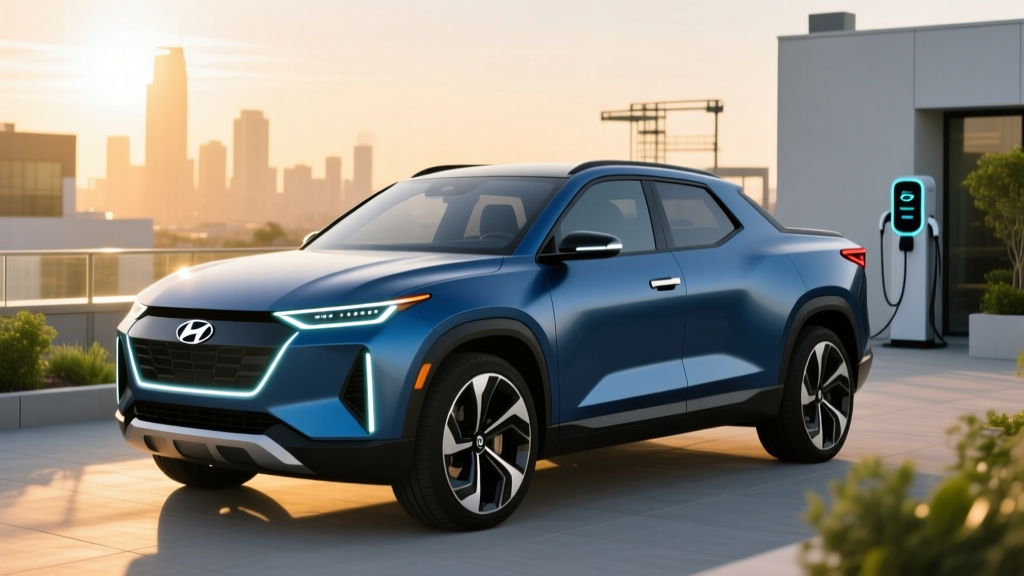
Hyundai has not published a press release, teaser image, or concept vehicle explicitly labeled "Santa Cruz EV." Any specifications discussed below are projections based on Hyundai's existing EV architecture and powertrain data, not confirmed factory figures.
Projected Platform and Powertrain: What an Electric Santa Cruz Could Look Like
If Hyundai green-lights an electric Santa Cruz, the most likely engineering path involves the company's E-GMP (Electric-Global Modular Platform), which underpins the Ioniq 5, Ioniq 6, and Kia EV6. E-GMP supports 800-volt architecture, enabling ultra-fast DC charging and both rear-wheel-drive and dual-motor AWD configurations.
| Attribute | Projected Estimate | Based On |
|---|---|---|
| Battery Capacity | 77.4 – 84 kWh (usable) | Ioniq 5 Long Range / Ioniq 9 |
| Battery Chemistry | NMC (nickel manganese cobalt) | Current E-GMP vehicles |
| EPA Range (est.) | 270 – 310 miles | Ioniq 5 AWD (290 mi EPA) adjusted for truck aero |
| Drivetrain | Dual-motor AWD (likely standard) | Truck segment AWD expectation |
| Horsepower | 320 – 380 hp | Ioniq 5 AWD (320 hp) |
| 0-60 mph | 5.0 – 5.8 seconds | Ioniq 5 AWD (5.1 sec) |
| Max DC Fast Charge Rate | ~240 kW (peak) | E-GMP 800V architecture |
| 10-80% DC Charge Time | ~18 – 22 minutes | Ioniq 5 real-world testing |
| Level 2 AC Charge Rate | 10.9 kW | Current E-GMP onboard charger |
| Towing Capacity (est.) | 3,500 – 5,000 lbs | Gas Santa Cruz turbo AWD (5,000 lbs) |
| Payload (est.) | 1,200 – 1,500 lbs | Gas Santa Cruz (~1,753 lbs, minus battery weight penalty) |
| Estimated Base MSRP | $42,000 – $48,000 | Ioniq 5 pricing + truck premium |
Important caveat: A pickup body style introduces more aerodynamic drag than a crossover, which typically reduces highway efficiency by 8-15%. Expect real-world highway range to land closer to 230-260 miles at 70 mph, and cold-weather range (below freezing) could drop an additional 20-30%, putting winter highway range in the 180-210 mile window. This is consistent with what we observe in the Ford F-150 Lightning and Rivian R1T.
Santa Cruz EV vs. Gas Santa Cruz: Cost and Capability Comparison
For buyers weighing whether to wait for an electric Santa Cruz or purchase the current gas model now, here's how the economics stack up using the 2025 gas Santa Cruz as a baseline. The gas Santa Cruz starts at approximately $28,250 (SE trim) and tops out around $43,000 (Limited turbo AWD).
| Category | 2025 Gas Santa Cruz (Turbo AWD) | Santa Cruz EV (Projected) |
|---|---|---|
| Purchase Price (MSRP) | $40,500 | $45,000 (est.) |
| Federal Tax Credit (§30D) | $0 | Up to $7,500* |
| Effective Purchase Price | $40,500 | $37,500 (est.) |
| Fuel / Electricity (5 yrs, 75,000 mi) | $9,400 (23 MPG combined, $3.50/gal) | $3,600 ($0.14/kWh, 3.2 mi/kWh) |
| Maintenance (5 yrs) | $3,200 | $1,500 |
| Insurance (5 yrs, est.) | $8,500 | $9,500 |
| Total 5-Year Cost | $61,600 | $52,100 |
*Federal §30D tax credit eligibility depends on buyer income caps ($150K single / $300K joint), vehicle MSRP caps ($80K for trucks), battery critical-mineral and component sourcing requirements, and point-of-sale transfer rules. Always verify current-year eligibility at IRS.gov and consult a tax professional.
The electric Santa Cruz's projected advantage comes primarily from the tax credit and dramatically lower fuel and maintenance costs. However, EV insurance premiums tend to run 10-20% higher due to repair-cost patterns, and the EV's residual value remains harder to predict given rapid battery-technology advancement.
Competitive Landscape: What Else Can You Buy?
If you need an electrified compact or midsize pickup today — or within the next year — the Santa Cruz EV isn't your only option. Here's how the field looks heading into the 2026 model year:
| Vehicle | Type | EPA Range / MPG | Starting MSRP | Status |
|---|---|---|---|---|
| Ford Maverick Hybrid | HEV | 42 MPG city / 33 hwy | ~$28,000 | On sale |
| Ford F-150 Lightning | BEV | 240 – 320 mi | ~$52,000 | On sale |
| Rivian R1T (Dual Motor) | BEV | 270 – 420 mi | ~$72,000 | On sale |
| Rivian R2 (announced) | BEV | ~300 mi (est.) | ~$45,000 (est.) | Expected 2027 |
| Chevrolet Silverado EV | BEV | 275 – 440 mi | ~$52,000 | On sale |
| Hyundai Santa Cruz (gas) | ICE | 23 MPG combined (turbo AWD) | ~$28,250 | On sale |
The Ford Maverick Hybrid is the closest analog to a potential Santa Cruz EV: compact, unibody, lifestyle-oriented, and priced under $30,000. It doesn't offer a plug or a bed longer than 4.5 feet, but its 42 MPG city figure makes it the efficiency champion of the segment today. If Hyundai brings a Santa Cruz EV to market near $45,000, it will need to offer substantially more range, tech, or utility than the Maverick Hybrid to justify a $15,000+ premium.
The Rivian R2 is the wildcard. If it launches near $45,000 with ~300 miles of range and Rivian's well-regarded adventure-oriented design language, it could preempt the Santa Cruz EV's target buyer entirely. Hyundai's advantage would be its dealer network, 10-year/100,000-mile powertrain warranty tradition, and potential §30D tax credit eligibility.
Real-World Ownership Considerations for a Santa Cruz EV
Buying an electric pickup isn't just about specs — it's about whether your daily life supports EV ownership. Here are the practical factors that will determine whether a Santa Cruz EV works for you:
Home Charging Access
A Level 2 home charger (240V, 40-48 amp circuit) is practically essential for convenient EV truck ownership. Expect to pay $800-$2,500 for professional installation of a hardwired Level 2 station, assuming your electrical panel has capacity. If you need a panel upgrade from 100A to 200A service, add $1,500-$3,000. At 10.9 kW, a full charge from 10-100% on Level 2 would take roughly 7-8 hours — fine for overnight charging, but slow if you need a quick turnaround.
If you live in an apartment or lack dedicated parking with electrical access, public DC fast charging becomes your primary fueling method. At current Electrify America and EVgo pricing (~$0.40-$0.55/kWh), your "fuel" cost roughly doubles compared to home charging, and you'll spend 20-30 minutes per session instead of plugging in at home.
Towing and Payload Reality
Electric pickups lose range dramatically when towing. The F-150 Lightning, for example, loses 40-55% of its EPA range when pulling a 5,000-lb trailer at highway speeds. A Santa Cruz EV with a projected 290-mile EPA range would realistically deliver 130-170 miles of range while towing near its maximum capacity. For frequent tow-heavy use, a hybrid or diesel remains more practical.
Climate Impact
Battery chemistry matters. NMC batteries (the likely choice for a Santa Cruz EV) lose roughly 20-30% of range in sustained sub-freezing temperatures, with additional energy consumed by cabin and battery heating. If you live in the upper Midwest or Mountain West, plan for a real-world winter range of 190-230 miles from a projected 290-mile EPA sticker. Hyundai's E-GMP vehicles include a heat pump (standard on most trims), which mitigates some of this loss compared to resistive heating.
Common Misconceptions About an Electric Santa Cruz
| Myth | Fact |
|---|---|
| "The Santa Cruz EV is available to order now." | Hyundai has not launched or opened reservations for any electric Santa Cruz. The current model is gasoline-only. |
| "An electric truck can't tow anything useful." | EV trucks can tow competitively — the gas Santa Cruz turbo AWD is rated for 5,000 lbs. An EV variant could match or exceed that. The limitation is range while towing, not capability. |
| "It will definitely qualify for the $7,500 tax credit." | §30D credit eligibility depends on battery sourcing, critical minerals, buyer income, and MSRP caps. Hyundai's current US-built EVs (like the Ioniq 5 from the Georgia Metaplant) have qualified, but rules change and must be verified at purchase. See IRS §30D guidance. |
| "EV batteries need replacing every few years." | Hyundai warranties its EV batteries for 10 years / 100,000 miles with a capacity-retention threshold (typically 70%). Real-world degradation data from E-GMP vehicles shows roughly 5-8% loss over 100,000 miles under normal use. |
| "I'll never need to visit a gas station, so charging is free." | Home charging costs ~$0.12-$0.18/kWh depending on your utility. Public DC fast charging averages $0.40-$0.55/kWh. A Santa Cruz EV would still cost roughly $5-$9 per "fill-up" at home. |
Decision Framework: Should You Wait or Buy Now?
Choose Your Path
Buy the gas Hyundai Santa Cruz NOW if:
- You need a compact pickup within the next 12 months
- You regularly tow more than 2,000 lbs and need predictable range
- You lack home charging access and live in a charging-desert area
- Your budget is firmly under $35,000
- You drive in extreme cold frequently and can't tolerate range uncertainty
Buy the Ford Maverick Hybrid NOW if:
- You want segment-best city fuel economy (42 MPG) without plugging in
- You want electrification-adjacent efficiency without EV charging logistics
- Your budget is $28,000-$38,000
Wait for a potential Santa Cruz EV (or Rivian R2) if:
- You have reliable Level 2 home charging access
- Your daily commute is under 80 miles round-trip
- You rarely tow over 2,000 lbs
- You want to minimize fuel and maintenance costs over 5+ years of ownership
- You're comfortable with a 2027-2028 purchase timeline
- You want the latest ADAS and infotainment tech that typically debuts on new EV platforms
What First-Time EV Buyers Should Know Before Waiting
If the Santa Cruz EV is your first electric vehicle, start preparing now — even before the truck is announced:
- Audit your electrical panel. Have a licensed electrician assess whether your home can support a 40-48 amp Level 2 circuit. A 200-amp panel is generally sufficient; a 100-amp panel will likely need upgrading.
- Research your utility's EV rate plans. Many utilities offer time-of-use (TOU) plans that make overnight charging significantly cheaper (sometimes $0.06-$0.08/kWh vs. $0.15-$0.20 during peak hours).
- Understand the §30D tax credit mechanics. The credit can now be transferred to the dealer at point of sale, reducing your out-of-pocket cost at purchase rather than waiting for a tax refund. But you must meet income caps ($150,000 single / $225,000 head of household / $300,000 joint) and the vehicle must meet battery-sourcing requirements. Rules are subject to legislative change.
- Test-drive existing Hyundai EVs. The Ioniq 5 and Ioniq 6 give you the best preview of what a Santa Cruz EV's driving dynamics, infotainment (Hyundai's latest ccNC system), and ADAS (Highway Driving Assist 2) will feel like.
- Map your local charging infrastructure. Use apps like PlugShare and A Better Routeplanner to see what DC fast charging exists along your common routes. Hyundai's E-GMP vehicles charge at up to ~240 kW on compatible stations, but most public chargers in the US still max out at 50-150 kW.
Frequently Asked Questions
Has Hyundai officially announced the Santa Cruz EV?
No. As of early 2026, Hyundai has not issued a press release, concept reveal, or confirmed production timeline for a Santa Cruz EV. The current Santa Cruz is sold exclusively with gasoline engines. Any specifications discussed in this article are projections based on Hyundai's E-GMP platform and current EV lineup.
When could the Hyundai Santa Cruz EV be available?
Based on Hyundai's product cadence and public roadmap statements, the earliest realistic window is the 2027 or 2028 model year, which could mean late 2026 or 2027 calendar-year availability. Hyundai's new Metaplant America in Georgia is ramping up EV production, which would be a logical build site.
Will the Santa Cruz EV use Tesla's NACS charging connector?
Hyundai has confirmed that its future North American EVs will adopt the NACS (North American Charging Standard) connector, aligning with the industry-wide shift away from CCS. If a Santa Cruz EV launches in 2027+, it will almost certainly feature a native NACS port, granting access to Tesla Supercharger stations via Hyundai's partnership.
How much will the Hyundai Santa Cruz EV cost?
Based on current E-GMP vehicle pricing and the truck-segment premium, a reasonable estimate is $42,000-$48,000 for a base AWD model, with higher trims potentially reaching $55,000+. This would position it above the gas Santa Cruz ($28,250-$43,000) but below the Rivian R1T and competitive with base F-150 Lightning trims.
What will the Santa Cruz EV's battery warranty be?
Hyundai currently offers a 10-year/100,000-mile battery warranty on its US-market EVs (Ioniq 5, Ioniq 6), covering defects and capacity degradation below a specified threshold (typically 70% state of health). It is reasonable to expect the same coverage on a future Santa Cruz EV.
Is it better to buy a Maverick Hybrid now or wait for the Santa Cruz EV?
If you need a vehicle now and value fuel efficiency without charging logistics, the Maverick Hybrid (42 MPG city, ~$28,000 starting) is the pragmatic choice. If you can wait 1-2 years, have home charging, and want a pure-electric driving experience with lower operating costs, waiting for the Santa Cruz EV (or Rivian R2) makes sense — but there is no guarantee of exact pricing, specs, or timeline.
Sources: EPA Fuel Economy (gas Santa Cruz MPG data), IRS §30D Clean Vehicle Credit (tax credit rules), Hyundai Motor America press site (product roadmap statements). All projected EV specifications are estimates based on published E-GMP platform data and are subject to change pending official Hyundai announcement.