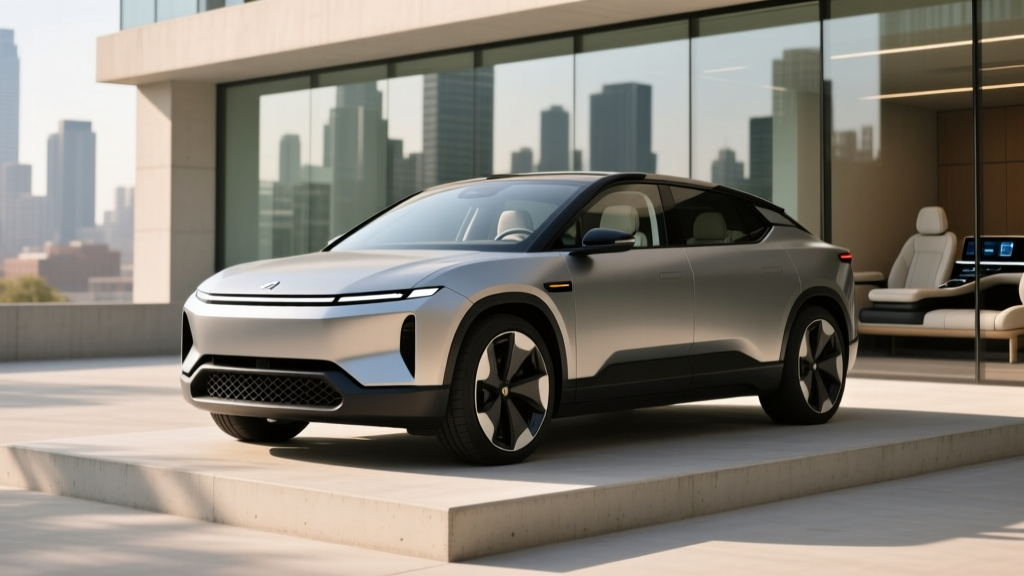
The Rivian R2 is the smaller, more affordable sibling to the R1S and R1T, designed to bring the brand's adventure-focused DNA to a compact SUV footprint. With production beginning at Rivian's Normal, Illinois facility in early 2026 and customer deliveries expected by mid-year, the R2 targets the high-volume mid-size electric SUV segment — a space currently dominated by the Tesla Model Y, Hyundai Ioniq 5, and Ford Mustang Mach-E. But unlike those competitors, Rivian is leaning hard into off-road capability, a native NACS charge port, and a vertically integrated tech stack.
Here's what you need to know about the 2026 Rivian R2 trims, from the base Standard pack to the top-tier Max battery option, including real-world range expectations, charging performance, and whether this EV qualifies for the federal tax credit under current IRS §30D rules.
2026 Rivian R2 Trim Levels and Pricing
Rivian has announced three primary configurations for the R2 at launch, differentiated primarily by battery capacity and drivetrain. Pricing below reflects the base MSRP before destination charges and before any federal or state incentives.
| Trim / Config | Drivetrain | Battery (usable kWh) | EPA Range (est.) | 0-60 mph | HP | Base MSRP |
|---|---|---|---|---|---|---|
| R2 Standard (Dual-Motor AWD) | Dual-Motor AWD | ~75 kWh (LFP) | ~270 mi | ~5.0 sec | ~400 | $45,000 |
| R2 Large (Dual-Motor AWD) | Dual-Motor AWD | ~92 kWh (NMC) | ~330 mi | ~4.5 sec | ~450 | $52,000 |
| R2 Max (Tri-Motor AWD) | Tri-Motor AWD | ~109 kWh (NMC) | ~365 mi | ~3.5 sec | ~665 | $58,000 |
Important note: As of early 2026, Rivian has confirmed the R2 will launch with a dual-motor AWD configuration as standard. The tri-motor Max variant is expected later in the 2026 model year or early 2027. All figures above are based on Rivian's preliminary announcements and may shift before final EPA certification. The ~$45,000 entry price is a target Rivian has publicly committed to for the Standard pack.
Real-World Range: What the EPA Sticker Doesn't Tell You
- R2 Standard (EPA ~270 mi): Expect ~220–240 mi on mixed highway driving at 70+ mph; ~180–210 mi in sub-freezing winter conditions.
- R2 Large (EPA ~330 mi): Expect ~270–295 mi highway; ~220–260 mi in cold weather.
- R2 Max (EPA ~365 mi): Expect ~300–325 mi highway; ~245–280 mi in cold weather.
Highway driving at sustained speeds above 70 mph typically costs EVs 12–18% of their EPA range. Cold weather (below 32°F) compounds this with battery efficiency losses and cabin heating demand, especially without a heat pump. Rivian has confirmed the R2 will include a standard heat pump, which should help mitigate winter range loss compared to resistive-heating EVs.
Rivian's boxy, upright design prioritizes interior volume and off-road ground clearance over aerodynamic efficiency. That means the R2's real-world highway efficiency will likely trail sleeker competitors like the Tesla Model Y or Hyundai Ioniq 5. If most of your driving is city and suburban, you'll land closer to the EPA sticker. If you're a frequent highway cruiser or live in a cold climate, budget for the lower end of the real-world estimates above.
Charging: DC Fast-Charge Speed and Home Level 2
Rivian has confirmed the R2 will ship with a native NACS (North American Charging Standard) port, giving it direct access to Tesla's Supercharger network — currently the most reliable and extensive DC fast-charging network in the U.S. This is a significant advantage over CCS-equipped rivals that require adapters.
| Charging Level | Power / Rate | Time or Miles Added |
|---|---|---|
| Level 1 (120V household) | ~1.4 kW | ~3–4 mi/hr |
| Level 2 (240V home, 48A) | ~11.5 kW | ~28–32 mi/hr |
| DC Fast Charge (Standard/Large) | Peak ~200 kW | 10–80% in ~25 min |
| DC Fast Charge (Max battery) | Peak ~220 kW | 10–80% in ~28 min |
A few things to keep in mind about these numbers:
- Peak kW is not sustained kW. Like all EVs, the R2's charge rate will taper as the battery fills. The 10–80% time is a more honest metric than peak kW. Expect the R2 to hold near-peak rates from roughly 10–50% SoC, then taper progressively through 80%.
- Preconditioning matters. If you navigate to a Supercharger using the R2's built-in navigation, the battery thermal management system will precondition the pack for optimal charge speed. Arriving at a charger with a cold battery without preconditioning can add 5–10 minutes to your session.
- Home Level 2 charging at 11.5 kW (48 amps on a 60-amp circuit) will fully recharge the Standard pack overnight in roughly 7–8 hours and the Max pack in about 10 hours. Budget $800–$2,000 for a professional Level 2 home charger installation depending on your panel capacity and conduit run.
Performance and Drivetrain
Rivian has built its reputation on dual-motor AWD performance with sophisticated torque vectoring, and the R2 carries that forward. The standard dual-motor setup uses one motor on each axle, providing true all-wheel drive with independent torque control. The tri-motor Max variant adds a second rear motor for aggressive rear-axle torque distribution.
Expected performance figures:
- Dual-Motor AWD: ~400–450 hp, ~4.5–5.0 sec 0–60 mph. This is brisk by any measure and more than adequate for highway merging, trailhead access, and daily driving.
- Tri-Motor AWD (Max): ~665 hp, ~3.5 sec 0–60 mph. This enters serious performance territory, comparable to a Tesla Model Y Performance.
Rivian's quad-motor R1T and R1S have demonstrated impressive off-road chops with tank turns and precise low-speed rock crawling. While the R2's dual- and tri-motor setups won't replicate the quad-motor's full capability, Rivian has confirmed the R2 will retain significant ground clearance (~8.5 inches), approach/departure angles suitable for light-to-moderate trails, and the brand's software-driven terrain modes. This positions the R2 uniquely against the Model Y, which has minimal off-road pretension.
Interior, Cargo, and Technology
The R2 is smaller than the three-row R1S but larger than a subcompact crossover. Think of it as Rivian's answer to the Model Y — a two-row compact SUV with a focus on versatility.
Estimated dimensions:
- Cargo volume (behind 2nd row): ~28–32 cu ft
- Cargo volume (2nd row folded): ~65–70 cu ft
- Front trunk (frunk): ~10–12 cu ft — a meaningful advantage over the Model Y's smaller frunk
- Rear legroom: ~38–40 inches (estimated)
Tech highlights:
- Infotainment: Rivian's proprietary software on a large center touchscreen (~15.6 inches expected), with integrated trip planning, Supercharger/charging network navigation, and over-the-air updates.
- Driver assistance: Rivian's Driver+ system, which includes adaptive cruise control, lane centering, and automatic lane changes on highways. This is an SAE Level 2 system — the driver must remain engaged and hands must stay on or near the wheel. It is not self-driving.
- Native NACS port: No adapter needed for Tesla Superchargers.
- Vehicle-to-Load (V2L): Expected to be available, allowing the R2 to power external devices (camping gear, tools, tailgate equipment) — a Rivian signature feature.
- Adventure-ready features: Integrated roof rack rails, gear tunnel potential, and Rivian's camp kitchen accessory compatibility (details TBD for R2).
Federal Tax Credit Eligibility (IRS §30D)
The question every EV buyer asks: does it qualify for the up-to-$7,500 federal tax credit? For the 2026 Rivian R2, the answer is likely yes for most trims, but with important caveats.
| Trim | MSRP | Est. Credit | Effective Price |
|---|---|---|---|
| R2 Standard (Dual-Motor) | $45,000 | Up to $7,500 | ~$37,500 |
| R2 Large (Dual-Motor) | $52,000 | Up to $7,500 | ~$44,500 |
| R2 Max (Tri-Motor) | $58,000 | Up to $7,500 | ~$50,500 |
- MSRP cap: SUVs must be at or below $80,000 MSRP. All announced R2 trims clear this threshold easily.
- Buyer income cap: Adjusted gross income must not exceed $150,000 (single), $225,000 (head of household), or $300,000 (joint filers).
- Battery sourcing: At least a percentage of critical minerals and battery components must be sourced from the U.S. or free-trade-agreement countries. These thresholds tighten annually. Rivian manufactures in Illinois, but battery cell sourcing details for the R2 have not been fully confirmed. The Standard (LFP) pack may face sourcing challenges, as LFP cells are predominantly manufactured in China.
- Point-of-sale transfer: As of 2024, buyers can transfer the credit to the dealer at purchase, receiving it as an immediate price reduction rather than waiting to claim it on their tax return. This is expected to remain available in 2026.
Bottom line: Consult a tax professional and check the latest IRS guidance before counting on the full $7,500. The LFP Standard pack's credit eligibility is the most uncertain due to battery-sourcing requirements.
Efficiency and Ownership Costs
Official EPA efficiency figures (MPGe and kWh/100 mi) are not yet published for the R2. However, based on the vehicle's aerodynamic profile and weight, we can estimate:
- Dual-Motor (Standard): ~105–110 MPGe combined, ~30–32 kWh/100 mi
- Dual-Motor (Large): ~100–108 MPGe combined, ~31–34 kWh/100 mi
- Tri-Motor (Max): ~92–100 MPGe combined, ~34–37 kWh/100 mi
For context, the Tesla Model Y Long Range AWD achieves 117 MPGe combined and 29 kWh/100 mi per fueleconomy.gov. The R2's boxier shape and heavier build will cost it a few MPGe points, which translates to slightly higher per-mile charging costs — though still dramatically cheaper than gasoline.
Estimated annual charging cost (12,000 miles/yr, $0.14/kWh national average home electricity): ~$500–$620. Compare that to ~$1,600–$1,900 annually for a 25-MPG gas SUV at $3.50/gallon.
Warranty Coverage
Rivian's warranty for the R1S/R1T provides a strong baseline for what to expect on the R2:
- Battery pack: 8 years / 175,000 miles (expected for R2), with a capacity retention threshold of ~70%.
- Powertrain: 8 years / 175,000 miles.
- Bumper-to-bumper: 5 years / 60,000 miles.
Rivian's battery warranty mileage limit (175,000) is notably generous compared to the industry-standard 100,000 miles. This matters for high-mileage drivers and long-term ownership confidence. Rivian manufactures its own battery packs, which gives it direct control over cell sourcing, pack design, and replacement logistics — a vertical-integration advantage similar to Tesla's.
How the R2 Stacks Up Against Key Competitors
| Spec | Rivian R2 Large | Tesla Model Y LR AWD | Hyundai Ioniq 5 LR AWD | Ford Mustang Mach-E ER AWD |
|---|---|---|---|---|
| Base MSRP | ~$52,000 | ~$48,000 | ~$52,000 | ~$51,000 |
| EPA Range | ~330 mi | ~320 mi | ~290 mi | ~300 mi |
| DC Fast Charge (peak kW) | ~200 kW | ~250 kW | ~238 kW | ~150 kW |
| 10–80% DC Time | ~25 min | ~22 min | ~18 min | ~38 min |
| Charge Port | NACS (native) | NACS (native) | CCS (NACS adapter) | CCS (NACS adapter) |
| Off-Road Capability | Strong | Minimal | Minimal | Moderate |
| Frunk | ~10–12 cu ft | ~4 cu ft | ~0.85 cu ft | ~4.7 cu ft |
Where the R2 wins: Off-road capability, frunk size, native NACS access without an adapter, adventure-oriented design, and Rivian's strong brand loyalty. The R2 also benefits from Rivian's vertically integrated software and OTA update track record.
Where the R2 trails: The Model Y and Ioniq 5 charge faster on DC. The Model Y remains the efficiency benchmark. The Ioniq 5's 800V architecture delivers best-in-class 10–80% charge times. If charging speed is your top priority, the R2's ~200 kW peak is adequate but not class-leading.
- You want genuine off-road and adventure capability in a compact EV SUV
- Native Tesla Supercharger access without an adapter is important to you
- You value a large frunk and versatile cargo layout for gear, pets, or camping
- You prefer Rivian's software ecosystem and brand identity
- Fastest possible DC charging is your top priority (Ioniq 5 or Model Y)
- You need three rows of seating (consider the R1S or Kia EV9)
- You want the lowest possible starting price (Model Y starts ~$4,000 lower)
Pros and Cons at a Glance
- Native NACS port — direct Supercharger access
- Class-leading off-road capability for the segment
- Large frunk (~10–12 cu ft) and versatile cargo space
- Generous 8-yr/175,000-mi battery warranty
- Heat pump standard for better cold-weather efficiency
- V2L capability for camping and power backup
- Strong OTA update track record from Rivian
- DC charge speed (~200 kW peak) trails Ioniq 5 and Model Y
- Boxy design means lower highway efficiency vs. sleeker rivals
- LFP Standard pack's tax credit eligibility uncertain (battery sourcing)
- Two-row only — no three-row option
- Brand-new platform — early-production quality unknowns
- Tri-Motor Max variant may not ship until late 2026 or 2027
Frequently Asked Questions
What is the real-world range of the Rivian R2?
For the R2 Large (dual-motor, ~92 kWh NMC), expect roughly 270–295 miles on highway-heavy trips at 70+ mph and 220–260 miles in sub-freezing winter conditions. The EPA estimate is ~330 miles, but real-world highway and cold-weather driving typically reduces that by 12–25%.
How fast does the Rivian R2 charge?
On a DC fast charger, the R2 is expected to peak at approximately 200 kW (dual-motor trims) and reach 10–80% in about 25 minutes. At home on a Level 2 charger (240V, 48A / 11.5 kW), expect roughly 28–32 miles of range added per hour, with a full overnight charge taking 7–10 hours depending on battery size.
How much does the Rivian R2 cost after tax credits?
The base R2 Standard is targeted at $45,000 MSRP. If the full $7,500 federal credit applies, the effective price drops to approximately $37,500. The R2 Large at $52,000 would fall to ~$44,500. However, credit eligibility depends on your income, the vehicle's battery sourcing compliance, and MSRP caps. The LFP-equipped Standard pack faces the most uncertainty on sourcing requirements.
Is the Rivian R2 worth buying vs. the Tesla Model Y?
It depends on your priorities. The Model Y is more aerodynamically efficient, charges slightly faster, and starts at a lower price. The R2 offers significantly better off-road capability, a much larger frunk, native NACS without an adapter, and Rivian's adventure-focused design language. If you camp, ski, or drive on unpaved roads regularly, the R2 fills a gap the Model Y doesn't.
Does the Rivian R2 qualify for the federal EV tax credit?
Most likely yes, but it depends on the trim and your tax situation. All R2 trims fall under the $80,000 SUV MSRP cap. Your adjusted gross income must be below $150K (single) / $300K (joint). The biggest variable is battery component and critical-mineral sourcing — the LFP Standard pack may face challenges here. Check IRS §30D guidance and consult a tax professional before relying on the credit.
What battery chemistry does the Rivian R2 use?
The Standard pack is expected to use LFP (lithium iron phosphate) chemistry, which offers longer cycle life, lower cost, and better thermal stability but lower energy density. The Large and Max packs are expected to use NMC (nickel manganese cobalt) for higher energy density and longer range. LFP packs can and should be charged to 100% regularly, while NMC packs benefit from daily charging limits of 80–90% for longevity.
When can I buy the Rivian R2?
Rivian began production of the R2 at its Normal, Illinois plant in early 2026, with customer deliveries expected to start mid-2026. Reservations opened in 2024, and early reservation holders are being prioritized. The tri-motor Max variant may not be available until late 2026 or early 2027.
Does the R2 have self-driving capability?
No. Rivian's Driver+ system is an SAE Level 2 driver-assistance system. It provides adaptive cruise control, lane centering, and automatic lane changes on divided highways, but the driver must remain fully engaged, monitor the road, and keep hands on or near the steering wheel at all times. It is not autonomous or self-driving.