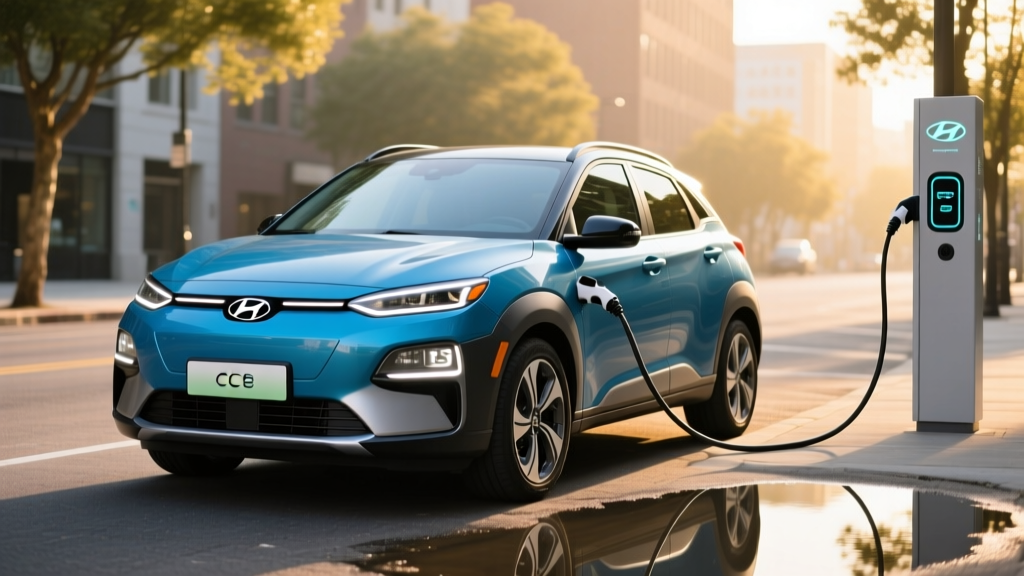
The Hyundai Kona Electric entered its second generation for the 2024 model year with a larger footprint, more range, and a critically important upgrade: DC fast charging that no longer feels like a punishment. Now in its 2026 model year, the Kona Electric remains one of the most practical compact electric crossovers for buyers who want a sub-$40,000 EV with genuine daily usability — without stepping up to the larger Ioniq 5. But how do the numbers actually shake out once you leave the dealership lot?
We've analyzed the official EPA fuel economy data, Hyundai's published specifications, and real-world driving patterns to give you the complete picture of the Kona Electric's capabilities, limitations, and ownership economics.
Complete 2026 Hyundai Kona Electric Specifications
| Specification | SE / SEL (FWD) | Limited (FWD) |
|---|---|---|
| EPA Range | 261 miles | 242 miles |
| Battery (usable) | 65.4 kWh, NMC lithium-ion | |
| Motor Output | 150 kW / 201 hp / 188 lb-ft torque | |
| Drivetrain | Front-wheel drive (single motor) | |
| 0–60 mph | ~7.4 seconds | |
| MPGe (city / hwy / combined) | 129 / 103 / 116 | 123 / 98 / 110 |
| Efficiency (kWh/100 mi) | 29 | 31 |
| Max DC Fast Charge | 100 kW (CCS/NACS adapter) | |
| 10–80% DCFC Time | ~43 minutes | |
| Level 2 AC Charge Rate | 11 kW onboard charger (~37 mi/hr) | |
| Cargo (behind rear seats) | 25.8 cu ft | |
| Cargo (seats folded) | 63.7 cu ft | |
| Rear Legroom | 38.2 in | |
| Base MSRP (incl. destination) | ~$34,075 (SE) | ~$39,075 (Limited) |
| Battery Warranty | 8 years / 100,000 miles | |
Range and Efficiency: The Real-World Picture
EPA Sticker: 261 miles (SE/SEL) / 242 miles (Limited)
Real-World Highway (70 mph, 68°F): Expect ~215–230 miles
Cold-Weather Highway (30°F): Expect ~175–200 miles
The Kona Electric's aerodynamic profile and single-motor FWD layout favor city efficiency. Highway driving at sustained speed and cold temperatures significantly reduce usable range — plan road trips around 180–200 mile segments to maintain a comfort buffer.
The SE and SEL trims achieve 116 MPGe combined, which translates to 29 kWh per 100 miles — competitive with the Chevrolet Bolt EUV and slightly behind the Kia Niro EV's 113 MPGe combined. The heavier Limited trim, burdened by larger 19-inch wheels and additional equipment, drops to 110 MPGe combined.
For a daily commuter driving 30–40 miles round trip, the Kona Electric's range is essentially a non-issue. You'll charge at home every two to three days and never think about it. Road trips require more planning: with DC fast charging capped at 100 kW, you're looking at 40+ minute stops, which means stretching your legs and grabbing a meal rather than a quick pit stop.
Charging Speed: Home and Public Networks
| Charging Level | Power (kW) | Rate (miles/hr) | Full Charge Time |
|---|---|---|---|
| Level 1 (120V household) | ~1.4 kW | ~5 mi/hr | ~48 hours (0–100%) |
| Level 2 (240V home/public) | 11 kW (max) | ~37 mi/hr | ~6.5 hours (0–100%) |
| DC Fast Charge | 100 kW (peak) | ~240 mi/hr (peak) | ~43 min (10–80%) |
The 11 kW onboard AC charger is a genuine strength here. Many competitors in this price range still use 7.2 kW or 9.6 kW chargers, meaning the Kona Electric refills noticeably faster on a home Level 2 station. A standard 48-amp home charger (like a ChargePoint Home Flex or Emporia Level 2) will deliver the full 11 kW, giving you roughly 37 miles of range per hour of charging — enough to refill overnight from any realistic daily drive.
The DC fast charging story is more nuanced. The Kona Electric peaks at approximately 100 kW, but like all EVs, it doesn't sustain that rate across the full charge curve. Expect peak speeds between 20–50% state of charge, with tapering above 60% and a significant slowdown past 80%. On a 150 kW or 350 kW Electrify America or Tesla Supercharger (with NACS adapter), you'll use the station's full capability only briefly. This is adequate for road trips but noticeably slower than the Ioniq 5's 800V architecture, which can sustain 200+ kW.
Connector note: The 2026 Kona Electric ships with a CCS1 port. Hyundai provides a NACS adapter for Tesla Supercharger access, which significantly expands your road-trip charging network. Check Hyundai's official Kona Electric page for adapter availability details.
Performance and Drivetrain
The Kona Electric uses a single front-mounted permanent-magnet synchronous motor producing 201 horsepower and 188 lb-ft of torque. The 0–60 mph sprint takes approximately 7.4 seconds — brisk enough for confident highway merging but not sporty by EV standards. There is no all-wheel-drive option; Hyundai reserves dual-motor AWD for the Ioniq 5 and larger vehicles.
Where the Kona Electric shines is low-speed responsiveness. Instant torque from a standstill makes it genuinely quick off the line in city traffic, and the regenerative braking system offers multiple levels adjustable via steering-wheel paddles, including an i-Pedal mode for near one-pedal driving. The suspension tuning leans comfortable rather than firm, which suits its commuter-car mission but means body roll is noticeable on twisty roads.
Towing is not this vehicle's forte — Hyundai rates it for no towing capacity. If you need to pull a trailer, look at the Ioniq 5 (up to 2,300 lbs with the tow package) or a larger electric SUV.
Interior Space, Technology, and Daily Usability
The second-generation Kona Electric grew substantially over its predecessor. Rear-seat legroom now measures 38.2 inches, which comfortably fits adults on longer drives. Cargo volume stands at 25.8 cubic feet behind the rear seats and 63.7 cubic feet with the 60/40 split seats folded — enough for a week's groceries or a couple of rolling suitcases.
Notably, the Kona Electric does not have a front trunk (frunk). The space under the hood houses power electronics, which is a missed opportunity for stowing charging cables or a small bag.
Tech highlights:
- Dual 12.3-inch displays (digital cluster + infotainment) on SEL and Limited trims
- Wireless Apple CarPlay and Android Auto on SE; wired on higher trims with navigation
- Hyundai SmartSense suite: forward collision-avoidance assist, lane-keeping assist, blind-spot monitoring, rear cross-traffic collision-avoidance
- Highway Driving Assist (Level 2 ADAS) on SEL and Limited — maintains speed and lane centering on divided highways
- Digital Key 2 (NFC/BLE phone-as-key) on Limited trim
- Vehicle-to-Load (V2L) capability with an available adapter — power a laptop, cooler, or small appliance from the traction battery
- Heat pump standard on all trims — critical for preserving range in cold weather
Highway Driving Assist is an SAE Level 2 driver-assistance system. It provides steering, acceleration, and braking support, but you must remain attentive and keep your hands on or near the wheel at all times. It is not autonomous driving. See NHTSA's guidance on automated vehicle safety for the full framework.
Notable drawbacks:
- No frunk for cable storage
- Rear visibility is compromised by thick C-pillars; the Limited's surround-view camera helps
- Infotainment can feel slightly sluggish compared to Tesla or Rivian interfaces
- No rear HVAC vents on the SE trim
- 100 kW DCFC ceiling means longer road-trip stops than Ioniq 5 or Tesla Model Y
Pricing, Trims, and Federal Tax Credit Eligibility
| Trim | Base MSRP (incl. destination) | Est. Federal Credit | Effective Price* |
|---|---|---|---|
| SE | ~$34,075 | Up to $7,500 | ~$26,575 |
| SEL | ~$36,075 | Up to $7,500 | ~$28,575 |
| Limited | ~$39,075 | Up to $7,500 | ~$31,575 |
*Effective price assumes full §30D credit eligibility. Actual credit depends on battery sourcing, buyer income, and MSRP caps. Consult a tax professional.
The Kona Electric's pricing is its strongest competitive weapon. The SE trim starts under $35,000, and with the federal tax credit applied at the point of sale, effective pricing drops into the high-$20,000s — territory that directly challenges well-equipped gas-powered compact SUVs on total cost of ownership.
- MSRP Cap: Vehicle MSRP must not exceed $80,000 (SUVs/crossovers) — Kona Electric qualifies ✅
- Buyer Income Cap: Modified AGI ≤ $150,000 (single) / $300,000 (joint) — verify your situation
- Battery Sourcing: Critical minerals and battery components must meet escalating North American sourcing thresholds — confirm current-year compliance on IRS.gov §30D page
- Point-of-Sale Transfer: You can transfer the credit to the dealer at purchase for an immediate price reduction (requires dealer registration)
- Final Assembly: Must be assembled in North America — Kona Electric for the US market is assembled in South Korea, which may affect eligibility ⚠️
Critical note: The Kona Electric's final assembly location has been a point of contention under §30D rules. Verify the current-year assembly requirement and any manufacturer updates with your dealer and the IRS before relying on the credit in your purchase calculation.
How It Stacks Up Against Key Competitors
| Attribute | Hyundai Kona Electric (SE) | Kia Niro EV | Chevrolet Bolt EUV (if available) | Tesla Model Y (LR) |
|---|---|---|---|---|
| EPA Range | 261 mi | 239 mi | 247 mi | 320 mi |
| Max DCFC | 100 kW | 85 kW | 55 kW | 250 kW |
| Base MSRP | ~$34,075 | ~$39,600 | ~$28,800* | ~$44,990 |
| 0–60 mph | 7.4 sec | 7.8 sec | 7.0 sec | 4.8 sec |
| Cargo (rear seats up) | 25.8 cu ft | 19.1 cu ft | 16.3 cu ft | 30.2 cu ft |
*Bolt EUV pricing reflects prior model year; verify 2026 availability.
The Kona Electric occupies a compelling middle ground. It offers more range and faster DC charging than the Niro EV at a lower starting price. It provides significantly more cargo space and faster charging than the Bolt EUV. And while the Tesla Model Y dominates on range, charging speed, and performance, it costs $10,000+ more at the base level and offers a very different ownership experience.
Who Should Buy the Kona Electric — And Who Shouldn't
✅ Choose the Kona Electric If:
- You commute 20–50 miles daily and can charge at home
- Your budget is $30,000–$40,000 and you want a new EV
- You value strong city efficiency and a comfortable ride over sporty handling
- You want Hyundai's 8-year/100,000-mile battery warranty for peace of mind
- You rarely take road trips over 300 miles
❌ Look Elsewhere If:
- You road-trip frequently and need 20-minute fast-charge stops
- You need all-wheel drive for snow or mountain driving
- You need to tow anything
- You want maximum cargo space (consider Ioniq 5 or Model Y)
- You want the latest Level 2+ ADAS features like hands-free driving
Frequently Asked Questions
What is the real-world range of the Hyundai Kona Electric?
The EPA rates the SE/SEL at 261 miles and the Limited at 242 miles. In real-world highway driving at 70 mph in moderate temperatures, expect roughly 215–230 miles. In freezing conditions, that drops to approximately 175–200 miles due to battery resistance and cabin heating demands, even with the standard heat pump.
How fast does the Kona Electric charge at home and on the road?
At home on a 240V Level 2 charger, the 11 kW onboard charger delivers about 37 miles of range per hour, fully recharging the 65.4 kWh battery in roughly 6.5 hours. On DC fast chargers, it peaks at 100 kW, reaching 10–80% in approximately 43 minutes. That's slower than the Ioniq 5 or Model Y but adequate for most use cases.
Does the 2026 Kona Electric qualify for the $7,500 federal tax credit?
Eligibility under IRS §30D depends on final assembly location (must be North America), battery critical-mineral sourcing thresholds, buyer income caps, and the $80,000 MSRP ceiling. The Kona Electric's assembly location has been a variable — verify current-year status on IRS.gov and with your dealer before finalizing your purchase.
Is the Kona Electric worth buying over the Ioniq 5?
It depends on your budget and needs. The Ioniq 5 offers significantly faster 800V DC charging (up to 240 kW), more interior space, available AWD, and a longer wheelbase — but starts roughly $8,000–$10,000 higher. If your budget is firm around $35,000 and you primarily commute, the Kona Electric is the smarter financial choice. If road trips and charging speed are priorities, the Ioniq 5 justifies its premium.
What is the battery warranty on the Kona Electric?
Hyundai provides an 8-year / 100,000-mile limited warranty on the high-voltage battery pack, covering defects and capacity loss below a specified threshold (typically 70% state of health). The basic vehicle warranty is 5 years / 60,000 miles. This is among the strongest battery warranties in the segment.
Does the Kona Electric have all-wheel drive?
No. The 2026 Kona Electric is exclusively front-wheel drive with a single motor. Hyundai does not offer a dual-motor AWD variant. For AWD in Hyundai's EV lineup, look at the Ioniq 5 or Ioniq 6.