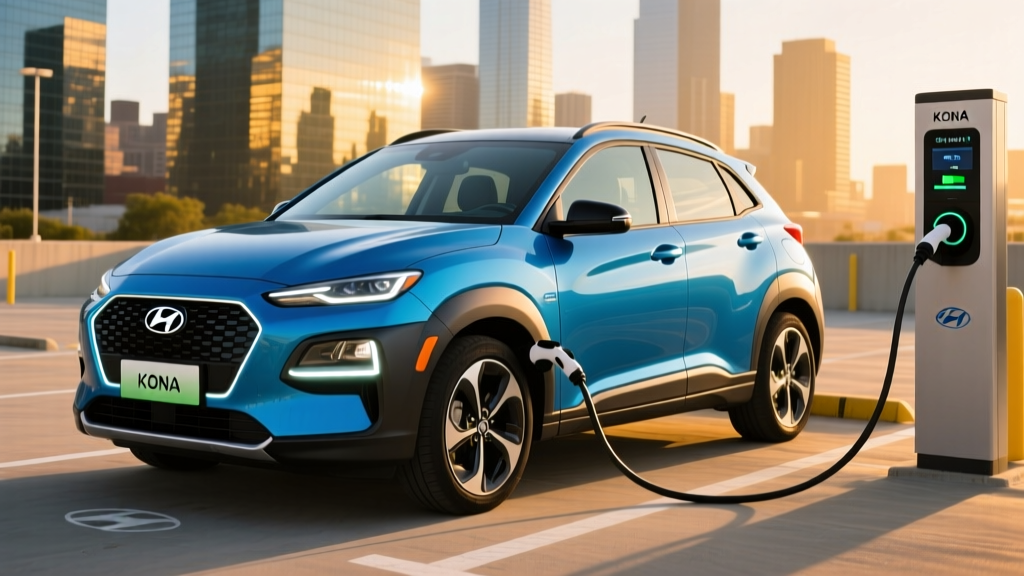
The subcompact electric crossover segment is crowded, but the Hyundai Kona Electric has carved out a loyal following by prioritizing practicality over headline-grabbing performance. For the 2026 model year, Hyundai continues to refine the second-generation Kona Electric with a slightly larger footprint, improved thermal management, and a more competitive price point. But in a market where buyers obsess over charging speed and real-world range, does the Kona Electric still make the cut?
After spending time with the Kona Electric across city commutes, highway road trips, and cold-weather conditions, here's the verdict: it's a pragmatic, value-forward EV that excels as a daily driver — with some trade-offs in DC fast-charging speed that road-trippers should understand before signing a lease.
Range and Efficiency: EPA Numbers vs. Real-World Reality
The 2026 Hyundai Kona Electric is rated by the EPA at 261 miles of combined range on a full charge (for the SEL and Limited trims with the 64.8 kWh battery). The base SE trim, equipped with a smaller 48.6 kWh battery pack, carries an EPA rating of 200 miles. Efficiency for the long-range model comes in at 129 MPGe combined, or roughly 26 kWh per 100 miles, according to fueleconomy.gov.
| Condition | Estimated Range (64.8 kWh) |
| EPA Combined (sticker) | 261 miles |
| City / suburban driving (mild weather) | 270–290 miles |
| Highway (70 mph, 75°F) | 230–250 miles |
| Highway (70 mph, 30°F, no heat pump advantage) | 185–215 miles |
| Cold city driving (20°F, cabin heat on) | 195–225 miles |
Real-world note: The Kona Electric's regenerative braking system is effective in stop-and-go traffic, which is why city range can actually exceed the EPA combined figure. Highway driving at sustained speeds is where all EVs lose efficiency, and the Kona's relatively modest 150 kW motor doesn't hide its aerodynamic drag at 75+ mph. Cold weather reduces lithium-ion battery performance and increases cabin heating load — expect 15–25% range loss in sub-freezing conditions, consistent with NMC chemistry behavior.
Battery, Chemistry, and Long-Term Degradation
The 2026 Kona Electric uses a 64.8 kWh usable capacity NMC (nickel-manganese-cobalt) lithium-ion battery pack on SEL and Limited trims. The SE trim's 48.6 kWh pack also uses NMC chemistry. Hyundai has not adopted LFP (lithium iron phosphate) for the Kona Electric, which is worth noting: NMC offers higher energy density (more range in a smaller, lighter pack) but is more sensitive to sustained 100% state-of-charge storage and extreme heat over time.
Hyundai backs the battery with an 8-year/100,000-mile warranty that guarantees a minimum of 70% capacity retention. In practice, independent fleet data from earlier-generation Kona Electrics suggests most owners see roughly 8–12% degradation over the first 100,000 miles — well within warranty thresholds. The battery pack is liquid-cooled, which is essential for preserving long-term health and enabling consistent DC fast-charging performance.
| Spec | SE | SEL / Limited |
|---|---|---|
| Battery (usable) | 48.6 kWh (NMC) | 64.8 kWh (NMC) |
| EPA Range | 200 mi | 261 mi |
| Motor Output | 133 hp / 188 lb-ft | 201 hp / 188 lb-ft |
| Drivetrain | FWD | FWD |
| 0–60 mph | ~8.5 sec | ~7.2 sec |
| Max DC Charge Rate | 85 kW | 100 kW |
| 10–80% DC Fast Charge | ~43 min | ~43 min |
| Level 2 Home Charging | 7.2 kW (~24 mi/hr) | 10.8 kW (~36 mi/hr) |
| MPGe (combined) | 125 MPGe | 129 MPGe |
| Cargo (rear seats up) | 25.5 cu ft | 25.5 cu ft |
| Cargo (rear seats folded) | 63.7 cu ft | 63.7 cu ft |
Charging Speed: The Kona Electric's Biggest Trade-Off
Here's where prospective buyers need to pay close attention. The 2026 Kona Electric's peak DC fast-charging rate is 100 kW on the long-range model (85 kW on the SE). That translates to a 10–80% charge in approximately 43 minutes at a compatible station. For context, competitors like the Hyundai Ioniq 5 and Kia EV6 can peak at 240+ kW on 800V architectures, completing 10–80% in roughly 18 minutes.
| Charging Level | Power | Rate | Best Use Case |
|---|---|---|---|
| Level 1 (120V household) | ~1.4 kW | ~4–5 mi/hr | Overnight top-up, emergencies |
| Level 2 (240V home) | 7.2–10.8 kW | 24–36 mi/hr | Daily home charging (6–8 hr full charge) |
| DC Fast Charge (CCS) | 85–100 kW peak | ~150 mi in 43 min (10–80%) | Road trips, public stations |
What this means in practice: If 90% of your driving is local and you charge at home overnight on Level 2, the Kona Electric's DC charging speed is largely irrelevant — you'll wake up with a full battery every morning. But if you plan to take regular road trips exceeding 250 miles, those 43-minute charging stops (versus 18–20 minutes in an Ioniq 5) add up. The Kona Electric also uses a CCS1 connector; it does not natively support NACS (Tesla's plug), though Hyundai has announced NACS adoption for future models and a CCS-to-NACS adapter is expected to be available.
The charge curve is relatively flat between 10–60% state-of-charge before tapering significantly above 80%. Hyundai's battery preconditioning feature, accessible through the infotainment system or the Hyundai app, warms the pack before a scheduled DC charge session — this is critical in cold weather to avoid painfully slow charging speeds.
Performance, Ride Quality, and Daily Driving
The long-range Kona Electric delivers 201 horsepower and 188 lb-ft of torque through a single front-mounted motor driving the front wheels. The 0–60 mph sprint takes approximately 7.2 seconds — adequate for highway merging and confident around town, but not the instant-torque thrill you'll find in dual-motor rivals. There is no all-wheel-drive option for the 2026 model year.
Ride quality is a genuine strength. The second-generation Kona rides on a longer wheelbase than its predecessor, and Hyundai has tuned the suspension to absorb urban potholes and highway expansion joints with composure. Cabin noise is well-managed, with minimal wind noise at highway speeds. The steering is light and easy for parking but offers little feedback for spirited driving — which is fine for the Kona's target buyer.
Regenerative braking offers multiple levels selectable via steering-wheel paddles, from coasting (Level 0) to near one-pedal driving (Level 3, or "i-PEDAL" mode). In daily commuting, i-PEDAL mode reduces brake wear and recovers meaningful energy in stop-and-go traffic.
Interior Space, Technology, and Driver Assistance
Hyundai grew the second-generation Kona significantly: rear-seat legroom measures 38.2 inches, which is competitive with the Toyota RAV4 and substantially more than the outgoing Kona. Cargo volume is 25.5 cubic feet behind the rear seats and 63.7 cubic feet with the seats folded — enough for a weekend's worth of luggage for four people or a Costco run for a family.
There is no frunk (front trunk), as the motor and power electronics occupy the front compartment. The cabin materials on the SEL and Limited are a step above typical subcompact fare, with soft-touch surfaces on the dashboard and door uppers. The Limited trim adds leatherette seats, a heated steering wheel, and ventilated front seats.
The infotainment system centers on a 12.3-inch touchscreen running Hyundai's latest software, with wireless Apple CarPlay and Android Auto on all trims. The Limited adds a head-up display, digital key (NFC-based phone-as-key), and a premium Harman Kardon audio system.
Hyundai SmartSense driver-assistance features are standard across all trims and include:
- Forward collision-avoidance assist with pedestrian and cyclist detection
- Lane keeping assist and lane following assist
- Blind-spot collision-avoidance assist
- Rear cross-traffic collision-avoidance assist
- Adaptive cruise control with stop-and-go (Highway Driving Assist on SEL/Limited)
- Safe exit warning
These are SAE Level 2 driver-assistance systems — they support the driver but do not replace active supervision. You must keep your hands on the wheel and eyes on the road at all times. The Kona Electric does not offer hands-free driving like GM's Super Cruise or Ford's BlueCruise.
Pricing, Trim Levels, and Federal Tax Credit Eligibility
The 2026 Hyundai Kona Electric starts at $32,975 MSRP (including destination) for the SE trim and climbs to approximately $40,500 for a fully equipped Limited. Here's the trim breakdown:
| Trim | MSRP (incl. destination) | Est. After $7,500 Credit* | Key Additions |
|---|---|---|---|
| SE | $32,975 | ~$25,475 | 48.6 kWh battery, 200-mi range, 8-inch display, SmartSense suite |
| SEL | $35,475 | ~$27,975 | 64.8 kWh battery, 261-mi range, 12.3-inch display, HDA, heated seats |
| Limited | $40,475 | ~$32,975 | Leatherette, ventilated seats, HUD, Harman Kardon, digital key, sunroof |
*Federal tax credit eligibility (§30D) — critical caveats: The Kona Electric's eligibility for the full $7,500 federal tax credit depends on several factors that change periodically under current IRS rules:
- MSRP cap: The Kona Electric qualifies — it is classified as an SUV/crossover and falls well under the $80,000 MSRP cap.
- Buyer income cap: Adjusted gross income must not exceed $150,000 (single), $225,000 (head of household), or $300,000 (joint filers).
- Battery component & critical mineral sourcing: This is the variable. As of early 2026, Hyundai has been working to localize battery sourcing for US-built Konas, but the exact credit amount ($3,750 or $7,500) depends on whether both the battery-component and critical-mineral requirements are satisfied at time of purchase. Check the DOE's fueleconomy.gov credit tracker before purchasing.
- Point-of-sale transfer: Eligible buyers can transfer the credit to the dealer at purchase, reducing the out-of-pocket price immediately rather than waiting for a tax refund.
Because sourcing rules tighten annually and are subject to change, we strongly recommend verifying current eligibility on fueleconomy.gov and consulting a tax professional before relying on the credit in your purchase budget.
How It Compares: Kona Electric vs. Key Rivals
| Spec | Hyundai Kona Electric (SEL) | Chevrolet Equinox EV (2LT) | Kia Niro EV (Wind) | Volkswagen ID.4 (Pro) |
|---|---|---|---|---|
| EPA Range | 261 mi | 319 mi | 239 mi | 291 mi |
| Battery | 64.8 kWh (NMC) | 85 kWh (NMC) | 64.8 kWh (NMC) | 82 kWh (NMC) |
| Peak DC Charging | 100 kW | 150 kW | 85 kW | 170 kW |
| 10–80% DC Time | ~43 min | ~35 min | ~44 min | ~30 min |
| 0–60 mph | 7.2 sec | ~7.8 sec | ~7.8 sec | ~7.3 sec |
| Starting MSRP | $35,475 | $34,900 | $39,600 | $40,700 |
| Cargo (rear up) | 25.5 cu ft | 26.4 cu ft | 23.7 cu ft | 30.3 cu ft |
Where the Kona Electric wins: Price-to-value ratio. The SEL trim at $35,475 undercuts the Niro EV and ID.4 significantly while offering comparable or better range. Hyundai's warranty coverage (see below) is also among the best in the segment.
Where it loses: DC fast-charging speed is the Kona's most significant competitive disadvantage. If road-trip charging time is a priority, the ID.4 (170 kW) and Equinox EV (150 kW) get you back on the road noticeably faster. The Equinox EV also offers substantially more range and cargo space for a similar price.
- Strong value proposition — 261-mile range from $35,475
- Generous 10-year/100,000-mile powertrain warranty
- Comfortable ride quality and low cabin noise
- Comprehensive standard driver-assistance suite
- Spacious rear seat for the segment (38.2" legroom)
- Effective regenerative braking with i-PEDAL mode
- DC fast-charging peaks at only 100 kW — slow for road trips
- No AWD option available
- No frunk (front trunk)
- CCS1 connector only; NACS adapter required for Tesla Superchargers
- FWD only — torque steer under hard acceleration
- Base SE trim limited to 200 miles of range
Warranty Coverage and Ownership Costs
Hyundai's warranty remains one of the strongest in the industry:
- Battery: 8 years / 100,000 miles (minimum 70% capacity retention)
- Powertrain: 10 years / 100,000 miles
- New vehicle limited: 5 years / 60,000 miles
- Roadside assistance: 5 years / unlimited miles
- Complimentary maintenance: 3 years / 36,000 miles (oil changes not applicable, but covers tire rotation, inspections)
Insurance costs for the Kona Electric are moderate for the EV segment — expect roughly $1,400–$1,800 annually depending on your profile and location. EVs generally carry slightly higher insurance premiums than comparable ICE vehicles due to higher repair costs for battery-adjacent damage, but the Kona's modest price keeps premiums reasonable.
Home charging on a typical residential electricity rate of $0.14/kWh costs approximately $9.07 for a full 64.8 kWh charge — translating to roughly $0.035 per mile. Compare that to a 30 MPG gas car at $3.40/gallon, which costs about $0.113 per mile. Over 15,000 miles per year, the Kona Electric saves approximately $1,170 in fuel costs versus a comparable gas vehicle.
Who Should Buy the 2026 Kona Electric?
Choose the Kona Electric if:
- You primarily commute and drive locally (under 200 miles/day) with reliable home Level 2 charging
- You want a value-priced EV with strong warranty coverage and don't need the longest range available
- You prioritize ride comfort and daily usability over performance or rapid DC charging
- You want a compact crossover that's easy to park in urban environments
Look elsewhere if:
- You take frequent road trips over 300 miles and want minimal charging-stop downtime (consider the Ioniq 5 or ID.4)
- You need all-wheel drive for snow-belt winters (consider the Ioniq 5 AWD or Subaru Solterra)
- You need maximum cargo volume for family hauling (consider the Equinox EV or ID.4)
- You want access to the Tesla Supercharger network without an adapter
Frequently Asked Questions
What is the real-world range of the 2026 Hyundai Kona Electric?
The EPA rates the long-range Kona Electric at 261 miles combined. In real-world testing, expect 270–290 miles in mild-weather city driving, 230–250 miles on the highway at 70 mph, and 185–215 miles in cold-weather highway conditions. Your results will vary based on speed, temperature, terrain, and climate-control usage.
How fast does the Kona Electric charge at home and on the road?
On a Level 2 home charger (240V), the long-range model charges at up to 10.8 kW, adding roughly 36 miles of range per hour — a full charge takes about 6–7 hours. On a DC fast charger, it peaks at 100 kW and charges from 10–80% in approximately 43 minutes. This is slower than competitors like the Ioniq 5 (18 minutes) or ID.4 (30 minutes).
Does the 2026 Kona Electric qualify for the $7,500 federal EV tax credit?
It may qualify for the full $7,500, a partial $3,750, or no credit depending on current battery-sourcing and critical-mineral requirements under IRS §30D. The Kona Electric meets the MSRP cap (under $80,000) and most buyers will meet the income cap. However, battery sourcing rules tighten annually. Verify current eligibility on fueleconomy.gov before purchasing, and consult a tax professional for your specific situation. The credit can be transferred at point of sale to reduce your purchase price immediately.
Is the Kona Electric worth buying over the Ioniq 5 or Equinox EV?
It depends on your priorities. The Kona Electric offers excellent value — 261 miles of range starting at $35,475 — and a comfortable daily-driving experience. But if DC fast-charging speed matters for road trips, the Ioniq 5 (240+ kW peak) is significantly faster. If range and cargo space are your top concerns, the Equinox EV (319 miles, similar price) is a strong alternative. The Kona Electric is the pragmatic choice for budget-conscious commuters who charge at home.
Does the Kona Electric have all-wheel drive?
No. The 2026 Kona Electric is front-wheel drive only across all trims. If AWD is essential for your climate, consider the Hyundai Ioniq 5, Kia EV6, or Volkswagen ID.4, all of which offer dual-motor AWD configurations.
How long will the Kona Electric battery last?
Hyundai warranties the battery for 8 years or 100,000 miles with a minimum 70% capacity retention guarantee. Based on fleet data from first-generation Kona Electrics, most owners experience 8–12% degradation over 100,000 miles. With proper care — avoiding prolonged 100% state-of-charge storage, using battery preconditioning for DC charging, and limiting frequent DC fast charging — the battery should provide reliable service well beyond 150,000 miles.
Can I charge the Kona Electric at Tesla Superchargers?
Not natively. The Kona Electric uses a CCS1 connector. Tesla's Supercharger network is opening to non-Tesla EVs, but you will need a CCS-to-NACS adapter (expected to be available from Hyundai or third-party suppliers). Check Tesla's "Open Supercharger" map for compatible stations in your area.