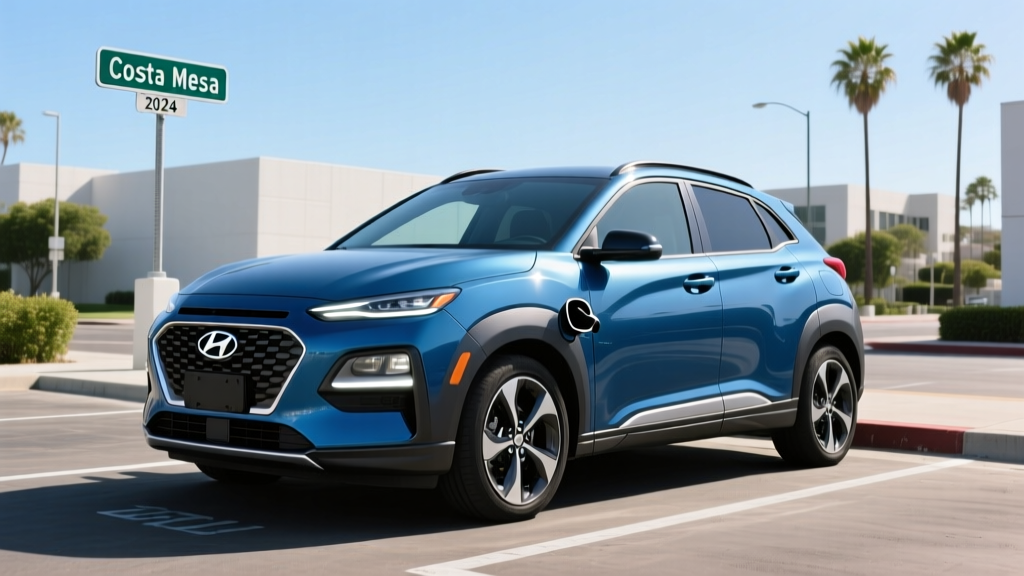
Quick Verdict: Is Leasing the Kona Electric in Costa Mesa a Smart Move?
The 2024 Hyundai Kona Electric (Long Range) starts at $32,675 MSRP and carries an EPA-estimated range of 261 miles on a 64.8 kWh battery. For buyers near Costa Mesa, California — where gas prices routinely exceed $5/gallon and sunshine keeps cabin-heating demands low — the Kona Electric is one of the most affordable ways into a modern EV. But the sticker price is only the beginning. Between federal tax credit eligibility (which can knock $7,500 off the effective purchase price when applied as a point-of-sale reduction), Southern California Edison rebates, and dramatically lower fuel and maintenance costs, the five-year ownership math tells a different story than the window sticker alone.
This guide walks through every dollar: purchase or lease cost, charging, insurance, maintenance, depreciation, and the incentives that change the equation. We use real numbers, not marketing promises.
2024 Kona Electric: Key Specs at a Glance
| Spec | Value |
|---|---|
| EPA Range | 261 miles (Long Range, FWD) |
| Battery | 64.8 kWh usable, NMC chemistry |
| DC Fast Charge (peak) | ~100 kW (10–80% in ~43 min) |
| Level 2 AC Charge | 10.9 kW (~29 mi/hr) |
| Motor Output | 201 hp / 188 lb-ft torque |
| 0–60 mph | ~7.4 seconds |
| MPGe (combined) | 105 MPGe |
| Efficiency | 32 kWh/100 mi |
| Base MSRP (SE) | $32,675 |
| SEL Trim | $34,175 |
| Limited Trim | $38,175 |
| Battery Warranty | 10 yr / 100,000 mi |
| Vehicle Warranty | 5 yr / 60,000 mi |
Five-Year Total Cost of Ownership Breakdown
Below is a five-year projection assuming 12,000 miles/year (60,000 miles total), home Level 2 charging at Southern California Edison's residential rate, and California insurance averages. We compare the Kona Electric against a similarly priced gasoline compact SUV (e.g., Honda HR-V AWD at ~$28,000 MSRP, 28 MPG combined).
| Cost Category | Kona Electric (5 yr) | Gas Compact SUV (5 yr) |
|---|---|---|
| Purchase / Lease (net after incentives) | ~$27,500* | ~$28,000 |
| Fuel / Charging | $3,888 | $10,714 |
| Maintenance | $1,200 | $3,500 |
| Insurance | $9,600 | $7,800 |
| Depreciation (est. resale value) | -$12,000 | -$14,500 |
| Total 5-Year Cost | ~$30,188 | ~$35,514 |
*Assumes $7,500 federal credit applied at point of sale, plus estimated $1,000 utility rebate. Actual figures depend on eligibility — see tax credit section below.
The Kona Electric's five-year cost advantage of roughly $5,000–$5,500 comes primarily from fuel and maintenance savings. Insurance erodes some of that gain, which we address in detail below.
Federal Tax Credit: Do You Qualify for the Full $7,500?
The IRS §30D Clean Vehicle Credit can reduce your federal tax liability by up to $7,500 — or, as of 2024 and continuing into current rules, be transferred to the dealer as a point-of-sale reduction, effectively lowering your down payment or monthly lease cost. But eligibility is not automatic. Here's the checklist:
- MSRP Cap: Vehicle must have an MSRP ≤ $55,000 (sedans/wagons) or ≤ $80,000 (SUVs/trucks/vans). The Kona Electric at $32,675–$38,175 clears this easily.
- Buyer Income Cap: Modified AGI must not exceed $150,000 (single), $225,000 (head of household), or $300,000 (married filing jointly).
- Battery Sourcing: $3,750 of the credit requires critical minerals sourced from the U.S. or a free-trade-agreement partner; the other $3,750 requires battery components manufactured or assembled in North America. Sourcing requirements tighten annually.
- Foreign Entity of Concern (FEOC): Vehicles with battery components from a FEOC (e.g., certain Chinese suppliers) after 2024, or critical minerals from a FEOC after 2025, lose credit eligibility.
- Point-of-Sale Transfer: You can elect to transfer the credit to the dealer at purchase, reducing the vehicle price upfront — even if you owe less than $7,500 in taxes. This applies to both purchases and qualifying leases.
- Leasing: Under §30D, the credit technically goes to the lessor (the finance company). Most manufacturers pass it through as a lease incentive, but confirm with your Costa Mesa dealer that it's reflected in the capitalized cost reduction.
For the Kona Electric specifically: Hyundai has confirmed North American battery assembly for the U.S.-built Kona Electric (production shifted to the Ellabell, Georgia plant). This positions the vehicle to qualify for the full $7,500 under current sourcing rules, but always verify at the IRS qualified vehicles list before signing, as eligibility can shift with supply-chain changes.
Charging vs. Gas: The Real Cost Per Mile in Orange County
Southern California Edison's residential EV rate (TOU-D-PRIME or similar) averages roughly $0.16–$0.20/kWh for off-peak overnight charging. At the Kona Electric's efficiency of 32 kWh/100 miles, that works out to:
| Metric | Kona Electric | Gas Compact SUV (28 MPG) |
|---|---|---|
| Energy Cost | $0.18/kWh (off-peak avg) | $5.00/gallon (OC avg) |
| Cost per 100 miles | $5.76 | $17.86 |
| Cost per mile | $0.058 | $0.179 |
| Annual fuel cost (12k mi) | $691 | $2,143 |
| 5-year fuel cost (60k mi) | $3,456 | $10,714 |
Maintenance Savings: Where EVs Quietly Win
The Kona Electric has no engine oil, no transmission fluid, no spark plugs, no timing belt, and no exhaust system. Regenerative braking dramatically reduces brake pad wear — many EV owners report original brake pads at 60,000+ miles.
| Maintenance Item | Gas Vehicle (5 yr / 60k mi) | Kona Electric (5 yr / 60k mi) |
|---|---|---|
| Oil changes (synthetic, every 7,500 mi) | $480 (8 changes) | $0 |
| Transmission fluid | $150 | $0 |
| Brake pads (front + rear) | $600–$900 | $0–$200 (regen preserves) |
| Engine air filter | $100 | $0 |
| Cabin air filter | $150 | $150 |
| Tire rotation / replacement | $1,200 | $1,200 (EVs are heavier; tires wear similarly) |
| Coolant / misc. | $320 | $100 |
| Total Estimated | ~$3,000–$3,500 | ~$1,150–$1,450 |
Over five years, maintenance savings of $1,800–$2,100 are realistic. The Kona Electric's scheduled service is essentially cabin filter swaps, tire rotations, and a brake fluid check every two years.
Insurance: The Cost Most EV Buyers Underestimate
EV insurance premiums run 15–25% higher than comparable gas vehicles. For the Kona Electric in Orange County, expect roughly $160–$180/month ($1,920–$2,160/year) versus $130–$150/month for a gas compact SUV. Over five years, that's an additional $1,500–$1,800 in insurance costs.
Why EVs cost more to insure:
- Higher repair costs: Battery pack damage in a collision can total a vehicle that would otherwise be repairable. Specialized high-voltage training is required for body shops.
- Parts pricing: EV-specific components (power electronics, battery modules) carry premium pricing versus mass-produced ICE parts.
- Vehicle weight: The Kona Electric weighs ~3,700 lbs — heavier than many gas compacts, which can increase collision severity.
- Total-loss frequency: Insurers are still calibrating battery repair-vs-replace thresholds, leading to more conservative (costly) total-loss decisions.
Cost-mitigation tip: Shop quotes from insurers with dedicated EV programs (GEICO, Progressive, State Farm all offer EV-specific policies). Some offer discounts for home-charger installation or low-mileage driving.
California and Local Incentives for Costa Mesa Buyers
Note: State and local incentives vary by jurisdiction, income, and utility provider. Always confirm current availability with official sources.
- Southern California Edison (SCE): Historically offers $1,000–$1,500 rebates for new EV purchases/leases through the Clean Fuel Reward or similar programs. Check SCE's current EV rebate page.
- California Clean Fuel Reward: Up to $1,000 at point of sale (funded by utilities; availability fluctuates).
- Clean Air Vehicle (CAV) Decal: Qualifying EVs may receive HOV lane access stickers through the California DMV, valid through specified expiration dates.
- CARB Clean Cars 4 All (income-based): Low-income residents in certain air districts can receive up to $9,500 toward an EV when scrapping an older vehicle. Costa Mesa falls under the South Coast Air Quality Management District (SCAQMD).
- Local municipal rebates: Some Orange County cities and water districts offer additional incentives for EV + charger bundles. Check with your city's sustainability office.
Combined with the $7,500 federal credit, a qualifying Costa Mesa buyer could stack $8,500–$10,000 in total incentives — bringing the effective Kona Electric SE price down to roughly $22,500–$24,000.
Depreciation: How Well Does the Kona Electric Hold Value?
EV depreciation has been a sore spot. Industry data from Kelley Blue Book and iSeeCars shows EVs losing 45–55% of value over three years, compared to 35–40% for gas vehicles. The Kona Electric is no exception — expect roughly 45–50% depreciation over five years, meaning a $32,675 SE might resell for $16,000–$18,000 at 60,000 miles.
Factors working against EV resale:
- Rapid price cuts on new EVs compress used values (Tesla's 2023–2024 price wars cascaded across all brands).
- Battery degradation concerns, even if largely overblown — modern NMC packs like the Kona's typically retain 85–90% capacity at 100,000 miles.
- Leasing flood: High lease volumes mean a wave of off-lease EVs hitting the used market simultaneously.
Factors working in your favor:
- Hyundai's 10-year/100,000-mile battery warranty transfers to second owners (as a 5-year/60,000-mile warranty), which supports resale confidence.
- California's strong used-EV demand and ZEV mandate keep the floor higher than in other states.
- If you lease rather than buy, depreciation risk transfers entirely to the lessor — a strong argument for leasing in today's volatile EV resale market.
Lease vs. Buy: Which Makes Sense in Costa Mesa?
For the 2024 Kona Electric specifically, leasing has compelling advantages:
- Depreciation protection: You return the car at lease-end and walk away. If EV values crater further, it's the lessor's problem.
- Point-of-sale credit: The $7,500 federal credit can be applied as a capitalized cost reduction on many Hyundai leases (confirm with dealer — structuring varies).
- Lower monthly commitment: A Kona Electric lease in Orange County typically runs $250–$350/month with $2,000–$3,500 due at signing (36 months / 10k–12k mi/yr), depending on trim and incentives.
- Upgrade flexibility: Battery tech and charging infrastructure improve rapidly; a 36-month lease lets you reassess in 2027.
Buy if: You plan to keep the car 7+ years, drive well over 12,000 miles/year (lease overage penalties are steep at $0.20–$0.25/mile), or want to maximize long-term savings after the vehicle is paid off.
Frequently Asked Questions
How much does it really cost to own a Kona Electric over 5 years?
Approximately $30,000–$32,000 total (including net purchase price after incentives, charging, insurance, maintenance, and depreciation) for 60,000 miles of driving. That's roughly $5,000 less than a comparable gas compact SUV, with the savings coming from fuel and maintenance — partially offset by higher insurance.
Does the 2024 Kona Electric qualify for the full $7,500 federal tax credit?
It is positioned to qualify, as Hyundai manufactures the U.S.-market Kona Electric in Georgia with North American battery assembly. However, your personal eligibility depends on income caps ($150k single / $300k joint), and the vehicle must appear on the current IRS qualified vehicle list. Always verify before signing.
How much do I save on fuel and maintenance versus a gas car?
In Orange County with $5/gallon gas and $0.18/kWh off-peak electricity, you'll save roughly $7,250 on fuel and $1,800 on maintenance over five years / 60,000 miles — about $9,000 total in operational savings.
Are EVs more expensive to insure?
Yes, typically 15–25% more. For the Kona Electric in Costa Mesa, budget an extra $1,500–$1,800 over five years compared to a gas compact SUV. Higher repair costs and battery-replacement risk drive the premium.
How well do EVs hold their value?
EVs depreciate faster than gas vehicles — roughly 45–50% over five years for the Kona Electric versus 35–40% for gas compacts. This is a key reason leasing can be the smarter financial move: you transfer that depreciation risk to the lessor.
Can I charge the Kona Electric at Tesla Superchargers?
The 2024 Kona Electric uses a CCS1 connector, not NACS. Hyundai has announced NACS adoption for future models, and CCS-to-NACS adapters are becoming available. As of now, you'll primarily use Electrify America, EVgo, ChargePoint, and other CCS-compatible networks — which are well-represented throughout Orange County.
Sources: EPA fuel economy data via fueleconomy.gov, IRS §30D rules via irs.gov, Hyundai Motor America specifications.