The subcompact electric crossover segment is crowded, but the Hyundai Kona Electric continues to carve out a distinct niche: practical daily range, a surprisingly well-finished cabin for its price point, and one of the longest battery warranties in the business. For 2026, the Kona Electric carries over the redesign that debuted for the 2024 model year — a larger, more refined vehicle that fixed most of the original generation's compromises. This review focuses on what buyers actually need to know: the real-world usability of the Hyundai Kona Electric interior, how far it actually goes on a charge, how fast it charges, and whether the math works after federal tax credits.
Hyundai Kona Electric Interior: Space, Materials, and Daily Livability
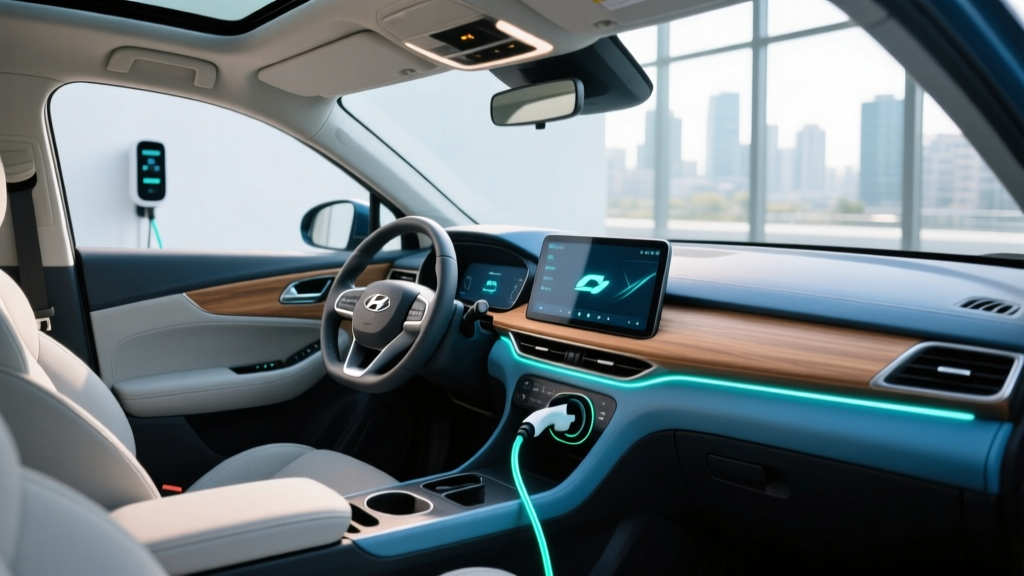
The keyword that brought you here deserves a thorough answer. The current-generation Kona Electric interior represents a significant step up from the first-generation car, which felt tight in the back seat and cheap in places. Hyundai stretched the wheelbase by roughly 2.4 inches for this generation, and that space shows up where it matters most: rear legroom and cargo volume.
Up front, the dual 12.3-inch panoramic display dominates the dash — one for the digital instrument cluster, one for infotainment running Hyundai's latest software. The center stack uses a mix of soft-touch materials and harder plastics, which is expected at this price point. Physical buttons for climate control and a rotary shift dial on the center console keep the interface intuitive. Wireless Apple CarPlay and Android Auto are standard across all trims, and the available head-up display projects speed and navigation cues onto the windshield.
In the back, legroom measures 38.2 inches — enough for adults on longer trips, a rarity in the subcompact crossover class. Headroom is generous thanks to the relatively flat roofline. Three-across seating is tight for adults but works for children. Rear USB-C ports and dedicated air vents are present on SEL and above.
Cargo space is a Kona Electric strong suit: 25.5 cubic feet behind the rear seats and 63.7 cubic feet with the 60/40 split rear seats folded. That's competitive with the Chevrolet Equinox EV and comfortably ahead of the older Nissan Leaf. There is no front trunk (frunk), which is a missed opportunity for stowing charging cables.
- No frunk for cable storage or small items
- Rear visibility is compromised by thick C-pillars — the surround-view camera (SEL and above) helps significantly
- Base SE trim uses cloth seats and lacks heated front seats, which most buyers will want in cold climates
- Infotainment is responsive but the menu hierarchy takes a few weeks to internalize
Range, Battery, and Efficiency: The Numbers That Matter
The Kona Electric is powered by a 64.8 kWh lithium-ion NMC (nickel manganese cobalt) battery pack. Hyundai does not offer an LFP (lithium iron phosphate) variant, which means you get higher energy density but should follow the typical 80% daily charge recommendation to maximize long-term battery health.
The EPA rates the front-wheel-drive Kona Electric at 261 miles of combined range on the SEL and Limited trims (18-inch wheels). The base SE trim, equipped with 17-inch wheels and lower rolling resistance, achieves 261 miles as well for the current model year.
EPA Estimate: 261 miles (combined)
Expect in practice: ~230–245 miles on mixed highway driving at 70 mph. In cold weather (below 30°F), plan for 185–210 miles depending on cabin heat usage. City driving with regenerative braking can exceed the EPA estimate, reaching 270+ miles in mild conditions.
The Kona Electric's heat pump (standard on SEL and above) mitigates cold-weather range loss compared to EVs without one, but physics still applies — expect 20–30% range reduction in deep winter.
Efficiency is rated at 129 MPGe combined (131 city / 125 highway), which translates to roughly 26 kWh per 100 miles. That's competitive with the segment and means home charging costs are low — roughly $0.04 per mile at the national average electricity rate of $0.16/kWh.
| Spec | Value |
|---|---|
| EPA Range | 261 miles (combined) |
| Battery Capacity | 64.8 kWh (NMC chemistry) |
| Efficiency | 129 MPGe / 26 kWh/100mi |
| Drivetrain | Front-wheel drive (single motor) |
| Horsepower | 201 hp / 188 lb-ft torque |
| 0–60 mph | ~7.4 seconds |
| Max DC Fast Charge | ~100 kW (peak) |
| 10–80% DCFC Time | ~43 minutes |
| Level 2 Charge Rate | 10.9 kW (~37 miles/hr) |
| Cargo Volume | 25.5 cu ft (rear up) / 63.7 cu ft (rear folded) |
| Rear Legroom | 38.2 inches |
| Battery Warranty | 10 years / 100,000 miles |
| Base MSRP | ~$32,975 (SE, incl. destination) |
Source: EPA Fuel Economy, Hyundai Motor America specifications.
Charging Speed: DC Fast Charging and Home Level 2
Charging speed is where the Kona Electric shows its most obvious generational limitation. The peak DC fast-charge rate is approximately 100 kW, which means a 10–80% session takes roughly 43 minutes at a compatible station. That's noticeably slower than the Hyundai Ioniq 5 (which peaks at ~240 kW on 800V architecture) and trails competitors like the Chevrolet Equinox EV. On a road trip, you'll spend more time at chargers than you would in a faster-charging EV.
The charge curve is relatively flat through the mid-range, but tapers sharply above 80% SoC. For road-trip efficiency, plan your stops to charge from roughly 10% to 75–80%, then move on.
At home on a Level 2 (240V) charger, the onboard charger accepts up to 10.9 kW, adding roughly 37 miles of range per hour. A full overnight charge from 10% to 100% takes about 7 hours on a 48-amp Level 2 station — easily accomplished while you sleep.
| Charging Level | Power (kW) | Miles Added per Hour | Typical Use Case |
|---|---|---|---|
| Level 1 (120V) | ~1.4 kW | ~5 mi/hr | Emergency/top-off only |
| Level 2 (240V, 48A) | 10.9 kW | ~37 mi/hr | Daily home charging |
| DC Fast Charge | ~100 kW peak | ~150+ mi/hr (peak) | Road trips; 10–80% in ~43 min |
The Kona Electric uses the CCS1 connector for DC fast charging and the J1772 connector for Level 2 AC charging. Hyundai has announced a transition to the NACS (Tesla-style) connector for future models, but the current Kona Electric ships with CCS. Adapters are available for Tesla Supercharger access where networks have opened to non-Tesla vehicles.
Performance and Driving Dynamics
The Kona Electric sends 201 horsepower and 188 lb-ft of torque to the front wheels via a single-speed reduction gear. The 0–60 mph sprint takes approximately 7.4 seconds — adequate for merging and passing, though it won't win stoplight races against the dual-motor EVs in this class.
Driving dynamics are tuned for comfort rather than sportiness. The suspension absorbs city potholes well, and the low center of gravity (from the under-floor battery) keeps body roll controlled through corners. Regenerative braking offers multiple levels adjustable via steering-wheel paddles, including a true one-pedal driving mode (i-Pedal) that brings the car to a complete stop without touching the brake pedal.
There is no all-wheel-drive option. If you need AWD for snow or traction, you'll need to look at the Ioniq 5 or competitors like the Subaru Solterra.
Pricing, Trims, and Federal Tax Credit Eligibility
The 2026 Hyundai Kona Electric is offered in three trims: SE, SEL, and Limited. Pricing starts around $32,975 including destination for the SE and climbs to approximately $41,000 for a fully equipped Limited.
| Trim | MSRP (incl. dest.) | Est. After §30D Credit* | Key Features |
|---|---|---|---|
| SE | ~$32,975 | ~$25,475 | 17" wheels, 12.3" displays, wireless CarPlay/AA |
| SEL | ~$36,475 | ~$28,975 | Heated seats, heat pump, blind-spot monitor, 18" wheels |
| Limited | ~$41,000 | ~$33,500 | Leather, sunroof, HUD, Highway Driving Assist 2 |
*Tax credit estimates assume full $7,500 eligibility. Actual credit depends on individual circumstances.
The Kona Electric's tax credit eligibility depends on several IRS rules that change periodically. As of the current tax year, key requirements include:
- MSRP Cap: Vehicle must be under $80,000 for SUVs/crossovers — the Kona Electric clears this easily
- Buyer Income Cap: Modified AGI must not exceed $150,000 (single) / $300,000 (joint)
- Battery Sourcing: Critical minerals and battery components must meet phased-in domestic content thresholds that tighten annually — check current-year IRS guidance before purchasing
- Point-of-Sale Transfer: Eligible buyers can transfer the credit to the dealer at purchase, reducing the out-of-pocket price immediately
Always verify eligibility with a tax professional and the latest IRS rules before relying on the credit in your purchase decision.
Safety and Driver-Assistance Technology
Hyundai equips the Kona Electric with its SmartSense suite as standard equipment across all trims. This includes forward collision-avoidance assist with pedestrian detection, lane-keeping assist, blind-spot collision warning, rear cross-traffic collision-avoidance, and driver attention warning.
The SEL and Limited trims add Highway Driving Assist (HDA), which combines adaptive cruise control with lane-centering for semi-automated highway driving. The Limited trim's HDA 2 adds lane-change assist. These are SAE Level 2 driver-assistance systems — the driver must remain fully engaged with hands on the wheel and eyes on the road at all times. This is not autonomous driving.
The Kona Electric earned top marks from the IIHS, and Hyundai's suite of standard active safety features is among the most comprehensive in the subcompact crossover segment regardless of powertrain.
How the Kona Electric Stacks Up Against Key Competitors
The Kona Electric competes in a tight segment. Here's how it compares on the metrics that matter most:
| Spec | Hyundai Kona Electric | Chevy Equinox EV | Volvo EX30 |
|---|---|---|---|
| EPA Range | 261 mi | ~319 mi | ~265 mi |
| Peak DC Charge | ~100 kW | ~150 kW | ~153 kW |
| 10–80% Time | ~43 min | ~30 min | ~27 min |
| Base MSRP | ~$32,975 | ~$33,000 | ~$36,000 |
| Cargo (rear up) | 25.5 cu ft | 26.4 cu ft | 16.5 cu ft |
| Battery Warranty | 10 yr / 100k mi | 8 yr / 100k mi | 8 yr / 100k mi |
Choose the Kona Electric if: You prioritize a well-finished interior with strong cargo space, value the 10-year battery warranty, commute under 50 miles round-trip, and want a proven package under $35,000 before incentives.
Look elsewhere if: You take frequent road trips over 200 miles (the ~100 kW charging speed and 43-minute 10–80% time will frustrate), need AWD for harsh winters, or want maximum range per dollar (the Equinox EV offers ~58 more miles for similar money).
Pros and Cons at a Glance
- Spacious, well-finished interior for the price class
- 25.5 cu ft cargo with competitive rear legroom (38.2")
- Industry-leading 10-year/100,000-mile battery warranty
- Strong standard safety suite (SmartSense) on all trims
- Heat pump standard on SEL+ reduces winter range loss
- Comfortable ride quality and effective one-pedal driving
- DC fast charging limited to ~100 kW (43 min 10–80%)
- No AWD option available
- No frunk for cable storage
- Base SE trim skimps on comfort features
- 261-mile range trails the Equinox EV by ~58 miles
- Thick C-pillars compromise rear visibility
Who Should Buy the Hyundai Kona Electric?
The Kona Electric is best suited as a daily commuter and urban/suburban runabout. If your typical day involves 30–60 miles of mixed driving with access to home Level 2 charging, the Kona Electric will rarely require a public charger. The comfortable ride, generous cargo space, and strong efficiency make it an excellent single-vehicle solution for couples or small families who don't regularly drive more than 200 miles in a day.
It is not ideal for frequent long-distance road trippers (slow DC charging adds significant stop time), those in heavy snow-belt regions who need AWD, or buyers who prioritize maximum range per dollar above all else. For those use cases, the Hyundai Ioniq 5, Chevrolet Equinox EV, or a plug-in hybrid may serve better.
Frequently Asked Questions
What is the real-world range of the Hyundai Kona Electric?
The EPA rates the Kona Electric at 261 miles combined. In real-world highway driving at 70 mph, expect roughly 230–245 miles. In cold weather below 30°F, range drops to approximately 185–210 miles depending on cabin heat usage and whether the heat pump is active (standard on SEL and above). City driving with regenerative braking can push past 270 miles in mild conditions.
How fast does the Kona Electric charge?
On a DC fast charger, the Kona Electric peaks at approximately 100 kW, completing a 10–80% charge in about 43 minutes. At home on a Level 2 (240V, 48A) charger, it accepts up to 10.9 kW, adding roughly 37 miles of range per hour — a full overnight charge takes about 7 hours. Level 1 (120V) charging adds only about 5 miles per hour and is practical only for emergency top-offs.
Does the Hyundai Kona Electric qualify for the federal EV tax credit?
The Kona Electric's MSRP is well under the $80,000 SUV cap, which is one requirement. However, full $7,500 credit eligibility depends on current-year battery sourcing and critical mineral rules under IRS §30D, as well as buyer income limits ($150,000 single / $300,000 joint MAGI). Battery component and mineral sourcing thresholds tighten annually — verify with a tax professional and the IRS before purchasing. If eligible, the credit can be transferred to the dealer at point of sale to reduce your purchase price immediately.
Is the Kona Electric worth buying vs. the Chevrolet Equinox EV?
It depends on your priorities. The Equinox EV offers ~319 miles of range and faster DC charging (~150 kW) for a similar starting price, making it the better choice for road-trip-heavy buyers. The Kona Electric counters with a more refined interior feel, significantly more cargo space (25.5 vs. 26.4 cu ft — close, but Kona's layout is more usable), Hyundai's superior 10-year battery warranty, and a more mature infotainment system. For pure commuters who rarely exceed 200 miles, the Kona Electric's interior quality and warranty edge it ahead.
Does the Kona Electric have a heat pump?
Yes, a heat pump is standard on the SEL and Limited trims but not on the base SE. The heat pump significantly reduces winter range loss by efficiently heating the cabin without drawing as much energy from the traction battery. If you live in a climate with cold winters, the SEL trim's heat pump alone justifies the price premium over the SE.
What is the Hyundai Kona Electric battery warranty?
Hyundai covers the Kona Electric's high-voltage battery for 10 years or 100,000 miles, whichever comes first. This is one of the longest battery warranties in the EV industry and covers defects and excessive capacity loss (typically defined as dropping below 70% state of health). The basic vehicle warranty is 5 years / 60,000 miles.