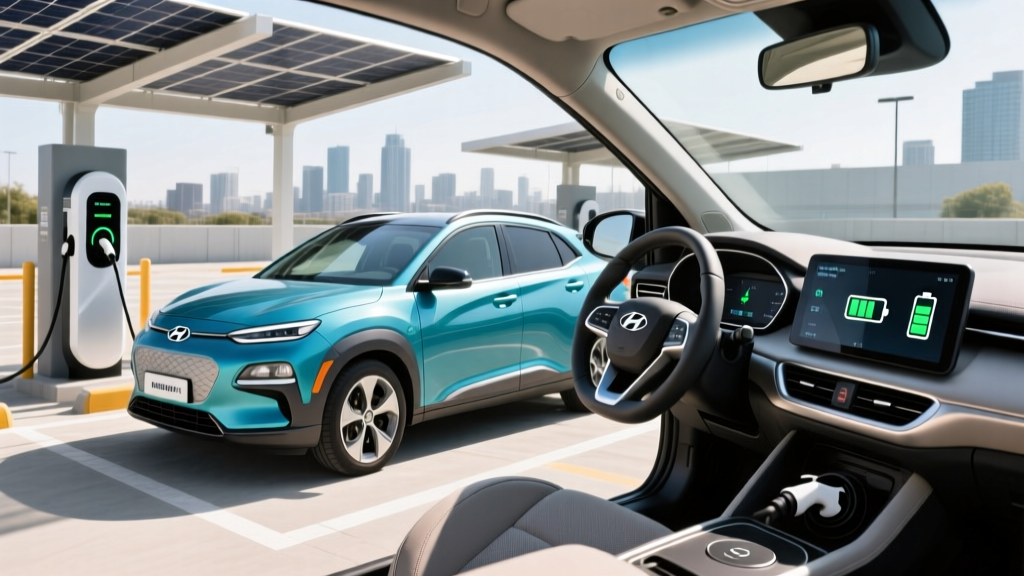
The 2026 Hyundai Kona Electric sits at a rare intersection in the EV market: a sub-$35,000 crossover with over 250 miles of EPA range, DC fast charging, and a practical footprint. But sticker price tells only a fraction of the ownership story. If you're researching Hyundai Kona Electric finance options, you need to see the full five-year picture — from federal tax credit eligibility to the real cost-per-mile of charging versus gasoline, plus the insurance and depreciation factors that catch many first-time EV buyers off guard.
This guide runs the numbers on the 2026 Kona Electric (SEL trim and up) using current EPA data, IRS §30D rules, and real-world ownership variables. Every figure is sourced, and every caveat is named.
2026 Hyundai Kona Electric: The Numbers That Matter
Before we model ownership costs, here's the spec foundation. The 2026 Kona Electric carries over the second-generation platform introduced for 2024, with a 64.8 kWh (usable) NMC lithium-ion battery and a front-mounted permanent-magnet synchronous motor.
| Spec | Value |
|---|---|
| EPA Range | 261 miles (SEL/Convenience); 238 miles (Limited AWD est.) |
| Real-World Range Expectation | ~220–240 mi highway; ~185–200 mi in sub-30°F cold |
| Battery (Usable) | 64.8 kWh, NMC chemistry |
| Motor Output | 201 hp / 188 lb-ft torque (FWD) |
| 0–60 mph | ~7.4 seconds |
| DC Fast Charge (Peak) | ~100 kW (10–80% in ~43 min) |
| Level 2 Charge Rate | 11 kW onboard charger (~6.5 hrs 0–100%) |
| Efficiency | 129 MPGe combined (per fueleconomy.gov) |
| Battery/Powertrain Warranty | 10 years / 100,000 miles |
| Base MSRP (SEL) | ~$34,175 (incl. destination) |
Federal Tax Credit: Does the Kona Electric Qualify Under §30D?
The federal EV tax credit under IRS §30D offers up to $7,500 for qualifying new EVs — but "up to" is the operative phrase. Eligibility depends on a matrix of buyer income, vehicle MSRP, battery-component sourcing, and critical-mineral requirements. Here's how the 2026 Kona Electric maps to current rules:
- MSRP Cap: Vehicle MSRP must not exceed $80,000 for SUVs/trucks, $55,000 for sedans/vans. The Kona Electric (classified as a small SUV) qualifies at ~$34,175–$39,000 MSRP. ✅
- Buyer Income Cap: Modified AGI must not exceed $150,000 (single), $225,000 (head of household), or $300,000 (married filing jointly). ✅ if within limits.
- Battery Component Sourcing: Battery components must be manufactured or assembled in North America to qualify for the $3,750 half. Hyundai sources Kona Electric battery packs from suppliers with varying North American content — check the latest IRS eligible vehicle list before purchasing, as sourcing rules tighten annually.
- Critical Minerals: A percentage of critical minerals must be sourced from the U.S. or a free-trade-agreement country for the other $3,750 half. This threshold increases each year.
- Point-of-Sale Transfer: Since 2024, you can transfer the credit to the dealer at purchase, reducing your out-of-pocket cost immediately rather than waiting for a tax refund. This effectively lowers your financed amount.
- Cannot be claimed as refundable credit if you have zero tax liability.
Bottom line for Kona Electric finance: If you meet income requirements and the vehicle's battery sourcing qualifies at time of purchase, you could receive the full $7,500 as a point-of-sale reduction. That drops a $34,175 SEL to an effective $26,675 before any state incentives — a significant shift in the finance calculation. However, battery-sourcing rules are subject to change, and not every Kona Electric configuration may qualify for the full amount in every model year. Always verify on the IRS qualified vehicles page before signing.
5-Year Total Cost of Ownership Breakdown
Here's what five years and 75,000 miles actually costs with the Kona Electric versus a comparable gas-powered subcompact SUV (we'll use the Hyundai Tucson Gas 2.5L FWD at ~$30,000 MSRP and 29 MPG combined as the baseline).
| Category | Kona Electric (SEL) | Gas SUV Baseline |
|---|---|---|
| Purchase Price (after $7,500 credit) | $26,675 | $30,000 |
| Fuel / Energy (75,000 mi) | $4,688 (at $0.14/kWh avg, 3.5 mi/kWh) | $9,052 (at $3.50/gal, 29 MPG) |
| Maintenance | $1,800 | $3,750 |
| Insurance (5-year total) | $9,750 (~$1,950/yr avg) | $7,500 (~$1,500/yr avg) |
| Depreciation (est.) | $10,670 (~40% of net cost) | $12,000 (~40%) |
| Total 5-Year Cost | $53,583 | $62,302 |
Charging vs. Gasoline: The Per-Mile Math
The Kona Electric's efficiency is roughly 3.5 miles per kWh (derived from its 129 MPGe combined rating). At the national average residential electricity rate of ~$0.16/kWh (EIA 2025 data), that works out to:
| Scenario | $/kWh or $/gal | Cost Per Mile |
|---|---|---|
| Home charging (national avg) | $0.16/kWh | $0.046/mi |
| Home charging (off-peak utility rate) | $0.09/kWh | $0.026/mi |
| Public DC fast charging (avg) | $0.35/kWh | $0.10/mi |
| Gas SUV (29 MPG combined) | $3.50/gal | $0.121/mi |
At home rates, the Kona Electric costs roughly 60–65% less per mile than the gas baseline. But if you rely exclusively on public DC fast chargers at $0.35/kWh, the per-mile cost nearly matches gasoline. This is why home charging access is the single largest financial variable in EV ownership. If you can install a Level 2 charger and use time-of-use utility rates, the savings compound dramatically over five years.
Maintenance Savings: Where the Kona Electric Wins Quietly
EVs don't eliminate maintenance — they reshape it. The Kona Electric has no engine oil, no spark plugs, no timing belt, no exhaust system, and no traditional multi-speed transmission. But it still needs cabin air filters, brake fluid checks, coolant top-offs, wiper blades, and tire rotations (EVs tend to wear tires faster due to instant torque and heavier curb weight).
| Service Item | Kona Electric | Gas SUV |
|---|---|---|
| Oil Changes | $0 | ~$600 (15 changes at $40) |
| Brake Pads | $0–$200 (regen extends life to 80k+ mi) | $600–$900 (2 sets) |
| Transmission Fluid | $0 | $150–$250 |
| Air Filters / Cabin Filters | $200 | $300 |
| Tire Rotation & Replacement | $1,200 (may need 1 extra set) | $1,000 |
| Coolant / Misc. | $200 | $300 |
| Total | ~$1,800 | ~$3,750 |
The regenerative braking system is the unsung hero here. By using the electric motor to decelerate, regen drastically reduces friction brake wear. Many Kona Electric owners report original brake pads at 60,000+ miles — a figure nearly unheard of in gas vehicles.
Insurance Reality: The Cost EV Buyers Underestimate
Here's where the honesty mandate kicks in: EVs typically cost 15–25% more to insure than comparable gas vehicles. The reasons are structural, not arbitrary:
- Higher repair costs: EV battery packs and power electronics are expensive to replace after collision damage. Even minor rear-end impacts can trigger battery-safety inspections costing thousands.
- Specialized labor: Fewer body shops have high-voltage-certified technicians, which drives up labor rates for EV repairs.
- Vehicle MSRP: The Kona Electric's pre-credit MSRP is higher than some gas subcompacts, and insurers base premiums on replacement cost, not your post-credit price.
- Total-loss thresholds: Battery damage can push a repair estimate past the total-loss threshold more easily than with a gas powertrain.
For the Kona Electric, expect average annual premiums of $1,800–$2,100 depending on your state, driving record, and coverage level — compared to $1,400–$1,600 for a gas Tucson. That's roughly $2,250 more over five years. Always run quotes from your insurer before purchasing; the gap varies significantly by carrier, and some (like GEICO and Progressive) have narrowed their EV surcharges.
Depreciation & Resale Value: The EV Market Shift
EV depreciation has been volatile since 2022, when a wave of Tesla price cuts and new model launches compressed used-EV values across the board. According to data from sources like iSeeCars and Kelley Blue Book, mainstream EVs depreciated 40–50% over three years between 2023–2025 — steeper than the 30–35% average for gas vehicles.
However, the Kona Electric has some depreciation tailwinds:
- Affordable entry price: Sub-$35K EVs hold appeal in the used market because buyers in that segment are price-sensitive and want low running costs.
- Hyundai's 10-year battery warranty: Transferable to second owners (with some limitations), which supports resale confidence.
- NACS transition: Hyundai has committed to adopting the NACS (Tesla-style) charging port for future models. The 2026 Kona Electric still uses CCS1, which may slightly affect long-term resale as the Supercharger network becomes NACS-dominant — though adapters mitigate this.
Expect the Kona Electric to retain roughly 55–60% of its net purchase price after five years (post-credit), translating to ~$10,670 in depreciation on a $26,675 net cost. If the federal credit is not available at purchase, depreciation in dollar terms will be higher because the starting basis is larger.
State, Local & Utility Incentives: The Stacked Savings
- California: Up to $2,000 via the Clean Fuel Rebate (income-dependent), plus potential CVRP rebate for lower-income buyers.
- Colorado: State tax credit of up to $5,000 for EVs under $80,000 MSRP (stackable with federal).
- Massachusetts: MOR-EV rebate of up to $3,500 (income-tiered).
- Utility rebates: Many utilities (e.g., PG&E, ConEdison, Xcel Energy) offer $500–$1,500 rebates for Level 2 home charger installation, plus time-of-use rate plans that reduce charging cost to $0.07–$0.10/kWh overnight.
- HOV lane access: Several states grant single-occupant HOV lane access for EVs — a non-monetary but high-value perk in congested metro areas.
If you stack the $7,500 federal credit with a $2,000 state rebate and a $1,000 utility charger incentive, the effective purchase price of a Kona Electric SEL could drop to $23,675 — territory that makes the finance math overwhelmingly favorable even with higher insurance costs.
Financing the Kona Electric: Practical Considerations
A few finance-specific notes for the Kona Electric:
- Point-of-sale credit transfer: If you transfer the §30D credit to the dealer, it reduces the amount you finance. On a $34,175 SEL with $7,500 transferred, your loan principal starts at $26,675 (plus taxes and fees, which vary by state — some states tax the pre-credit amount).
- Hyundai Motor Finance rates: Hyundai frequently offers promotional APRs (e.g., 1.9%–3.9% for 60 months) on EV models to drive adoption. Compare against your bank or credit union.
- Lease considerations: If you lease, the §30D credit technically goes to the lessor (Hyundai), but many manufacturers pass it through as a "lease cash" reduction. Hyundai has historically done this — verify current lease terms.
- Gap insurance: Given EV depreciation volatility, consider gap coverage if financing with a low down payment. If the vehicle is totaled, gap insurance covers the difference between the insurance payout and your remaining loan balance.
Frequently Asked Questions
How much does it really cost to own a Hyundai Kona Electric over 5 years?
With the full $7,500 federal tax credit and home charging, the 5-year/75,000-mile total cost of ownership is approximately $53,500. Without the credit, it rises to roughly $61,000. The major variables are tax credit eligibility, electricity rates, insurance premiums in your state, and whether you rely on home or public charging.
Do I qualify for the $7,500 federal EV tax credit on the Kona Electric?
You may, if your modified adjusted gross income is under $150K (single) / $300K (married filing jointly), and the specific vehicle's battery meets North American component-sourcing and critical-mineral thresholds. The Kona Electric's MSRP is well under the $80,000 SUV cap. Check the IRS eligible vehicle list for the specific build date and battery configuration, as eligibility can vary by production batch.
How much do I save on fuel and maintenance versus a gas car?
Over 75,000 miles, expect roughly $4,300 in fuel savings (home charging at national average rates vs. gas at $3.50/gal and 29 MPG) and approximately $1,950 in maintenance savings. Combined, that's about $6,250 — though fuel savings shrink if you rely heavily on expensive public DC fast charging.
Are EVs more expensive to insure than gas cars?
Yes, typically 15–25% more for the Kona Electric versus a comparable gas SUV. This is driven by higher repair costs for battery and power electronics damage, fewer certified repair shops, and the vehicle's pre-credit MSRP. Budget an extra $350–$500 per year for insurance.
How well does the Kona Electric hold its resale value?
Expect roughly 55–60% value retention after five years on a net-of-credit basis. EV depreciation has been steeper than gas vehicles in recent years due to rapid technology advances and price competition, but the Kona Electric's affordable price point and Hyundai's 10-year battery warranty provide some floor. The CCS-to-NACS charging transition may introduce modest uncertainty for long-term resale.
What happens to the battery warranty if I sell the car?
Hyundai's 10-year/100,000-mile battery warranty is partially transferable to second owners, typically covering 8 years/100,000 miles from the original in-service date for subsequent owners. This supports resale value but verify the exact transfer terms in your purchase documentation.