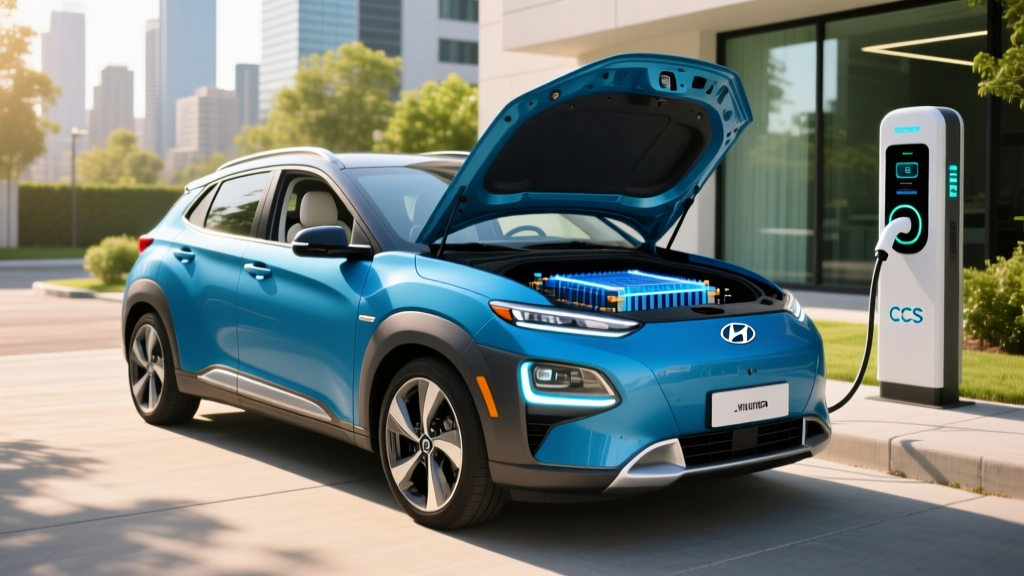
The subcompact electric crossover segment has matured fast, and the Hyundai Kona Electric remains one of its most practical anchors. Redesigned for the 2024 model year on Hyundai's K3 architecture, the Kona Electric enters 2026 with the same 64.8 kWh battery, NACS port availability, and a starting price that undercuts several rivals while delivering competitive range. But specs on paper only tell half the story — what matters is how this EV performs on real highways, at real chargers, and in real winter conditions.
We've spent time with the Kona Electric across multiple drives and charging sessions to bring you the numbers that actually matter: sustained charge rates, highway efficiency at 75 mph, cold-weather range loss, and whether the §30D federal tax credit applies to your purchase. Here's the complete picture.
2026 Kona Electric at a Glance: Key Specs
| Spec | Value |
|---|---|
| EPA Range (SEL / Limited) | 261 miles |
| Battery Capacity (usable) | 64.8 kWh, NMC chemistry |
| Motor Output | 201 hp / 188 lb-ft torque |
| Drivetrain | Front-wheel drive (single motor) |
| 0–60 mph | ~7.0 seconds |
| EPA Efficiency | 129 MPGe city / 103 MPGe hwy / 116 MPGe combined |
| Energy Consumption | 29 kWh / 100 mi |
| Max DC Fast Charge | ~100 kW peak |
| 10–80% DC Charge Time | ~43 minutes |
| Level 2 Home Charging | 10.9 kW (approx. 35 mi/hr) |
| Cargo Volume (rear seats up / down) | 25.5 cu ft / 63.7 cu ft |
| Rear Legroom | 38.2 inches |
| Battery Warranty | 10 years / 100,000 miles |
| Base MSRP (SE) | $34,975 (incl. destination) |
Real-World Range: What the EPA Number Doesn't Tell You
The EPA rates the 2026 Kona Electric at 261 miles for the SEL and Limited trims, and 200 miles for the base SE trim (which uses a smaller 48.6 kWh battery). These are solid numbers for the subcompact crossover class, but EPA estimates assume a mix of city and highway driving at moderate temperatures. Your actual experience will vary.
EPA Sticker: 261 miles (SEL/Limited, 64.8 kWh)
City/Suburban Driving (65°F): ~265–280 miles — the Kona's regenerative braking recovers energy efficiently in stop-and-go traffic, sometimes exceeding the EPA estimate.
Highway Driving (75 mph sustained): ~215–230 miles — aerodynamic drag hits every EV hard at speed, and the Kona's bluff-front crossover profile is no exception.
Cold Weather (20°F, highway): ~170–195 miles — expect 25–35% range reduction in freezing temps, especially if using cabin heat without preconditioning. The Kona Electric offers a heat pump on Limited trims, which mitigates some loss.
Mountain/Terrain: Highly variable — steep climbs consume heavily, but regen on descents recovers a meaningful percentage.
The Kona Electric's efficiency of 29 kWh per 100 miles (combined) is respectable but not class-leading. The Chevrolet Bolt EUV, for instance, achieves 28 kWh/100 mi with a slightly smaller battery. In practice, the Kona's thermal management system does a competent job keeping the battery in its optimal temperature window, but it doesn't have the aggressive preconditioning routines you'll find in a Hyundai Ioniq 5 or Tesla Model Y.
Charging Speeds: DC Fast, Level 2, and What to Expect
Charging capability is where the Kona Electric draws its clearest line against competitors. It's adequate for daily needs and moderate road trips, but it won't win any fast-charging drag races.
| Charging Level | Power (kW) | Speed | Best Use Case |
|---|---|---|---|
| Level 1 (120V household) | ~1.4 kW | ~4–5 mi/hr | Overnight top-up, emergency |
| Level 2 (240V home/public) | 10.9 kW | ~35 mi/hr (full charge ~7 hr) | Daily home charging |
| DC Fast Charge | ~100 kW peak | 10–80% in ~43 min | Road trips, quick top-ups |
The DC fast-charging reality: The Kona Electric peaks around 100 kW on a capable DC fast charger, but like most EVs, it doesn't sustain peak rate for the entire session. The charge curve holds strongest between 10% and 55% state of charge (SoC), then tapers progressively. From 80% to 100%, expect very slow charging — this is normal battery-protection behavior, but it means you should plan road-trip stops to charge only to 80% and keep moving.
For the 2026 model year, Hyundai has made the NACS (Tesla-style) charge port available alongside the legacy CCS1 port. This is a significant advantage: NACS-equipped Kona Electrics can access Tesla Supercharger stations (now open to non-Tesla EVs via the NACS standard), dramatically expanding your fast-charging network on road trips. If you're ordering new, NACS is the recommended choice.
At home on a Level 2 charger (240V, 48A circuit recommended), the Kona's 10.9 kW onboard charger replenishes the 64.8 kWh battery from empty in roughly 7 hours. A typical overnight session from 30% to 80% takes about 3–3.5 hours — more than enough for any daily commute pattern. Installation of a Level 2 home charger typically runs $500–$2,000 depending on your electrical panel's capacity and the run length from panel to garage. Always get a quote from a licensed electrician before committing.
Performance and Driving Impressions
The Kona Electric's single front-mounted motor produces 201 horsepower and 188 lb-ft of torque, sending power exclusively to the front wheels. The 0–60 mph sprint clocks in at approximately 7.0 seconds — quick enough for confident highway merging and passing, if not exactly thrilling.
Where the Kona Electric shines is in daily drivability. Instant torque from a standstill makes it feel peppier than the 0–60 number suggests in city driving. The steering is light and predictable, the ride quality is firm but well-damped over rough pavement, and the cabin remains quiet at speed — a benefit of the lack of engine noise and Hyundai's sound-deadening efforts.
Regenerative braking offers multiple levels, adjustable via steering-wheel paddles. Level 3 provides strong enough deceleration for near one-pedal driving in most city scenarios, though it doesn't quite bring the car to a complete hold without touching the brake pedal — Hyundai stops short of full one-pedal mode.
What it doesn't do: There is no AWD option. If you live in heavy snow country and want all-wheel drive in an EV at this price point, you'll need to look at the Kia EV6 (AWD available, though at higher cost) or a used Tesla Model Y Dual Motor. The Kona Electric also has no towing rating — it's not designed to pull a trailer.
Pricing, Trims, and Federal Tax Credit Eligibility
Hyundai offers the 2026 Kona Electric in three trims. Pricing includes the mandatory destination charge:
| Trim | MSRP (incl. destination) | Battery | EPA Range |
|---|---|---|---|
| SE | $34,975 | 48.6 kWh | 200 miles |
| SEL | $38,475 | 64.8 kWh | 261 miles |
| Limited | $41,475 | 64.8 kWh | 261 miles |
Does the Kona Electric Qualify for the Federal EV Tax Credit?
Under current IRS §30D rules, the Kona Electric's eligibility for the up-to-$7,500 federal tax credit depends on several factors that shift with battery sourcing and assembly requirements. As of 2026, the critical criteria include:
- MSRP Cap: The vehicle must have an MSRP at or below $55,000 for SUVs/crossovers. All Kona Electric trims clear this threshold.
- Buyer Income Limits: Modified adjusted gross income (MAGI) must not exceed $150,000 (single), $225,000 (head of household), or $300,000 (joint filing).
- Battery Sourcing: A percentage of critical minerals must be sourced from the U.S. or free-trade-agreement countries, and battery components must meet North American manufacturing thresholds. These percentages increase annually, and eligibility can change mid-year.
- Point-of-Sale Transfer: If eligible, you can transfer the credit to the dealer at purchase, reducing your out-of-pocket cost immediately rather than waiting to claim it on your tax return.
Because battery-sourcing rules tighten each year and Hyundai's supply chain evolves, we strongly recommend checking the fueleconomy.gov tax credit database and consulting a tax professional before relying on the credit. The SEL and Limited trims at $38,475–$41,475 represent the strongest value when the credit applies, bringing effective cost into the low-to-mid $30,000s.
Interior, Tech, and Daily Livability
The redesigned Kona Electric's cabin is a meaningful step up from the previous generation. A dual 12.3-inch display setup (digital cluster + infotainment) dominates the dashboard, running Hyundai's latest infotainment software with wireless Apple CarPlay and Android Auto. The center console includes physical knobs for climate control — a welcome ergonomic choice that many competitors have abandoned for touchscreen-only interfaces.
Cargo and passenger space: With 25.5 cubic feet behind the rear seats and 63.7 cubic feet with the rear seats folded, the Kona Electric offers practical cargo volume for its footprint. Rear-seat legroom of 38.2 inches accommodates adults comfortably on shorter trips, though taller passengers may find headroom snug due to the sloping roofline. The frunk (front trunk) is small — roughly 0.9 cu ft — suitable for charging cables but little else.
Driver assistance: Every Kona Electric comes with Hyundai SmartSense, which includes forward collision-avoidance assist with pedestrian detection, lane-keeping assist, blind-spot collision warning, rear cross-traffic collision-avoidance, and highway driving assist (HDA). HDA combines adaptive cruise control with lane-centering on divided highways — it's an SAE Level 2 system, meaning you must keep your hands on the wheel and eyes on the road at all times. It works well for reducing fatigue on long highway stretches but is not autonomous driving.
Notable drawbacks: The Kona Electric's interior uses more hard plastics than rivals like the Volkswagen ID.4, especially on the lower door panels and center console sides. The rear visibility is compromised by thick C-pillars, making the standard rearview camera essential. And while the infotainment system is functional, its response times lag behind the snappier interfaces in Hyundai's own Ioniq 5.
- Competitive 261-mile EPA range at a sub-$39K starting point (SEL)
- NACS port option unlocks Tesla Supercharger network
- 10-year / 100,000-mile battery warranty — best in class
- Physical climate controls and solid infotainment with wireless CarPlay/Android Auto
- Strong standard safety suite (SmartSense) across all trims
- Heat pump on Limited trim improves cold-weather efficiency
- DC fast charging peaks at ~100 kW — slower than Ioniq 5, Model Y, and EV6
- Front-wheel drive only; no AWD option for snow-belt buyers
- Interior hard plastics feel budget-tier in places
- No towing capability
- Rear visibility limited by thick pillars
- SE trim's 200-mile range (48.6 kWh) may feel limiting for road trips
How the Kona Electric Stacks Up Against Key Rivals
The subcompact EV crossover space is competitive. Here's how the Kona Electric compares to its most direct alternatives on the metrics that matter:
| Spec | Hyundai Kona Electric (SEL) | Chevrolet Bolt EUV | Volkswagen ID.4 (Std) | Kia Niro EV |
|---|---|---|---|---|
| EPA Range | 261 mi | 247 mi | 206 mi (std) / 275 mi (Pro S) | 239 mi |
| Battery (usable) | 64.8 kWh | 65 kWh | 62 kWh (std) / 82 kWh (Pro) | 64.8 kWh |
| DC Fast Charge Peak | ~100 kW | ~55 kW (CCS) | ~135 kW (std) / 170 kW (Pro) | ~85 kW |
| 10–80% DC Time | ~43 min | ~55 min | ~30 min (Pro) | ~45 min |
| 0–60 mph | ~7.0 sec | ~7.0 sec | ~7.7 sec (RWD) | ~7.8 sec |
| Starting MSRP | $38,475 (SEL) | ~$28,800 (discontinued, remaining stock) | ~$40,795 | ~$40,975 |
| Battery Warranty | 10 yr / 100k mi | 8 yr / 100k mi | 8 yr / 100k mi | 10 yr / 100k mi |
The takeaway: The Kona Electric occupies a strong middle ground. It offers more range than the base ID.4 at a lower price, charges faster than the Bolt EUV (which has been discontinued but may still appear in remaining dealer stock), and undercuts the Niro EV on price while matching its range. Its main weakness relative to the ID.4 Pro and the Ioniq 5 is DC fast-charge speed — if you road-trip frequently and prioritize 20-minute charging stops, you'll want a vehicle with 150+ kW capability.
Who Should Buy the Kona Electric?
- Commute 40–80 miles round-trip and want a comfortable, efficient daily driver with range to spare
- Charge primarily at home and take road trips only a few times per year
- Want a long battery warranty (10 years / 100,000 miles) for peace of mind
- Value NACS access to the Tesla Supercharger network for road-trip flexibility
- Prefer physical buttons and a straightforward infotainment interface over minimalist touchscreens
- Need AWD for heavy snow or off-pavement driving
- Road-trip frequently and want 150+ kW DC fast charging for quick stops
- Need to tow any trailer (the Kona has no tow rating)
- Require maximum rear-seat and cargo space — the ID.4 and Ioniq 5 offer significantly more room
Battery Longevity and Warranty Coverage
Hyundai backs the Kona Electric's battery with a 10-year / 100,000-mile warranty — among the longest in the industry and double the duration of many competitors' 8-year coverage. The warranty covers defects and capacity loss below a specified threshold (typically 70% state of health, though confirm exact terms with your dealer at purchase).
The NMC (nickel manganese cobalt) battery chemistry in the Kona Electric offers good energy density but is more sensitive to sustained high-state-of-charge storage than LFP (lithium iron phosphate) chemistries. For maximum longevity:
- Avoid routinely charging to 100% unless you need the full range for a trip. Set your charge limit to 80% for daily driving.
- Minimize repeated DC fast charging — frequent high-power sessions accelerate degradation slightly over time.
- In extreme heat, try to park in shade or a garage; in extreme cold, precondition the battery while plugged in before driving.
Real-world data from earlier-generation Kona Electrics suggests degradation of roughly 8–12% over the first 100,000 miles under normal use — well within the warranty threshold and meaning you'll still have approximately 230+ miles of range after a decade of typical ownership.
Frequently Asked Questions
What is the real-world range of the 2026 Hyundai Kona Electric?
The EPA rates the SEL and Limited trims at 261 miles. In real-world driving, expect roughly 265–280 miles in city conditions, 215–230 miles on the highway at 75 mph, and 170–195 miles in freezing cold weather with cabin heat. The base SE trim is rated at 200 miles EPA and will proportionally deliver less in all conditions.
How fast does the Kona Electric charge at home and on the road?
On a Level 2 home charger (240V), the Kona charges at up to 10.9 kW, adding roughly 35 miles of range per hour and fully replenishing the 64.8 kWh battery in about 7 hours. On a DC fast charger, it peaks at approximately 100 kW, reaching 10–80% in about 43 minutes. Plan road-trip stops around 40–45 minute breaks for optimal efficiency.
Does the Kona Electric qualify for the $7,500 federal EV tax credit?
Eligibility depends on current IRS §30D rules, including battery critical-mineral sourcing, North American component manufacturing, buyer income limits, and the $55,000 MSRP cap for SUVs. All Kona Electric trims fall under the MSRP cap. However, sourcing requirements tighten annually, and eligibility can change. Always verify on fueleconomy.gov and consult a tax professional before purchasing.
Is the Kona Electric worth buying over the Ioniq 5 or Model Y?
It depends on your priorities. The Kona Electric costs $5,000–$10,000 less than an Ioniq 5 or Model Y and delivers competitive range for daily commuting. However, both the Ioniq 5 (800V architecture, ~230 kW peak DC charging) and Model Y (~250 kW Supercharger speeds) charge dramatically faster on road trips and offer more interior space. If your budget is firm around $38,000–$42,000 and you primarily commute, the Kona Electric is an excellent choice. If you road-trip monthly and value rapid charging, stretch the budget for the Ioniq 5.
Can I charge the Kona Electric at Tesla Superchargers?
Yes — if your 2026 Kona Electric is equipped with the NACS charge port (available as an option or standard depending on build date and market). Tesla has opened its Supercharger network to non-Tesla EVs with NACS connectors. If your Kona has the CCS1 port, you'll need to use Electrify America, EVgo, ChargePoint, or other public DC networks. We recommend ordering with NACS for maximum charging flexibility.
What is the Kona Electric's warranty coverage?
Hyundai provides a 10-year / 100,000-mile battery warranty, a 5-year / 60,000-mile new-vehicle limited warranty, and a 10-year / 100,000-mile powertrain warranty. The battery warranty covers capacity degradation below the manufacturer's specified threshold (confirm exact percentage with your dealer). This is among the most comprehensive coverage in the EV segment.
Sources: EPA efficiency and range data via fueleconomy.gov; IRS §30D tax credit rules via irs.gov; Hyundai specifications via Hyundai News.