Quick Verdict: A Practical Subcompact EV With Honest Range
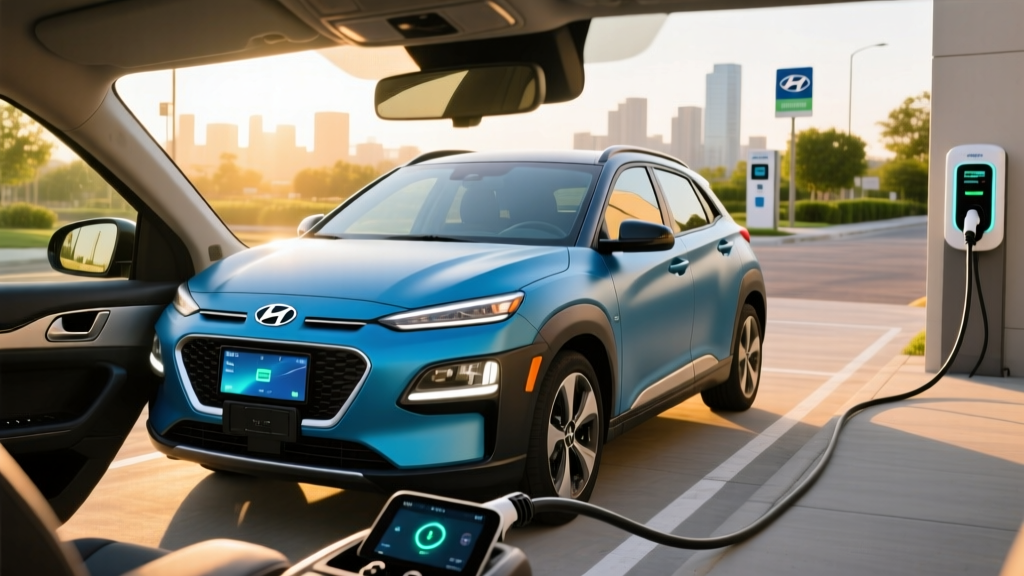
The 2025 Hyundai Kona Electric returns after a full redesign for the 2024 model year, carrying over with the same 67.3 kWh battery pack, 201-horsepower front-wheel-drive powertrain, and an EPA-estimated 261 miles of range. It occupies a specific niche: a subcompact crossover aimed at urban commuters and small households who need credible highway range without stepping up to the Ioniq 5's footprint or price. The Kona Electric doesn't chase performance records or 800-volt charging architecture — it prioritizes everyday usability, strong warranty coverage, and a starting price that undercuts most rivals.
For 2025, Hyundai keeps the trim structure simple: SE, SEL, and Limited. The base SE starts at $32,975 (including destination), while the range-topping Limited reaches $41,025. Federal tax credit eligibility under IRS §30D remains a moving target dependent on battery sourcing, buyer income, and MSRP caps — more on that below.
Range, Efficiency, and the Real-World Reality Check
Real-World Expectation: ~220–245 miles in mixed driving; ~195–215 miles sustained highway at 70+ mph; ~165–190 miles in sub-freezing winter conditions
The Kona Electric's efficiency story is one of its strongest attributes. The SE trim, riding on smaller 17-inch wheels and lighter curb weight, achieves an EPA-estimated 129 MPGe combined (131 city / 127 highway) — translating to roughly 26 kWh per 100 miles. The SEL and Limited trims drop to 118 MPGe combined (120 city / 116 highway), or about 28 kWh per 100 miles, due to the larger wheels and added equipment weight.
These numbers are competitive within the subcompact EV segment. The Chevrolet Equus — excuse me, Bolt EUV — is discontinued after 2023, leaving the Kona Electric to compete primarily with the Kia Niro EV, Nissan Ariya (pricier), and Volvo EX30 (newer but smaller battery). Against the Niro EV's 239-mile EPA rating, the Kona's 261-mile figure (or 290 on the SE) gives it a meaningful edge for road-trip flexibility.
The real-world caveats matter. On a flat, 65-mph suburban commute in mild weather, you'll approach or match the EPA sticker. Push it to 75 mph on an interstate, and expect a 15–20% reduction — physics doesn't negotiate on aerodynamic drag. Cold weather compounds the hit: at 25°F with the cabin heater running, the battery's internal resistance increases and thermal management draws additional power, shaving range to roughly 170–195 miles on the SEL/Limited. The Kona Electric does include a battery preconditioning function and a heat pump (standard on Limited, available on SEL via the Convenience package), which mitigates but doesn't eliminate winter losses. According to fueleconomy.gov, the combined energy consumption figures are accurate under standardized testing, but your mileage will vary based on driving style, climate, and terrain.
Battery, Charging Speeds, and the 100 kW Ceiling
The 2025 Kona Electric uses a 67.3 kWh usable battery (approximately 65.4 kWh usable after buffer) with NMC (nickel manganese cobalt) chemistry. Hyundai has not adopted LFP (lithium iron phosphate) for this model, which means you get higher energy density in a compact package but should follow standard NMC care practices: avoid prolonged storage at 100% state of charge, and don't regularly let it sit below 10%.
| Charge Level | Power / Rate | Time / Speed | Connector |
|---|---|---|---|
| Level 1 (120V household) | ~1.4 kW | ~4 mi/hr added; 0–100% in ~48 hours | J1772 / NACS (with adapter) |
| Level 2 (240V home/public) | 10.9 kW (onboard charger) | ~32 mi/hr; 0–100% in ~6.5 hours | J1772 / NACS (with adapter) |
| DC Fast Charge | Peak ~100 kW | 10–80% in ~43 minutes | CCS1 (native) / NACS (with adapter) |
The Kona Electric's DC fast-charging peak of approximately 100 kW is the most common criticism in reviews, and it's a fair one. In a segment where the Ioniq 5 can peak at 240 kW (on 800V architecture) and even the Volkswagen ID.4 hits 175 kW on newer models, 100 kW means longer pit stops on road trips. The charge curve is relatively flat between 20–60% SoC, then tapers noticeably above 80%, which is standard NMC behavior but means the advertised 43-minute 10–80% time assumes ideal battery temperature and a capable charger.
On the home front, the 10.9 kW onboard AC charger is a genuine strength. Most competitors in this price range offer 7.2 kW or 9.6 kW. At 10.9 kW on a 48-amp Level 2 circuit, you'll add roughly 32 miles of range per hour of charging, meaning a full overnight charge from near-empty is easily achievable. If you're installing a home Level 2 charger, plan for a 60-amp dedicated circuit with a hardwired unit rated for at least 48 amps continuous output to take full advantage.
Hyundai equips the Kona Electric with a CCS1 (Combined Charging System) port natively. For Tesla Supercharger access, you'll need a NACS adapter, which Hyundai has been providing or making available for newer models — confirm availability with your dealer at purchase.
Performance, Drivetrain, and Daily Driving Dynamics
Horsepower: 201 hp / 188 lb-ft torque
Drivetrain: Front-wheel drive (single motor) — AWD not available
Top Speed: Electronically limited to ~104 mph
The single-motor, front-wheel-drive layout delivers adequate acceleration for merging and passing. The 7.3-second 0–60 time isn't thrilling by EV standards (the Ioniq 5 RWD does it in ~5.1 seconds), but it's competitive with the Niro EV and considerably quicker than most gasoline subcompacts. Instant torque delivery makes it feel punchier around town than the stopwatch suggests.
There is no all-wheel-drive option. If you live in a region with heavy snow or need AWD traction, you'll need to look at the Kia EV6, Hyundai Ioniq 5, or Volkswagen ID.4 AWD variants. The Kona Electric is strictly a front-driver, which is fine for the vast majority of commuters but a limitation worth noting for mountain or winter-heavy driving.
Ride quality is tuned toward comfort rather than sportiness. The suspension absorbs urban potholes and expansion joints well, and the cabin is impressively quiet at highway speeds — a benefit of the absence of engine noise combined with Hyundai's sound-deadening efforts. Regenerative braking offers four levels (0–3) adjustable via steering-wheel paddles, with Level 3 approaching one-pedal driving in stop-and-go traffic, though it won't bring the car to a complete hold without touching the brake.
Interior Space, Cargo, and Technology
The redesigned Kona Electric is noticeably larger than its predecessor. Hyundai stretched the wheelbase and overall length, translating to meaningful gains in passenger and cargo room:
- Front legroom: 41.7 inches
- Rear legroom: 38.3 inches
- Cargo volume (behind rear seats): 25.5 cubic feet
- Cargo volume (rear seats folded): 63.7 cubic feet
- Frunk (front trunk): Not available — the motor and power electronics occupy the front compartment
Rear-seat space is a genuine improvement and now accommodates adults comfortably on longer trips. The 25.5 cu ft cargo area behind the second row beats the Kia Niro EV (22.6 cu ft) and is competitive with the segment. The absence of a frunk is a missed opportunity — competitors like the Ford Mustang Mach-E and Hyundai's own Ioniq 5 offer front storage — but the Kona's compact footprint limits packaging options.
Infotainment and tech highlights:
- Dual 12.3-inch displays (instrument cluster + touchscreen) on SEL and Limited; single 12.3-inch screen on SE
- Wireless Apple CarPlay and Android Auto (standard all trims)
- Hyundai's latest Bluelink connected services with remote climate preconditioning, charge scheduling, and vehicle location
- Over-the-air (OTA) software updates for infotainment and select vehicle systems
- Digital Key 2 (NFC + UWB) on Limited trim — use your smartphone as the key fob
- Vehicle-to-load (V2L) capability via an available adapter, allowing you to power small devices or appliances from the traction battery
Driver assistance (Hyundai SmartSense — standard across all trims):
- Forward Collision-Avoidance Assist with pedestrian, cyclist, and junction-turning detection
- Lane Keeping Assist and Lane Following Assist
- Blind-Spot Collision-Avoidance Assist
- Rear Cross-Traffic Collision-Avoidance Assist
- Highway Driving Assist (HDA) on SEL and Limited — a SAE Level 2 system combining adaptive cruise control with lane centering. The driver must keep hands on the wheel and remain engaged at all times. This is not autonomous driving.
- Navigation-based smart cruise control with curve speed reduction (Limited)
Pricing, Trims, and Federal Tax Credit Eligibility
| Trim | Base MSRP | EPA Range | Key Additions Over Prior Trim |
|---|---|---|---|
| SE | $32,975 | 290 miles | 17" alloys, 12.3" touchscreen, SmartSense suite, heated front seats |
| SEL | $36,975 | 261 miles | 18" alloys, dual 12.3" displays, HDA, wireless phone charging, power driver seat |
| Limited | $41,025 | 261 miles | Leather, heat pump, Digital Key 2, HUD, ventilated front seats, sunroof, premium audio |
Under the IRS §30D clean vehicle credit, eligible buyers may qualify for up to $7,500 — but eligibility is far from guaranteed for the Kona Electric and depends on several factors:
- MSRP cap: The Kona Electric qualifies as an SUV/crossover, so the cap is $80,000. All trims clear this easily.
- Buyer income limits: Modified AGI must not exceed $150,000 (single), $225,000 (head of household), or $300,000 (joint).
- Battery sourcing requirements: The credit is split into two halves ($3,750 each) based on critical mineral sourcing and battery component manufacturing in the US or FTA-partner nations. Hyundai's supply chain has been evolving — the Kona Electric is assembled in South Korea, which historically has disqualified it from the full credit under the North American final assembly requirement.
- Point-of-sale transfer: If eligible, you can transfer the credit to the dealer at purchase for an immediate price reduction rather than claiming it on your tax return.
Bottom line: Because the Kona Electric is built in Ulsan, South Korea (not in North America), it does not meet the final assembly requirement for the §30D new-vehicle credit. However, leasing the vehicle may allow Hyundai to pass through a commercial clean vehicle credit (§45W) as a lease incentive — a common workaround. Check with your dealer and a tax professional for your specific situation.
Ownership Costs, Warranty, and Long-Term Outlook
Hyundai's warranty coverage remains one of the strongest in the EV segment:
- New vehicle limited warranty: 5 years / 60,000 miles
- Powertrain warranty: 10 years / 100,000 miles
- EV battery warranty: 10 years / 100,000 miles (capacity retention above 70% of original)
- Complimentary maintenance: 3 years / 36,000 miles (oil changes don't apply, but this covers tire rotations, inspections, and fluid top-offs)
The 10-year/100,000-mile battery warranty with a 70% capacity retention floor is a meaningful commitment. For reference, a 30% degradation on the 67.3 kWh pack would leave roughly 47 kWh usable — enough for approximately 170–185 miles of real-world range. In practice, NMC batteries in Hyundai/Kia EVs have shown moderate degradation curves: expect roughly 5–8% capacity loss in the first 50,000 miles, then a slower decline. Most owners will never approach the warranty threshold.
Insurance costs for the Kona Electric tend to run 10–20% higher than the gasoline Kona, reflecting EV repair-cost patterns and parts pricing. Get a quote before purchasing — premiums vary significantly by zip code, driving record, and insurer.
Charging cost comparison: At the national average residential electricity rate of ~$0.16/kWh, a full home charge costs approximately $10.77 (67.3 × $0.16), yielding a cost per mile of roughly $0.04. At $3.50/gallon gasoline and 30 MPG, a comparable gas car costs about $0.12/mile. Over 15,000 miles annually, that's a fuel savings of roughly $1,200/year — though actual savings depend on your local electricity rate and public charging mix.
Pros, Cons, and the Competition
- 290-mile EPA range on SE trim is class-leading
- 10.9 kW onboard charger enables fast Level 2 home charging
- 10-year/100,000-mile battery and powertrain warranty
- Spacious interior for a subcompact — 38.3" rear legroom
- Strong standard safety suite (SmartSense)
- Competitive starting price at $32,975
- Heat pump on Limited trim improves cold-weather efficiency
- DC fast charging peaks at ~100 kW — slowest in its class
- No AWD option
- No frunk (front trunk)
- Built in South Korea — does not qualify for §30D purchase credit
- Rear visibility is limited; camera-dependent
- Regen doesn't achieve true one-pedal stop-and-hold
- SE trim's 17" wheels look modest next to competitors
- Choose the Kona Electric SE if: You want maximum range (290 mi) at the lowest price, primarily commute in urban/suburban settings, and can charge at home overnight. The SE's smaller wheels and lighter weight deliver the best efficiency.
- Choose the Kona Electric Limited if: You want premium features (heat pump, ventilated seats, HUD, leather) and can accept the 29-mile range penalty for the upgraded equipment. The heat pump is worth it in cold climates.
- Look elsewhere if: You need AWD, frequently road-trip and need 150+ kW DC charging, or require the federal purchase tax credit. Consider the Ioniq 5, Kia EV6, or Volkswagen ID.4 instead.
- Consider leasing if: You want the Kona Electric but need the lease-credit workaround to offset the purchase price, since the South Korean assembly disqualifies it from §30D.
Frequently Asked Questions
What is the real-world range of the 2025 Hyundai Kona Electric?
The EPA rates the SE trim at 290 miles and the SEL/Limited at 261 miles. In real-world mixed driving, expect roughly 220–245 miles (SEL/Limited). Sustained highway driving at 70+ mph drops this to about 195–215 miles. In freezing weather with cabin heating, plan for 165–195 miles. Preconditioning the battery while plugged in helps preserve range in cold conditions.
How fast does the Kona Electric charge at home and on DC fast chargers?
At home on a 240V Level 2 charger, the Kona Electric's 10.9 kW onboard charger adds about 32 miles per hour, with a full charge taking approximately 6.5 hours. On DC fast chargers, it peaks at roughly 100 kW, reaching 10–80% in about 43 minutes under optimal conditions. This is the vehicle's weakest spec relative to competitors — the Ioniq 5 charges 10–80% in roughly 18 minutes on a 350 kW station.
Does the 2025 Kona Electric qualify for the $7,500 federal tax credit?
Under current IRS §30D rules, the Kona Electric does not qualify for the new-vehicle purchase credit because it is assembled in South Korea, not in North America. However, leasing may unlock a commercial credit that the leasing company can pass through as a capitalized-cost reduction. Consult your dealer and a tax professional to confirm your eligibility.
Is the Kona Electric worth buying vs. the Kia Niro EV or Hyundai Ioniq 5?
It depends on your priorities. The Kona Electric offers more range (261–290 mi vs. 239 mi for the Niro EV) at a similar price, with faster home charging. But if you need DC fast charging for road trips, the Ioniq 5 (240 kW peak, ~18 min 10–80%) is dramatically quicker to refuel and offers AWD — though it starts around $42,000 and is a larger vehicle. The Kona Electric is the better value for home-charging commuters; the Ioniq 5 is the better road-trip EV.
Does the Kona Electric have a heat pump?
The heat pump is standard on the Limited trim and available on the SEL through the Convenience package. It is not available on the base SE. A heat pump significantly improves cabin heating efficiency in cold weather by extracting ambient heat rather than relying solely on resistive heating, reducing winter range loss by roughly 10–15% compared to vehicles without one.
What is the battery warranty coverage?
Hyundai covers the Kona Electric's battery for 10 years or 100,000 miles, whichever comes first. The warranty guarantees that the battery will retain at least 70% of its original usable capacity. If degradation exceeds 30% within that period, Hyundai will repair or replace the battery to bring it above the threshold.