The Quick Answer on Hyundai & Kia Affordable EVs
If you're shopping for Hyundai and Kia affordable EVs in 2026, your two best bets are the Hyundai Kona Electric (starting around $32,975, EPA 261 miles) and the Kia EV6 (starting around $42,600, EPA up to 310 miles on the RWD Light trim). The Kona Electric is the clear value pick for city and suburban drivers who can charge at home, while the EV6 justifies its higher price with 800V ultra-fast DC charging (10–80% in ~18 minutes) and a roomier cabin. Both qualify for varying levels of the federal §30D tax credit depending on your income, the vehicle's battery sourcing, and current-year IRS rules — so eligibility is not guaranteed for every buyer.
Current Hyundai and Kia EV Lineup: Specs at a Glance
Hyundai Motor Group (which includes Kia and Genesis) has built one of the broadest EV portfolios in the industry on its E-GMP platform and earlier front-drive architecture. Here's what's on sale for the 2026 model year at the affordable end of the spectrum:
| Model | Base MSRP | EPA Range | Battery (kWh usable) | Chemistry | Max DC Charge (kW) | 10–80% DC Time | 0–60 mph | HP |
|---|---|---|---|---|---|---|---|---|
| Hyundai Kona Electric SEL | $32,975 | 261 mi | 65.4 kWh | NMC | 100 kW | ~43 min | 7.5 sec | 201 |
| Hyundai Ioniq 5 SE (RWD) | $42,550 | 303 mi | 77.4 kWh | NMC | 240 kW (800V) | ~18 min | 7.2 sec | 170 |
| Kia EV6 Light (RWD) | $42,600 | 310 mi | 77.4 kWh | NMC | 240 kW (800V) | ~18 min | 7.3 sec | 169 |
| Kia Niro EV Wind | $39,600 | 239 mi | 64.8 kWh | NMC | 85 kW | ~50 min | 7.8 sec | 201 |
Note: EPA range figures from fueleconomy.gov. Real-world highway range at 70+ mph typically drops 10–15% below EPA. In freezing weather (below 25°F), expect a further 20–30% reduction unless you precondition the battery while plugged in.
Real-World Range Reality Check
Kona Electric: EPA 261 mi → expect ~220–235 mi on mixed highway driving; ~180–200 mi in cold weather.
Ioniq 5 RWD: EPA 303 mi → expect ~255–275 mi highway; ~210–240 mi in cold weather.
EV6 RWD: EPA 310 mi → expect ~260–285 mi highway; ~215–245 mi in cold weather.
The 800V architecture on the Ioniq 5 and EV6 doesn't add range, but it drastically cuts road-trip charging stops — a 240 kW peak means you can add ~150 miles in roughly 10 minutes at a compatible charger.
Cost Breakdown: EV vs Gas — Where the Savings Actually Are
The purchase price of an EV is only one part of the equation. To understand total cost of ownership, we need to compare fueling, maintenance, insurance, and depreciation against a similarly priced gas crossover.
| Cost Factor | Hyundai Kona Electric ($32,975) | Hyundai Kona 1.6T Gas ($28,475) | Notes |
|---|---|---|---|
| Purchase Price (MSRP) | $32,975 | $28,475 | $4,500 EV premium upfront |
| Fed. Tax Credit (§30D) | Up to $3,750 (see below) | $0 | Varies by buyer income & battery sourcing; check IRS §30D rules |
| Effective Purchase Price | ~$29,225 | $28,475 | Gap narrows to ~$750 after credit |
| Fuel/Energy (15,000 mi/yr) | ~$540/yr (home charging at $0.14/kWh) | ~$1,650/yr (28 MPG avg at $3.10/gal) | $1,110/yr savings with home L2 charging |
| Maintenance (annual) | ~$150/yr (tire rotation, cabin filter) | ~$450/yr (oil, filter, plugs, brakes) | Regen braking extends pad life significantly |
| Insurance (annual avg) | ~$1,850/yr | ~$1,550/yr | EV premiums run ~15–20% higher on average |
| 5-Year Total Cost (est.) | ~$43,675 | ~$45,475 | EV breaks even or saves ~$1,800 over 5 yrs |
Key takeaway: The Kona Electric breaks even with the gas Kona within 3–4 years if you charge primarily at home. Public DC fast charging at $0.35–$0.50/kWh erodes those savings quickly — a road-trip-heavy driver who relies on Electrify America or EVgo will see fueling costs approach gas-car levels.
Tax Credit Eligibility: What You Actually Qualify For
The federal §30D clean vehicle credit is not a flat $7,500 for every buyer. Current IRS rules impose several hurdles that change the equation for Hyundai and Kia models specifically:
- Buyer income caps: AGI must not exceed $150,000 (single), $225,000 (head of household), or $300,000 (joint filing).
- MSRP caps: Vans/SUVs/pickups: $80,000 max. Other vehicles (sedans, hatchbacks): $55,000 max. The Kona Electric and Niro EV fall under the $55,000 cap as hatchbacks/crossovers; the Ioniq 5 and EV6 qualify under the $80,000 SUV cap.
- Battery sourcing: The credit splits into two halves — $3,750 for critical minerals and $3,750 for battery component assembly, each with escalating domestic-content thresholds that tighten annually. As of 2026, Hyundai Motor Group has shifted significant battery cell production to the Georgia and Michigan plants (via joint ventures with SK On and LG Energy Solution), improving eligibility compared to the 2023–2024 period when most Hyundai/Kia EVs received $0.
- Point-of-sale transfer: You can now transfer the credit to the dealer at purchase, reducing your out-of-pocket cost immediately rather than waiting for tax filing.
- Final assembly: Must be in North America. The Ioniq 5, EV6, and Kona Electric sold in the U.S. now meet this requirement following HMG's Metaplant America in Georgia coming online.
Important: Consult a tax professional and verify current eligibility on IRS.gov before purchasing. Battery sourcing requirements tighten each year, and specific trim/battery-pack combinations may differ.
Charging at Home vs Public: What First-Time Buyers Must Know
The single biggest ownership variable is whether you can install a Level 2 home charger. Here's how the Hyundai/Kia lineup handles each charging scenario:
| Level | Power (kW) | Miles Added per Hour | Where | Best For |
|---|---|---|---|---|
| Level 1 (120V) | 1.2–1.4 kW | ~3–5 mi/hr | Any standard outlet | Overnight top-ups if daily driving <30 mi |
| Level 2 (240V) | 7.2–11 kW | ~20–36 mi/hr | Home (NEMA 14-50 or hardwired) | Daily primary charging; full overnight charge |
| DC Fast (Kona/Niro) | 85–100 kW peak | ~150–200 mi in 30 min | Public stations | Road trips; not ideal for daily use |
| DC Fast (Ioniq 5/EV6) | 200–240 kW peak | ~150+ mi in ~10 min | 350 kW-capable public stations | Road trips with minimal downtime |
Home Charging Installation: Real Costs
Most Hyundai and Kia EVs come with an included Level 2 charge cable (or a partnership discount on home chargers like the ChargePoint Home Flex). Installation costs depend on your electrical panel:
| Component | Low Estimate | High Estimate | Notes |
|---|---|---|---|
| Level 2 Charger (hardware) | $350 | $700 | ChargePoint Home Flex, Emporia Vue, Wallbox Pulsar Plus |
| Electrician labor (50A circuit, NEMA 14-50) | $500 | $1,500 | Depends on panel proximity and conduit run length |
| Panel upgrade (200A service) | $1,500 | $4,000 | Required if your panel is 100A or maxed out |
| Permit & inspection | $50 | $300 | Varies by municipality |
| Total (typical install) | $900 | $2,500 | Without panel upgrade: $900–$2,200 |
Have your electrician check your panel's available amperage before committing. A 200A panel with spare breaker slots makes for a straightforward $1,000–$1,500 install. An older 100A panel in a 1970s home could push you past $4,000 total — and that changes the ownership math.
Common Misconceptions About Hyundai and Kia EVs
| Myth | Fact |
|---|---|
| "Hyundai and Kia EVs don't qualify for any tax credit." | Since HMG opened U.S. battery and assembly plants, several 2025–2026 models now qualify for partial or full §30D credits. Eligibility varies by model, battery pack, and buyer income — verify on IRS.gov. |
| "The Kona Electric charges too slowly for road trips." | At 100 kW peak, the Kona adds ~120 miles in 30 minutes on a DC fast charger. It's slower than the EV6's 240 kW, but perfectly workable for 2–3 stops on a 500-mile drive. |
| "EV batteries need replacing every few years." | Hyundai and Kia provide a 10-year/100,000-mile battery warranty. Real-world degradation data from E-GMP vehicles shows ~5–8% capacity loss after 100,000 miles — meaning a 310-mile EV6 still delivers ~285+ miles after years of use. |
| "You can't drive EVs in winter." | You can, but range drops 20–30% in sub-freezing temps. The Ioniq 5 and EV6 include battery preconditioning (via navigation-routed preconditioning to a charger) and a heat pump on higher trims, which recovers ~10% of cold-weather loss. Plan for shorter winter range; don't skip the EV. |
| "All Hyundai/Kia EVs charge the same speed." | The Kona Electric and Niro EV use a 400V architecture (85–100 kW peak). The Ioniq 5 and EV6 use an 800V architecture (up to 240 kW peak) — roughly 2.5x faster at compatible stations. |
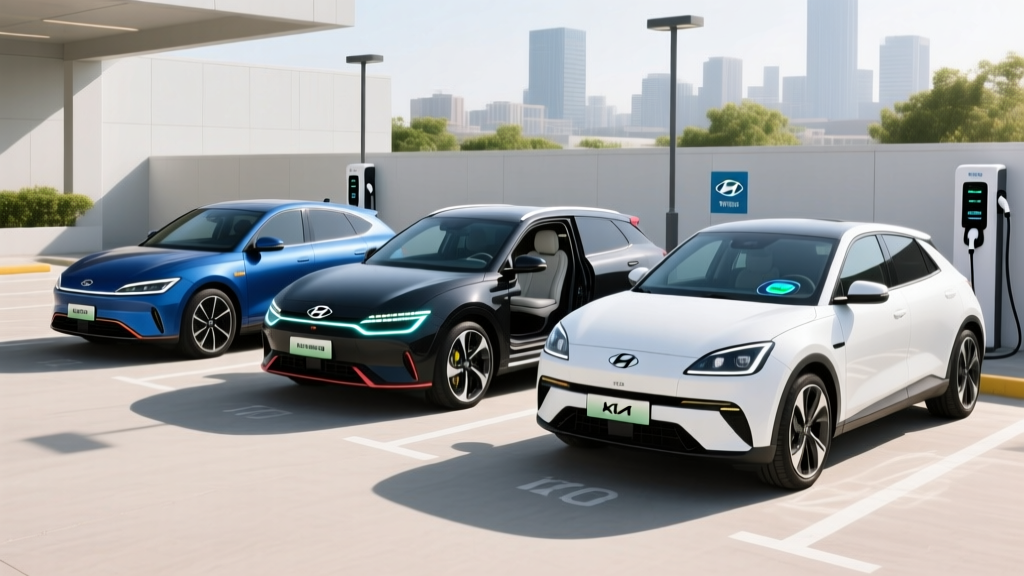
Hyundai vs Kia: Which Affordable EV Fits You?
Hyundai and Kia share platforms, batteries, and powertrains — but they target slightly different buyers with styling, feature packaging, and pricing strategies.
Decision Framework: Which Hyundai or Kia EV Should You Buy?
Choose the Hyundai Kona Electric if:
- Your budget is under $35,000 before incentives
- Your daily commute is under 60 miles round-trip
- You have home Level 2 charging (or can install it)
- You rarely take road trips over 250 miles one-way
- You want the lowest total cost of ownership in the lineup
Choose the Kia Niro EV if:
- You want slightly more cargo space (23.9 cu ft vs Kona's 19.7 cu ft behind rear seats)
- You prefer Kia's dealer network in your area
- Budget is still a priority but you need a practical family hatchback
Choose the Hyundai Ioniq 5 if:
- Road-trip charging speed matters (18-min 10–80% at 350 kW chargers)
- You want a flat floor, spacious cabin, and V2L (vehicle-to-load) capability
- Budget stretches to ~$42,000–$50,000
- You value IIHS Top Safety Pick+ ratings and available Highway Driving Assist 2
Choose the Kia EV6 if:
- You want the longest EPA range in the group (310 mi on RWD Light)
- You prefer sportier styling and a more driver-focused cockpit
- You want 800V fast charging at a slightly lower entry price than the Ioniq 5 AWD trims
- GT-Line aesthetics and available GT performance variant (576 HP, 0–60 in 3.4 sec) appeal to you
EV vs Hybrid: When a PHEV Might Make More Sense
Not every buyer is ready for a full BEV. If you lack home charging access, live in a region with sparse public charging infrastructure, or regularly drive 400+ miles without stopping, a plug-in hybrid may serve you better today.
| Factor | Kia EV6 (BEV) | Kia Sportage PHEV | Kia Sportage (Gas HEV) |
|---|---|---|---|
| Starting Price | $42,600 | $39,590 | $31,590 |
| Electric-Only Range | 310 mi (full) | 34 mi (EPA) | N/A |
| MPGe / MPG Combined | 134 MPGe | 84 MPGe (elec) / 38 MPG (gas) | 43 MPG |
| Fueling Flexibility | Electric only | Electric + gas | Gas only |
| Road-Trip Convenience | Requires charge planning | Seamless gas backup | Gas station anywhere |
| Maintenance | Lowest (no oil, minimal brakes) | Moderate (gas engine maintenance) | Moderate |
| Best For | Home chargers, <300 mi daily | Short EV commutes + long trips | No charging access, high mileage |
If your commute is 20–30 miles and you can charge overnight, the Sportage PHEV lets you drive electric most weekdays while keeping a gas tank for weekend road trips. But if you have reliable home charging and your longest regular trip is under 250 miles, the EV6's lower running costs and smoother driving experience win out over five years.
Warranty, Reliability, and Long-Term Ownership
Hyundai Motor Group backs its EVs with one of the strongest warranty packages in the industry:
- Battery warranty: 10 years / 100,000 miles (capacity retention threshold: typically 70% of original capacity)
- Powertrain warranty: 10 years / 100,000 miles
- Bumper-to-bumper: 5 years / 60,000 miles
- Roadside assistance: 5 years / unlimited miles
For context, that battery warranty covers a battery replacement (or repair to bring capacity above 70%) if degradation exceeds 30% within the coverage period. Based on IIHS data and owner surveys, E-GMP platform vehicles (Ioniq 5, EV6) have shown strong early reliability — though long-term 150,000+ mile data is still accumulating since these vehicles launched in 2022.
One ownership note: Hyundai and Kia EVs use NMC (nickel manganese cobalt) battery chemistry, which offers higher energy density (more range per pound) than LFP (lithium iron phosphate). The trade-off is that NMC batteries are more sensitive to sustained 100% state-of-charge storage. For longest battery life, set your daily charge limit to 80% and only charge to 100% before long trips.
Frequently Asked Questions
Are Hyundai and Kia EVs reliable?
Early reliability data for the E-GMP platform (Ioniq 5, EV6) is positive, with few widespread mechanical complaints. The Kona Electric, in production since 2019, has a longer track record. Hyundai/Kia's 10-year battery warranty provides substantial protection against premature degradation. As with any first-generation platform, early-production 2022 models had some software and 12V battery issues that have been addressed in subsequent model years.
Do Hyundai and Kia EVs work with Tesla Superchargers?
Starting in 2025, Hyundai and Kia began equipping new EVs with the NACS (North American Charging Standard) port, replacing CCS1 on many trims. If you buy a 2026 model with a NACS port, you can use Tesla Superchargers natively. If your model has CCS1, a Hyundai/Kia-approved NACS adapter enables Supercharger access. Verify the connector on your specific trim before purchase — the transition is ongoing across trims.
What happens if I can't charge at home?
Without home charging, EV ownership becomes more expensive and less convenient. Public DC fast charging costs $0.35–$0.50/kWh (vs. $0.12–$0.18/kWh at home), eroding fuel savings. Workplace charging or apartment-building Level 2 chargers can bridge the gap. If neither is available, a PHEV like the Kia Sportage Plug-In Hybrid may be a better fit until your charging situation improves.
How much does it cost to insure a Hyundai or Kia EV?
EV insurance premiums typically run 15–20% higher than equivalent gas models due to higher repair costs and battery replacement expense. For a Kona Electric, expect annual premiums around $1,700–$2,000 depending on your state, driving record, and coverage level. Shop quotes from multiple insurers — some (like Progressive and State Farm) now offer EV-specific discounts that narrow the gap.
Is the Ioniq 5 or EV6 better for road trips?
Both share the 800V E-GMP platform with identical 240 kW peak charging capability. The EV6 RWD Light edges out on EPA range (310 vs 303 miles), while the Ioniq 5 offers a slightly roomier rear seat and more cargo volume (27.2 vs 24.4 cu ft). For pure road-trip efficiency, the EV6's extra 7 miles and available 350 kW charging compatibility give it a marginal edge. For family comfort, the Ioniq 5's boxier cabin wins. Both add roughly 150 miles of range in 10 minutes at a compatible DC fast charger.