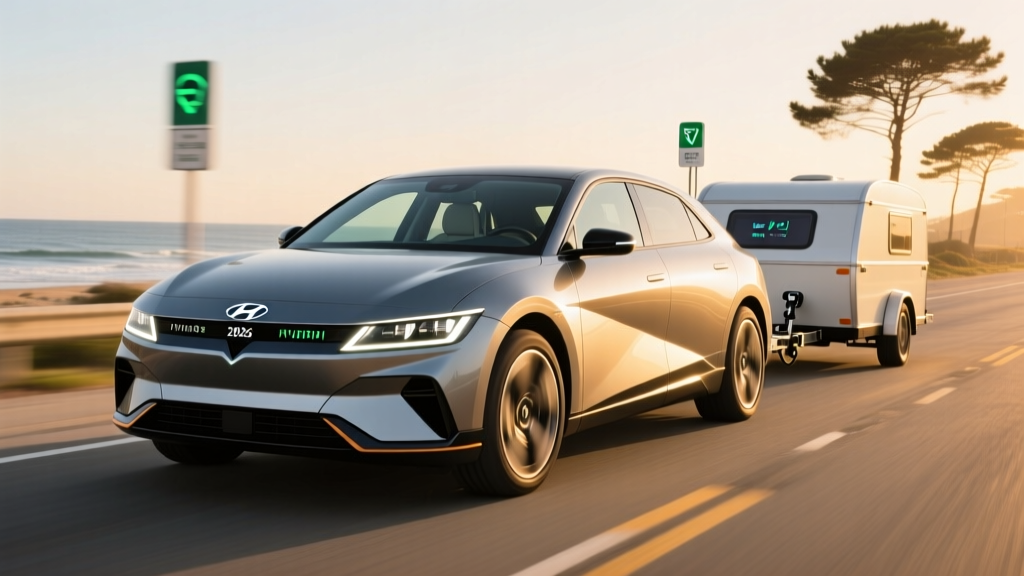
The three-row electric SUV segment is crowded, but the 2026 Hyundai Ioniq 9 carves out a distinct niche: it is one of the few mainstream EVs that pairs genuine family hauling with legitimate trailer capability. With an EPA-estimated range up to 335 miles, an 800-volt architecture enabling 10–80% DC fast charges in roughly 24 minutes, and a maximum towing capacity of 5,000 pounds (when properly equipped), the Ioniq 9 asks whether you really need a body-on-frame truck to pull a camper or boat.
Below, we break down every spec that matters to buyers researching the Ioniq 9 towing capacity, real-world range, charging speeds, pricing, and federal tax credit eligibility — with the caveats and numbers the brochures tend to gloss over.
Hyundai Ioniq 9 Key Specs at a Glance
| Spec | Long Range RWD | Long Range AWD | Performance AWD |
|---|---|---|---|
| EPA Range | 335 mi | 311 mi | 290 mi |
| Battery (usable) | 110.3 kWh, NMC (nickel-manganese-cobalt) | ||
| Horsepower | 215 hp | 338 hp | 422 hp |
| 0–60 mph | ~7.8 sec | ~5.8 sec | ~4.8 sec |
| Max DC Fast Charge | ~240 kW peak (800V architecture) | ||
| 10–80% DC Charge | ~24 minutes (ideal conditions) | ||
| Level 2 Home Charge | 10.9 kW (≈31 mi/hr) | ||
| Max Towing Capacity | 5,000 lbs (with factory tow package) | ||
| MPGe (combined) | ~89 MPGe | ~84 MPGe | ~79 MPGe |
| EPA Efficiency | ~36 kWh/100mi | ~39 kWh/100mi | ~42 kWh/100mi |
Source: fueleconomy.gov and Hyundai Motor America. Figures vary by model year and trim; verify at purchase.
What Is the Real-World Range of the Ioniq 9?
Real-World Expectation: ~270–295 miles highway (70–75 mph); ~230–260 miles in sub-freezing weather; ~180–220 miles when towing a 3,500–5,000 lb trailer.
The Ioniq 9's 110.3 kWh (usable) NMC lithium-ion battery is among the largest in its class, and the Long Range RWD variant's 335-mile EPA figure is genuinely competitive with the Kia EV9 and ahead of the Rivian R1S standard pack. But EPA tests are conducted at moderate speeds and temperatures.
In highway driving at 70–75 mph, expect to consume roughly 36–42 kWh per 100 miles depending on trim, wheels, and ambient conditions. That translates to around 270–295 miles before you'll want to stop. In cold weather (below 32°F), range drops 15–25% even with the available heat pump, because cabin heating and battery conditioning draw significant energy.
The towing reality: This is where the Ioniq 9 towing capacity meets physics. Pulling a loaded 4,500-pound travel trailer at highway speeds will roughly halve your range. Plan for 180–220 miles between charges when towing near the maximum rating, and route your trips around reliable DC fast chargers. Hyundai includes a trailer wiring harness and integrated trailer brake controller with the factory tow package, but the energy cost of towing is non-negotiable regardless of the badge on the grille.
Charging Speed: 800V Architecture in Practice
| Charging Level | Power / Voltage | Speed (Approx.) | Best For |
|---|---|---|---|
| Level 1 (120V) | 1.4 kW | ~4 mi/hr | Emergency / trickle |
| Level 2 (240V home) | 10.9 kW | ~31 mi/hr (full in ~11 hrs) | Daily overnight charging |
| DC Fast (50 kW) | 50 kW | ~130 mi/hr | Older public stations |
| DC Fast (150 kW) | 150 kW | ~10–80% in ~35 min | Electrify America, EVgo |
| DC Fast (250+ kW) | ~240 kW peak | ~10–80% in ~24 min | Hyundai/Ionity 800V stations |
The Ioniq 9 uses Hyundai's E-GMP platform with native 800-volt architecture, the same hardware that made the Ioniq 5 a charging benchmark. At a 350 kW-capable charger (such as Electrify America's latest stalls or Hyundai's own network), the Ioniq 9 peaks around 240 kW and sustains high charge rates through the bulk of the curve, reaching 80% State of Charge in approximately 24 minutes under ideal thermal conditions.
Charge-curve reality check: Like all EVs, the Ioniq 9 tapers charging speed significantly above 80% SoC to protect the battery. If you routinely charge to 100% at DC fast stations, expect the 80–100% segment to add another 20–30 minutes. For road trips, the 10–80% sprint is the number that matters — and 24 minutes is competitive with the best in the segment.
For home charging, the onboard 10.9 kW charger replenishes the 110.3 kWh battery in roughly 11 hours on a Level 2 (240V/48A) circuit. Most owners will need a 60-amp dedicated circuit installed; budget $800–$2,500 for professional installation depending on your panel's capacity and distance from the garage.
Towing Capacity Deep Dive: 5,000 Pounds, With Caveats
The headline number is clear: the 2026 Ioniq 9 can tow up to 5,000 pounds when equipped with the factory towing package (available on SEL and above, standard on Limited and Calligraphy trims). This matches the Kia EV9 and exceeds most unibody electric crossovers, though it falls short of the Rivian R1S (up to 7,700 lbs) and the Tesla Model X (up to 5,000 lbs for current models).
What 5,000 lbs actually gets you:
- A mid-size travel trailer (20–24 ft, dry weight 3,500–4,500 lbs)
- A pair of jet skis on a dual-axle trailer (~2,500 lbs)
- A small boat on a single-axle trailer (~3,000–4,000 lbs)
- A utility trailer loaded with landscaping materials or motorcycles
What it doesn't get you: Large fifth-wheel campers, horse trailers with livestock, or heavy equipment trailers. If your typical load exceeds 4,500 lbs loaded, you'll be operating near the Ioniq 9's limit, which compounds range loss and increases wear on brakes and suspension.
The factory tow package includes a Class III hitch receiver, 4-pin/7-pin wiring harness, integrated trailer brake controller, and a digital rearview mirror option that displays a camera feed when a trailer blocks the rear window. Hyundai's Highway Driving Assist 2 (HDA2) remains functional with a trailer attached, though the system's lane-centering calibration accounts for the added length.
Performance, Drivetrain, and Daily Driving
The Ioniq 9 offers three powertrain configurations:
- Long Range RWD: Single rear motor, 215 hp, 258 lb-ft torque. Adequate for commuting but noticeably deliberate when merging with a full cabin. 0–60 mph in approximately 7.8 seconds.
- Long Range AWD: Dual-motor, 338 hp, 446 lb-ft. The sweet spot for most buyers — confident highway passing, light off-road capability, and a 0–60 of ~5.8 seconds.
- Performance AWD: Dual-motor with enhanced output, 422 hp, 523 lb-ft. Quick for a three-row SUV at ~4.8 seconds to 60 mph, but the efficiency penalty drops range to 290 miles EPA.
Ride quality is a standout. The Ioniq 9 uses a multi-link rear suspension with available frequency-selective dampers, delivering a composed, quiet highway cruise that belies its 5,000+ lb curb weight. Steering is light and numb — this is not a sport SUV — but body control is impressive for a vehicle with this much mass.
Regenerative braking offers four levels via steering-wheel paddles, including a true one-pedal driving mode (i-Pedal) that brings the vehicle to a complete stop without touching the brake pedal. When towing, Hyundai recommends reducing regen aggressiveness to prevent trailer push on deceleration.
Interior, Cargo, and Three-Row Practicality
The Ioniq 9 is a genuine three-row SUV with seating for up to seven passengers (captain's chairs in the second row reduce capacity to six). Interior dimensions are generous:
- First-row legroom: 41.7 inches
- Second-row legroom: 39.4 inches (slides fore/aft)
- Third-row legroom: 31.5 inches — usable for children or short trips, tight for adults on long drives
- Cargo behind 3rd row: 15.9 cu ft
- Cargo behind 2nd row (3rd row folded): 45.7 cu ft
- Max cargo (all rear seats folded): 87.1 cu ft
- Front trunk (frunk): ~1.8 cu ft (RWD) / ~0.7 cu ft (AWD) — enough for a charging cable bag, not groceries
The flat floor and slim center console create an airy cabin. Materials are premium without being ostentatious — vegan leather, recycled fabrics, and real aluminum trim on higher trims. The dual 12.3-inch curved display runs Hyundai's latest infotainment with wireless Apple CarPlay and Android Auto, over-the-air updates, and a Digital Key 2 feature that lets you unlock and start the vehicle with your smartphone.
Notable drawbacks: The third row remains a compromise for adults on long trips. The frunk is disappointingly small. And the touch-capacitive climate controls, while sleek, lack the tactile feedback of physical buttons — a recurring complaint in Hyundai's recent interiors.
Pricing, Trims, and Federal Tax Credit Eligibility
| Trim | Drivetrain | Base MSRP | Est. After §30D Credit* |
|---|---|---|---|
| SE Standard Range | RWD | $52,395 | ~$44,895 |
| SE Long Range | RWD | $56,895 | ~$49,395 |
| SEL Long Range | AWD | $63,395 | ~$55,895 |
| Limited | AWD | $69,895 | ~$62,395 |
| Calligraphy | AWD (Perf.) | $75,395 | ~$67,895 |
*Estimated price assumes full $7,500 federal tax credit applied at point of sale. Actual eligibility depends on buyer income, vehicle MSRP cap, and battery sourcing requirements. Verify current rules at IRS.gov §30D.
Does the Ioniq 9 qualify for the federal EV tax credit? As of 2026, the Ioniq 9 is assembled at Hyundai's Metaplant in Ellabell, Georgia, which positions it favorably for the §30D New Clean Vehicle Credit. However, eligibility is not automatic. Buyers must meet all of the following:
- Income caps: Modified AGI ≤ $150,000 (single), $225,000 (head of household), $300,000 (joint)
- MSRP cap: SUVs/vans must have an MSRP ≤ $80,000 — all Ioniq 9 trims currently qualify
- Battery sourcing: Critical minerals and battery components must meet phased-in domestic/content thresholds (these thresholds tighten annually through 2030)
- Point-of-sale transfer: Eligible buyers can apply the credit as a down-payment reduction at the dealer rather than waiting for a tax refund
Because battery-sourcing rules evolve annually and depend on specific build dates, always confirm eligibility with your dealer and a tax professional before signing. The IRS maintains a qualifying vehicle list that is updated regularly.
Ioniq 9 vs. Key Competitors: Is It Worth Buying?
Against the Kia EV9, the Ioniq 9 is mechanically similar (same platform, same battery) but trades styling and interior design philosophy. The Ioniq 9 leans more upscale and conservative; the EV9 is bolder and slightly more utilitarian. Both tow 5,000 lbs. Choose based on which design language and dealer experience you prefer.
Against the Rivian R1S, the Ioniq 9 sacrifices 2,700 lbs of towing capacity and genuine off-road capability but saves $15,000–$25,000 and offers faster DC charging. If you tow a 20-foot Airstream and hit trails, the R1S justifies its premium. If you tow a boat to the lake twice a summer and commute daily, the Ioniq 9 is the smarter financial play.
Against the Tesla Model X, the Ioniq 9 offers a more conventional SUV experience with better third-row access, a more intuitive infotainment system, and a lower entry price. The Model X counters with the Supercharger network (though Hyundai now has access via adapter) and available Autopilot/FSD (Supervised) — a Level 2 driver-assist system, not autonomous driving.
- 5,000-lb towing with integrated brake controller
- 335-mile EPA range (Long Range RWD)
- 800V architecture: ~24 min 10–80% DC charge
- Spacious second row; usable third row for kids
- Strong warranty: 10-yr/100,000-mi battery
- Competitive pricing vs. Rivian/Tesla
- Towing cuts range roughly in half
- Small frunk for a vehicle this size
- Touch-capacitive climate controls frustrate
- Third row tight for adults on long drives
- Performance trim drops range to 290 mi
- No spare tire (tire-inflator kit only)
Warranty, Ownership, and Who the Ioniq 9 Suits
Hyundai backs the Ioniq 9 with one of the strongest warranty packages in the segment:
- Battery: 10 years / 100,000 miles (capacity retention threshold: 70%)
- Powertrain: 10 years / 100,000 miles
- New vehicle limited: 5 years / 60,000 miles
- Roadside assistance: 5 years / unlimited miles
- Complimentary maintenance: 3 years / 36,000 miles
The 10-year battery warranty with a 70% capacity-retention guarantee is among the most generous in the industry, and it applies to the original owner for the full decade. This should ease long-term ownership anxiety, especially for buyers planning to keep the vehicle past the typical 5-year lease cycle.
Who the Ioniq 9 is for:
- Families who need three rows daily and want EV running costs without range compromise
- Light-to-moderate towers — boat owners, weekend warriors with small campers, or anyone pulling under 4,500 lbs regularly
- Road trippers who value 24-minute fast charges and 300+ miles of range between stops
- Commute-heavy households that can charge at home overnight and rarely need the full battery
Who should look elsewhere:
- Heavy towers (5,000+ lbs regularly) — consider the Rivian R1S or a PHEV truck like the Ford F-150 PowerBoost
- Off-road enthusiasts — the Ioniq 9 is a pavement-and-gravel SUV, not a trail rig
- Two-row households — the Ioniq 5 or Tesla Model Y offer better value if you don't need the third row
Frequently Asked Questions
What is the Hyundai Ioniq 9 towing capacity?
The 2026 Ioniq 9 has a maximum towing capacity of 5,000 pounds when equipped with the factory towing package (standard on Limited and Calligraphy, available on SEL and above). This covers most mid-size travel trailers, boat trailers, and utility trailers. Towing near the maximum will reduce real-world range to approximately 180–220 miles.
What is the real-world range of the Ioniq 9?
The EPA rates the Long Range RWD at 335 miles, but expect 270–295 miles in real-world highway driving and 230–260 miles in freezing temperatures. The AWD Long Range delivers ~265–285 miles highway. When towing a 4,000-lb trailer, plan for 180–220 miles between charges.
How fast does the Ioniq 9 charge at home and on the road?
On a Level 2 home charger (240V, 10.9 kW), the Ioniq 9 gains approximately 31 miles of range per hour, fully charging in about 11 hours. At a DC fast charger capable of 250+ kW, the 800V architecture enables a 10–80% charge in approximately 24 minutes under ideal conditions. Charging slows significantly above 80% to protect battery health.
Does the Ioniq 9 qualify for the $7,500 federal EV tax credit?
The Ioniq 9 is assembled in Georgia and is positioned to qualify for the full $7,500 §30D credit, but eligibility depends on the buyer's income (≤ $150K single / $300K joint), the vehicle's MSRP (must be ≤ $80K for SUVs — all trims qualify), and battery-sourcing requirements that tighten annually. The credit can be transferred to the dealer at point of sale as a price reduction. Always verify current eligibility at IRS.gov and consult a tax professional.
Is the Ioniq 9 worth buying over the Kia EV9 or Rivian R1S?
If you want the best value in a three-row EV with legitimate towing, the Ioniq 9 SEL AWD at ~$63K (before credits) is difficult to beat. The Kia EV9 is mechanically similar but styled differently. The Rivian R1S tows more (7,700 lbs) and handles off-road duty better but costs $15K–$25K more and charges slower. Choose the Ioniq 9 if daily comfort, fast charging, and value matter more than maximum towing or trail capability.
What is the Ioniq 9's battery chemistry and warranty?
The Ioniq 9 uses an NMC (nickel-manganese-cobalt) lithium-ion battery with 110.3 kWh of usable capacity. NMC offers higher energy density than LFP (lithium iron phosphate), which is why it's used in long-range applications. Hyundai warrants the battery for 10 years or 100,000 miles with a 70% capacity-retention threshold — one of the strongest guarantees in the EV market.
Can I use the Ioniq 9 for camping and road trips?
Yes, with planning. The 335-mile EPA range (RWD) and 24-minute fast charging make road trips practical on major corridors with DC fast infrastructure. For camping, the available Vehicle-to-Load (V2L) adapter lets you power campsite devices (up to 3.6 kW) from the traction battery — enough for lights, a laptop, an electric cooler, or a coffee maker. Just factor in range loss if you're also towing.
Editorial note: Specifications reflect 2026 model-year data available at publication. Pricing, tax credit rules, and vehicle availability are subject to change. Always confirm final specs and incentive eligibility with your Hyundai dealer and a qualified tax advisor before purchasing.