The Hyundai Ioniq 9 arrives for the 2026 model year as the flagship three-row electric SUV in Hyundai's E-GMP lineup, slotting above the Ioniq 5 and Ioniq 6 in both size and ambition. Built on the same Electric-Global Modular Platform that underpins the Ioniq 5 but stretched to accommodate three rows and a massive battery pack, the Ioniq 9 targets families who need genuine seven-passenger space without resorting to a minivan. The headline feature for most shoppers searching for the Hyundai Ioniq 9 interior is the cabin's sheer volume and Hyundai's "Living Space" design philosophy — but the powertrain underneath is equally notable, with a 110.3 kWh battery pack and available dual-motor AWD.
After spending time with the spec sheets, EPA filings, and real-world driving data, here is everything you need to know about the Ioniq 9's range, charging performance, interior practicality, pricing, and whether it earns a spot on your shortlist against the Kia EV9, Rivian R1S, and Tesla Model X.
2026 Hyundai Ioniq 9 at a Glance: Core Specifications
| Specification | SE/SEL (RWD) | AWD Models | Performance (Dual-Motor) |
|---|---|---|---|
| EPA Range | 335 miles | 311 miles | 290 miles |
| Battery (usable) | 110.3 kWh (NMC lithium-ion) | ||
| Horsepower | 215 hp | 338 hp | 422 hp |
| 0–60 mph | ~8.2 sec | ~6.0 sec | ~4.9 sec |
| Drivetrain | RWD (single motor) | AWD (dual motor) | AWD (dual motor) |
| Max DC Fast Charge | 240 kW (peak) | ||
| 10–80% DCFC Time | ~24 minutes (optimal conditions) | ||
| Level 2 Home Charge | 10.9 kW (48A) — ~30 mi/hr | ||
| MPGe (combined) | 89 MPGe | 83 MPGe | 79 MPGe |
| Efficiency | 34 kWh/100mi | 37 kWh/100mi | 39 kWh/100mi |
| Base MSRP | $67,500 | $72,500 | $78,000 |
Source: Hyundai Motor America and fueleconomy.gov. Figures reflect 2026 model-year EPA estimates; real-world results will vary.
Hyundai Ioniq 9 Interior: Space, Materials, and the "Living Space" Cabin
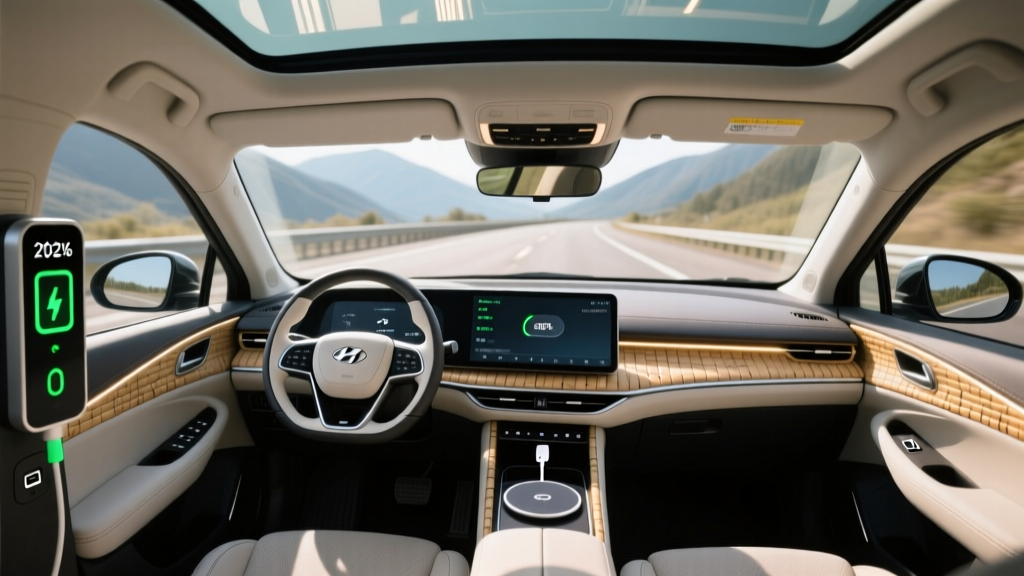
The Hyundai Ioniq 9 interior is the primary reason this SUV exists. Hyundai designed the cabin around a flat floor (a direct benefit of the E-GMP skateboard architecture) and a wheelbase stretching 123.2 inches — roughly 11 inches longer than the Ioniq 5. That extra length translates directly into third-row usability, which is where most competitors stumble.
Passenger Dimensions and Seating
| Measurement | Front Row | Second Row | Third Row |
|---|---|---|---|
| Headroom | 40.1 in | 39.3 in | 37.8 in |
| Legroom | 41.7 in | 39.6 in | 32.1 in |
| Shoulder Room | 60.2 in | 58.7 in | 54.3 in |
The third row's 32.1 inches of legroom is genuinely usable for adults on shorter trips and comfortable for children or teenagers on longer drives. The second-row captain's chairs (standard on SEL and above, optional on SE) offer a relaxation mode with power-reclining and leg rests — a feature Hyundai calls "Premium Relaxation Seats." A seven-passenger bench configuration is standard on the SE trim.
Cargo Volume
- Behind third row: 17.2 cu ft (enough for two carry-on suitcases and groceries)
- Behind second row (third row folded): 45.8 cu ft
- Behind first row (all rear seats folded): 84.6 cu ft
- Front trunk (frunk): 2.4 cu ft (AWD models); 3.5 cu ft (RWD)
The frunk is modest compared to the Ioniq 5's — the larger front motor and HVAC hardware in the Ioniq 9 eat into that space. Plan on using it for charging cables and a small emergency kit rather than meaningful luggage.
Materials and Build Quality
Hyundai uses a mix of recycled PET fabrics, bio-processed leather (on SEL and above), and eco-friendly TPO (thermoplastic olefin) surfaces throughout. The headliner incorporates recycled plastic fibers. Fit and finish on the upper trims are competitive with the Kia EV9 and noticeably better than the Tesla Model X's inconsistent panel gaps, though the Rivian R1S still edges ahead on perceived material richness at similar price points.
Infotainment and Technology
The dashboard features a curved panoramic display combining a 12.3-inch digital instrument cluster and a 12.3-inch central touchscreen running Hyundai's latest ccNC (Connected Car Navigation Cockpit) software. Wireless Apple CarPlay and Android Auto are standard. Additional tech highlights:
- Dual wireless phone charging pads (15W each) in the center console
- Digital Center Mirror (camera-based rearview displayed in the center display when the physical mirror is obstructed)
- Over-the-air (OTA) software updates for powertrain, ADAS, and infotainment
- Highway Driving Assist 2 (HDA2) with lane-change assist — SAE Level 2 driver assistance
- Remote Smart Parking Assist (move the vehicle in/out of tight spots via key fob)
- Available Head-Up Display with augmented-reality navigation prompts
Range, Battery, and Real-World Efficiency
The Ioniq 9's 110.3 kWh usable battery pack uses NMC (nickel-manganese-cobalt) chemistry, consistent with Hyundai's approach in the Ioniq 5 and 6. NMC offers higher energy density than LFP (lithium iron phosphate), which is critical for fitting enough capacity into a large SUV while keeping weight manageable. Hyundai has not announced an LFP variant for the Ioniq 9 at this time.
EPA estimate (RWD): 335 miles
In real-world highway driving at 70–75 mph with climate control active, expect approximately 275–295 miles from the RWD model. Cold-weather driving (below 32°F) can reduce range by 15–30%, bringing usable range down to roughly 235–260 miles on the RWD variant. The AWD and Performance models will see proportionally larger real-world reductions due to higher base consumption. These figures align with observed results from the Ioniq 5 and Kia EV9 on the same platform.
The RWD model's 89 MPGe combined and 34 kWh/100mi efficiency are respectable for a 5,000+ lb three-row SUV, though the Kia EV9 RWD achieves a slightly better 87 MPGe with its smaller 100.4 kWh pack. The Ioniq 9 trades some efficiency for its larger battery and additional range.
Charging Performance: DC Fast Charging and Home Level 2
Hyundai's E-GMP platform is known for strong 800V-class charging architecture, and the Ioniq 9 continues this tradition. On a 350 kW DC fast charger (such as those at Electrify America or Ionity stations), the Ioniq 9 can accept a peak charge rate of 240 kW.
| Charging Level | Power / Voltage | Speed | Notes |
|---|---|---|---|
| Level 1 (120V) | ~1.4 kW | ~4 mi/hr | Emergency/trickle only |
| Level 2 (240V, 48A) | 10.9 kW | ~30 mi/hr | Full charge in ~11 hours |
| DC Fast (350 kW station) | 240 kW peak | 10–80% in ~24 min | Charge curve tapers above 80% |
| DC Fast (150 kW station) | ~130 kW sustained | 10–80% in ~40 min | Common at older stations |
Understanding the charge curve: The 240 kW figure is a peak rate, not a sustained rate. Like all modern EVs, the Ioniq 9 charges fastest between roughly 10% and 50% State of Charge (SoC), then progressively tapers as the battery management system protects cell health. Charging from 80% to 100% on DC fast charging is significantly slower and is not recommended for routine use — plan your road-trip stops around the 10–80% window for the best time efficiency.
For home charging, the onboard 10.9 kW AC charger adds about 30 miles of range per hour. A full overnight charge from near-empty takes roughly 11 hours, which is practical for daily use if you install a Level 2 wallbox on a 60-amp circuit (48A continuous). Most owners will rarely need a full 0–100% charge at home, as daily driving consumes far less.
The Ioniq 9 ships with a NACS (North American Charging Standard) port for the 2026 model year, giving it native access to Tesla Supercharger stations (V3 and V4) without an adapter — a significant advantage for road-trip charging infrastructure. A CCS adapter is available for legacy networks.
Pricing, Trims, and Federal Tax Credit Eligibility
| Trim | Drivetrain | MSRP | Est. After §30D Credit* |
|---|---|---|---|
| SE | RWD | $67,500 | $59,995 |
| SEL | RWD | $71,500 | $63,995 |
| SEL AWD | AWD | $75,500 | $67,995 |
| Limited | AWD | $78,500 | $70,995 |
| Performance | AWD (422 hp) | $81,000 | $73,495 |
*Estimated prices assume the buyer qualifies for the full $7,500 federal tax credit under IRS §30D. The credit can now be transferred to the dealer at the point of sale as an upfront discount.
- MSRP Cap: SUVs must have an MSRP at or below $80,000. The Ioniq 9 SE, SEL, and SEL AWD qualify; the Limited and Performance trims exceed the cap and are NOT eligible for the federal credit.
- Buyer Income Cap: Modified AGI must not exceed $150,000 (single), $225,000 (head of household), or $300,000 (joint filers).
- Battery Sourcing: A percentage of critical minerals and battery components must meet US or FTA-partner sourcing requirements. Hyundai has been working to shift Ioniq 9 battery supply chains to meet these rules, but eligibility can change. Always verify current status on the IRS clean vehicle credit page before purchasing.
- Point-of-Sale Transfer: Buyers can transfer the credit to the dealer for an immediate price reduction, even if they owe no federal tax — a significant change from earlier rules.
For buyers who do not qualify due to income limits or MSRP caps, Hyundai frequently offers lease incentives that can capture a portion of the savings through a commercial clean vehicle credit pass-through. Ask your dealer about current lease programs.
Driving Impressions and Performance
The RWD Ioniq 9 delivers 215 horsepower from a single rear motor — adequate for daily commuting and highway merging, but this 5,000+ lb SUV doesn't feel quick off the line. The 0–60 mph time of approximately 8.2 seconds is leisurely by EV standards. Hyundai clearly prioritized range over acceleration in the RWD tuning.
The AWD dual-motor models are the sweet spot for most buyers. With 338 horsepower and a ~6.0-second 0–60 time, the AWD Ioniq 9 feels properly quick for a three-row family hauler. The Performance variant bumps output to 422 hp and drops 0–60 to around 4.9 seconds — genuinely brisk, though the Rivian R1S Dual-Motor still holds an edge in sporty handling dynamics.
Ride quality is a strong suit. The multi-link rear suspension and available electronically controlled dampers absorb highway expansion joints and rough pavement with composure. Cabin noise levels are low, aided by acoustic laminated glass on the front and rear doors (Limited and above). The steering is light and numb — typical Hyundai tuning — but perfectly acceptable for the target audience.
Towing Capacity
When properly equipped with the factory tow package, the AWD Ioniq 9 is rated for up to 5,000 lbs of towing capacity (braked trailer). The RWD model is limited to approximately 2,500 lbs. This is competitive with the Kia EV9 and sufficient for a small boat, utility trailer, or a pair of jet skis — but it falls well short of the Rivian R1S (7,700 lbs) and the Ford F-150 Lightning.
Safety, ADAS, and Warranty
The Ioniq 9 includes Hyundai's full SmartSense suite as standard equipment across all trims:
- Forward Collision-Avoidance Assist with pedestrian and cyclist detection
- Blind-Spot Collision-Avoidance Assist with rear cross-traffic alert
- Lane Keeping Assist and Lane Following Assist
- Rear Occupant Alert (ultrasonic sensor to detect rear-seat passengers)
- Highway Driving Assist 2 (HDA2) with lane-change assist
- Available: Digital Key 2 (phone-as-key via NFC/UWB), Remote Smart Parking Assist
Hyundai has not published NHTSA or IIHS crash test results for the Ioniq 9 at the time of writing; the vehicle is expected to undergo testing in 2026. Given the Ioniq 5's IIHS Top Safety Pick+ rating, expectations are high. Check iihs.org and nhtsa.gov for updates.
Warranty Coverage
| Coverage | Term |
|---|---|
| New Vehicle Limited | 5 years / 60,000 miles |
| Powertrain | 10 years / 100,000 miles |
| EV Battery | 10 years / 100,000 miles (capacity retention ≥70%) |
| Corrosion Perforation | 7 years / unlimited miles |
| Roadside Assistance | 5 years / unlimited miles |
Hyundai's 10-year/100,000-mile EV battery warranty is among the best in the industry, and the 70% capacity retention threshold is the standard benchmark. For context, the Rivian R1S offers 8 years/175,000 miles, and the Tesla Model X offers 8 years/150,000 miles — Hyundai wins on years but trails on mileage.
Hyundai Ioniq 9 vs. Key Competitors
| Spec | Hyundai Ioniq 9 AWD | Kia EV9 AWD | Rivian R1S Dual-Motor | Tesla Model X LR |
|---|---|---|---|---|
| EPA Range (AWD) | 311 mi | 280 mi | 352 mi (Max Pack) | 335 mi |
| Battery (usable) | 110.3 kWh | 100.4 kWh | 141 kWh (Max) | 100 kWh |
| Max DCFC | 240 kW | 236 kW | 200 kW | 250 kW |
| 0–60 mph | ~6.0 sec | ~7.7 sec | ~5.0 sec | ~3.8 sec |
| Base AWD MSRP | $72,500 | $66,900 | $84,900 | $81,630 |
| 3rd-Row Legroom | 32.1 in | 32.0 in | 32.5 in | 33.9 in |
| §30D Credit Eligible | SE/SEL trims | Most trims | No (MSRP > $80K) | No (MSRP > $80K) |
- Best-in-class 335-mile EPA range (RWD)
- Genuinely usable third row with 32.1" legroom
- 240 kW DC fast charging with NACS port
- 10-year/100,000-mile battery warranty
- Lower trims qualify for §30D tax credit
- Relaxation second-row seats on upper trims
- High starting price — $67,500 base MSRP
- RWD model's 8.2-sec 0–60 feels sluggish
- Limited and Performance trims exceed $80K MSRP cap (no tax credit)
- Small frunk (2.4 cu ft AWD)
- Towing limited to 5,000 lbs (trails Rivian/Ford)
- No LFP battery option for buyers who prefer 100% daily charging
Who Should Buy the Hyundai Ioniq 9?
Buy the Ioniq 9 if:
- You need a genuine three-row EV with a usable third row for children or occasional adult passengers
- Range is your top priority — the 335-mile RWD EPA rating leads the segment
- You want NACS native charging for Tesla Supercharger access without adapters
- You value Hyundai's 10-year warranty and can stay within the §30D MSRP cap (SE or SEL trim)
- Your daily commute and road-trip patterns benefit from the large battery's buffer in cold weather
Look elsewhere if:
- You need serious towing capacity (Rivian R1S: 7,700 lbs)
- You want a sporty driving experience (Tesla Model X or Rivian R1S handle better)
- Your budget is under $60,000 (consider the Kia EV9 or wait for more affordable three-row EVs)
- You prefer LFP battery chemistry for daily 100% charging without degradation concerns
Frequently Asked Questions
What is the real-world range of the Hyundai Ioniq 9?
The EPA rates the RWD Ioniq 9 at 335 miles and the AWD model at 311 miles. In real-world highway driving at 70–75 mph, expect roughly 275–295 miles (RWD) and 260–280 miles (AWD). Cold weather below freezing can reduce these figures by 15–30%. The large 110.3 kWh battery provides a meaningful buffer compared to rivals with smaller packs.
How fast does the Ioniq 9 charge?
On a 350 kW DC fast charger, the Ioniq 9 peaks at 240 kW and charges from 10–80% in approximately 24 minutes under optimal conditions. At a more common 150 kW station, expect 10–80% in about 40 minutes. At home on a Level 2 wallbox (10.9 kW), you'll add roughly 30 miles of range per hour, with a full charge taking about 11 hours.
How much does the Ioniq 9 cost after the federal tax credit?
The SE RWD starts at $67,500 MSRP and drops to approximately $59,995 after the $7,500 §30D credit — assuming you meet income and battery-sourcing requirements. However, the Limited ($78,500) and Performance ($81,000) trims exceed the $80,000 SUV MSRP cap and are not eligible for the federal credit. Always verify current eligibility at IRS.gov.
Does the Hyundai Ioniq 9 qualify for the federal EV tax credit?
Yes, but only for trims with an MSRP at or below $80,000 (SE, SEL, SEL AWD). Additionally, the buyer must meet income caps ($150K single / $300K joint) and the vehicle must meet battery critical-mineral and component sourcing requirements. These sourcing rules evolve annually — confirm eligibility before purchasing.
Is the Ioniq 9 worth buying vs. the Kia EV9 and Rivian R1S?
The Ioniq 9 offers the best EPA range in the segment (335 miles RWD) and a strong warranty, making it ideal for range-focused families. The Kia EV9 starts lower and offers similar interior space with slightly less range. The Rivian R1S provides better off-road capability, more towing capacity, and a sportier drive, but starts above $84,000 and does not qualify for the §30D credit. Your priorities — range vs. price vs. capability — will determine the best fit.
Does the Ioniq 9 have a NACS or CCS charging port?
The 2026 Ioniq 9 comes equipped with a native NACS (North American Charging Standard) port, providing direct access to Tesla Supercharger V3/V4 stations without an adapter. This is a significant advantage as the industry standardizes on NACS for DC fast charging across North America.