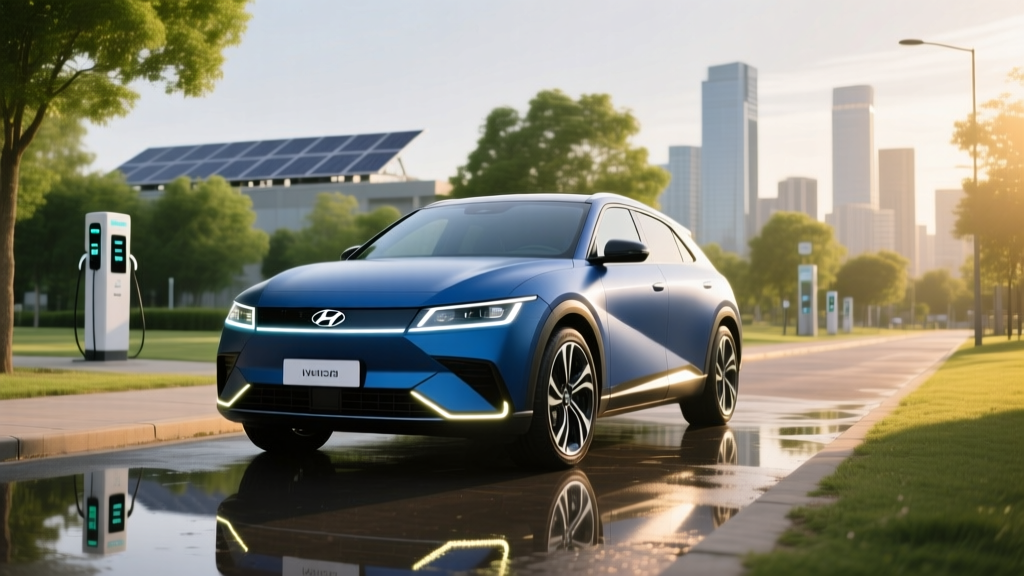
The three-row electric SUV segment has been dominated by a handful of players since the early 2020s, but the 2026 Hyundai Ioniq 9 arrives with a proposition that could reshape buyer expectations: genuine 300-plus-mile range in a full-size family hauler, ultra-fast 800-volt charging architecture, and a starting price that undercuts the Tesla Model X and Rivian R1S by a significant margin. Built on Hyundai Motor Group's next-generation eM platform at the new Metaplant America facility in Georgia, the Ioniq 9 is the brand's flagship electric SUV and the spiritual successor to the well-received Ioniq 5 crossover — just substantially larger.
After examining Hyundai's published specifications, EPA filings, and early drive impressions, here's what prospective buyers need to know about the Ioniq 9's range, charging behavior, ownership economics, and where it fits in the competitive landscape.
Specs at a Glance: 2026 Hyundai Ioniq 9
| Specification | SE Standard Range (RWD) | SE/SEL/Limited Long Range (RWD) | Long Range AWD |
|---|---|---|---|
| EPA Range | ~260 mi (est.) | 335 mi | 311 mi |
| Battery (usable) | 76.1 kWh | 110.3 kWh | 110.3 kWh |
| Chemistry | NMC (Nickel Manganese Cobalt) | NMC (4th-gen cells) | NMC (4th-gen cells) |
| Horsepower | 215 hp | 215 hp | 379 hp |
| 0-60 mph | ~7.8 sec (est.) | ~7.8 sec (est.) | ~5.2 sec |
| Peak DC Fast Charge | ~240 kW | 350 kW | 350 kW |
| 10-80% DC Time | ~22 min (est.) | ~20 min (claimed) | ~20 min (claimed) |
| Level 2 Home Charge | 10.9 kW (~27 mi/hr) | 10.9 kW (~35 mi/hr) | 10.9 kW (~32 mi/hr) |
| MPGe (combined) | TBD | ~89 MPGe (est.) | ~84 MPGe (est.) |
| Drivetrain | RWD single motor | RWD single motor | Dual-motor AWD |
| Towing Capacity | — | Up to 3,500 lbs (w/ tow pkg) | Up to 3,500 lbs (w/ tow pkg) |
| Starting MSRP | $59,900 | $64,350 | $68,850 |
Note: Standard Range figures for the base SE trim are preliminary estimates based on Hyundai's early disclosures and the smaller 76.1 kWh pack option confirmed for select markets. Long Range figures reflect EPA-submitted data for the 110.3 kWh variant. Always verify final specs at fueleconomy.gov before purchasing.
Range and Efficiency: EPA Numbers vs. the Real World
Real-World Expectation: On highway-heavy road trips at 70-75 mph, expect approximately 275-295 miles from the Long Range RWD before needing to stop. In freezing temperatures (below 30°F), plan for a 20-25% reduction — bringing usable range down to roughly 220-250 miles. City and suburban driving with regenerative braking maximized will push you closer to, or slightly above, the EPA sticker.
The Ioniq 9 Long Range packs a 110.3 kWh usable battery — one of the largest in any mainstream three-row SUV — using Hyundai's fourth-generation NMC (nickel manganese cobalt) cells. These cells offer a meaningful energy-density improvement over the third-gen packs found in the Ioniq 5 and Ioniq 6, allowing Hyundai to fit more capacity without making the vehicle unmanageably heavy.
Efficiency is the hidden story here. Despite a curb weight approaching 5,500 pounds in AWD form, the Ioniq 9's heat pump (standard on all trims), optimized thermal management system, and slippery aerodynamic profile (a drag coefficient of approximately 0.28) keep energy consumption competitive. Expect roughly 34-36 kWh per 100 miles in mixed driving for the Long Range RWD — translating to an estimated 87-89 MPGe. The AWD variant will consume slightly more, around 38-40 kWh/100mi.
For context, the Kia EV9 (which shares the eM platform architecture) achieves 89 MPGe combined in its Long Range RWD form with a slightly smaller 100.0 kWh pack. The Ioniq 9's larger battery gives it a range edge, though efficiency per mile is comparable.
Charging Speed: 800-Volt Architecture Pays Off
Hyundai's commitment to 800-volt electrical architecture — first introduced on the Ioniq 5 — carries over to the Ioniq 9 and remains one of its strongest competitive advantages. Most rivals in the three-row EV SUV space still use 400-volt systems, which physically limits how fast they can accept DC current.
| Charging Level | Power / Rate | Speed (Miles Added) | Notes |
|---|---|---|---|
| Level 1 (120V household) | ~1.4 kW | ~4 mi/hr | Emergency/top-up only; full charge takes 3+ days |
| Level 2 (240V home) | 10.9 kW | ~35 mi/hr (LR RWD) | Full 0-100% in ~10.5 hours; overnight-ready |
| DC Fast Charge (peak) | 350 kW | ~250+ mi in 15 min (ideal) | Requires 350 kW station; curve tapers above 80% |
| DC Fast Charge (typical 150 kW) | 150 kW | ~120 mi in 15 min | Common Electrify America / EVgo rate |
Understanding the charge curve: The "350 kW peak" number represents the maximum rate the Ioniq 9 can accept under ideal conditions — battery preconditioned, low state of charge (around 10-15%), and connected to a charger capable of delivering that power. Like all EVs, the Ioniq 9's charge rate tapers as the battery fills. Expect to sustain roughly 250-300 kW between 10-50% SoC, then a gradual step-down through the 50-80% window. The claimed 10-80% time of approximately 20 minutes assumes a 350 kW-capable station.
At a more common 150 kW DC fast charger — the kind you'll find at most Electrify America and EVgo plazas — the Ioniq 9 will still charge briskly thanks to its 800V architecture, completing 10-80% in roughly 30-35 minutes. This is noticeably faster than 400V competitors like the VW ID.4 or Toyota bZ4X, which can bottleneck at these stations.
Connector note: For 2026, the Ioniq 9 ships with the Tesla NACS (North American Charging Standard) port as standard equipment in the US market, granting direct access to Tesla's Supercharger network (now open to non-Tesla vehicles via the NACS standard). A CCS1 adapter is available for legacy Electrify America and other CCS stations. This dual-network access is a significant practical advantage for road-trippers.
Performance and Driving Impressions
The Ioniq 9 is not a performance SUV in the mold of a Tesla Model X Plaid or Rivian R1S Quad-Motor. Hyundai has tuned it for comfort, quietness, and effortless highway cruising rather than lap times. That said, the dual-motor AWD variant's 379 horsepower and estimated 5.2-second 0-60 mph time provide more than adequate passing power and confident merging.
The RWD Long Range models, with 215 hp from a single rear motor, are adequate for daily driving but will feel leisurely when fully loaded with passengers and cargo. The 0-60 time stretches to an estimated 7.8 seconds — perfectly fine for a family hauler, but don't expect to win any stoplight sprints.
Ride quality benefits from Hyundai's multi-link rear suspension and available electronically controlled adaptive damping (standard on Limited trim). Air suspension is offered on the top-spec Calligraphy trim, providing up to 2.4 inches of ride-height adjustment — useful for loading cargo, improving highway aerodynamics, or increasing ground clearance for light off-pavement use.
Driver assistance: The Ioniq 9 ships with Hyundai's Highway Driving Assist 2 (HDA 2), a Level 2 driver-assistance system per SAE classification. It combines adaptive cruise control with lane-centering and can perform automated lane changes with driver confirmation. This is a hands-on, eyes-on system — the driver must remain engaged at all times. It is not "self-driving." Limited trims offer an available Advanced Highway Driving Assist with enhanced curve-speed management and navigation-based predictive adjustments.
Interior, Cargo, and Family Practicality
The Ioniq 9's cabin is where it makes its strongest case as a family flagship. Three rows of seating accommodate up to seven passengers (or six with available second-row captain's chairs on SEL and above). Second-row legroom is generous at approximately 39.5 inches, and the third row can handle adults on shorter trips with about 32 inches of legroom — competitive with the Kia EV9 and slightly better than the Mazda CX-90 PHEV's cramped third row.
Cargo volume:
- Behind third row: ~15 cu ft (groceries, strollers, a few carry-ons)
- Behind second row (third row folded): ~44 cu ft
- Behind first row (all rear rows folded): ~87 cu ft
- Front trunk (frunk): ~3.5 cu ft (small — enough for a charging cable bag and emergency kit)
The frunk is notably small compared to the Ford F-150 Lightning's massive front trunk, but it exists — something the Kia EV9 does not offer. The flat floor and wide cargo opening make loading straightforward.
Tech highlights:
- Dual 12.3-inch displays (instrument cluster + infotainment) in a single curved housing
- Wireless Apple CarPlay and Android Auto (standard all trims)
- Over-the-air (OTA) software updates for powertrain, ADAS, and infotainment
- Digital Key 2 (use your smartphone as a key; share with family members)
- Vehicle-to-Load (V2L): Power external devices up to 3.6 kW from the charge port — useful for camping, tailgating, or emergency backup
- Available head-up display with augmented-reality navigation overlay (Limited/Calligraphy)
- Relaxation-mode front seats with leg rests (driver and passenger) for charging-stop comfort
Pricing, Trims, and Federal Tax Credit Eligibility
| Trim | Drivetrain | MSRP | Est. Federal Credit* | Effective Price |
|---|---|---|---|---|
| SE Standard Range | RWD | $59,900 | Up to $7,500 | ~$52,400 |
| SE Long Range | RWD | $64,350 | Up to $7,500 | ~$56,850 |
| SEL Long Range | RWD | $68,850 | Up to $7,500 | ~$61,350 |
| SEL Long Range | AWD | $72,350 | Up to $7,500 | ~$64,850 |
| Limited Long Range | AWD | $78,500 | Up to $7,500 | ~$71,000 |
| Calligraphy Long Range | AWD | $84,900 | Up to $7,500 | ~$77,400 |
*Federal tax credit eligibility under IRS §30D is subject to multiple requirements that change annually. The figures above assume maximum eligibility.
- MSRP cap: SUVs/vans/pickups must have an MSRP at or below $80,000. The Ioniq 9 Calligraphy at $84,900 exceeds this cap — buyers of that trim will NOT qualify for the federal credit.
- Buyer income limits: Modified AGI must not exceed $300,000 (joint filers), $225,000 (head of household), or $150,000 (individual).
- Battery sourcing: The credit is split into two halves ($3,750 each) — one for critical minerals sourcing and one for battery component manufacturing. Hyundai's Georgia-built Ioniq 9 uses battery cells from the adjacent SK On plant, which significantly improves North American content compliance. However, exact credit amounts ($3,750 vs. $7,500) depend on the model year's specific critical-mineral threshold percentages set by the Treasury Department.
- Point-of-sale transfer: Eligible buyers can transfer the credit to the dealer at purchase, reducing the out-of-pocket price immediately rather than waiting for a tax refund.
- Consult a tax professional to confirm your personal eligibility before relying on the credit in your purchase decision.
Ownership Costs, Warranty, and Long-Term Outlook
Hyundai backs the Ioniq 9 with one of the strongest warranty packages in the EV segment:
- Battery & drive unit: 10 years / 100,000 miles (whichever comes first), covering defects and capacity loss below 70% of original capacity
- New vehicle limited: 5 years / 60,000 miles
- Complimentary maintenance: 3 years / 36,000 miles (covers tire rotations, cabin air filter, multi-point inspections)
- Roadside assistance: 5 years / unlimited miles
The 10-year battery warranty is a standout — most competitors offer 8 years/100,000 miles. Hyundai's 70% capacity-retention threshold is also industry-standard, though buyers should note that real-world NMC battery degradation for modern liquid-cooled packs typically runs 1-2% per year under normal use, meaning most owners will retain 85-90% capacity at the 100,000-mile mark.
Charging cost reality: At the US average residential electricity rate of ~$0.16/kWh (per EIA data), fully charging the 110.3 kWh Long Range battery at home costs approximately $17.65 — delivering 335 miles of range. That works out to roughly $0.053 per mile. Compare this to a gas-powered three-row SUV averaging 22 MPG at $3.40/gallon: $0.155 per mile. Over 15,000 miles per year, home-charging the Ioniq 9 saves an estimated $1,500 annually in fuel costs.
Public DC fast charging is more expensive — typically $0.35-$0.50/kWh at Electrify America or EVgo — bringing road-trip fuel costs closer to gas parity. Ioniq 9 buyers who can install a Level 2 home charger will see the greatest economic benefit.
How the Ioniq 9 Stacks Up Against Competitors
| Attribute | 2026 Hyundai Ioniq 9 LR RWD | 2026 Kia EV9 LR RWD | 2025 Tesla Model X LR AWD | 2025 Rivian R1S Dual-Motor |
|---|---|---|---|---|
| EPA Range | 335 mi | 304 mi | 335 mi | 352 mi (Max Pack) |
| Battery (usable) | 110.3 kWh | 100.0 kWh | ~100 kWh | 141 kWh (Max) |
| Peak DC Charge | 350 kW | 236 kW | 250 kW | 200+ kW |
| 10-80% DC Time | ~20 min | ~24 min | ~25 min | ~30 min |
| Starting MSRP | $64,350 | $59,900 | $81,630 | $79,900 |
| Third Row | Yes (7-seat) | Yes (7-seat) | Yes (6-seat opt.) | Yes (7-seat) |
| 800V Architecture | Yes | Yes | No (400V) | No (400V) |
| NACS Native | Yes | Yes (2025+) | Yes (native) | Yes (2025+) |
Pros and Cons
- Class-leading 350 kW DC fast charging via 800V architecture
- 335-mile EPA range in Long Range RWD — excellent for a three-row SUV
- Native NACS port for direct Tesla Supercharger access
- Strong 10-year / 100,000-mile battery warranty
- Comfortable, quiet ride with available air suspension
- V2L capability (3.6 kW) for camping and backup power
- Georgia-built — supports domestic manufacturing and improves tax-credit sourcing compliance
- Spacious second and third rows with genuine adult usability
- Starting price above $60K; well-equipped AWD models push $75K+
- Calligraphy trim ($84,900) exceeds the §30D MSRP cap — no federal credit
- Standard Range RWD model has limited availability and reduced range (~260 mi)
- Small frunk (3.5 cu ft) compared to some competitors
- RWD base model's 215 hp feels underpowered for a 5,500-lb vehicle when loaded
- Third-row cargo space (15 cu ft) is tight for a vehicle this size
- No off-road-focused variant (unlike Rivian R1S) for adventure-oriented buyers
- Infotainment system relies heavily on touchscreen — minimal physical buttons
Who Should Buy the Hyundai Ioniq 9?
- You need a three-row family SUV with 300+ mile range for road trips
- Fast public charging matters to you (frequent highway travel, limited home charging)
- You want Tesla Supercharger access without owning a Tesla
- You value a long battery warranty and Hyundai's reputation for reliability
- You can charge at home and want to minimize per-mile fuel cost
- Budget is tight — the Kia EV9 offers similar utility for ~$4,500 less
- You need serious off-road capability — consider the Rivian R1S
- You want a performance-oriented electric SUV — the Tesla Model X or Porsche Cayenne EV may suit better
- You need maximum cargo volume — a minivan (even a PHEV like the Chrysler Pacifica Hybrid) offers more behind the third row
Frequently Asked Questions
What is the real-world range of the Hyundai Ioniq 9?
The EPA rates the Long Range RWD at 335 miles, but real-world highway driving at 70-75 mph typically yields 275-295 miles. In cold weather (below 30°F), expect a 20-25% reduction, bringing range to approximately 220-250 miles. City driving with regenerative braking can match or slightly exceed the EPA number.
How fast does the Ioniq 9 charge at home and on the road?
At home on a 240V Level 2 charger (10.9 kW), the Long Range model adds about 35 miles of range per hour, with a full charge taking roughly 10.5 hours — easily accomplished overnight. On a 350 kW DC fast charger, Hyundai claims 10-80% in approximately 20 minutes. At a more common 150 kW station, expect 10-80% in about 30-35 minutes.
How much does the Ioniq 9 cost after the federal tax credit?
With the full $7,500 §30D credit applied (assuming you meet income, MSRP, and battery-sourcing requirements), the SE Long Range RWD drops from $64,350 to approximately $56,850. However, the Calligraphy trim at $84,900 exceeds the $80,000 SUV MSRP cap and does not qualify. The credit can be transferred to the dealer at point of sale for an immediate price reduction. Always confirm your eligibility with a tax professional and check current IRS §30D rules.
Does the Ioniq 9 qualify for the federal EV tax credit?
Most trims likely qualify for at least a partial credit ($3,750), with the full $7,500 dependent on critical-mineral and battery-component sourcing thresholds for the 2026 model year. The Ioniq 9's Georgia assembly and SK On battery cells give it a strong North American content advantage. The key limitation is the $80,000 MSRP cap for SUVs — trims priced above that (Calligraphy) are excluded regardless of other factors. Buyer income caps also apply ($300K joint / $150K individual).
Is the Ioniq 9 worth buying over the Kia EV9 or Tesla Model X?
Against the Kia EV9, the Ioniq 9 offers more range (335 vs. 304 miles) and faster peak charging (350 kW vs. 236 kW) for about $4,500 more. If budget is your priority, the EV9 is the smarter buy; if range and road-trip charging speed matter, the Ioniq 9 justifies the premium. Against the Tesla Model X, the Ioniq 9 starts nearly $20,000 lower, offers comparable range, and charges faster — though the Model X benefits from Tesla's mature Supercharger network and available Falcon Wing doors. The Ioniq 9 is the strongest all-around value proposition in the segment for 2026.
What is the Ioniq 9's towing capacity?
When equipped with the factory tow package, Long Range models (both RWD and AWD) are rated for up to 3,500 pounds — sufficient for a small boat trailer, lightweight camper, or utility trailer. Note that towing will significantly reduce range, typically by 30-50% depending on trailer weight and aerodynamics.
Does the Ioniq 9 have a frunk?
Yes, but it's modest — approximately 3.5 cubic feet. It's suitable for storing the mobile charging cable, a small emergency kit, or a bag of groceries, but don't expect the expansive front trunk found in the Ford F-150 Lightning or Rivian R1S.
Sources: EPA / fueleconomy.gov, Hyundai Motor America Press, IRS §30D Clean Vehicle Credits