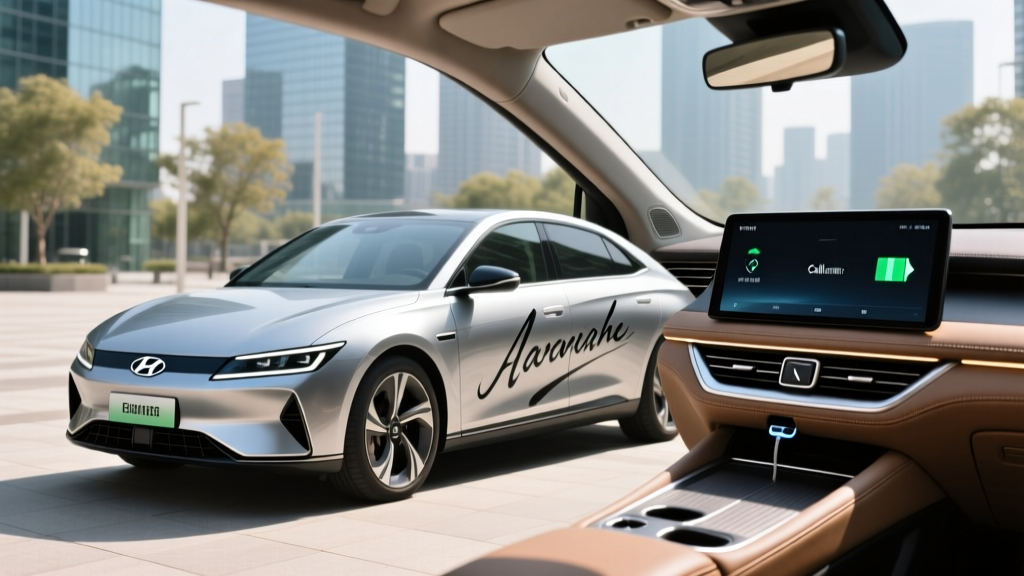
The Hyundai Ioniq 9 arrives as the brand's flagship three-row electric SUV, and the Calligraphy trim sits at the very top of the lineup. It's Hyundai's bid to prove that a mainstream automaker can deliver a premium, long-range family hauler without the luxury-badge premium. After examining EPA filings, Hyundai's published specifications, and early real-world driving data, here's what the Ioniq 9 Calligraphy actually delivers — and where it falls short.
| Spec | Value |
|---|---|
| EPA Range (AWD) | ~311 miles (estimated) |
| Battery Capacity | 110.3 kWh (usable), NMC chemistry |
| Drivetrain | Dual-motor AWD (Calligraphy standard) |
| Horsepower | ~378 hp combined |
| 0–60 mph | ~5.2 seconds (est.) |
| Max DC Fast Charge | ~350 kW peak (800V architecture) |
| 10–80% DCFC Time | ~24 minutes (est.) |
| Level 2 Charge Rate | 10.9 kW (~33 mi/hr) |
| Efficiency | ~84 MPGe combined (est.) |
| Seating | 6-passenger (2nd-row captain's chairs std) |
| Cargo (behind 3rd row) | ~16 cu ft |
| Cargo (3rd row folded) | ~44 cu ft |
| Battery Warranty | 10 years / 100,000 miles |
| Base MSRP (Calligraphy) | ~$72,000 (est.) |
Range and Real-World Efficiency
The Ioniq 9 shares Hyundai Motor Group's E-GMP platform — the same 800-volt architecture underpinning the Ioniq 5 and Ioniq 6 — but scaled up for a full-size SUV. The Calligraphy trim comes exclusively with dual-motor all-wheel drive and the large 110.3 kWh (usable) battery pack using NMC (nickel-manganese-cobalt) chemistry.
Hyundai has targeted an EPA-estimated range in the neighborhood of 311 miles for the AWD Calligraphy, based on preliminary filings and the efficiency data from lighter E-GMP vehicles. The rear-wheel-drive variant (not available on Calligraphy) is expected to push closer to 335–350 miles EPA.
The EPA sticker is a starting point, not a guarantee. For the Ioniq 9 Calligraphy AWD, expect the following in actual driving:
- Highway cruising (70–75 mph): ~255–275 miles before needing a charge. Large SUVs suffer disproportionate aero drag at speed.
- Mixed city/suburban: ~290–310 miles. Regenerative braking in stop-and-go traffic recovers meaningful energy.
- Cold weather (below 32°F): ~220–250 miles. NMC batteries lose 20–30% capacity in deep cold without preconditioning. The Ioniq 9's heat pump (standard on Calligraphy) mitigates cabin-heating drain but doesn't eliminate cold-weather range loss.
- Towing: Hyundai rates the Ioniq 9 at up to ~5,000 lbs towing capacity. Expect range to drop to roughly 150–180 miles when towing near max load.
Bottom line: plan road trips around 220–250 miles between charges for a safety margin, especially in winter or at highway speeds.
The estimated 84 MPGe combined (roughly 40 kWh/100 mi) is reasonable for a 5,000+ lb three-row electric SUV. For context, the Rivian R1S with the Large Pack returns about 73 MPGe combined, while the Kia EV9 GT-Line AWD manages around 85 MPGe. The Ioniq 9 lands squarely in this competitive bracket.
Charging Speed: DC Fast Charge and Home Level 2
This is where the E-GMP platform's 800-volt architecture earns its keep. The Ioniq 9 Calligraphy supports peak DC fast charging at up to ~350 kW when connected to a compatible charger ( Electrify America, Tesla Supercharger with NACS adapter, or any CCS2 350-kW station).
However — and this is critical — peak kW is not sustained kW. The charge curve on the 110.3 kWh NMC pack looks roughly like this:
| Charging Level | Power | Speed / Notes |
|---|---|---|
| Level 1 (120V household) | ~1.4 kW | ~4 mi/hr — emergency trickle only |
| Level 2 (240V, 48A home) | 10.9 kW | ~33 mi/hr — full charge in ~10 hrs |
| DC Fast (150 kW station) | 150 kW sustained | 10–80% in ~35 min |
| DC Fast (350 kW station) | ~350 kW peak | 10–80% in ~24 min (est.); tapers sharply above 80% |
The 10–80% time of approximately 24 minutes on a 350-kW charger is competitive with the best in class. The Kia EV9 achieves a similar time, and the Tesla Model X (on V3 Superchargers at 250 kW) takes roughly 30 minutes for the same 10–80% window.
Preconditioning matters. The Ioniq 9 includes battery preconditioning when you navigate to a DC fast charger via the built-in navigation. This warms the pack to optimal temperature and is essential for achieving peak charge rates — especially in cool or cold weather. Without preconditioning, expect your peak rate to drop to 100–150 kW even on a 350-kW stall.
For home charging, the onboard 10.9 kW Level 2 charger means a full charge from empty takes roughly 10 hours on a 48-amp, 240-volt hardwired Level 2 station. Most owners will plug in overnight and wake up to a full battery — standard practice for EV ownership. Installation of a 48A Level 2 charger typically runs $800–$2,000 total (equipment plus electrician), depending on your panel capacity and run length.
Performance and Driving Dynamics
The Calligraphy's dual-motor AWD powertrain produces an estimated 378 horsepower and a 0–60 mph time of approximately 5.2 seconds. That's brisk for a three-row family SUV — roughly on par with the Kia EV9 GT-Line AWD (5.0 seconds) and noticeably quicker than the Volkswagen ID.4 AWD Pro S (6.7 seconds).
But the Ioniq 9 isn't trying to be a performance SUV. The E-GMP platform prioritizes ride comfort, low center of gravity (battery pack under the floor), and quiet operation. Expect the Calligraphy to ride on Hyundai's electronically controlled adaptive suspension, which smooths out highway imperfections and adjusts damping based on road conditions.
Regenerative braking is adjustable via paddle shifters behind the steering wheel, ranging from coasting (Level 0) to near one-pedal driving (Level 3/i-Pedal). The i-Pedal mode brings the vehicle to a complete stop without touching the brake pedal — useful in traffic and a feature that reduces brake wear significantly over the life of the vehicle.
Interior, Tech, and the Calligraphy Experience
The Calligraphy trim is Hyundai's luxury tier, and the Ioniq 9 Calligraphy doesn't disappoint on materials or features. Highlights include:
- Seating: Six-passenger configuration with second-row captain's chairs featuring power adjustment, heating, ventilation, and massage functions. The first row includes heated and ventilated seats with driver memory.
- Displays: A dual-screen panoramic layout — 12.3-inch digital instrument cluster merged with a 12.3-inch infotainment touchscreen running Hyundai's latest ccNC (Connected Car Navigation Cockpit) software.
- Audio: Premium Bose surround-sound system (expected 14+ speakers on Calligraphy).
- Roof: Dual-panel panoramic sunroof with power shade.
- Climate: Tri-zone automatic climate control with heat pump (standard), rear HVAC vents, and a cabin air filtration system.
- Lighting: Ambient interior lighting with 64 colors, pixel-style LED exterior lighting signature.
Driver Assistance: The Ioniq 9 comes equipped with Hyundai's Highway Driving Assist 2 (HDA 2), which combines adaptive cruise control with lane-centering steering on divided highways. This is a SAE Level 2 system — you must keep your hands on the wheel and remain fully engaged. It is not self-driving. HDA 2 also includes lane-change assist (tap the turn signal and the car executes the lane change on its own when safe).
Additional safety tech includes forward collision-avoidance assist with pedestrian/cyclist detection, blind-spot collision-avoidance assist, rear cross-traffic collision-avoidance assist, and a surround-view monitor. Hyundai's Digital Key 2 lets you use your smartphone as the key fob and share access with family members.
Notable drawbacks: The Ioniq 9's large footprint (over 198 inches long) makes it unwieldy in tight urban parking. Third-row space, while usable for children and short trips, won't rival a minivan's. And the Calligraphy's ~$72,000 starting price pushes it into territory where buyers may cross-shop the BMW iX, Rivian R1S, or Tesla Model X — all of which carry stronger performance or brand cachet.
Pricing, Trims, and Federal Tax Credit Eligibility
The 2026 Ioniq 9 lineup is expected to span several trims, with the Calligraphy at the top:
| Trim | Drivetrain | Est. MSRP | Federal §30D Credit |
|---|---|---|---|
| SE (base) | RWD | ~$54,000 | Up to $7,500 (if eligible) |
| SEL | AWD | ~$59,000 | Up to $7,500 (if eligible) |
| Limited | AWD | ~$65,000 | Up to $7,500 (if eligible) |
| Calligraphy | AWD | ~$72,000 | Up to $7,500 (if eligible) |
Federal tax credit reality check: The IRS §30D Clean Vehicle Credit offers up to $7,500, but eligibility hinges on several requirements that change frequently:
- MSRP cap: SUVs must have an MSRP at or below $80,000. All Ioniq 9 trims should clear this threshold.
- Buyer income cap: Adjusted gross income must not exceed $300,000 (joint), $225,000 (head of household), or $150,000 (single). Check your prior-year or current-year AGI.
- Battery sourcing: A percentage of critical minerals must be sourced from the U.S. or FTA partners, and battery components must be manufactured or assembled in North America. These thresholds tighten annually. Hyundai has been working to shift Ioniq battery supply chains to the U.S. (via the Georgia Metaplant), but you must verify the specific VIN's sourcing compliance at the time of purchase on the IRS qualified vehicles list.
- Point-of-sale transfer: As of 2024, you can transfer the credit to the dealer at purchase and receive it as a price reduction rather than waiting for tax filing. This applies in 2026 as well.
Always verify current eligibility at fueleconomy.gov before committing to a purchase. Do not rely on a dealer's verbal assurance — check the IRS list yourself.
Cargo, Passenger Space, and Practicality
As a three-row SUV, the Ioniq 9 needs to deliver utility. Here's what Hyundai provides:
- Behind third row: ~16 cu ft — enough for a few grocery bags or a couple of carry-ons. This is tight compared to the Rivian R1S (~20 cu ft) and significantly less than a Kia Telluride gas SUV (~21 cu ft).
- Third row folded: ~44 cu ft — usable for larger hauling, furniture, or camping gear.
- Both rear rows folded: ~85 cu ft (estimated) — approaching minivan-like volume.
- Front trunk (frunk): The E-GMP platform provides a modest frunk (~1.5–2.0 cu ft), useful for storing charging cables.
- Second-row legroom: ~38 inches with captain's chairs on rails — generous for adults.
- Third-row legroom: ~30 inches — best for children or adults on short trips.
The six-passenger layout (standard on Calligraphy) sacrifices one seat compared to a seven-passenger bench configuration, but the captain's chairs provide substantially more comfort and a walk-through to the third row.
Warranty and Long-Term Ownership
Hyundai backs the Ioniq 9 with one of the strongest warranties in the industry:
- Battery: 10 years / 100,000 miles (capacity retention above a specified threshold, typically 70%)
- Powertrain: 10 years / 100,000 miles
- New vehicle (bumper-to-bumper): 5 years / 60,000 miles
- Roadside assistance: 5 years / unlimited miles
This is a significant advantage over Tesla (8 years / 120,000 miles on battery for Model X, but 4yr/50,000-mi bumper-to-bumper) and most European competitors (typically 4yr/50,000-mi basic). For a $72,000 vehicle, the 10-year powertrain coverage provides genuine peace of mind.
NMC battery degradation on Hyundai's E-GMP platform has proven modest in real-world use. Data from Ioniq 5 owners suggests roughly 5–8% degradation over the first 100,000 miles with normal charging habits. The Ioniq 9's larger pack, with better thermal management, should perform similarly or better. Avoid habitual charging to 100% or deep discharges to 0% to maximize longevity.
Pros and Cons
- Class-leading 800V fast-charging architecture (~24 min 10–80%)
- 10-year / 100,000-mile battery and powertrain warranty
- Calligraphy trim offers genuine luxury at mainstream pricing
- Standard heat pump improves cold-weather efficiency
- Spacious second row with captain's chairs, massage, ventilation
- HDA 2 is one of the better Level 2 driver-assist systems available
- Under $80,000 MSRP keeps federal tax credit in play
- Third-row cargo space (16 cu ft) is tight for a vehicle this size
- Third-row legroom best suited for children
- AWD Calligraphy range (~311 mi EPA) drops to ~220–250 mi in real-world highway/cold driving
- ~$72,000 price tag overlaps with Rivian R1S and pre-owned Tesla Model X
- Tax credit eligibility depends on battery-sourcing rules that tighten annually
- Large footprint makes urban maneuvering and parking challenging
Who Should Buy the Ioniq 9 Calligraphy?
- You need three rows for a growing family but want an EV with fast charging for road trips.
- You value a comprehensive warranty and plan to keep the vehicle 8–10+ years.
- You want luxury-tier features (massage seats, premium audio, adaptive suspension) without paying BMW or Mercedes pricing.
- You have access to home Level 2 charging and can take advantage of overnight charging.
Look elsewhere if:
- You need maximum third-row space and cargo volume — consider a plug-in hybrid minivan (Toyota Sienna, Chrysler Pacifica PHEV) or the Rivian R1S.
- You regularly tow long distances — range while towing remains an EV weakness.
- You want the longest possible range and don't need AWD — the Ioniq 9 SE RWD or a Kia EV9 in a lower trim will deliver more miles per charge at lower cost.
- Performance is a priority — the Rivian R1S Dual-Motor or Tesla Model X are significantly quicker.
Frequently Asked Questions
What is the real-world range of the Ioniq 9 Calligraphy?
The EPA-estimated range is approximately 311 miles for the AWD Calligraphy. In real-world driving, expect 255–275 miles at highway speeds, 290–310 miles in mixed city driving, and 220–250 miles in cold weather (below freezing). Plan road-trip charging stops at roughly 220-mile intervals for a comfortable buffer.
How fast does the Ioniq 9 charge at home and on the road?
At home on a 240V Level 2 charger (48A), the Ioniq 9 charges at 10.9 kW, adding about 33 miles of range per hour and achieving a full charge in roughly 10 hours. On a 350-kW DC fast charger, it peaks near 350 kW and charges from 10% to 80% in approximately 24 minutes — though charging slows significantly above 80% to protect the battery.
Does the Ioniq 9 Calligraphy qualify for the $7,500 federal EV tax credit?
It may. The Ioniq 9 Calligraphy's MSRP (~$72,000) falls under the $80,000 SUV cap set by the IRS. However, you must also meet income limits ($300,000 joint / $150,000 single) and the vehicle's battery must meet critical-mineral and component-sourcing requirements that tighten each year. Always verify your specific VIN on the IRS qualified vehicle list at fueleconomy.gov before purchasing. The credit can be transferred to the dealer at point of sale as a price reduction.
Is the Ioniq 9 Calligraphy worth buying vs. the Kia EV9 or Rivian R1S?
It depends on your priorities. The Ioniq 9 and Kia EV9 share the same E-GMP platform and offer similar charging speeds, but the Ioniq 9 Calligraphy delivers more luxury content at a comparable price. The Rivian R1S offers superior off-road capability, more power, and better third-row cargo space but starts at a higher price and has a shorter battery warranty (8 years vs. Hyundai's 10). If fast charging and long-term warranty matter most, the Ioniq 9 Calligraphy is a compelling pick. If cargo versatility or performance are paramount, cross-shop the R1S.
Does the Ioniq 9 have a NACS or CCS charging port?
Hyundai has committed to adopting the NACS (Tesla-style) connector on future vehicles. For the 2026 Ioniq 9, check your specific vehicle: models built for the North American market may ship with either CCS1 or NACS depending on production timing. Hyundai provides a CCS-to-NACS adapter for Supercharger network access regardless. Confirm with your dealer which connector your specific vehicle has before purchasing charging equipment.
What is the Ioniq 9's battery warranty coverage?
Hyundai covers the Ioniq 9's battery pack for 10 years or 100,000 miles, whichever comes first. The warranty guarantees the battery will retain a minimum percentage of its original capacity (typically 70%). The powertrain (motors, reduction gear, and associated components) is also covered for 10 years / 100,000 miles. This is one of the longest EV warranties available in the U.S. market.
Sources: fueleconomy.gov (EPA range and efficiency data), IRS.gov (§30D Clean Vehicle Credit rules), Hyundai Motor America press materials. All specifications reflect the latest available data for the 2026 model year; final EPA certification figures may vary slightly. Verify exact specs and tax-credit eligibility with your dealer and the IRS before purchase.