Why the Ioniq 6 Is Dominating Lease Searches in 2026
The Hyundai Ioniq 6 has carved out a distinct niche in the midsize electric sedan segment. With its wind-sculpted 0.21 drag coefficient, 800-volt architecture, and competitive starting price, it consistently ranks among the most efficient EVs on the market. For buyers searching for Hyundai Ioniq 6 lease deals, the math gets interesting fast: lower monthly payments than buying, protection from long-term depreciation uncertainty, and the ability to upgrade into next-generation solid-state battery vehicles within three years.
This review breaks down everything you need to evaluate an Ioniq 6 lease in the 2026 model year — from real-world range and charging behavior to total cost of ownership and federal tax credit implications when leasing versus purchasing.
Range, Efficiency, and Battery Specs
The 2026 Hyundai Ioniq 6 carries over the powertrain lineup that made the 2024 refresh compelling, with continued availability of the Standard Range and Long Range configurations. Here are the core specifications:
| Spec | SE/SEL Standard Range (RWD) | SE/SEL/Limited Long Range (RWD) | SE/SEL/Limited Long Range (AWD) |
|---|---|---|---|
| EPA Range | 240 mi | 361 mi | 316 mi |
| Battery (usable) | 54.0 kWh | 77.4 kWh | 77.4 kWh |
| Chemistry | NMC | NMC | NMC |
| Combined MPGe | 140 MPGe | 140 MPGe | 117 MPGe |
| kWh/100 mi | 24 | 24 | 29 |
| Horsepower | 149 hp | 225 hp | 320 hp |
| 0-60 mph | ~7.5 sec | ~6.1 sec | ~4.9 sec |
| Drivetrain | RWD | RWD | Dual-motor AWD |
| Max DC Fast Charge | ~175 kW | ~240 kW | ~240 kW |
| 10-80% DC Time | ~20 min | ~18 min | ~18 min |
| Level 2 (10.9 kW) | ~30 mi/hr | ~43 mi/hr | ~43 mi/hr |
| Base MSRP | $38,650 | $42,750 | $46,750 |
The EPA rates the Ioniq 6 Long Range RWD at 361 miles. In real-world highway testing at 70 mph in moderate temperatures (60-75°F), expect approximately 290-310 miles on a full charge. Cold-weather driving (below 32°F) can reduce range by 20-30%, yielding roughly 250-280 miles. City driving with regenerative braking engaged often meets or slightly exceeds the EPA estimate. The AWD variant sacrifices roughly 45 miles of EPA range due to the added front motor weight and drivetrain losses.
The Ioniq 6's 140 MPGe combined rating (Long Range RWD) places it among the most efficient EVs available, rivaling the Tesla Model 3 and beating the Ford Mustang Mach-E and BMW i4 on efficiency. Per fueleconomy.gov, that translates to roughly $550-$650 in annual electricity costs at 15,000 miles/year and a national average electricity rate of $0.16/kWh.
Charging: 800V Architecture That Actually Delivers
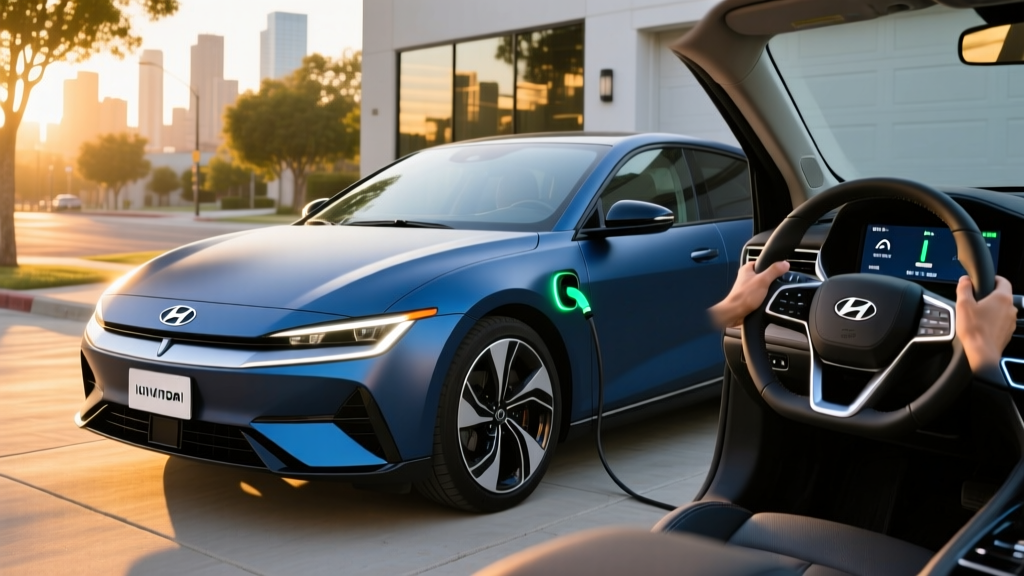
The Ioniq 6's standout technical advantage is its 800-volt electrical architecture, shared with the Kia EV6 and Genesis GV60. This enables charging at up to 350 kW on compatible DC fast chargers — though sustained rates tell a more complete story than peak numbers.
| Charging Level | Power (kW) | Speed | Typical Use Case |
|---|---|---|---|
| Level 1 (120V) | 1.4 kW | ~4 mi/hr | Emergency/overnight trickle |
| Level 2 (240V, 48A) | 10.9 kW | ~43 mi/hr | Home/office daily charging |
| DC Fast (50 kW) | 50 kW | ~150 mi/hr | Older public chargers |
| DC Fast (150 kW) | ~150 kW | ~440 mi/hr | Common highway chargers |
| DC Fast (350 kW capable) | Peak ~240 kW | ~700 mi/hr (peak) | Electrify America/Ionity 350 kW stalls |
Charging curve reality: The Ioniq 6 Long Range peaks near 240 kW when battery temperature is preconditioned (automatic when the navigation system routes to a charger). That peak rate holds from roughly 10-55% state of charge, then tapers progressively. The 10-80% time of approximately 18 minutes is legitimate at a 350 kW station. At a more common 150 kW charger, expect 10-80% in roughly 25-28 minutes. The Standard Range model, which lacks the full 800V capability, peaks around 175 kW.
For home charging, a Level 2 wallbox at 48 amps (10.9 kW) replenishes the Long Range battery from empty to full in about 7.5 hours — easily overnight. Installation costs for a Level 2 home charger typically range from $800-$2,000 depending on electrical panel capacity and run distance. Always consult a licensed electrician for a site-specific quote.
Lease Deals vs. Buying: The Financial Breakdown
When evaluating Hyundai Ioniq 6 lease deals, understanding the lease-versus-buy calculus is essential. Hyundai frequently offers aggressive lease incentives on the Ioniq 6, and the 2026 model year is no exception.
| Factor | Lease (36 mo / 10K mi/yr) | Purchase (60-mo loan) |
|---|---|---|
| MSRP | $42,750 | $42,750 |
| Negotiated Price / Cap Cost | $39,500 | $39,500 |
| Federal Tax Credit (§30D) | Passed through as cap cost reduction* | $7,500 (if eligible) |
| Effective Price After Credit | ~$32,000 | ~$32,000 |
| Down Payment | $3,000 | $5,000 |
| Monthly Payment (est.) | $349-$429 | $490-$550 |
| Disposition / Resale at End | Walk away or buy at residual | Own the asset (depreciation risk) |
*Under current IRS rules, when a vehicle is leased, the §30D credit technically goes to the lessor (the leasing company). Reputable lessors pass this through as a capitalized cost reduction, effectively lowering your monthly payment. Always confirm the credit is applied in the lease paperwork.
- MSRP cap: Sedans must be under $55,000 — all Ioniq 6 trims qualify.
- Income cap: AGI ≤ $150,000 (single), $225,000 (head of household), $300,000 (joint).
- Battery sourcing: Critical minerals and battery components must meet escalating domestic-content thresholds per the Inflation Reduction Act. Hyundai has shifted significant battery sourcing to the U.S. (SK On plant in Georgia), but verify current-year eligibility on IRS.gov before signing.
- Point-of-sale transfer: Eligible buyers can transfer the credit to the dealer as a down-payment reduction at purchase, or it applies as a cap cost reduction in a lease.
Leasing makes particular sense for the Ioniq 6 if you want to hedge against EV depreciation uncertainty — a real factor as battery technology evolves rapidly. A 36-month lease lets you transition into a next-generation vehicle (potentially with solid-state batteries) by 2029 without absorbing residual-value risk.
Interior Space, Tech, and Daily Livability
The Ioniq 6's teardrop exterior creates a distinctive cabin with a flat floor and generous rear legroom. However, the sloping roofline does cut into rear headroom and cargo space compared to the Ioniq 5 crossover.
| Dimension | Measurement |
|---|---|
| Front Headroom | 40.2 in |
| Front Legroom | 42.3 in |
| Rear Headroom | 37.3 in |
| Rear Legroom | 37.4 in |
| Cargo Volume (trunk) | 11.2 cu ft |
| Frunk | 1.6 cu ft (RWD) / 0.8 cu ft (AWD) |
| Wheelbase | 116.1 in |
The dual 12.3-inch panoramic displays run Hyundai's latest infotainment system with wireless Apple CarPlay and Android Auto, over-the-air updates, and Hyundai's Digital Key 2 (phone-as-key via NFC/UWB). The Limited trim adds a head-up display, Bose premium audio, ventilated front seats, and a hands-on capacitive steering wheel for Highway Driving Assist 2.
Standout tech: Vehicle-to-load (V2L) capability lets you power devices (up to 3.6 kW) from the Ioniq 6's battery — useful for camping, tailgating, or emergency backup. The interior ambient lighting syncs with driving modes, and the center console bridge design creates usable storage beneath the dash.
Notable drawbacks: The 11.2 cu ft trunk is smaller than the Tesla Model 3's (23 cu ft with the frunk) and far less than the Ioniq 5's 27.2 cu ft. The rear window visibility is compromised by the fastback design. Touch-sensitive HVAC controls on the center console can be frustrating to use while driving. And unlike Tesla's Supercharger network, Hyundai relies on third-party networks (Electrify America, EVgo, ChargePoint) — though NACS adapter compatibility now grants access to Tesla Superchargers.
Driver Assistance and Safety
The Ioniq 6 comes standard with Hyundai SmartSense, a comprehensive Level 2 ADAS suite including forward collision-avoidance assist, lane-keeping assist, blind-spot monitoring, rear cross-traffic alert, and adaptive cruise control with stop-and-go.
All Ioniq 6 driver-assistance features, including Highway Driving Assist 2, are SAE Level 2 systems. The driver must remain fully attentive, keep hands on the wheel (or demonstrate engagement via the capacitive sensor), and be prepared to take over at any moment. This is not autonomous or self-driving capability.
Highway Driving Assist 2 (HDA2, available on SEL and standard on Limited) adds lane-change assist and machine-learning-based adaptive cruise that mimics the driver's acceleration patterns. It's competent for long highway stretches but requires continuous supervision. The Ioniq 6 earned a 2024 IIHS Top Safety Pick+ rating, and NHTSA awarded it a 5-star overall safety rating per NHTSA.gov.
Warranty and Long-Term Ownership
Hyundai backs the Ioniq 6 with one of the strongest warranty packages in the EV market:
- Battery: 10 years / 100,000 miles (capacity retention above 70%)
- Powertrain: 10 years / 100,000 miles
- New Vehicle: 5 years / 60,000 miles
- Roadside Assistance: 5 years / unlimited miles
- Complimentary Maintenance: 3 years / 36,000 miles
The 10-year battery warranty is a major differentiator versus Tesla (8 years/120,000 miles for Model 3 Long Range) and most European competitors. For lease customers, the 3-year complimentary maintenance covers the entire lease term, reducing ownership friction.
Who Should Lease the Ioniq 6 — and Who Shouldn't
Pros
- Class-leading efficiency (140 MPGe, 24 kWh/100 mi)
- Genuinely fast 800V DC charging (10-80% in ~18 min)
- 361-mile EPA range on Long Range RWD
- 10-year/100,000-mi battery warranty
- V2L capability
- Competitive pricing under $43K for Long Range SE
- All trims under §30D MSRP cap
- Quiet, refined ride quality
Cons
- Small trunk (11.2 cu ft) for the class
- Poor rear visibility from fastback roofline
- Touch-sensitive controls frustrate some drivers
- No NACS port native (adapter required for Superchargers)
- AWD range drops to 316 mi EPA
- Standard Range lacks full 800V charging speed
- Rear headroom tight for tall passengers
- No front trunk on AWD (minimal on RWD)
- Lease the Ioniq 6 Long Range RWD if: You want maximum range and efficiency, commute 30-60 miles daily, have home Level 2 charging, and want to hedge against EV depreciation.
- Lease the AWD if: You live in a snowy climate and need traction, and can accept the ~45-mile range penalty.
- Look elsewhere if: You need serious cargo space (consider the Ioniq 5 or Kia EV6), you want native NACS (Tesla Model 3), or you regularly tow (Ioniq 6 is not rated for towing).
Competitor Comparison
At the Ioniq 6's price point, the primary competitors are the Tesla Model 3 Long Range, BMW i4 eDrive40, and the Polestar 2. The Ioniq 6 wins on efficiency and charging speed, the Model 3 wins on cargo space and charging infrastructure, and the i4 wins on driving dynamics and build materials. The Polestar 2 trails on range and efficiency.
For buyers specifically hunting Hyundai Ioniq 6 lease deals, the combination of low MSRP, federal tax credit eligibility across all trims, aggressive Hyundai lease incentives, and low running costs makes it one of the most accessible premium EV sedans on the market.
Frequently Asked Questions
What is the real-world range of the 2026 Hyundai Ioniq 6?
The EPA rates the Long Range RWD at 361 miles. Expect 290-310 miles in real-world highway driving at moderate temperatures, and 250-280 miles in freezing conditions. City driving with regen often matches or exceeds the EPA figure.
How fast does the Ioniq 6 charge at home and on the road?
At home on a Level 2 charger (10.9 kW), the Long Range adds roughly 43 miles per hour, filling from empty in about 7.5 hours. On a 350 kW DC fast charger with battery preconditioning, it peaks at ~240 kW and charges 10-80% in approximately 18 minutes. At a 150 kW charger, expect 25-28 minutes for 10-80%.
How much does the Ioniq 6 cost after the federal tax credit?
The Long Range SE starts at $42,750 MSRP. With the full $7,500 §30D credit applied (subject to income, sourcing, and MSRP requirements), the effective price drops to roughly $35,250. On a lease, the credit is typically applied as a cap cost reduction, lowering monthly payments by approximately $100-$130/month over 36 months.
Does the 2026 Ioniq 6 qualify for the $7,500 federal EV tax credit?
All Ioniq 6 trims fall under the $55,000 sedan MSRP cap. Buyer income must be ≤ $150,000 (single) / $300,000 (joint). Battery sourcing requirements must be met — Hyundai has moved significant production to U.S. facilities, but verify on the IRS qualified vehicles list before committing. In a lease, the lessor claims the credit and should pass savings to you.
Is it better to lease or buy the Ioniq 6?
Leasing makes sense if you want lower monthly payments, plan to upgrade in 3 years as battery tech evolves, and want to avoid depreciation risk. Buying makes sense if you drive over 12,000 miles/year (lease penalties apply), want to keep the car 7+ years, and want full ownership of the tax credit. Lease deals are particularly strong on the Ioniq 6 due to Hyundai's frequent incentive programs.
Can the Ioniq 6 use Tesla Superchargers?
Yes, via a NACS adapter. Hyundai provides or sells a CCS-to-NACS adapter that enables access to Tesla's Supercharger network. Future model years may include a native NACS port, but the 2026 Ioniq 6 ships with CCS1.