Quick Verdict: The Ioniq 5 V2L Is More Than a Party Trick
The Hyundai Ioniq 5 has been a staple of the mainstream EV market since its 2022 debut, but the vehicle-to-load (V2L) feature remains one of its most underappreciated differentiators. For the 2026 model year, the Ioniq 5 continues to offer V2L capability — the ability to power external devices, appliances, and even your home during an outage — through both an interior 120V outlet and an available exterior V2L adapter that plugs into the charge port. With up to 3.6 kW of continuous output, the Ioniq 5 V2L system can run a full-size refrigerator, power tools at a job site, or keep essential circuits alive during a blackout for days.
But V2L is only as valuable as the EV underneath it is practical. Fortunately, the 2026 Ioniq 5 delivers on the fundamentals: up to 318 miles of EPA-estimated range, blistering 800V DC fast charging, a spacious cabin, and competitive pricing that undercuts many rivals even before tax incentives. Here's everything you need to know about owning one.
Hyundai Ioniq 5 Key Specs at a Glance
| Spec | SE/SEL RWD | SEL/Limited AWD | N (Performance) |
|---|---|---|---|
| EPA Range | 318 mi | 290 mi | 221 mi |
| Battery (usable) | 84.0 kWh (NMC) | 84.0 kWh (NMC) | 84.0 kWh (NMC) |
| Horsepower | 168 hp | 320 hp | 641 hp |
| 0–60 mph | 7.0 sec | 4.5 sec | 3.25 sec |
| Drivetrain | RWD (single motor) | AWD (dual motor) | AWD (dual motor) |
| Max DC Fast Charge | 238 kW | 238 kW | 238 kW |
| 10–80% DC Time | ~18 min | ~18 min | ~18 min |
| Level 2 Charge Rate | 10.9 kW (~37 mi/hr) | 10.9 kW (~37 mi/hr) | 10.9 kW (~37 mi/hr) |
| MPGe (combined) | 114 MPGe | 103 MPGe | 85 MPGe |
| V2L Output | 3.6 kW | 3.6 kW | 3.6 kW |
| Base MSRP | $43,600 | $47,100 | $67,500 |
Range and Efficiency: EPA Numbers vs. Reality
The 2026 Ioniq 5 RWD models equipped with the Long Range battery pack carry an EPA-estimated 318 miles of range. Dual-motor AWD versions drop to 290 miles, while the performance-oriented Ioniq 5 N settles at 221 miles. According to fueleconomy.gov, the RWD Long Range achieves 114 MPGe combined (29 kWh/100 mi), making it one of the more efficient midsize electric crossovers on the market.
Efficiency varies meaningfully by trim. The RWD's 29 kWh/100 mi is genuinely competitive with the Tesla Model Y Long Range and significantly better than the Ford Mustang Mach-E Extended Range AWD. If you prioritize efficiency and range above all else, the single-motor RWD is the clear pick.
V2L Deep Dive: How It Works and What It Can Power
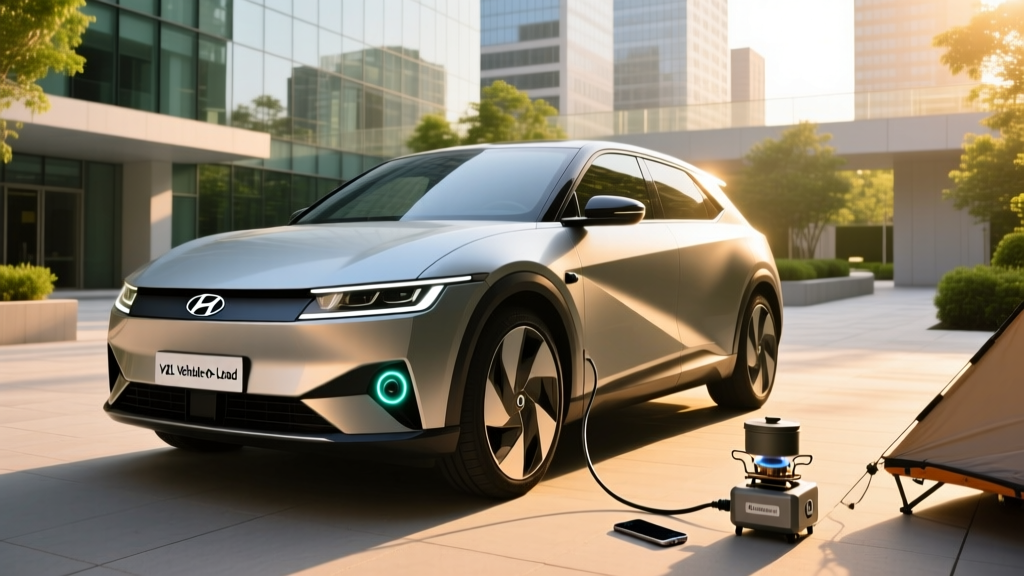
Vehicle-to-load (V2L) lets the Ioniq 5 function as a mobile 3.6 kW generator. The system works two ways:
- Interior V2L outlet: A standard 120V household-style outlet located in the rear seat area (available on SEL and above). This is always accessible and doesn't require an adapter. It's rated for up to 3.6 kW, though sustained high-draw use is more practical through the exterior port.
- Exterior V2L adapter: A dongle that plugs into the vehicle's charge port and provides a NEMA 5-15 or 5-20 receptacle. This is the more versatile option for outdoor use — powering a campsite, tailgate, job-site tools, or an extension cord run into your home.
At 3.6 kW of continuous output, the Ioniq 5 V2L can handle:
- A full-size refrigerator (~150–400W running, ~1,200W startup surge)
- A microwave (~1,000–1,500W)
- Multiple power tools simultaneously (circular saw ~1,800W + drill ~500W)
- A window AC unit (~1,200W)
- Home essential circuits via a transfer switch (requires professional installation and a compatible inverter setup for whole-home backup)
With the 84.0 kWh battery, running a continuous 1.5 kW load (roughly a refrigerator plus some lights and a router) would deplete the battery from 100% to the vehicle's minimum SoC buffer in approximately 40–45 hours. That's multi-day blackout coverage for essential appliances.
Important V2L caveats: V2L draws from the main traction battery, so using it reduces your driving range proportionally. Running 3.6 kW for one hour consumes roughly 3.6 kWh — about 12–14 miles of range. Hyundai also limits V2L discharge to a minimum state of charge (typically around 20%), preserving enough battery to drive to a charger. The exterior V2L adapter is often a dealer-installed accessory or included with higher trims — confirm availability at purchase.
Charging Speed: 800V Architecture Still Sets the Pace
The Ioniq 5's 800V electrical architecture remains one of its strongest selling points. On a compatible 350 kW DC fast charger (like those at Electrify America stations), the Ioniq 5 peaks at approximately 238 kW and can charge from 10% to 80% state of charge in roughly 18 minutes under ideal conditions.
| Charging Level | Power / Voltage | Speed | Use Case |
|---|---|---|---|
| Level 1 (120V) | ~1.4 kW | ~4–5 mi/hr | Emergency / overnight trickle |
| Level 2 (240V, 48A) | 10.9 kW | ~37 mi/hr (full in ~8.5 hrs) | Home daily charging |
| DC Fast (50 kW) | 50 kW (CHAdeMO/CCS) | ~150 mi/hr | Older public chargers |
| DC Fast (150 kW) | 150 kW | ~10–80% in ~28 min | Common highway chargers |
| DC Fast (350 kW) | Peak 238 kW | ~10–80% in ~18 min | Ultra-fast stations |
Charging curve reality: The 238 kW peak is just that — a peak. The Ioniq 5 sustains roughly 200+ kW from 10% to about 55% SoC, then tapers progressively. From 80% to 100%, charging slows dramatically to protect the battery, adding roughly another 20–25 minutes. For road trips, plan to charge in the 10–80% window for maximum time efficiency. Battery preconditioning activates automatically when you navigate to a DC fast charger via the built-in route planner, warming the pack for optimal charge acceptance — a critical feature that some competitors still lack.
At home on a 240V Level 2 charger (the setup most EV owners should install), the Ioniq 5 accepts up to 10.9 kW, adding roughly 37 miles of range per hour. A full charge from empty takes about 8.5 hours — easily achievable overnight. Home Level 2 installation typically costs $500–$2,000 depending on panel proximity and local permit requirements, according to industry data. Consult a licensed electrician for your specific situation.
For 2025–2026 model years, Hyundai transitioned the Ioniq 5 to the NACS (Tesla-style) charge port on new vehicles sold in North America, granting native access to Tesla's Supercharger network (now with 15,000+ V3/V4 stalls). Earlier Ioniq 5 models with the CCS1 port can access Superchargers via Hyundai's included NACS adapter.
Performance and Driving Dynamics
The Ioniq 5 lineup spans a wide performance range. The base RWD model's 168 hp and 7.0-second 0–60 time are adequate for commuting but feel leisurely compared to the AWD's 320 hp and 4.5-second sprint. The Ioniq 5 N, with its 641 hp (in N Grin Boost mode), rockets to 60 mph in 3.25 seconds and adds track-oriented features like simulated gear shifts, N e-Shift, and adjustable regen levels.
For most buyers, the dual-motor AWD strikes the best balance. The 4.5-second 0–60 time is brisk enough for confident highway merging, and the AWD system provides tangible traction benefits in rain and snow. The ride quality across the lineup is composed — Hyundai tuned the Ioniq 5 for comfort over sportiness, which suits its crossover mission. Road noise is well-managed at highway speeds, and the low center of gravity (thanks to the floor-mounted battery pack) keeps body roll in check through corners.
Regenerative braking offers four levels selectable via steering-wheel paddles, including a full one-pedal driving mode (i-Pedal) that brings the car to a complete stop without touching the brake pedal. This is one of the more intuitive regen implementations in the segment.
Interior, Cargo, and Practicality
The Ioniq 5's cabin is defined by its flat floor and long 118.1-inch wheelbase, which creates genuinely generous interior space:
- Front legroom: 41.7 inches
- Rear legroom: 39.4 inches — enough for tall adults to sit behind tall drivers comfortably
- Cargo volume (rear seats up): 27.2 cu ft
- Cargo volume (rear seats folded): 59.3 cu ft
- Front trunk (frunk): 0.85 cu ft (AWD) / 2.0 cu ft (RWD) — enough for a charging cable bag or small items, but not a meaningful storage space compared to the Ford Mach-E's 4.7 cu ft frunk
The dual 12.3-inch panoramic display setup handles infotainment and instrument cluster duties. Wireless Apple CarPlay and Android Auto are standard. Physical climate-control buttons sit below the main screen — a welcome decision that avoids the touchscreen-only frustration found in some competitors. A head-up display with augmented-reality navigation is available on Limited trims.
The center console slides fore and aft (Hyundai calls it the "Universal Island"), and the flat floor allows front-seat passengers to exit through either side in tight parking spots. Build quality is solid, with soft-touch materials on upper surfaces and durable plastics lower down.
Pricing, Trims, and Federal Tax Credit
| Trim | MSRP | Est. After §30D Credit* |
|---|---|---|
| SE Standard Range RWD | $43,600 | ~$36,100 |
| SE Long Range RWD | $46,100 | ~$38,600 |
| SEL AWD | $50,600 | ~$43,100 |
| Limited AWD | $58,200 | ~$50,700 |
| Ioniq 5 N | $67,500 | Not eligible (over MSRP cap) |
*Estimated after maximum $7,500 federal tax credit. Actual eligibility depends on your income, battery sourcing compliance, and point-of-sale transfer availability. Per IRS §30D rules, the buyer must meet modified adjusted gross income thresholds ($150,000 single / $300,000 joint), the vehicle MSRP must be under $80,000 for SUVs (the Ioniq 5 qualifies), and the battery must meet critical-mineral and component-sourcing requirements that shift annually. The Ioniq 5 N exceeds the $80,000 SUV MSRP cap and is ineligible. Always verify current-year eligibility with a tax professional or the IRS website before purchasing.
For 2026, the §30D credit can be transferred to the dealer at the point of sale, reducing your purchase price directly rather than waiting for a tax refund. Hyundai has also been offering competitive lease incentives that can stack with the commercial clean vehicle credit passed through to lessees — check current dealer offers.
Safety, Driver Assistance, and Tech
The Ioniq 5 earned the IIHS Top Safety Pick+ designation and a 5-star overall NHTSA safety rating. Hyundai's SmartSense suite of driver-assistance features is standard across all trims and includes:
- Forward collision-avoidance assist with pedestrian, cyclist, and junction-turning detection
- Blind-spot collision-avoidance assist
- Rear cross-traffic collision-avoidance assist
- Navigation-based smart cruise control with stop-and-go
- Lane-keeping assist and lane-following assist
- Highway Driving Assist (HDA) — combines adaptive cruise and lane centering on divided highways
- Remote smart parking assist (on Limited trims)
Pros and Cons
Pros
- Best-in-class DC fast charging (10–80% in ~18 min on 350 kW)
- 3.6 kW V2L capability — interior and exterior
- Spacious rear seat and flat-floor cabin design
- Up to 318 miles EPA range (RWD)
- Physical climate buttons alongside touchscreen
- Competitive pricing before incentives
- NACS port (2025+) for native Supercharger access
- Strong IIHS and NHTSA safety ratings
Cons
- Frunk is tiny (0.85–2.0 cu ft depending on drivetrain)
- RWD base model feels underpowered for the price
- Rear wiper absent on earlier builds (check model year)
- V2L adapter sometimes sold separately — confirm at purchase
- No Apple CarPlay/Android Auto on the widest-screen HUD trims in some model years (wireless CarPlay standard on most)
- Towing limited to 2,300 lbs (AWD) — not a serious hauler
- Ioniq 5 N is thrilling but expensive and range-compromised at 221 mi
Who Should Buy the Ioniq 5 with V2L?
The Ioniq 5 V2L is ideal for buyers who want a practical, fast-charging electric crossover with the added security of mobile power. Specific use cases where it shines:
- Homeowners in outage-prone areas: V2L can sustain essential appliances for days during grid failures, eliminating the need for a standalone generator.
- Outdoor enthusiasts: Power a campsite, charge e-bikes, run an electric grill, or keep a cooler running on road trips.
- Daily commuters who road-trip occasionally: 318 miles of range and 18-minute fast charging make highway travel practical, while V2L adds utility at the destination.
- Families needing rear-seat space: 39.4 inches of rear legroom handles child seats and tall teenagers comfortably.
It's less ideal if you need serious towing capacity (look at the Rivian R1S or Ford F-150 Lightning), maximum cargo volume (the Kia EV9 three-row SUV offers more), or if your budget is under $35,000 (consider the Chevy Equinox EV or a used Ioniq 5).
Battery Warranty and Long-Term Ownership
Hyundai backs the Ioniq 5's battery pack and electric powertrain with a 10-year/100,000-mile limited warranty — one of the longest in the industry. The basic vehicle warranty covers 5 years/60,000 miles. The battery warranty guarantees that the pack will retain at least 70% of its original capacity during the coverage period. If degradation exceeds 30% within 10 years or 100,000 miles, Hyundai will repair or replace the battery.
The 84.0 kWh pack uses NMC (nickel manganese cobalt) chemistry, which offers higher energy density than LFP but is more sensitive to sustained high states of charge. For maximum longevity, Hyundai recommends charging to 80% for daily use and reserving 100% charges for road trips. The vehicle's built-in charge-limit setting makes this easy to enforce.
Based on fleet data from similar Hyundai/Kia E-GMP platform vehicles (EV6, GV60), degradation has been modest — typically 5–8% over the first 60,000 miles. Out-of-warranty battery replacement, should it ever be needed, currently ranges from $12,000–$18,000 depending on the pack configuration and labor.
Frequently Asked Questions
What is the real-world range of the Hyundai Ioniq 5?
The EPA rates the RWD Long Range at 318 miles and the AWD at 290 miles. In real-world highway driving at 70–75 mph in mild weather, expect roughly 250–275 miles (RWD) or 230–250 miles (AWD). Cold weather (below freezing) can reduce range by 20–30%, bringing winter highway range to approximately 200–220 miles for the RWD. City driving with regenerative braking often matches or slightly exceeds the EPA estimate.
How fast does the Ioniq 5 charge at home and on the road?
On a 350 kW DC fast charger, the Ioniq 5 peaks at 238 kW and charges from 10% to 80% in approximately 18 minutes. On a 150 kW charger, expect 10–80% in about 28 minutes. At home on a 240V Level 2 charger (10.9 kW), it adds roughly 37 miles of range per hour, with a full charge taking about 8.5 hours. A standard 120V outlet (Level 1) adds only 4–5 miles per hour and is suitable only for emergency or supplemental use.
Does the Hyundai Ioniq 5 qualify for the federal EV tax credit?
Most Ioniq 5 trims qualify for up to $7,500 under IRS §30D, provided you meet the income caps ($150,000 single / $300,000 joint MAGI), the vehicle MSRP is under the $80,000 SUV threshold (all trims except the Ioniq 5 N qualify), and the battery meets the current year's critical-mineral and component-sourcing requirements. The credit can be transferred to the dealer at the point of sale for an instant price reduction. Always verify current-year rules at irs.gov or with a tax professional.
How does the Ioniq 5 V2L compare to competitors?
The Ford F-150 Lightning offers a more robust V2L/V2H system (up to 9.6 kW with the optional Pro Power Onboard), but it's a full-size truck at a higher price point. The Kia EV6 shares the E-GMP platform and offers similar V2L capability. The Tesla Model Y has no V2L feature. Among midsize electric crossovers, the Ioniq 5 offers the best combination of V2L utility, charging speed, and price.
Can I use V2L while the car is charging?
No. The V2L system cannot discharge to external loads while the vehicle is actively receiving a charge. You can set the vehicle to begin V2L output once charging completes, or use V2L when the vehicle is unplugged.
Is the Ioniq 5 worth buying over the Tesla Model Y or Ford Mach-E?
Choose the Ioniq 5 if you prioritize the fastest DC charging in the segment, V2L capability, and a distinctive design. Choose the Model Y if you want access to Tesla's integrated ecosystem, slightly more cargo space, and the broadest Supercharger network (though the Ioniq 5 now has NACS access too). Choose the Mach-E if you prefer a more traditional driving feel and a larger frunk. All three are strong choices — the Ioniq 5 wins on charging speed and V2L utility specifically.